
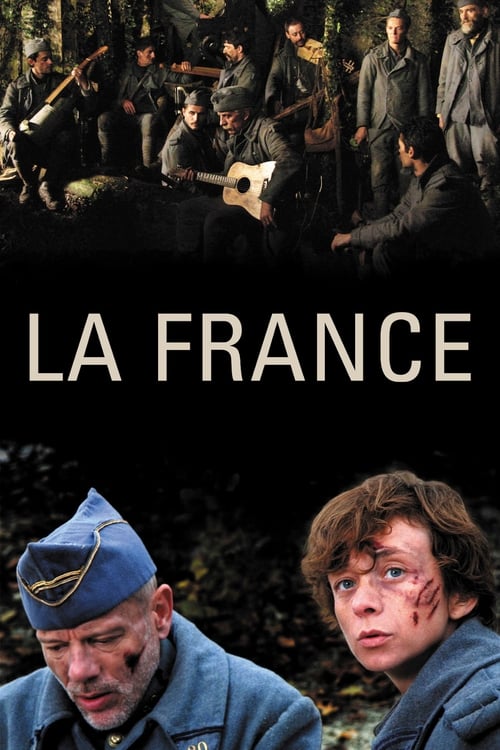












Popular
What motivates the character of Camille to disguise herself as a soldier?
How does Camille's relationship with the soldier she meets, known as the 'Lieutenant', evolve throughout the film?
What role does the setting of World War I play in shaping the characters' experiences?
How does Camille's journey reflect her internal struggle with identity and loss?
What significance does the character of the 'Old Man' hold in Camille's journey?
Should I watch it?
Ask Your Own Question

What is the plot?
Sorry, we aren't able to watch and write up a full detailed plot yet. Check back in a few days.









What is the ending?
In the ending of "La France," the protagonist, Camille, finds herself at a crossroads after a series of emotional and physical journeys during World War I. She ultimately decides to return home, having experienced profound changes and realizations about love, loss, and the impact of war. The film concludes with a sense of ambiguity regarding her future and the relationships she has formed.
As the film approaches its conclusion, we see Camille, played by Sylvie Testud, navigating the war-torn landscape of France. She has been searching for her husband, who has been missing in action. The emotional weight of her journey is palpable; she has encountered various soldiers and civilians, each with their own stories of loss and longing.
In the final scenes, Camille arrives at a makeshift military camp where she meets a soldier named Gaspard, portrayed by Guillaume Depardieu. Their relationship has developed throughout the film, marked by moments of tenderness and shared grief. Gaspard, who has been deeply affected by the war, is struggling with his own demons. As they share a quiet moment together, the bond between them deepens, yet it is underscored by the reality of the war that surrounds them.
The atmosphere is heavy with uncertainty. Camille learns that her husband is likely dead, a revelation that shatters her hopes. In a poignant scene, she stands alone, grappling with her emotions. The camera captures her vulnerability, the weight of her loss evident in her expression. She is torn between the love she feels for Gaspard and the loyalty she holds for her husband, whose fate remains unknown.
As the film nears its end, Camille makes the decision to leave the camp and return home. This choice signifies a turning point for her character. She has been irrevocably changed by her experiences, and the journey back symbolizes a return to reality, albeit one that is forever altered by the war. The final moments show her walking away from the camp, her silhouette framed against the backdrop of the desolate landscape. The viewer is left with a sense of ambiguity about her future, as she steps into the unknown, carrying the weight of her experiences and the memories of those she has lost.
Gaspard, left behind, watches her go, embodying the pain of separation and the complexities of love forged in the crucible of war. His fate remains uncertain, as the film does not provide closure for his character, leaving the audience to ponder the impact of war on personal relationships.
In summary, the ending of "La France" encapsulates the themes of love, loss, and the enduring scars of war. Camille's journey concludes with her return home, a decision that reflects her growth and the emotional turmoil she has faced, while Gaspard's fate remains a haunting reminder of the war's toll on human connections.
Is there a post-credit scene?
The movie "La France," produced in 2007, does not have a post-credit scene. The film concludes its narrative without any additional scenes or content after the credits roll. The story focuses on the emotional journey of the protagonist, Camille, as she searches for her husband during World War I, and the ending leaves viewers with a poignant sense of resolution regarding her experiences and the impact of war on personal lives.
What motivates the character of Camille to disguise herself as a soldier?
Camille is driven by a deep sense of longing and desperation to find her husband, who has gone missing in action during World War I. Her emotional turmoil and determination to uncover the truth about his fate propel her to take on the guise of a soldier, allowing her to traverse the war-torn landscape and search for him.
How does Camille's relationship with the soldier she meets, known as the 'Lieutenant', evolve throughout the film?
Initially, Camille and the Lieutenant share a bond forged out of shared experiences of loss and the harsh realities of war. As they navigate the challenges of their circumstances, their relationship deepens, marked by moments of tenderness and vulnerability. Camille's internal conflict grows as she grapples with her feelings for the Lieutenant while still being devoted to her missing husband.
What role does the setting of World War I play in shaping the characters' experiences?
The backdrop of World War I is crucial in shaping the characters' experiences, as it creates a sense of chaos and uncertainty. The desolate landscapes, the sounds of battle, and the constant threat of danger heighten the emotional stakes for Camille and the other characters. The war serves as a catalyst for their personal transformations and the choices they make in pursuit of love and survival.
How does Camille's journey reflect her internal struggle with identity and loss?
Camille's journey is a poignant exploration of her internal struggle with identity and loss. Disguised as a soldier, she grapples with her femininity and the societal expectations of women during wartime. Her quest to find her husband forces her to confront her fears and desires, leading to moments of self-discovery and a reevaluation of her role in a world ravaged by conflict.
What significance does the character of the 'Old Man' hold in Camille's journey?
The 'Old Man' serves as a symbolic figure in Camille's journey, representing the wisdom of experience and the harsh realities of war. His interactions with Camille provide her with insights into the nature of loss and the impact of war on individuals and families. He acts as a mentor of sorts, guiding her through her emotional turmoil and helping her to understand the broader implications of her search for her husband.
Is this family friendly?
"La France," produced in 2007, is a film that explores themes of love, loss, and the impact of war. While it has artistic merit, it contains several elements that may not be suitable for children or sensitive viewers.
-
War and Violence: The backdrop of World War I is central to the film, and there are scenes depicting the harsh realities of war, including the emotional toll it takes on soldiers and their families.
-
Death and Grief: The film addresses themes of loss, with characters grappling with the absence of loved ones. This can evoke strong emotions and may be distressing for younger viewers.
-
Mature Themes: The narrative includes complex adult relationships and emotional struggles, which may be difficult for children to understand.
-
Nudity and Sexual Content: There are scenes that include nudity and intimate moments, which may not be appropriate for younger audiences.
-
Emotional Turmoil: Characters experience significant emotional distress, including longing, sadness, and existential reflection, which could be upsetting for sensitive viewers.
Overall, while "La France" is a poignant exploration of its themes, its content may not be suitable for all audiences, particularly children.







