














Popular
What is the relationship between Salvador Dalí and Federico García Lorca in the film?
How does the film depict the impact of the Spanish Civil War on the characters?
What role does the character of Gala play in Dalí's life in the film?
How does the film portray the artistic rivalry between Dalí and Lorca?
What is the significance of the title 'Little Ashes' in relation to the characters?
Should I watch it?
Ask Your Own Question

What is the plot?
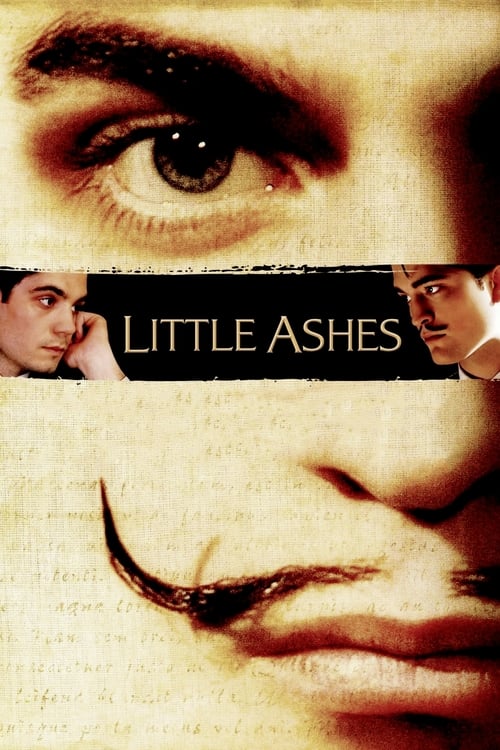
In 1922, Madrid feels like a city holding its breath, with old conservatism pressing down on new artistic impulses, and at the center of that tension arrives an 18-year-old Salvador Dalí, awkwardly theatrical, brilliantly self-conscious, and utterly determined to become a great artist. He steps into the Residencia de Estudiantes with the look of someone already imagining his own legend, and that strange mix of shyness and exhibitionism immediately pulls attention toward him. Around him, Spain's brightest young minds circulate through the student residence, a modern enclave where ideas about art, sexuality, politics, and the future collide in private rooms and public displays of wit.
Dalí is quickly drawn into the orbit of two men who already dominate that social and artistic world: Federico García Lorca, the charismatic poet with easy warmth and magnetic intelligence, and Luis Buñuel, the aspiring filmmaker whose forceful personality and cynical edge make him both companion and rival. Together, the three form a dazzling, provocative trio, the kind of youthful clique that seems to believe it can shock Spain awake through brilliance alone. They trade ideas, cultivate poses, and feed one another's ambitions, but beneath the exhilarating surface, the film makes clear that the group is unstable from the beginning because each man wants something different from art, from freedom, and from one another.
At first, Federico García Lorca is the social center of gravity. He is the one who seems most naturally at home among the university elite, and the one whose renown grows as his poetry begins to gather notice. Yet for all his confidence, Lorca is emotionally exposed. He is not merely charming; he is hungry for connection, for recognition, and, as the story develops, for Dalí himself. At the same time, Salvador Dalí remains difficult to read. He is outwardly odd, a young man who uses eccentricity like armor, but he is also intensely receptive to beauty and admiration. The more Lorca speaks, the more Dalí listens; the more Lorca glows, the more Dalí seems to circle him with a fascination he barely understands.
The film places this budding triangle against a Spain that is visibly constricted by "conservative morality" and increasingly destabilized by modern influences like jazz, Freud, and the avant-garde. That atmosphere matters because the characters' rebellion is not limited to art. Their experiments are social, sexual, and ideological, and every step toward self-expression feels dangerous in a country where private deviance can become public ruin. In that environment, Buñuel becomes the first of the trio to pull away. As Dalí and Lorca draw into each other's orbit, he grows isolated, watching the bond deepen with a mixture of unease and disgust. He is the practical one, the one who believes artistic freedom is better pursued elsewhere, and so he decides to leave Spain for Paris to chase his own future.
His departure is not a dramatic rupture with shouted accusations, but it changes the balance of the story immediately. With Buñuel gone, Dalí and Lorca are left alone in the charged intimacy that had already been building around them. Lorca has devoted admirers around him, including the writer Magdalena, who clearly cares for him, but he barely seems to notice her attention. She is present as a reminder that Lorca's emotional life is not simple and that affection around him is often unreturned. He is already leaning toward Dalí, and Dalí, despite his evasiveness, cannot fully resist the pull.
The film then moves away from Madrid and into summer, where the emotional temperature rises. Dalí takes Lorca to Cadaqués, the seaside village where his family lives, and this setting changes everything. The bright, salt-sweet world of the coast feels freer than the university, but it is also more intimate, because Lorca is no longer just visiting Dalí as a friend--he is being absorbed into Dalí's home, his rituals, and his private life. Dalí's family accepts Lorca, and that acceptance matters enormously, because it allows Lorca to step closer to the emotional center of Dalí's world. The two young men share their deepest beliefs, inspirations, and secrets, and for a time they exist in the illusion that they have found a love beyond convention, one "not dreamed of by others," a fusion of souls rather than merely a meeting of minds.
The film builds this section with a sense of suspended wonder. The sea, the light, and the isolation of Cadaqués all contribute to the feeling that the rest of the world has fallen away. Lorca's emotional openness intensifies, while Dalí's resistance begins to feel less like indifference than fear. Their bond becomes increasingly physical and emotionally inescapable, and one night, in the phosphorescent sea water, the relationship crosses the final line from friendship into romance. It is one of the film's defining moments, both luminous and fragile, because it is framed not as liberation but as a point of no return. The water glows around them as if nature itself is briefly conspiring to sanctify what happens, yet the atmosphere is also heavy with the knowledge that the moment cannot last.
For Lorca, this closeness is a revelation. For Dalí, it is much harder to contain. Lorca wants the relationship to become real in a way that can endure, but Dalí cannot or will not meet that demand. The tension is not simply that he is closeted or constrained by society; the story also suggests that his emotional and artistic identity are too unstable for the kind of mutual commitment Lorca seeks. Dalí is drawn to intensity, to shock, to the thrill of transgression, but when the bond becomes serious enough to require reciprocity, he recoils. Lorca's feelings deepen; Dalí's capacity to answer them does not.
Buñuel's return makes that imbalance impossible to ignore. He visits them at university after having seen enough of their intimacy to become suspicious and appalled. His reaction is not compassion but alarm, and his presence reintroduces the outside world's judgment into the private drama the three men have been creating for themselves. In Buñuel's eyes, the triangle has become something unstable and possibly shameful; in the film's emotional logic, his discomfort helps push the story toward fracture. He has already chosen Paris, and now that choice feels like both a career move and a moral retreat. He is leaving not just to find success, but to escape a bond he cannot accept.
At the same time, Dalí begins to experience Lorca's attachment as a kind of pressure he cannot bear. Lorca's obsession--passionate, idealistic, and relentless--becomes too much for him, and the film makes clear that Dalí is as disturbed by emotional dependence as he is seduced by admiration. What Lorca experiences as devotion, Dalí experiences as confinement. This is the moment when their relationship stops being simply romantic and becomes tragic, because both men are now trapped by what they want from the other. Lorca wants permanence; Dalí wants motion, spectacle, and escape. Lorca wants the truth of their bond; Dalí wants the freedom to remain undefined.
Eventually, Dalí leaves for Paris as well. His departure is decisive, and it turns the story from a triangle into two separate trajectories: Buñuel in one direction, Dalí in another, and Lorca left increasingly exposed in Spain. Paris is presented as a city of decadence, artistic opportunity, and moral looseness, and Dalí enters it with remarkable speed, adapting to the glittering surfaces of elite culture. There, he becomes entangled with Gala, a married woman who moves with ease through celebrity circles and who represents an entirely different kind of power from Lorca's poetic intensity. Gala is worldly where Lorca is inward, socially strategic where Lorca is emotionally direct, and Dalí's attraction to her marks his transformation into someone more interested in status, performance, and power than in shared vulnerability.
This Parisian phase carries the film toward its emotional climax because it confirms what Lorca most feared: Dalí is not simply temporarily distracted but fundamentally moving away from him. The man who once seemed receptive to a rare and radical intimacy is now enveloped by a world that prizes decadence and hierarchy. The political dimension of this shift is crucial. By the time Lorca comes to visit, Dalí's politics have drifted toward the ruling class, while Lorca remains aligned with ideas and people that place him in greater danger. The split is no longer only personal. It is ideological, social, and historical.
When Federico García Lorca visits Paris, the film stages its final major confrontation in a quiet but devastating key. He is no longer entering a shared dream with Salvador Dalí; he is arriving at the home of someone who has been changed almost beyond recognition. Dalí is living in a world of glamour and decadence, and he is now socially and politically distant from the poet who once felt like his soulmate. The confrontation is not resolved through a violent argument or a clean break; instead, it lands as a collision between memory and reality. Lorca sees that the man he loved has become someone else--someone drawn toward privilege, celebrity, and self-invention in ways that leave no room for their old intimacy.
That final meeting carries the emotional weight of an ending long in preparation. Every earlier scene has been pushing toward this recognition that the bond between them cannot survive the forces acting on it: social repression in Spain, artistic ambition, Buñuel's departure, Lorca's need for emotional truth, and Dalí's inability to remain loyal to any single self. The film does not give them a consoling reconciliation. Instead, it leaves Lorca confronted with the reality that the relationship he imagined has not endured, and Dalí unable or unwilling to return to the person he once was with him.
There is no large body count in the story, and no major on-screen death drives the plot to its close. The film's deaths are historical rather than dramatized within the narrative frame, and the central trio survives the events shown in the film itself. The tragedy is therefore not literal mortality but emotional obliteration: the death of a friendship, the death of a love, and the death of a shared artistic identity. Buñuel is gone in Paris, removed from the triangle by choice. Lorca is left behind by Dalí, and Dalí, having chosen decadence, spectacle, and proximity to power, becomes a transformed figure who no longer belongs to the world of their youthful fusion.
One of the film's most haunting motifs is the idea that art can preserve what life cannot. Lorca's plea that his name be remembered in Dalí's work--"Remember me when you are at the beach, and above all when you paint crackling things and little ashes... Put my name in the picture"--captures the tragic logic of the story: if love cannot last, perhaps art can hold the trace of it. That sentiment hangs over the ending because it suggests that Lorca already understands his place in Dalí's life may eventually be reduced to memory, image, and influence rather than lived presence. The title itself points in that direction, to something fragile, burned, and almost erased, even as it remains visible in the ash.
The final scenes therefore land as a quiet devastation rather than a melodramatic climax. Dalí remains in Paris, embedded in a decadent social world and aligned with a politics that no longer resembles Lorca's. Buñuel has already removed himself from the emotional center of the story by leaving for Paris earlier, and his alienation is complete. Lorca, having come to see Dalí one last time, leaves with the painful knowledge that the relationship that shaped them both has not become a stable partnership, only an episode of youth, desire, and artistic awakening that could not survive the pressures of reality. The film closes on that fracture: the trio that once seemed destined to redefine modern art is broken, their bond transformed into memory, regret, and implication, with no reconciliation offered and no comfort restored.







What is the ending?
In the ending of "Little Ashes," Salvador Dalí and Federico García Lorca's relationship reaches a poignant conclusion. After a period of emotional turmoil and separation, Dalí's artistic ambitions take precedence, leading to a rift between him and Lorca. The film closes with a sense of unresolved tension, as Lorca's tragic fate is foreshadowed, and Dalí is left to grapple with his choices and the impact of their relationship on his life and art.
As the film approaches its conclusion, the atmosphere is thick with tension and unspoken emotions. Salvador Dalí, portrayed with a mix of ambition and insecurity, is increasingly consumed by his desire for artistic recognition. He is seen in his studio, surrounded by canvases and sketches, his mind racing with ideas that reflect his growing obsession with surrealism. The vibrant colors of his paintings contrast sharply with the somber mood that envelops him, hinting at the internal conflict he faces.
Meanwhile, Federico García Lorca, played with a deep sense of passion and vulnerability, is struggling with his own identity and the societal pressures of the time. He is depicted in moments of introspection, often gazing out at the Spanish landscape, his heart heavy with unfulfilled love and longing. The bond between him and Dalí is palpable, yet fraught with complications. Their conversations are charged with both affection and tension, as Lorca seeks to understand Dalí's artistic drive while grappling with his own feelings of inadequacy.
In a pivotal scene, Lorca confronts Dalí about the distance that has grown between them. The dialogue is raw and emotional, revealing Lorca's fear of losing Dalí to his ambitions. Dalí, caught between his love for Lorca and his desire for success, responds with a mix of defensiveness and vulnerability. The scene is set against the backdrop of a dimly lit room, the shadows reflecting the emotional turmoil within both characters.
As the narrative unfolds, the political climate in Spain becomes increasingly oppressive, adding another layer of tension to their relationship. Lorca's fears about his safety and the implications of his sexuality weigh heavily on him. In a heart-wrenching moment, he expresses his concerns to Dalí, who, while sympathetic, is ultimately unable to fully grasp the gravity of Lorca's situation. This disconnect serves as a poignant reminder of the societal constraints that bind them.
The climax of the film arrives when Lorca is arrested during a crackdown on dissenters. The scene is charged with urgency and despair as Dalí learns of Lorca's fate. The news hits him like a thunderbolt, and the vibrant colors of his world seem to fade into a muted palette. He is depicted in a state of shock, grappling with the reality of losing the one person who understood him deeply.
In the final scenes, Dalí is shown in a state of reflection, surrounded by his art, which now feels hollow without Lorca's presence. The camera lingers on his face, capturing the mix of regret and longing that defines his emotional state. The film closes with a haunting image of Dalí, alone in his studio, as the weight of his choices and the loss of Lorca settle heavily upon him. The screen fades to black, leaving the audience with a sense of unresolved tension and the tragic implications of their relationship.
In summary, the fates of the main characters are intertwined with the themes of love, ambition, and societal constraints. Dalí is left to navigate his artistic journey alone, while Lorca's tragic end serves as a stark reminder of the dangers faced by those who dare to love openly in a repressive society. The film concludes with a poignant sense of loss, encapsulating the complexities of their relationship and the impact of their choices on their lives.
Is there a post-credit scene?
The movie "Little Ashes," produced in 2008, does not have a post-credit scene. The film concludes its narrative without any additional scenes or content after the credits roll. The story wraps up with the emotional and complex relationships between the characters, particularly focusing on the bond between Salvador Dalí, Federico García Lorca, and Luis Buñuel, leaving the audience with a poignant reflection on their lives and the impact of their artistic pursuits.
What is the relationship between Salvador Dalí and Federico García Lorca in the film?
In 'Little Ashes', the relationship between Salvador Dalí and Federico García Lorca is central to the narrative. They share a deep bond that evolves from friendship to a complex emotional connection. Dalí, portrayed as eccentric and flamboyant, is captivated by Lorca's passionate and poetic nature. Their interactions are filled with tension, longing, and unspoken desires, particularly as Lorca grapples with his feelings for Dalí, who is both fascinated and conflicted by his own identity and artistic ambitions.
How does the film depict the impact of the Spanish Civil War on the characters?
The film illustrates the looming threat of the Spanish Civil War through the characters' lives and their artistic pursuits. As the political climate becomes increasingly oppressive, the characters, particularly Lorca, feel the weight of their societal responsibilities. The war serves as a backdrop that heightens the emotional stakes, forcing Lorca to confront his identity as a gay man and a poet, while Dalí's surrealist tendencies become a means of escape from the harsh realities surrounding them.
What role does the character of Gala play in Dalí's life in the film?
Gala, portrayed as a significant figure in Dalí's life, enters the narrative as a muse and later becomes his lover. Her presence complicates the dynamic between Dalí and Lorca, as she represents both inspiration and a source of jealousy for Lorca. Gala's influence on Dalí's work and personal life is profound, as she embodies the tension between his artistic ambitions and his emotional attachments, ultimately leading to a rift in his relationship with Lorca.
How does the film portray the artistic rivalry between Dalí and Lorca?
The artistic rivalry between Dalí and Lorca is depicted through their contrasting approaches to art and life. Dalí's surrealism is characterized by flamboyance and a desire for fame, while Lorca's poetry is rooted in deep emotional expression and cultural identity. Their rivalry is not just professional but also personal, as they challenge each other's beliefs and artistic integrity. This tension is palpable in their interactions, showcasing how their differing visions of art reflect their inner struggles and desires.
What is the significance of the title 'Little Ashes' in relation to the characters?
The title 'Little Ashes' symbolizes the remnants of passion, dreams, and the fleeting nature of youth experienced by the characters. It reflects the ephemeral quality of their relationships, particularly between Dalí and Lorca, as well as the destruction brought by the civil war. The ashes represent both the beauty and the tragedy of their artistic aspirations and personal connections, highlighting how their lives are intertwined with loss and longing.
Is this family friendly?
"Little Ashes," produced in 2008, is not considered family-friendly due to its mature themes and content. Here are some potentially objectionable or upsetting aspects that may occur for children or sensitive viewers:
-
Sexual Content: The film includes scenes depicting sexual relationships and intimacy, particularly between the main characters, which may be inappropriate for younger audiences.
-
Homosexual Themes: The central narrative revolves around the romantic relationship between Salvador Dalí and Federico García Lorca, exploring their emotional and sexual connection, which may be challenging for some viewers.
-
Emotional Turmoil: Characters experience intense emotional struggles, including jealousy, longing, and existential crises, which may be distressing for sensitive viewers.
-
Historical Context of Repression: The film touches on themes of political repression and the societal challenges faced by LGBTQ+ individuals in early 20th-century Spain, which may be upsetting for some.
-
Artistic Expression: There are scenes that depict the characters' artistic endeavors, which may include abstract or surreal imagery that could be confusing or unsettling for younger viewers.
Overall, the film's exploration of complex relationships and emotional depth may not be suitable for children or those who are sensitive to such themes.







