


Popular
What songs does P!NK perform during the Funhouse Tour in Australia?
How does P!NK interact with the audience during the concert?
What visual elements are featured in the Funhouse Tour performance?
What is the significance of the 'Funhouse' theme in the concert?
How does P!NK's performance style contribute to the overall experience of the concert?
Should I watch it?
Ask Your Own Question

What is the plot?
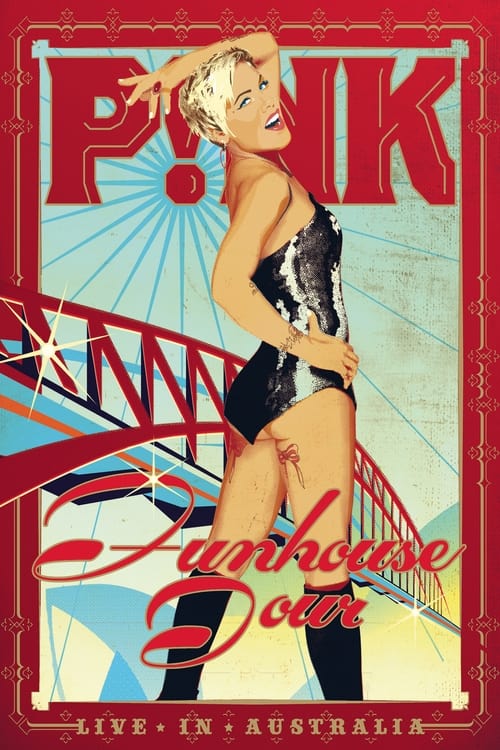
The story begins in darkness, in the vast enclosed space of the Sydney Entertainment Centre in Sydney, New South Wales, Australia, in mid‑July 2009, during the Australian leg of P!nk's Funhouse Tour. The arena hums with anticipation: thousands of people packed into the seats and standing spaces, lights dimmed to a low electric blue, the stage dominated by a towering circus‑funhouse façade. Painted panels, warped mirrors, and stylized carnival motifs stretch up toward the rafters, where rigging, trapeze lines, and aerial harnesses hang in the shadows, waiting.
It is night; the exact minute is unannounced, but the concert is well into prime evening hours, the moment when a city has surrendered itself to noise and light. The only "character" who matters is already hovering just out of sight: Alecia Beth Moore, known to all of them as P!nk. Around her, a small army of real people--guitarist Justin Derrico, bassist Eva Gardner, drummer Mark Schulman, keyboardists Kat Lucas and Paul Mirkovich, backing vocalists Jenny Douglas‑McRae and Stacy Campbell, and dancers and acrobats--stand ready. They are not introduced as characters, not given fictional histories or secrets; they exist in a different kind of story, one written in sound and muscle and light.
The lights cut out completely. A roar moves through the crowd like a single living creature. Somewhere in that darkness, a recorded snippet hits--often on this tour it's a shard of high‑voltage rock, an adrenaline‑shot overture that primes the throat and the heart. When the stage explodes into color, it's with the first assault: "Bad Influence."
P!nk bursts into view, striding or sliding into the center of the circus‑styled main stage, already inside the song's swagger. The band punches in behind her, drums and guitar thick and loud. The funhouse lights spin. She grabs the microphone like it's an extension of her arm and leans into the crowd as if she's confronting an old friend and a troublemaking accomplice at once.
"You ready, Sydney?" she shouts over the riff, a real‑time cry rather than scripted dialogue, and the building answers with a wall of noise.
There is no fictional murder to launch, no victim to find. The only thing being killed here is silence. As she powers through "Bad Influence," P!nk's persona is already clear: defiant, playful, dangerous in the way of someone who can turn their own pain into fuel. She prowls the stage, the circus imagery framing her as the ringmaster of a chaotic inner world.
Without cutting away to another location or time, the song burns out and slides into the next: "Just Like a Pill." The first transition is pure momentum. Lighting shifts from wild carnival color to something more concentrated and emotional, often cool blues and mauves that echo the song's ache. The band leans into the familiar riff, and the arena erupts in recognition.
P!nk's voice is sharp and controlled, threading through lyrics about addiction to a toxic love. There is no onstage manifestation of a lover, no villain stepping out of the wings; the battle happens inside her voice. She closes her eyes on certain lines, then opens them wide to meet the crowd, as if daring them to look at the same scars.
As "Just Like a Pill" gives way, she doesn't break character because there is no separate character. She is herself, but heightened. The stage fades for a beat, then surges into the bright, slightly nostalgic opening of "Who Knew." The set shifts subtly: perhaps a projection of carnival lights, perhaps a simple wash of color. The exact stage design for every beat is a lived memory for those there, known in outline from tour descriptions rather than exact frames, but the emotional throughline is clear.
"Who Knew" is about loss and the unexpected ways life changes; in the context of this non‑fiction concert, it plays as an elegy, not for a specific character but for moments and people gone. Her face, magnified on arena screens, shows it: a tightening around the eyes, a softness on the chorus. The tension here is not who will die or be saved but whether she will allow herself to show everything she feels.
The crowd sings with her, thousands of voices on the line "If someone said three years from now, you'd be long gone…" The song ends not with a plot twist but with a shared exhale.
Momentum carries the night forward into "Ave Mary A," a song that sharpens the tone. The lighting hardens, reds and whites striking through the dark. The arrangement feels like a march, a protest, P!nk turning outward toward the world's hypocrisies and broken promises. Again, no fictional villains step forward; the "antagonists" are systems and behaviors, invisible yet omnipresent. She spits certain lines more than she sings them, pacing the stage like someone arguing with ghosts.
When the song ends, she takes one of those small, real pauses to address the crowd, bridging one emotional terrain to the next.
"Thank you so much, Sydney," she says, breathless but grinning. "You all look so beautiful tonight." The words themselves are simple, but they're a release valve. The tension of the last songs is momentarily softened by the warmth of this connection. There is no secret encoded in the compliment, no hidden agenda. It is a human being acknowledging the thousands staring back at her.
The show then shifts into another of her signature confessional anthems, "Don't Let Me Get Me." The circus/funhouse world supports her, but the center is just P!nk in a spotlight, singing about self‑loathing and the fight to like the person in the mirror. It is the closest thing the night has to an internal confrontation. She sings, "I'm my own worst enemy," and the stage design responds: perhaps fragmented lights, perhaps projections that double and distort her figure. The funhouse mirrors, whether literal or implied by light, serve as metaphor: the way we see ourselves is always warped.
As this song fades, there is a perceptible shift from introspection to something more playful and provocative. The scene transitions into her cheekiest staging: "I Touch Myself," the Divinyls cover that has become notorious on this tour for its sex‑charged visuals. A couch is brought onstage, styled to fit the circus‑cabaret vibe, and as she lounges on it, disembodied hands emerge as part of the set, groping and teasing. It is humorous, theatrical, and knowingly over the top.
There is no literal seduction between characters, no romantic subplot. Instead, P!nk performs sexual autonomy and female desire as a spectacle. She might quip to the crowd, "My mom hates this part," or something similarly self‑deprecating, turning the moment into both parody and empowerment. The couch, the hands, the song's lyrics all create a mini‑story within the concert: a woman who refuses to be ashamed of her body or pleasure, even against the implied disapproval of others. But when the song ends, that micro‑story dissipates; no one is left changed but the audience.
The next emotional pivot is into "Please Don't Leave Me," which the staging often treats as an earnest, if still theatrical, plea. Again, she is alone with her microphone, the band supplying a propulsive yet vulnerable backdrop. The lights might narrow to a tight focus, the circus trappings receding so the lyrics can dominate. The tension now is relational: the push‑pull of wanting someone to stay and wanting to push them away. She sings, "How did I become so obnoxious?" with a half‑smile that acknowledges her own extremes.
The audience, aware of P!nk's own public relationship ups and downs, reads autobiography into every line. But onstage, there is no visible partner to beg, no fight to resolve; the conflict is sung, not enacted.
Without pausing too long, she drives straight into "U + Ur Hand," a snarling, club‑ready track that flips vulnerability into hard‑edged defiance. The visual energy spikes again. Dancers may swarm the stage, choreography aggressive and flirtatious. Strobe lights and bright colors slice through the arena. Here, the "confrontation" is with a whole archetype: the pushy man who assumes access to a woman's body. "I'm not here for your entertainment," she belts, and the song becomes a declaration of boundaries. No one steps up as the target; the whole world is the target.
She grins between lines, pointing out into the crowd, maybe singling out a fan for a teasing moment. But every gesture circles back to the same drive: control her own night, her own story.
On many dates of this tour, the next step is "Leave Me Alone (I'm Lonely)," a song that plays with contradiction and space in relationships. Sources for the Sydney video edit suggest its inclusion; the overall structure of the show in Australia follows the core tour pattern. In performance, the song is almost playful, lyrics about wanting closeness and distance simultaneously sung on a bouncing, rock‑driven rhythm. It's another kind of tension: the impossibility of wanting mutually exclusive things.
P!nk might turn certain lines into call‑and‑response with the audience, turning the internal contradiction into a shared joke. The stage remains visually vibrant, the circus theme not literal in every moment but always present, like an undertone.
Between songs, she occasionally stops to talk. These fragments of banter are not scripted beats in a fictional narrative but real‑time communication. She thanks Sydney for breaking attendance records, teases the front row, maybe introduces a band member with a quick joke. There is no secret she's building to, no confession that will reframe everything; she's pacing the energy of a very long show.
At some point in the middle of the concert, the tone begins to darken and deepen again. One of the night's most intimate songs appears: "Family Portrait." When she performs it, the vast arena suddenly feels smaller. The circus fades back; the focus is a woman singing about divorce, childhood pain, and the longing for a family that doesn't fall apart. People in the audience cry; others hold each other.
There is no flashback scene to a childhood kitchen, no actor playing a father leaving. But the song itself is so descriptive that images form in the minds of everyone listening. This is the closest the concert comes to a plotted flashback: memory as music. Every time she sings the line "Can we work it out? Can we be a family?" she is re‑enacting a plea that will never be directly answered on this stage.
The show's mid‑section also incorporates "I Don't Believe You" and "Crystal Ball" in various Australian dates, songs that dig into trust, faith, and uncertainty. In "I Don't Believe You," the staging is typically bare, emphasizing the heartbreak in her voice. In "Crystal Ball," the arrangement strips down, sometimes to acoustic guitar or minimal backing, creating a pause in the sensory overload. The funhouse theme momentarily quiets, and we are left with the performer at her most exposed.
There are no revelations of crime, no climactic discovery of a hidden letter. The only revelations are emotional: a superstar revealing that beneath the big show, she still doubts, still fears, still wonders what the future holds.
Around this central stretch, P!nk also unleashes songs like "Trouble" and "Babe I'm Gonna Leave You." "Trouble" is all swagger and rock, her voice cracking with intentional grit as she runs and jumps across the stage, sometimes climbing on set pieces. The song is a confrontation with chaos itself, a proclamation that she is both its source and its survivor.
"Babe I'm Gonna Leave You," often done as a cover with more live‑band intensity, adds another layer of departure and letting go. There is no lover appearing to beg her to stay; the entire narrative happens in the lyrics and the performance. When she hits the wailing high notes, the tension isn't "Will they break up?" but "Can she sustain this emotional and vocal intensity?" The answer is always yes, but the question keeps the audience on edge.
One of the most visually dramatic sequences of the night arrives with "Sober." For this number, P!nk frequently uses aerial acrobatics, attaching to a harness and rising above the stage--and sometimes over the audience--while singing. In the Sydney Entertainment Centre, the rigging that had been a silent promise overhead becomes active. The lights dim to an eerie glow, perhaps with spotlights tracking her ascent. As she sings about the fear and thrill of being "sober," of facing oneself without the numbing of substances or distractions, she is literally hanging in the air, spinning and dropping in carefully choreographed stunts.
People in the crowd gasp at each fall and catch, each moment when she seems to be inches from calamity before the harness snatches her back. The tension here is visceral. It's not fictional danger; it's actual risk, even if meticulously planned. Every move defies gravity, and the circus motif reaches its purest form: a high‑wire act of emotional confession.
No one dies. No one falls. The "death‑defying" nature of the act is the point: she confronts danger and survives, turning that survival into art.
At other points, she steps into musical homage and transformation. "Bohemian Rhapsody" appears in the latter portion of the set, P!nk taking on Queen's iconic labyrinth of a song. The staging often involves elaborate lighting, syncopated cues for band and backing singers, and a playful theatricality--perhaps camp, perhaps reverent. She and her band lean into the song's shifts, from ballad to operatic weirdness to hard rock. The funhouse is now also a jukebox, twisting familiar songs through her own voice.
Later, she covers "Crazy" by Gnarls Barkley, often pairing it with mirrors and distorted imagery to emphasize themes of sanity, perception, and the way the world labels those who feel intensely. The funhouse mirrors motif is literal here: reflective surfaces and lighting tricks that fracture her image, making multiple P!nks spin and blink across the stage. Again, there's no literal breakdown, no character being institutionalized or saved. The story is purely psychological: what if the world calls you crazy for reacting honestly to a crazy world?
Threaded between these covers and her original songs are performances of "Funhouse" itself and other Funhouse album tracks like "It's All Your Fault" and "One Foot Wrong." "Funhouse" is a thematic keystone. When she performs it, the circus set comes fully alive--flames or fiery lighting, spinning wheels, maybe dancers in clownish or carnival costumes. The lyrics talk about a house once full of love now "burning down," a relationship turned into a haunted carnival. "This used to be a funhouse," she sings, "but now it's full of evil clowns." The stage reflects this with exaggerated, almost grotesque visuals: a beautiful nightmare.
There is no literal house onstage, no partner revealed as a monster. The evil clowns are metaphors for the ways intimacy can curdle. The funhouse itself is the tour, the show, the career: a place where everything is bright and twisted and both joyful and painful.
"It's All Your Fault" and "One Foot Wrong" extend this story of missteps, blame, and the fragile balance between feeling grounded and falling apart. The lighting for these might skew toward reds and dark tones, the choreography more stress‑laden, bodies pulling and pushing against each other. She sings of accidents and responsibility, but there's no final adjudication, no judge or jury. The verdict is left in the echo of the chorus, in the way the notes hang in the rafters.
As the show moves into its later stages, P!nk returns again to anthems of pure self‑assertion: "So What" appears on many Australian dates, a brash middle‑finger salute to heartbreak in the guise of a shout‑along party song. The stage turns riotous: bright lights, confetti, perhaps pyrotechnics. She struts with exaggerated attitude, often walking the length of extended catwalks jutting into the audience.
"I'm still a rock star!" she screams into the mic, and Sydney screams it back at her. Any tension here is not whether she'll win--that's never in doubt--but how many walls she can knock down with her energy.
Throughout, the band and dancers remain essential yet uncharacterized. Justin Derrico's guitar solos shred through the air; Eva Gardner's bass lines pulse under everything; Mark Schulman drives the beat. They are real people playing real music, not fictional allies or rivals. Their presence adds layers to the sensory experience, not subplots.
As the main set draws closer to its end, P!nk often performs "Get the Party Started" in a way that re‑frames the song. Once merely a straightforward party track, here it becomes a peak of theatricality. For the Funhouse Tour, this number is frequently staged with trapeze or harness work, combining the party anthem with acrobatics. The Sydney Entertainment Centre becomes a swirling carnival dome, lights sweeping across thousands of faces as she swings or flies overhead, sometimes upside down, still singing steadily.
The crowd is at fever pitch. They know the show cannot go on forever, but the energy suggests otherwise. The tension now is about sustainability: how can a human body keep delivering at this level? How can a night like this end without feeling like a loss?
After "Get the Party Started," the stage might cut to a video montage on many tour dates, set to "God Is a DJ," a reminder of her earlier work and the continuous thread of her career. On the DVD, the focus stays more tightly on the live material, but the concept still hangs in the air: life itself as a dance floor, nights like this as sacred events.
Then comes the quieting. The main set has already featured emotional peaks, but the true emotional climax is reserved for the final live performance: "Glitter in the Air." The song is gentle, reflective, built around piano and soft instrumentation. It asks questions rather than shouts answers: "Have you ever thrown a fistful of glitter in the air? Have you ever looked fear in the face and said, 'I just don't care'?"
For this number, P!nk often returns to the aerial rigging. The circus becomes ethereal. She might be suspended above a pool of projected or real water, spinning slowly, or seated on a swinging apparatus high above the stage. Lights soften to blues and silvers, as if the entire arena has been placed under a glass dome filled with moonlight and dust.
Her voice floats, intimate even in its power. People in the audience fall silent or whisper the words; tears are common. If earlier songs were confrontations--with lovers, with the industry, with herself--this one is a surrender, not to defeat but to the beauty of risk and presence.
There is still no hidden truth to reveal, no masked figure stepping forth. The secret, if there is one, is that all along, the "story" has been the journey from noise to stillness, from defiance to acceptance, from external spectacle to internal reflection.
When "Glitter in the Air" reaches its final chorus, she is often mid‑air, body stretched almost weightless, singing into the vastness. As the last note fades, she slowly descends or is lowered back to the stage. The crowd erupts, thunderous, the sound bouncing off every surface of the Sydney Entertainment Centre. She stands there, sweat‑damp, breathing hard, eyes shining.
"Thank you, Sydney! I love you!" she calls out, voice hoarse but full. It is not a cleverly scripted last line; it's what she feels, said in the simplest possible way.
She bows with her band and dancers, maybe linking hands, maybe taking a moment to point to each of them as a way of giving credit: Justin Derrico, Eva Gardner, Mark Schulman, Kat Lucas, Paul Mirkovich, and others. Their names are not spoken as part of some narrative roll call; they are acknowledgments of real work, real collaboration.
Lights begin to rise slightly as she and the company wave and start to exit the stage. The noise of the crowd swells again, some people chanting her name, others just screaming wordless gratitude. There is no post‑credits stinger, no last‑minute twist where someone returns from the dead or a secret crime is confessed. There was never a fictional death to begin with; no character in this film dies, no one kills anyone, and no mystery is solved.
The only arc completed is the arc of a night: entering the funhouse, being dazzled and confronted and soothed, and then finding oneself back outside, changed only in the ways that music and shared experience can change a person.
The camera, in the home‑video version, lingers on the stage as it empties, on the audience still lit by the afterglow of performance. Credits roll over these images, naming directors Baz Halpin, Larn Poland, and Paul Mirkovich, producers including P!nk herself and Roger Davies, engineers, mixers, crew. These names are not characters but the real‑world architects of what has just unfolded.
Eventually, the screen goes dark. The Sydney Entertainment Centre, at 35 Harbour Street--destined years later to be demolished--returns to silence for the night. Chairs will be folded, cables coiled, costumes hung. P!nk will leave the building and, on another night, in another city, walk into another funhouse.
The story ends not with a narrative resolution but with a feeling suspended in time: the echo of the last chorus of "Glitter in the Air," the memory of a woman flying above a crowd, and the understanding that in this film, the only things that live and die are songs, born in the first note and gone in the last, leaving their glitter behind in the air.
More Movies Like This
Browse All Movies →

What is the ending?
In the ending of P!NK: Funhouse Tour - Live in Australia, the concert culminates in a powerful finale where P!NK performs her hit song "So What." The performance is filled with high energy, vibrant visuals, and an emotional connection with the audience. As the show concludes, P!NK expresses her gratitude to the fans, leaving them with a sense of empowerment and joy.
As the concert reaches its climax, the stage is alive with a dazzling array of lights and colors. P!NK, dressed in a striking outfit, stands center stage, her presence commanding the attention of the thousands of fans gathered in the arena. The atmosphere is electric, filled with anticipation as the opening notes of "So What" begin to play. The crowd erupts in cheers, their excitement palpable.
Scene by scene, the performance unfolds. P!NK engages with the audience, her voice powerful and emotive as she sings about resilience and independence. The lyrics resonate deeply, reflecting her personal journey and struggles, which she shares through her music. As she moves across the stage, her choreography is dynamic, incorporating acrobatics and dance that showcase her physicality and artistry.
The visuals behind her are equally captivating, with large screens displaying vibrant imagery that complements the song's themes. Fireworks and confetti explode in the air, adding to the celebratory atmosphere. P!NK's connection with her fans is evident; she encourages them to sing along, creating a sense of unity and shared experience.
As the song reaches its peak, P!NK's emotional state is one of triumph and liberation. She embodies the spirit of the song, celebrating her individuality and strength. The audience mirrors her energy, singing and dancing, fully immersed in the moment. This connection highlights the central theme of the concert: empowerment through self-expression and resilience in the face of challenges.
As the final notes of "So What" echo through the arena, P!NK takes a moment to express her heartfelt gratitude to her fans. She acknowledges their support and the journey they have shared, emphasizing the importance of community and connection. The lights dim slightly, and the crowd's cheers swell, creating a powerful sense of closure.
In the aftermath of the performance, P!NK exits the stage, leaving behind a sea of elated fans. The concert concludes with a feeling of joy and empowerment, reinforcing the message that embracing one's true self is a source of strength. Each main character in this narrative--the fans, P!NK herself--experiences a sense of fulfillment and connection, united by the music and the shared experience of the concert. The ending encapsulates the essence of the Funhouse Tour, celebrating individuality, resilience, and the power of music to bring people together.
Is there a post-credit scene?
The movie "P!NK: Funhouse Tour - Live in Australia" does not contain a post-credit scene. The concert film focuses on P!NK's electrifying performance during her Funhouse Tour, showcasing her powerful vocals, acrobatic stunts, and engaging stage presence. The film captures the energy of the live audience and the emotional connection P!NK shares with her fans throughout the concert, but it concludes without any additional scenes or content after the credits.
What songs does P!NK perform during the Funhouse Tour in Australia?
P!NK performs a variety of songs during the Funhouse Tour in Australia, including hits like 'Just Like a Pill,' 'So What,' 'Sober,' 'Raise Your Glass,' and 'Funhouse.' Each performance is accompanied by elaborate choreography and stunning visuals.
How does P!NK interact with the audience during the concert?
Throughout the concert, P!NK engages with the audience by sharing personal stories, encouraging sing-alongs, and expressing her gratitude. She often moves around the stage, making eye contact and creating a connection with fans, which enhances the emotional experience of the performance.
What visual elements are featured in the Funhouse Tour performance?
The Funhouse Tour features vibrant and dynamic visual elements, including elaborate stage designs, colorful backdrops, and impressive lighting effects. P!NK also incorporates acrobatics and aerial performances, adding a theatrical flair to the concert.
What is the significance of the 'Funhouse' theme in the concert?
The 'Funhouse' theme represents a playful yet introspective exploration of P!NK's life and experiences. The set design and performance style reflect a carnival atmosphere, symbolizing the ups and downs of her journey, while also showcasing her resilience and strength.
How does P!NK's performance style contribute to the overall experience of the concert?
P!NK's performance style is characterized by high energy, emotional depth, and physicality. Her ability to blend powerful vocals with acrobatic stunts and expressive movements captivates the audience, making each song feel personal and impactful, thus enhancing the overall concert experience.
Is this family friendly?
P!NK: Funhouse Tour - Live in Australia is a concert film that showcases P!NK's dynamic performance style and her engaging stage presence. While the film is primarily a celebration of music and entertainment, there are several aspects that may be considered objectionable or upsetting for children or sensitive viewers:
-
Mature Themes: The concert features songs that address adult themes such as heartbreak, relationships, and personal struggles, which may not be fully understood by younger audiences.
-
Language: Some of P!NK's lyrics contain strong language and suggestive content that may not be appropriate for children.
-
Visuals and Costumes: The performance includes provocative costumes and choreography that may be considered too mature for younger viewers.
-
Emotional Intensity: Certain songs evoke strong emotions related to personal pain and societal issues, which might be overwhelming for sensitive individuals.
-
Stage Effects: The concert includes dramatic visual effects, including pyrotechnics and intense lighting, which could be startling for some viewers.
Overall, while the concert is a vibrant and energetic showcase of P!NK's artistry, parents may want to consider these elements when deciding if it is suitable for their children or sensitive viewers.








