




Popular
What role does Dr. Mudd play in the aftermath of Lincoln's assassination?
How does Dr. Mudd's relationship with his family evolve throughout the film?
What are the circumstances surrounding Dr. Mudd's arrest?
How does Dr. Mudd cope with his imprisonment?
What is the significance of Dr. Mudd's trial in the film?
Should I watch it?
Ask Your Own Question

What is the plot?
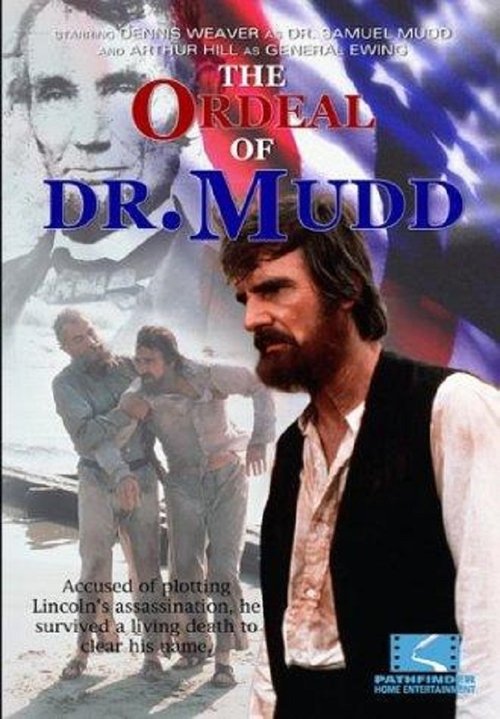
The Ordeal of Dr. Mudd (1980): A Complete Narrative Spoiler
The night of April 14, 1865, is thick with tension and uncertainty. In the quiet Maryland countryside, Dr. Samuel A. Mudd, a country physician, tends to his family and farm, unaware that the world outside is convulsing with the news that President Abraham Lincoln has been shot at Ford's Theatre. The air is electric with rumors, but in the Mudd household, the only sounds are the creak of floorboards and the distant hoot of an owl.
Suddenly, a sharp knock shatters the silence. Dr. Mudd, played with quiet dignity by Dennis Weaver, opens the door to find two strangers--one of them, a man in obvious pain, his face shadowed by a hat. "Doctor, I need your help," the man gasps. Mudd, ever the healer, ushers them inside. The man with the injury is John Wilkes Booth, though Mudd does not yet know his name or his crime. Booth's leg is broken, his face pale with agony. Mudd sets to work, splinting the leg, offering comfort, asking no questions. His wife, Frances Mudd (Susan Sullivan), watches with concern but trusts her husband's judgment.
As dawn breaks, the strangers depart, leaving behind only a sense of unease. The next morning, the truth crashes into the Mudd home: Lincoln is dead, and the assassin is on the run. The doctor's act of mercy is about to become his undoing.
The Arrest and Accusation
Within days, federal soldiers arrive at the Mudd farm. "Dr. Mudd, you are under arrest for conspiracy in the assassination of President Lincoln," an officer barks. Mudd, bewildered, protests: "I only treated a man's broken leg. I did not know who he was." But his words fall on deaf ears. The nation is hungry for vengeance, and Mudd, a Southern sympathizer in a Union state, is an easy target.
He is taken to Washington, D.C., where President Andrew Johnson and Secretary of State Edwin Stanton (Richard Dysart) have ordered a military commission to try the conspirators. The courtroom is a cauldron of anger and fear. The prosecution, led by Stanton, paints Mudd as a willing accomplice, a member of a Confederate communications network, and a man who knowingly harbored a murderer. The evidence is thin, the witnesses unreliable, but the mood is merciless.
General Thomas Ewing Jr. (Arthur Hill), Mudd's defense attorney, fights valiantly. "There is no proof Dr. Mudd knew Booth's crime," Ewing argues. "He acted as any doctor would--without question, without prejudice." But the commission is unmoved. The verdict: guilty. Mudd escapes the death penalty by a single vote but is sentenced to life imprisonment at Jefferson Prison, a remote fortress on the Dry Tortugas islands off Florida, referred to in the film as "Devil's Island."
Imprisonment and Suffering
The journey to Jefferson Prison is a descent into hell. The island is a sun-baked rock surrounded by shark-infested waters, its walls crumbling, its air thick with despair. Mudd is stripped of his dignity, forced into hard labor, and subjected to the whims of a sadistic commandant. In one harrowing scene, the commandant slaps Mudd across the face, sneering, "You're nothing but a traitor, Mudd. You'll die here, forgotten."
The prison is soon gripped by a yellow fever epidemic. The officer physician dies, and the commandant, desperate, turns to Mudd. "You're a doctor," he growls. "Fix this." Mudd, despite his bitterness, cannot turn away from suffering. He organizes a makeshift hospital, tending to officers and inmates alike, risking his own life in the process. The epidemic begins to subside, and Mudd, once reviled, is now seen as a savior.
Confrontations and Revelations
Throughout his ordeal, Mudd maintains his innocence. In letters to Frances, he writes, "I am unjustly accused, but I will not let them break my spirit." Frances, meanwhile, petitions anyone who will listen, pleading for her husband's release. Her efforts are met with silence or dismissal.
In the prison, tensions boil over. One prisoner, driven mad by despair, attempts to escape. He is shot dead by guards, his body left as a warning. The commandant tightens his grip, but Mudd, now indispensable, is spared the worst abuses. The film suggests that Mudd is treated better than others because of his medical skills, though life remains harsh for all.
As months turn into years, Mudd's resolve is tested. He confronts the commandant: "You know I am no conspirator. I am a healer, not a killer." The commandant, unmoved, replies, "Your fate is not mine to decide."
The Climax: Redemption and Pardon
The climax of the film centers on the yellow fever crisis. Mudd works tirelessly, his hands steady, his voice calm. He saves lives, including that of a young officer who had once tormented him. The officer, humbled, whispers, "Thank you, Doctor. I was wrong about you."
News of Mudd's heroism reaches Washington. Pressure builds for his release. Finally, in 1869, President Andrew Johnson issues a pardon. Mudd is free to return home, his name still stained but his spirit unbroken.
The Ending: Legacy and Unfinished Business
The film's final scenes show Mudd reunited with Frances, their embrace wordless but full of emotion. The camera lingers on their faces--relief, sorrow, and a quiet determination. The narrator reflects on Mudd's legacy: though pardoned, he is never fully exonerated in the eyes of history.
The story does not end with Mudd's death, but with the ongoing efforts of his descendants, particularly his grandson Richard Mudd, who petitions successive presidents--Jimmy Carter, Ronald Reagan--to clear the family name. The film's closing message is bittersweet: "The truth is complicated, and justice is not always swift or sure."
Deaths and Their Causes
- President Abraham Lincoln: Shot by John Wilkes Booth at Ford's Theatre, Washington, D.C., April 14, 1865 (off-screen, but central to the plot).
- Four conspirators: Hanged at the Washington Arsenal, July 7, 1865, by order of the military commission (off-screen, but mentioned as a consequence of the trial).
- Yellow fever victims: Several prisoners and the prison's officer physician die from the epidemic at Jefferson Prison before Mudd takes charge of treatment (off-screen, but pivotal to the story).
- Escapee prisoner: Shot dead by guards during a failed escape attempt at Jefferson Prison (on-screen, heightening the tension and danger of prison life).
Major Plot Revelations and Twists
- Mudd's ignorance: The film reveals that Mudd did not know Booth's identity or crime when he treated him, emphasizing his innocence and the injustice of his conviction.
- Political motivation: The prosecution's case is shown to be driven more by revenge and the desire for scapegoats than by solid evidence.
- Medical redemption: Mudd's skills as a doctor become his salvation, transforming him from despised prisoner to respected healer during the yellow fever epidemic.
- Historical controversy: The film acknowledges that Mudd's name was never fully cleared, and his descendants continued to fight for his exoneration long after his death.
Character Secrets
- Dr. Samuel A. Mudd: His secret is his genuine innocence--he acted as a healer, not a conspirator, but is swept up in the political maelstrom.
- Frances Mudd: Her secret is her unwavering loyalty and her behind-the-scenes efforts to free her husband, despite public scorn.
- General Thomas Ewing Jr.: His secret is his belief in Mudd's innocence and his frustration with a justice system more concerned with appeasement than truth.
- Commandant at Jefferson Prison: His secret is his grudging respect for Mudd's medical abilities, even as he maintains a facade of cruelty.
Visual and Emotional Moments
- The midnight knock: The tension as Mudd opens his door to Booth, the dim lamplight casting long shadows, the audience's dread as they realize the significance of the moment.
- The trial: The claustrophobic courtroom, the hostile stares, Mudd's pale face as the verdict is read, the crushing weight of injustice.
- Prison life: The scorching sun, the stench of disease, the clank of chains, Mudd's hands trembling as he tends to the sick, the slow dawning of respect in the eyes of his captors.
- The pardon: The moment Mudd receives the news, his face a mix of disbelief and relief, the bittersweet reunion with Frances, the sense of a life forever altered.
Dialogue Highlights
- Mudd to Booth: "Lie still. This will hurt, but it must be done."
- Mudd at his trial: "I am a doctor, not a conspirator. I treated a wounded man--nothing more."
- Ewing to the court: "You condemn an innocent man to satisfy the mob. Is this justice?"
- Frances to a government official: "My husband is no murderer. He is a healer. Have you no mercy?"
- Commandant to Mudd: "You're a traitor, Mudd. You'll die here, forgotten."
- Mudd to the commandant: "You know I am no conspirator. I am a healer, not a killer."
- Officer to Mudd: "Thank you, Doctor. I was wrong about you."
Final Scene and Resolution
The film ends not with a triumphant fanfare, but with a quiet reflection. Mudd is home, but the world has moved on. The scars of his ordeal remain--in his family, in his community, in the history books. The camera pulls back, showing the Mudd farm, now a place of memory rather than innocence. The narrator's voice lingers: "The ordeal of Dr. Mudd is over, but the question of his guilt or innocence endures. Some stories are never truly finished."
And so, the story of Dr. Samuel A. Mudd--the country doctor who became a national villain, then a prison hero, and finally a symbol of the complexities of justice--reaches its ambiguous, haunting conclusion. The film leaves the audience to ponder: in times of fear and vengeance, how many innocent lives are shattered in the name of justice? And how many, like Mudd, must wait for history's uncertain verdict?
More Movies Like This
Browse All Movies →


What is the ending?
In the ending of "The Ordeal of Dr. Mudd," Dr. Samuel Mudd is finally exonerated after enduring years of hardship and wrongful imprisonment for his association with John Wilkes Booth. The film concludes with Mudd returning to his family, where he is welcomed back with open arms, but the scars of his ordeal remain.
As the final scenes unfold, we see Dr. Mudd, played by F. Murray Abraham, in the confines of the military prison where he has spent years. The atmosphere is heavy with despair, and Mudd's face reflects the toll that time and isolation have taken on him. He is a man who has lost everything--his reputation, his freedom, and the trust of his community. The weight of his wrongful conviction hangs over him like a dark cloud, and he grapples with feelings of anger and hopelessness.
In a pivotal moment, Mudd receives news that President Andrew Johnson has decided to grant him a pardon. The news is delivered by a military officer, who enters the dreary prison cell with a sense of formality. Mudd's initial reaction is one of disbelief; he struggles to process the idea that he might finally be free. The officer explains the circumstances surrounding the pardon, emphasizing the political motivations behind it, but Mudd is primarily focused on the prospect of returning to his family.
The scene shifts to Mudd's release from prison. As he steps outside, the sunlight hits his face for the first time in years, and he squints, momentarily blinded by the brightness. The air is fresh, and he takes a deep breath, savoring the taste of freedom. However, the joy of liberation is tempered by the knowledge of the years lost and the pain endured. Mudd's expression is a mixture of relief and lingering sorrow.
The next scene transitions to Mudd's homecoming. He arrives at his family's farm, where his wife, played by a supporting actress, and their children await him. The reunion is emotional; his wife rushes into his arms, tears streaming down her face. The children, initially hesitant, soon join in the embrace, and the family is momentarily united in joy. Yet, there is an undercurrent of tension as they all recognize the challenges that lie ahead. Mudd's wife expresses her relief but also her concern about how the community will react to his return.
As the family gathers around the dinner table, the atmosphere is bittersweet. They share stories and laughter, but Mudd's silence speaks volumes. He is physically present but emotionally distant, haunted by memories of his imprisonment and the stigma attached to his name. The children, unaware of the full extent of their father's ordeal, are eager to hear about his time away, but Mudd struggles to find the words. His internal conflict is palpable; he wants to protect them from the harsh realities of his experience, yet he knows that the truth cannot be hidden forever.
The film concludes with a poignant scene of Mudd standing outside his home, looking out over the fields that he once tended. The sun sets in the background, casting a warm glow over the landscape, symbolizing both hope and the uncertainty of the future. Mudd's face reflects a mix of determination and vulnerability as he contemplates the road ahead. He knows that while he has been physically freed, the emotional scars of his ordeal will take time to heal.
In the final moments, the camera pulls back, showing Mudd surrounded by his family, yet still isolated in his thoughts. The screen fades to black, leaving the audience with a sense of unresolved tension, highlighting the lasting impact of injustice and the struggle for redemption. The fate of Dr. Mudd is one of tentative hope, as he begins to rebuild his life, but the shadows of his past loom large, reminding viewers of the complexities of human experience and the enduring effects of societal judgment.
Is there a post-credit scene?
The Ordeal of Dr. Mudd, produced in 1980, does not contain a post-credit scene. The film concludes its narrative without any additional scenes or content after the credits roll. The story focuses on Dr. Samuel Mudd, who is famously known for treating John Wilkes Booth after the assassination of President Abraham Lincoln, and the subsequent consequences he faces. The film wraps up with a poignant reflection on Mudd's struggles and the impact of his choices, leaving the audience with a sense of closure regarding his ordeal.
What role does Dr. Mudd play in the aftermath of Lincoln's assassination?
Dr. Samuel Mudd, a country doctor, becomes embroiled in the aftermath of President Lincoln's assassination when he treats John Wilkes Booth's broken leg. His decision to help Booth, despite the political implications, leads to his arrest and trial.
How does Dr. Mudd's relationship with his family evolve throughout the film?
Dr. Mudd's relationship with his wife, Frances, and their children is strained as he faces the consequences of his actions. Initially supportive, Frances becomes increasingly worried about the repercussions of his involvement with Booth, leading to emotional turmoil and conflict within the family.
What are the circumstances surrounding Dr. Mudd's arrest?
Dr. Mudd is arrested after federal agents discover that he treated Booth's injury. The dramatic scene unfolds as soldiers storm his home, and Mudd's initial shock turns to desperation as he realizes the gravity of the situation and the impact it will have on his life and family.
How does Dr. Mudd cope with his imprisonment?
During his imprisonment, Dr. Mudd faces harsh conditions and isolation. He struggles with despair but also finds resilience, using his medical skills to help fellow prisoners, which highlights his character's complexity and determination to maintain his dignity.
What is the significance of Dr. Mudd's trial in the film?
Dr. Mudd's trial serves as a pivotal moment in the film, showcasing the political climate of the time. The trial is marked by intense scrutiny and public opinion, reflecting the societal tensions following Lincoln's assassination, and Mudd's defense reveals his internal conflict and the moral dilemmas he faces.
Is this family friendly?
The Ordeal of Dr. Mudd, produced in 1980, contains several elements that may be considered objectionable or upsetting for children or sensitive viewers. Here are some aspects to consider:
-
Violence and Historical Context: The film is set during the aftermath of President Lincoln's assassination, which involves themes of violence and betrayal. There are depictions of the Civil War and its brutal realities, which may be distressing.
-
Imprisonment and Torture: Dr. Mudd faces harsh treatment and imprisonment, including scenes that depict the harsh conditions of a military prison. The emotional toll of his situation may be unsettling.
-
Themes of Injustice: The film explores themes of wrongful accusation and the struggle for justice, which can evoke feelings of frustration and sadness.
-
Emotional Distress: Characters experience significant emotional turmoil, including fear, despair, and hopelessness, which may be intense for younger viewers.
-
Death and Loss: The narrative includes references to death and the impact of loss on families, which can be heavy and potentially upsetting.
These elements contribute to a serious tone throughout the film, making it more suitable for mature audiences.







