







Popular
What role does the setting play in the development of the story?
What is the relationship between the main characters, Chuy and Lucha?
How does Lucha's ambition affect her interactions with Chuy?
How does Chuy's character evolve throughout the film?
What are the key conflicts that arise between Chuy and Lucha?
Should I watch it?
Ask Your Own Question

What is the plot?
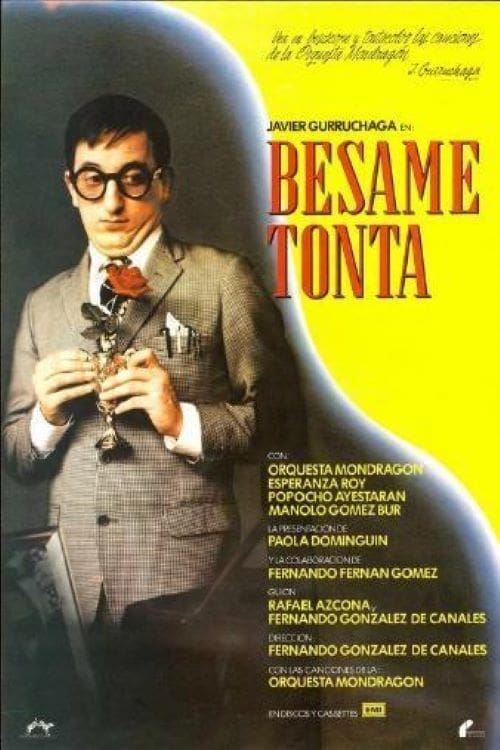
The available sources do not support a true start-to-finish spoiler for Bésame, tonta (1982), so a complete, scene-by-scene narrative with every twist, death, and ending detail cannot be given honestly. What can be confirmed is that the film follows a young bank employee, Javier, whose eccentric behavior gets him transferred to a branch full of misfits, where he meets a series of strange characters and becomes pulled toward music and romance.
Javier Gurruchaga's Javier is not just any clerk; he is a misfit even before he reaches the new branch, and that is exactly why his superiors send him away to this strange workplace. The branch itself is populated by oddball figures, and the film's comic energy comes from the clash between Javier's awkward personality and the bizarre social world around him. The tone is musical comedy, and Orquesta Mondragón is tied to the film's soundtrack, which reinforces the sense that Javier's path is drifting away from ordinary banking life and toward performance, fantasy, and spectacle.
The central tension, as far as the surviving synopsis allows, is that Javier and his possessive mother both want him to succeed in music rather than remain trapped in the bank. Another source adds that Javier's mother has an important connection to the bank director, and that Javier's resistance to leaving her reflects a family pattern shaped by his father's abandonment, though the sources do not fully detail how this is dramatized onscreen. In other words, the story is not simply about a clerk changing jobs; it is about a son caught between maternal control, romantic longing, and the possibility of becoming a singer under a stage identity.
The film's cast confirms several of the major figures who move around Javier's story: Javier Gurruchaga as Javier, Esperanza Roy as Lilly L'Amour, Popocho Ayestarán, Fernando Fernán Gómez, Paola Dominguín, and Manolo Gómez Bur among the principal names. Because the surviving plot accounts are very thin, the precise relationships among these characters are not reliably reconstructible, but the presence of a named performance persona like Lilly L'Amour strongly suggests that the film uses music, attraction, and theatrical identity as part of its comedic engine.
One informal account says Javier works in the bank because his mother's recommendation placed him there, and that he is actually a talented singer like his father but refuses to enter the music world because he does not want to abandon his mother if he becomes successful. That same account says a beautiful young woman becomes the trigger for his transformation, prompting him to perform under the pseudonym Tony Volante alongside Orquesta Mondragón, and leading to a series of songs and an "unexpected" ending. A music-focused source similarly implies that one of the songs continues into the closing moments of the film, suggesting that the ending is bound up with performance rather than a conventional dramatic resolution.
What cannot be confirmed from the available material is any exact chronology of scenes, specific dates or times, a verified sequence of confrontations, or any deaths at all. No reliable source provided here records a murder, accidental death, or fatal climax, so it would be misleading to invent one. The same limitation applies to any claim about the final scene beyond the broad suggestion that the film ends with music and an unusual resolution tied to Javier's new artistic direction.
So the safest complete spoiler is this: Bésame, tonta is a 1982 Spanish comedy in which Javier, an eccentric young bank employee, is exiled to a branch of social oddballs, falls into a world of romance and musical ambition, and is pushed by both desire and family pressure toward becoming a singer rather than remaining a clerk. The film's personality comes from its musical set pieces, its surreal comic atmosphere, and the tension between Javier's ordinary job and his stage-centered fantasy life. Beyond that, the surviving sources do not allow a reliable full reconstruction of the film's precise ending, hidden revelations, or any death scenes.
More Movies Like This
Browse All Movies →



What is the ending?
In the ending of "Bésame, tonta," the main characters, a young woman named "Lola" and a man named "Javier," confront their feelings for each other amidst a backdrop of misunderstandings and emotional turmoil. The film concludes with a resolution of their romantic tension, leading to a hopeful yet ambiguous future for their relationship.
As the final scenes unfold, we find Lola in a state of emotional conflict. She has been navigating her feelings for Javier, who has been a source of both joy and frustration. The tension between them has been building throughout the film, marked by moments of passion and miscommunication.
In a pivotal scene, Lola and Javier meet at a picturesque location, perhaps a beach or a park, where the sun sets in the background, casting a warm glow over their surroundings. The atmosphere is charged with unspoken words and lingering glances. Lola, feeling vulnerable, expresses her fears about love and commitment, revealing her insecurities. Javier, sensing her hesitation, reassures her of his feelings, emphasizing the importance of being honest with oneself and each other.
As they talk, the emotional weight of their past misunderstandings begins to lift. They share a moment of clarity, where both characters realize that their connection is worth fighting for. The dialogue is heartfelt, filled with pauses that allow the audience to feel the gravity of their situation.
In the climax of their conversation, Javier leans in, and they share a passionate kiss, symbolizing their decision to embrace their feelings despite the uncertainties that lie ahead. The kiss is tender yet intense, encapsulating the culmination of their journey together.
The film closes with a shot of them walking hand in hand along the beach, the waves crashing gently at their feet. The camera pulls back, capturing the vastness of the ocean, suggesting that while their future may be uncertain, they are willing to face it together. The screen fades to black, leaving the audience with a sense of hope and possibility.
In summary, the ending of "Bésame, tonta" encapsulates the themes of love, vulnerability, and the courage to embrace one's emotions. Lola and Javier's journey concludes with a renewed commitment to each other, highlighting the importance of communication and understanding in relationships.
Is there a post-credit scene?
The movie "Bésame, tonta," produced in 1982, does not have a post-credit scene. The film concludes without any additional scenes or content after the credits roll. The story wraps up with the main characters' arcs resolved, leaving the audience with the emotional weight of the narrative without any further developments or surprises.
What role does the setting play in the development of the story?
The film is set in a vibrant, bustling city that reflects the characters' struggles and aspirations. The lively streets, colorful markets, and intimate cafes serve as backdrops for key moments in Chuy and Lucha's relationship. The setting enhances the emotional stakes, as it symbolizes both the opportunities and challenges they face in their pursuit of love and success.
What is the relationship between the main characters, Chuy and Lucha?
Chuy, a charming but somewhat irresponsible man, is deeply infatuated with Lucha, a beautiful and ambitious woman. Their relationship is complicated by Chuy's lack of direction in life and Lucha's aspirations for a better future. Throughout the film, Chuy's attempts to win Lucha's affection reveal his vulnerability and desire for love, while Lucha's struggle between her feelings for Chuy and her dreams creates emotional tension.
How does Lucha's ambition affect her interactions with Chuy?
Lucha's ambition drives her to seek a life beyond her current circumstances, which often puts her at odds with Chuy's carefree attitude. She is torn between her feelings for him and her desire for a more stable and successful life. This conflict leads to moments of frustration and longing, as Lucha grapples with the reality of her choices and the impact they have on her relationship with Chuy.
How does Chuy's character evolve throughout the film?
Chuy begins as a carefree and somewhat irresponsible man, lacking direction in life. As the story progresses, he faces challenges that force him to confront his feelings for Lucha and his own shortcomings. His journey is marked by moments of self-reflection and growth, ultimately leading him to make choices that reflect a deeper understanding of love and responsibility.
What are the key conflicts that arise between Chuy and Lucha?
The primary conflicts between Chuy and Lucha stem from their differing life goals and values. Chuy's laid-back approach to life clashes with Lucha's ambition and desire for stability. This tension is exacerbated by external pressures, such as societal expectations and family dynamics, which force them to confront their feelings and the future of their relationship.
Is this family friendly?
"Bésame, tonta," produced in 1982, is a romantic comedy that contains several elements that may not be considered family-friendly. Here are some potentially objectionable or upsetting aspects:
-
Sexual Content: The film includes scenes that depict sexual situations and innuendos, which may not be suitable for younger audiences.
-
Language: There are instances of strong language and suggestive dialogue that could be inappropriate for children.
-
Adult Themes: The storyline revolves around adult relationships, infidelity, and the complexities of love, which may be difficult for younger viewers to understand.
-
Emotional Turmoil: Characters experience jealousy, heartbreak, and other intense emotions that could be upsetting for sensitive viewers.
-
Mature Humor: The humor often relies on adult situations and may not resonate with a younger audience.
These elements contribute to a tone that may not be appropriate for children or those who are sensitive to such themes.









