
















Popular
Should I watch it?
Ask Your Own Question

What is the plot?
Sorry, we aren't able to watch and write up a full detailed plot yet. Check back in a few days.








What is the ending?
In the ending of "Dance with a Stranger," Ruth Ellis is convicted of murder and sentenced to death. Despite her attempts to appeal and the public's divided opinion on her case, she ultimately faces execution. The film concludes with her final moments, reflecting on her life and the choices that led her to this tragic fate.
As the final act unfolds, the atmosphere is heavy with tension and despair. Ruth Ellis, portrayed with a haunting vulnerability, sits in her prison cell, her demeanor a mix of resignation and defiance. The weight of her impending execution looms over her, and she grapples with the reality of her situation. The audience witnesses her emotional turmoil as she reflects on her past, particularly her tumultuous relationship with David Blakely, the man she killed.
In a poignant scene, Ruth receives a visit from her mother, who expresses her sorrow and disbelief over the events that have transpired. Their conversation is filled with unspoken pain, as Ruth's mother struggles to understand her daughter's choices. Ruth, in turn, reveals her feelings of isolation and betrayal, emphasizing the lack of support she felt from those around her.
As the execution date approaches, Ruth's legal team works tirelessly to secure a reprieve, but their efforts are met with resistance. The public's fascination with her case grows, and the media frenzy surrounding her trial intensifies. Ruth becomes a symbol of both victimhood and culpability, embodying the complexities of love, betrayal, and societal judgment.
In the final moments of the film, Ruth is led to the execution chamber. The stark, sterile environment contrasts sharply with the vibrant life she once led. As she walks toward her fate, her expression is a mixture of fear and acceptance. The film captures her last moments with a haunting stillness, emphasizing the gravity of her situation.
The final scene shows Ruth's execution, leaving the audience with a profound sense of loss. The film closes on a somber note, highlighting the tragic consequences of Ruth's choices and the societal pressures that shaped her life. Each character's fate is sealed: Ruth faces death, while David's legacy is forever intertwined with her tragic story, serving as a reminder of the destructive power of love and obsession.
Is there a post-credit scene?
The movie "Dance with a Stranger," produced in 1985, does not have a post-credit scene. The film concludes with a poignant and somber ending that encapsulates the tragic life of the main character, Ruth Ellis, without any additional scenes or epilogues after the credits roll. The focus remains on the emotional weight of Ruth's story and the events leading to her fate, leaving the audience to reflect on the themes of love, betrayal, and societal judgment.
What is the relationship between Ruth Ellis and David Blakely in the film?
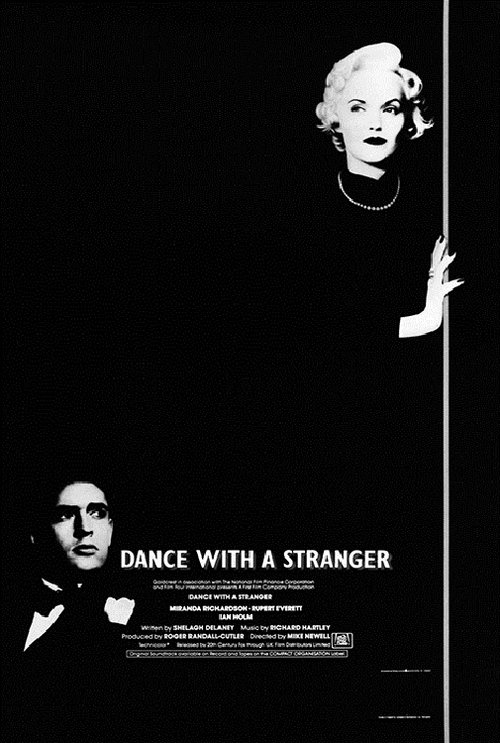
Ruth Ellis and David Blakely share a tumultuous romantic relationship that is central to the narrative of 'Dance with a Stranger.' Ruth, portrayed by Miranda Richardson, is a young woman who becomes infatuated with David, played by Rupert Everett. Their relationship is marked by passion and volatility, as David is charming yet irresponsible, leading Ruth to experience a mix of love, obsession, and despair. As the story unfolds, Ruth's emotional state deteriorates due to David's infidelity and lack of commitment, ultimately driving her to a tragic decision.
How does Ruth Ellis's character evolve throughout the film?
Ruth Ellis begins as a vibrant and hopeful young woman, seeking love and acceptance. As her relationship with David Blakely progresses, her character evolves into a more complex figure, grappling with feelings of betrayal and despair. The emotional highs of their romance are juxtaposed with the lows of David's infidelity and her increasing isolation. Ruth's transformation is marked by her descent into a state of desperation, culminating in her tragic actions that reflect her internal turmoil and longing for control over her life.
What role does the media play in Ruth Ellis's story?
The media plays a significant role in shaping public perception of Ruth Ellis throughout the film. As her relationship with David Blakely becomes more scandalous, the press sensationalizes their story, portraying Ruth as both a victim and a femme fatale. This media scrutiny amplifies Ruth's emotional struggles, as she grapples with her public image versus her private pain. The relentless coverage contributes to her sense of isolation and desperation, ultimately influencing the narrative surrounding her trial and execution.
What are the circumstances leading to Ruth Ellis's crime?
Ruth Ellis's crime is precipitated by a culmination of emotional distress and betrayal. After enduring David Blakely's repeated infidelities and emotional manipulation, Ruth reaches a breaking point. The film depicts a pivotal scene where, in a moment of rage and despair, she confronts David about his unfaithfulness. This confrontation escalates, leading Ruth to commit the act of murder. The circumstances surrounding her crime are steeped in her emotional turmoil, reflecting her feelings of abandonment and hopelessness.
How does the film portray the trial of Ruth Ellis?
The trial of Ruth Ellis is depicted with a focus on the sensationalism surrounding her case. The film illustrates the courtroom drama, highlighting the public's fascination with her story and the media's portrayal of her as both a tragic figure and a villain. Ruth's defense is complicated by her emotional state and the societal attitudes towards women at the time. The trial serves as a critical turning point in the narrative, showcasing the clash between Ruth's personal struggles and the legal system's response to her actions, ultimately leading to her tragic fate.
Is this family friendly?
"Dance with a Stranger," produced in 1985, is not considered family-friendly due to its mature themes and content. Here are some potentially objectionable or upsetting aspects that may occur for children or sensitive viewers:
-
Violence: The film includes scenes of violence, particularly related to the central crime, which may be distressing.
-
Substance Abuse: There are depictions of alcohol consumption and its effects on characters, which may be unsettling for some viewers.
-
Sexual Content: The film contains scenes that involve adult relationships and sexual situations, which may not be appropriate for younger audiences.
-
Emotional Turmoil: Characters experience significant emotional distress, including themes of betrayal, loneliness, and despair, which could be upsetting.
-
Crime and Legal Proceedings: The narrative revolves around a murder case, including police investigations and courtroom scenes that may be intense or disturbing.
These elements contribute to the film's overall tone and may not be suitable for children or sensitive viewers.









