














Popular
How do the relationships between the characters evolve throughout the film?
What role does the dance competition play in the characters' personal growth?
What challenges do the main characters face during the dance competition?
What are the key moments that highlight the characters' struggles with self-identity?
How do the characters' backgrounds influence their motivations for participating in the dance?
Should I watch it?
Ask Your Own Question

What is the plot?
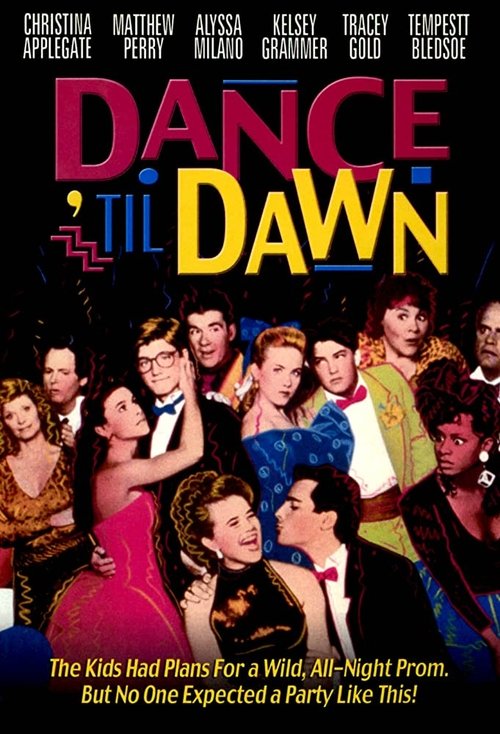
Dance 'Til Dawn opens on the day of the senior prom at Herbert Hoover High School, where the entire town seems to be acting as if one night will decide everyone's future. The school's social order is already fully charged: Patrice Johnson, the beautiful but bossy head of the prom committee, treats the event like her personal kingdom, and the prom itself is decorated as an image-conscious fantasy built to impress people who will likely never admit they are impressed. Around her orbit the usual teenage power structure is in motion, but beneath the glitter the night is already cracking apart. Shelley Sheridan, one of the school's most admired girls, is suddenly broken up with by her jock boyfriend Kevin McCrea just before the dance because she refuses to sleep with him. Kevin, who cares almost entirely about status and getting what he wants, immediately starts scrambling for a replacement date so he can preserve appearances and still salvage the night. Shelley, meanwhile, is left with the humiliating problem of being seen as prom-less, and she refuses to let anyone see how badly the breakup stings. Rather than go home and be pitied, she lies to her friends and says she has other plans, then sets out on her own in a way that looks carefree on the surface but is actually a desperate attempt to avoid public embarrassment.
The film begins to braid together a series of parallel journeys as the evening starts to unfold. Dan, the geeky, space-obsessed outsider, is introduced on his own path, already uninterested in prom in the conventional sense. He has a father waiting for him to fulfill the expected ritual, but Dan's real desire is to slip away from the social performance and spend the night where he actually wants to be. He buys a corsage badly and awkwardly, a small but telling sign that he is not built for the polished prom-machine everyone else worships. Instead of moving toward the dance floor, he heads toward the science fiction film festival, a place that fits his obsessions and gives him an excuse to escape the social pressure of Hoover High. In another thread, Angela, quiet and plain compared with the school's polished social elite, is about to be pulled into the night's central transformation. Her friend Margaret is more protective and skeptical than Angela herself, and Angela's parents, Ed and Ruth, are already set up as overbearing watchers who will spend the whole evening trying to control her choices. Their concern is not subtle; it is the kind of parental vigilance that turns a teenage night out into a surveillance operation. At the same time, Nancy and Larry are introduced as yet another couple in crisis, with their marriage hanging by a thread and the night giving them one more chance to patch things up or fall apart completely.
Shelley's first act of rebellion is not dramatic, but it is important: she refuses to play the role everyone expects from a girl who has just been dumped right before prom. She is not going to sit at home and cry into a phone. Instead, she drifts into the town cinema, where an old horror movie is playing and she hopes, for once, to be invisible. The theater is a refuge because it is the one place in town where nobody expects her to be glamorous, social, or partnered. It is also where the film quietly turns prom night into something more accidental and less scripted. Shelley is trying to avoid being seen as a loser, but her attempt to hide leads her directly into the path of Dan, who is there for exactly the same reason: he wants out of the prom script. The two of them are, in very different ways, running from the same social machine, and the movie uses that coincidence to build one of its central romantic reversals. Shelley is the "popular girl," Dan is the outsider, and the night will slowly strip away the labels that have defined them all year.
Back at school, Kevin pivots instantly from breakup to replacement. He does not mourn Shelley; he simply treats her absence as a logistical problem to be solved. Going on what one account describes as the dumb advice of a friend who thinks Angela is "easy," Kevin asks shy, nerdy Angela to go to prom with him. His interest is not sincere, and the film makes that clear very quickly. He is less interested in Angela as a person than as a route to sex, bragging rights, and a way to keep up the image of being the kind of guy who always gets what he wants. Angela, meanwhile, is flattered and vulnerable enough to be pulled into the situation, but she is not blind. Her friend Margaret senses the danger immediately and becomes one of the film's clearest voices of suspicion. The adults are also circling from the edges: Ed and Ruth, Angela's parents, refuse to trust the situation and begin shadowing her through the night, determined to monitor every move she makes. Jack, Dan's father, begins his own separate search, trying to figure out why his son has not gone to prom as expected. The effect is that every teenager is being watched by some adult, and every adult is either spying, arguing, or trying to repair a relationship of their own.
When Shelley and Dan cross paths, the film shifts from social panic to unexpected connection. Shelley is initially careful, because even in escape she cannot stop thinking about appearances, but Dan is different from the boys she is used to. He does not look at her as a trophy, and he does not seem impressed by her school status. He is awkward, funny in a dry way, and more interested in being honest than in acting cool. That honesty becomes the emotional center of the night. Shelley, who has spent so long being the girl everyone notices, starts to enjoy the relief of being seen without performance. Their time together moves away from school, away from the prom, and into a series of detours that feel like the natural consequence of two people trying not to be found. They drift from the theater to a science fiction movie marathon, then toward makeout point, and each move deepens the sense that they are building a private world out of shared avoidance. The irony is sharp: by trying not to be seen as prom rejects, they become the one couple whose connection feels real. Their scenes carry a gentle, slightly breathless quality, as if both of them know they are breaking from the script and are thrilled by it even while pretending otherwise.
That same night, Kevin tries to manufacture his own romantic outcome with Angela, and the results expose him more and more plainly. He takes Angela to prom, but his behavior immediately reveals that he is pursuing her for the wrong reasons. He treats her like a rumor he has decided to test, not a person he wants to know. Angela, shy but not naïve, is drawn into the evening's social electricity because Kevin's attention flatters her, but she is also given a growing sense of what is happening. Patrice, who is trying to run the prom like a flawlessly staged event, becomes another pressure point in the background. She wants glamour, control, and admiration, but the night keeps slipping out of her hands. The prom theme, the decorations, the self-importance of the committee, and Patrice's own certainty that everyone will orbit her vision all begin to look ridiculous as the evening turns messy. Kevin's attention to Angela, Patrice's obsession with control, and the adults' refusal to stop spying all collide into a single night of escalating confusion.
The prom itself is presented as a glittering but fragile centerpiece. Herbert Hoover High becomes a social stage where every glance, outfit, and pairing is judged in real time. The event matters so much to the students because the movie treats it as a rite of passage that supposedly shapes college futures, popularity, and adulthood. That exaggerated belief gives the night its comic pressure, but it also makes every small humiliation feel enormous. Shelley's absence from the dance floor is noticed. Kevin's replacement date is noticed. Patrice's authority as organizer is noticed. Angela's transformation begins to matter because prom is the one arena where the school's beauty hierarchy can be rewritten, if only briefly. Around all of this, the parents are busy creating their own absurd parallel drama, as if the children's inability to communicate has infected the adults too. Nancy and Larry's marriage crisis continues in the background, while Jack keeps hunting Dan, and Ed and Ruth keep following Angela with the anxious intensity of people who believe control is the same thing as love.
As the evening accelerates, the movie pushes its characters into increasingly humiliating and revealing situations. Kevin's pursuit of Angela becomes more aggressive, and the night stops being a game of social substitution and starts becoming a confrontation over boundaries. Shelley, away from the dance, finds in Dan not just a temporary escape but a real alternative to the life she has been expected to live. Dan's interest in science fiction and his natural outsider status make him the opposite of Kevin in every meaningful way. He is not trying to prove anything. Shelley, for her part, begins to enjoy being outside the status machine. Their attraction grows because neither of them is interested in the false promises that define the prom crowd. One account describes Dan solving their tension by kissing Shelley, and from that moment they more or less spend the rest of the night making out and choosing each other in defiance of everyone else's assumptions.
At the same time, Angela's storyline starts to pivot from discomfort into self-discovery. Kevin's motives are exposed by the way he pushes too hard and starts to see her less as a partner than as a prize. Margaret's distrust proves justified, and Angela's own confidence begins to sharpen as she realizes that being wanted by the wrong person is not the same as being valued. Patrice's control continues to crack; her plan for the perfect night is visibly failing, and her relationship with Roger becomes increasingly strained as he takes the blame for everything she does not like. Instead of functioning as a stable couple, Patrice and Roger turn into a procession of mutual frustration and public indignity. The film keeps dragging them through setbacks until they are stranded on the wrong side of town, a visual joke that also serves as a symbolic punishment for Patrice's obsession with appearances. By the time she is clutching a sad bouquet of balloons, her evening has become a monument to humiliation rather than triumph.
The after-party at Patrice's house is where the night's chaos becomes unavoidable. What should be the victory lap after prom instead turns into a continuation of the same social breakdown. The party is noisy, chaotic, and increasingly out of anyone's control. The teens spill into a private space that quickly stops feeling glamorous and starts feeling cramped, overheated, and emotionally dangerous. Kevin's behavior toward Angela grows more openly handsy, and the tension between them turns from flirtation into something that needs to be confronted. Angela's discomfort intensifies as she realizes that Kevin's interest has never been about her in any meaningful sense. Patrice, meanwhile, cannot maintain the illusion that her house represents order. The party becomes another humiliation, another proof that her social power is less real than she thought, and another sign that this night is unraveling every identity built on popularity and performance.
The parents' side of the story keeps cutting in and reinforcing the same theme from a different angle. Ed and Ruth's surveillance of Angela is not just comic overprotection; it is a visible expression of how frightened they are of losing control over their daughter's future. Jack's pursuit of Dan is similarly desperate, because he wants to understand why his son refuses the ritual that every other family seems to value. Nancy and Larry's marriage problem continues to mirror the teenagers' romantic instability, suggesting that nobody in this town really has the stability they pretend to have. Everyone is watching everyone else, and nobody is communicating directly. The result is a night built out of mistaken assumptions, half-truths, and mounting emotional pressure.
The biggest emotional turn arrives as Shelley and Dan continue their unexpected romance. Shelley no longer seems embarrassed by the fact that her prom plan collapsed; instead, she begins to inhabit the freedom of the night. Dan, who initially looked like the most isolated person in the film, turns out to be exactly the right companion for someone who no longer wants to be trapped by the expectations of Hoover High. Their relationship is not played as a joke at their expense. The film treats it as a real, tender shift in allegiance, as if both of them are discovering that what looked like failure is actually a better outcome than the one they were supposed to want. By choosing each other, they reject the entire logic of the night, and the more the rest of the prom spirals, the more grounded they seem.
Angela's arc reaches its peak when she stops being merely the target of Kevin's attention and becomes the person defining the terms of the evening. She is crowned prom queen, and that moment matters not because it validates the school's beauty standards, but because it gives her the confidence to move beyond them. The coronation becomes a symbolic reversal: the girl who was supposed to be shy and easily controlled is now the one with the power to reinterpret her future. This transformation is later tied directly to the morning-after revelations. The most important of these is the truth about her parents, who reveal that they had to get married because they conceived her while they were still high school students and high on drugs. That confession reframes Angela's whole understanding of family, shame, and obligation. It also gives her permission to choose a future different from the one her parents expect. Confident in the wake of prom, she decides she is going to art school in Italy rather than Bible college, a choice that crystallizes the movie's theme of self-definition.
The night's climax is less about a single explosive event than about a cascade of personal reckonings. Kevin's shallowness is finally undeniable, and he is left with nothing he wanted. According to one summary, he ends the night without sex, and when his friend makes a lewd comment implying that he and Angela "went all the way," Kevin slugs him in anger and defends Angela's honor. That moment is revealing because it shows that even Kevin, the night's most obvious manipulator, is forced into a morally clearer position by the end. He may have entered the evening as a status-obsessed creep, but he leaves it having learned something about consequence, shame, and public judgment. He does not become a better person in any grand sense, but he is forced to confront the ugliness of the version of himself that tried to use Angela as a shortcut to masculinity.
Patrice and Roger's relationship also reaches its endpoint. After enduring the indignities of the night, the couple finally splits for good. Roger breaks up with Patrice at the morning-after diner, and he leaves with the intention of becoming a fireman. Patrice's parents react as though the breakup is actually a relief, which underscores how little of Patrice's carefully staged social importance translates into genuine support at home. Her humiliation is not just romantic; it is familial and social, the full collapse of the identity she has spent the night trying to protect. The image of Patrice stranded and defeated, still clutching those sad balloons, lingers as one of the film's sharpest visual jokes. She has spent the night trying to control the room, and by the end she cannot even keep hold of the illusion that her relationship or her party meant what she thought it did.
Dan's own family storyline resolves in the final morning sequence as well. Jack, who has spent the night tracking him down, finally comes face-to-face with the truth of what Dan has been doing and why. At the diner or pancake house where everyone converges after the prom, Jack also presents Dan with the forgotten corsage, a small gesture that carries unexpected emotional weight. It is the object Dan fumbled earlier, now returned in a context where the emotional meaning of the night can finally be acknowledged. The corsage becomes a symbol of the whole movie: awkward at first, but meaningful once the chaos settles. Dan and Shelley's relationship is confirmed in the same space, and they decide to go steady, which shocks the surrounding seniors but makes perfect emotional sense to them. Their kiss at the end closes the film not as a punchline but as a quiet affirmation that genuine connection has emerged from the wreckage of the prom.
The morning-after diner scene is where every remaining thread is tied together in rapid, blunt conversation. Hudson's, or Hud's, becomes the communal clearinghouse for the night's wreckage, the place where secrets are spoken out loud because there is nowhere left to hide them. Angela arrives with the confidence earned by the previous night's transformation, and the truth about her parents comes out in plain language. Her parents' story is embarrassing, messy, and human, and once she hears it she is able to detach her future from their assumptions. She announces that she is going to art school in Italy rather than Bible college, turning revelation into self-direction. Margaret stands with her as part friend and part witness to this new identity. The adults, who spent the whole night spying and controlling, are finally forced into the open, and the absurdity of their secrecy is laid bare. Nancy and Larry's marriage crisis also remains part of the background mood, reinforcing the sense that the night has not created these problems so much as exposed them.
The film ends by letting these revelations settle into a final image of youthful reordering. Shelly and Dan are no longer the people who began the night; they are a couple now, and their relationship is framed as the most honest thing to emerge from the chaos. Kevin, stripped of his illusions, is left angry but corrected. Angela, no longer controlled by her parents' narrative, steps into an adult future of her own choosing. Patrice, whose control over the prom never translated into control over her own life, is left with the humiliating fragments of a night she wanted to perfect. The adults, meanwhile, are exposed as flawed, needy, and just as directionless as the teenagers they spend the night chasing. The movie's final emotional logic is simple: the polished romantic scripts fail, the awkward truth survives, and the people who stop performing are the ones who actually move forward.








What is the ending?
In the ending of "Dance 'Til Dawn," the characters come together at the prom, where their individual journeys culminate in a night of celebration, self-discovery, and resolution. Each character faces their fears and insecurities, leading to moments of connection and growth. The film concludes with a sense of hope and the promise of new beginnings as the characters dance into the night.
As the prom night unfolds, the atmosphere is electric with excitement and anticipation. The gymnasium is adorned with shimmering decorations, and the music pulses through the air, setting the stage for a night that will be remembered.
Scene by scene, the characters arrive at the prom, each carrying their own emotional baggage. We see Lisa, who has struggled with her self-image, stepping into the venue with newfound confidence. She is dressed beautifully, and her transformation is evident as she smiles, ready to embrace the night. Her friends rally around her, providing support and encouragement, which reinforces her sense of belonging.
Meanwhile, we shift to the character of Brad, who has been grappling with the pressure of fitting in and living up to expectations. As he enters the prom, he feels a mix of anxiety and excitement. He spots Lisa and is struck by her beauty, realizing that he has feelings for her that go beyond friendship. This moment of clarity pushes him to confront his own fears and take a chance on love.
In another corner of the gym, we find the quirky character of Daryl, who has always been the odd one out. He arrives with a unique dance routine in mind, determined to showcase his individuality. As he begins to dance, he draws attention and admiration from his peers, which boosts his confidence. This moment signifies a turning point for Daryl, as he learns to embrace who he is rather than conforming to others' expectations.
As the night progresses, the characters engage in various interactions that highlight their growth. Lisa and Brad share a dance, and their chemistry is palpable. They talk about their dreams and fears, revealing their vulnerabilities. This heartfelt exchange deepens their connection, and they share a tender kiss, marking the beginning of a romantic relationship.
Simultaneously, Daryl's performance becomes a highlight of the evening, and he is celebrated for his unique style. The crowd cheers him on, and he basks in the acceptance he has longed for. This moment serves as a reminder that being true to oneself can lead to unexpected joy and recognition.
As the prom draws to a close, the characters gather for the final dance. The music swells, and the lights dim, creating an intimate atmosphere. Each character reflects on their journey, feeling a sense of accomplishment and belonging. They realize that the challenges they faced have only made them stronger and more connected to one another.
In the final moments, the camera pans over the joyful faces of the characters as they dance together, united in their experiences. The film ends on a hopeful note, suggesting that while the night may be ending, their friendships and newfound relationships will continue to flourish beyond the prom.
In summary, the fates of the main characters are intertwined with their personal growth. Lisa and Brad embark on a romantic relationship, Daryl finds acceptance and confidence, and all the characters leave the prom with a sense of belonging and hope for the future. The ending encapsulates the themes of self-discovery, friendship, and the importance of embracing one's true self.
Is there a post-credit scene?
"Dance 'Til Dawn," produced in 1988, does not have a post-credit scene. The film concludes without any additional scenes or content after the credits roll. The story wraps up with the characters reflecting on their experiences and the events of the night, focusing on the themes of friendship, love, and the challenges of adolescence. The ending emphasizes the emotional growth of the characters as they navigate their relationships and the pressures of high school life.
How do the relationships between the characters evolve throughout the film?
Throughout the film, the relationships between the characters evolve significantly. Initially, some characters are at odds due to jealousy or misunderstandings, but as they work together for the dance competition, they learn to communicate better and support one another. Romantic interests develop, and friendships are tested, ultimately leading to stronger bonds by the end.
What role does the dance competition play in the characters' personal growth?
The dance competition serves as a catalyst for personal growth among the characters. It pushes them out of their comfort zones, forcing them to confront their fears and insecurities. As they prepare and perform, they gain confidence, learn the value of teamwork, and discover their true selves, which is pivotal for their development.
What challenges do the main characters face during the dance competition?
The main characters, particularly the high school students, face various challenges during the dance competition, including personal insecurities, romantic tensions, and the pressure to perform well. Each character grapples with their own fears and aspirations, leading to moments of doubt and conflict as they prepare for the big event.
What are the key moments that highlight the characters' struggles with self-identity?
Key moments that highlight the characters' struggles with self-identity include scenes where they express their doubts about fitting in or being good enough for the competition. For instance, one character may have a breakdown before the performance, revealing their fear of failure, while another might have a moment of clarity during practice, realizing their passion for dance and their desire to be true to themselves.
How do the characters' backgrounds influence their motivations for participating in the dance?
The characters' backgrounds significantly influence their motivations for participating in the dance. Some come from supportive families that encourage their artistic pursuits, while others face pressure to succeed from parents or peers. These differing backgrounds shape their attitudes towards the competition, with some viewing it as a chance to prove themselves, while others see it as an opportunity for self-expression and connection.
Is this family friendly?
"Dance 'Til Dawn," produced in 1988, is generally considered a family-friendly film, but it does contain some elements that may be objectionable or upsetting for children or sensitive viewers. Here are a few aspects to consider:
-
Teenage Relationships: The film explores themes of teenage romance and relationships, which may include some awkward or uncomfortable moments that could be challenging for younger viewers to understand.
-
Social Pressures: Characters face social pressures related to popularity, acceptance, and fitting in, which may resonate with some viewers but could also evoke feelings of anxiety or discomfort.
-
Mild Language: There are instances of mild language that may not be suitable for very young children.
-
Emotional Turmoil: Some characters experience emotional struggles, such as feelings of rejection or insecurity, which could be upsetting for sensitive viewers.
-
Dance Competition Stakes: The competitive nature of the dance event may create tension and anxiety among characters, which could be intense for some viewers.
Overall, while the film is lighthearted and focuses on dance and friendship, these elements may require parental guidance for younger audiences.








