




























Loading additional questions...
Popular
What is the main character's name and what is his initial situation at the college?
How does Dave's life change when he discovers the 'big man' on campus?
What challenges does Dave face in trying to help the caveman fit in at the college?
How do Dave's relationships with his friends evolve throughout the film?
What role does the college's social hierarchy play in the story, particularly regarding the treatment of the caveman?
Should I watch it?
Ask Your Own Question

What is the plot?
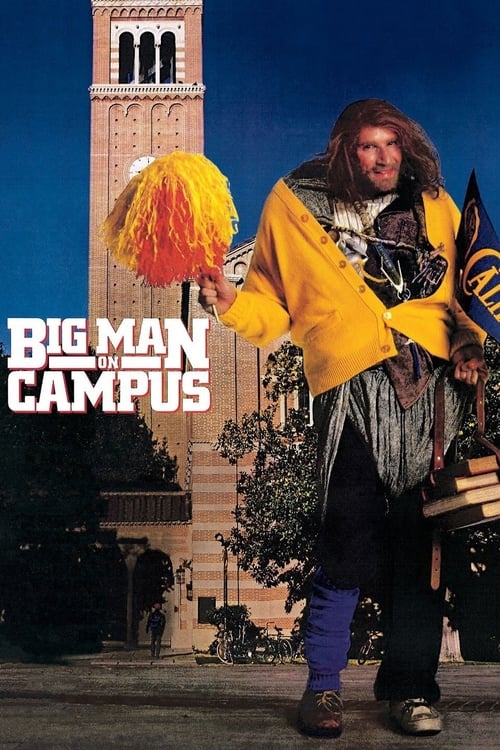
A news broadcast opens the film by reporting an apparent sighting of a "mysterious creature" on the UCLA campus, turning the whole university into the stage for a campus legend before anyone has actually seen the truth. When reporters interview Alex Kominski and his girlfriend Cathy Adams, both of them brush off the rumor and act as if they do not believe in any monster at all, but the film immediately undercuts that denial by showing the real figure watching from the bell tower with a telescope, silently tracking Cathy from above. From the first moments, the story sets up the central irony: everyone on campus thinks this is an urban myth, while the audience knows the "creature" is real, lonely, and obsessively attached to the life below him.
That hidden watcher is Bob Maloogaloogaloogaloogalooga, a hunchbacked, secluded man who has been living for years in the abandoned tower above UCLA, surrounded by old furniture, hoarded objects, and the shabby clutter of a self-made nest. He survives on vending-machine candy bars, stares down at the campus through his telescope, and remains cut off from ordinary human contact except for the remote, desperate kind of connection created by watching other people from afar. The film makes his fascination with Cathy Adams clear early: she is the sweet, pretty student he has fixated on, and his gaze toward her is not presented as sinister in a monstrous sense so much as painfully lonely, awkward, and unsure of how else to reach the world. At the same time, Alex Kominski is introduced as Cathy's boyfriend, a college underachiever who is on the edge of failing out, which makes him both a comic foil and, eventually, the most important human bridge between Bob and society.
The film moves quickly from rumor to public crisis at a renaissance-themed carnival on campus, where Alex gets into a scuffle after insulting another student's girlfriend. Cathy steps in to intervene, and that moment becomes the turning point of the whole story, because Bob sees her in danger and makes his first dramatic move into the open. In one burst of panic and misplaced heroism, he swings down on a rope to rescue her, but the rescue is as clumsy as it is revealing: he misses his mark, crashes into bystanders, runs wildly through the crowd, and throws the carnival into chaos. The sequence is the first major confrontation in the film, and it does several things at once: it proves the legend is true, exposes Bob to public view, and transforms him in the eyes of the crowd from a whispered rumor into a visible threat.
That public disturbance brings the authorities down on him immediately, and campus security captures him after the chase. The capture is a crucial twist, because it strips away the mystery of the tower creature and reveals the truth beneath the legend: Bob is not a supernatural monster but a frightened, physically misshapen, socially isolated man who has been hidden away for years. This revelation changes the moral center of the movie. The story stops being about whether the creature exists and becomes a battle over what kind of person Bob is allowed to be in other people's eyes. Some characters see him as a curiosity, some as a hazard, and some as someone who can be helped, but the film consistently pushes against the idea that he is merely an object to be contained.
Once Bob is in custody, the university's psychological machinery takes over. Dr. Webster, the psychology professor, sees Bob as an extraordinary opportunity to study a previously isolated human being and arranges for Alex Kominski to serve as his round-the-clock caretaker. The arrangement is not presented as a free choice in any normal sense: Alex is on the verge of flunking out, and Dr. Webster dangles a B average as the price of compliance, making the deal impossible for Alex to refuse. Alex agrees to move in with Bob, supervise him, and help civilize him, and the movie turns from campus farce into a weird domestic comedy built around forced cohabitation, resentment, and gradual understanding. This is also where the title's irony becomes funniest: Alex, the supposedly normal student, is suddenly the one stuck babysitting the "monster," while the monster turns out to be the more vulnerable of the two.
Bob is given a fuller identity through the absurdly elongated name Bob Maloogaloogaloogaloogalooga, a comic mouthful that becomes part nickname, part joke, and part marker of how far removed he is from ordinary social life. The film leans into that ridiculousness, but it also uses it to emphasize Bob's instability in the human world: even his name feels cobbled together, improvised, and half-owning, half-imposed. As Alex and the psychologists try to classify him, Bob is moved into the system as a subject to be studied, tested, and managed. The result is a series of behavioral experiments and therapy sessions that make the film feel like a comedy built on rehabilitation, but with a darker edge underneath: every attempt to educate Bob is also an attempt to control him.
That conflict becomes sharper when Dr. Diane Girard, the speech therapist, enters the story and begins working with Bob on communication and social adaptation. Her sessions are important not only because they teach Bob language, but because they show how much he wants to connect once someone gives him a way to do it. The film repeatedly frames these efforts with physical comedy and awkward setbacks, yet each small improvement matters, because every word Bob manages to speak proves he is not the inhuman creature people have imagined. The therapy scenes gradually soften him, and they also make him more emotionally legible, especially as his attachment to Cathy and his dependence on Alex become clearer.
At the same time, the film introduces its institutional antagonist: Dr. Victoria Fisk. Fisk openly declares that Bob is a danger to society and argues that he should be institutionalized rather than rehabilitated. She is not just skeptical; she is actively invested in proving her diagnosis correct, and the plot gives her a distinctly manipulative edge as she resorts to underhanded methods to support her position and protect her professional reputation. Her conflict with Dr. Girard is ideological, but it is also personal and political. Fisk stands for fear, control, and the preservation of authority through labels; Girard stands for patience, empathy, and the possibility that Bob can actually be brought into ordinary human life. The courtroom and institutional settings make that conflict public, turning Bob into a test case not just of psychology but of moral judgment.
One of the film's key revelations comes in a therapy session with Dr. Webster, when Bob speaks about his past and discloses that his father left when Bob was an infant. That detail changes the emotional frame of the entire story. Bob's isolation is no longer just a strange quirk or an eccentric backstory; it becomes the result of abandonment so early and so deep that the tower seems less like a hideout than a shelter built out of trauma. The revelation helps explain why he has spent so much time watching from a distance instead of joining the world, and why Cathy's gentleness and Alex's reluctant companionship matter so much once they begin to reach him. The movie does not stop there, but this is the point where Bob's "monster" identity starts to dissolve most clearly into a human history of loss.
As Bob lives with Alex, the two men form a tense and often comic household. Alex is supposed to be Bob's responsible caretaker, but he is also a resentful boyfriend forced into a bizarre arrangement that constantly puts him between Bob and Cathy. Bob's uncivilized habits, his strange behavior, and his intense fascination with Cathy all create friction, but the film keeps underlining that Alex is not dealing with a brute or a villain; he is dealing with someone who has never been taught how to belong anywhere. That domestic dynamic gives the movie much of its momentum. Small confrontations over space, manners, and trust become part of a larger emotional process in which Bob is slowly exposed to ordinary life and Alex is slowly forced to see him as more than a problem.
Meanwhile, Dr. Fisk's campaign against Bob escalates into public and institutional pressure. In court, she paints him as a menace, and her testimony attempts to harden the authorities around the idea that he cannot be safely integrated into society. The court sequence underscores the film's central tension: Bob is being judged before the world has really given him a chance, and the entire legal-medical apparatus is already leaning toward confinement. The movie's title may be a joke, but the stakes are serious within the story's own logic, because Bob's freedom and humanity are both on trial. Fisk's maneuvers make the danger of the situation more than theoretical, since her willingness to manipulate evidence suggests she would rather be proven right than be fair.
There is also a romantic and emotional countercurrent running through the whole film, because Bob's attachment to Cathy is not just the motivation for his initial rescue attempt; it is also what gradually makes him visible as a feeling person. Cathy is not presented as a passive object of desire, but as someone kind enough to intervene when things go wrong and compassionate enough to be part of the effort to help Bob. Her presence in the story is essential, because she is the person Bob has watched from afar and the person whose danger prompts his first public act. Her closeness makes the film's emotional arc possible: Bob begins as an unseen watcher and ends as someone other characters can no longer dismiss as a myth or a joke.
As the testing and therapy continue, the movie moves toward its climax by making the central question not whether Bob can be caught or studied, but whether he can be understood before Fisk's version of him wins out. The tension comes from the contrast between two stories being told about Bob at once. One story says he is a dangerous aberration who belongs behind walls. The other says he is a frightened, damaged man who has finally been given a chance at language, routine, and human contact. Each test, each therapy scene, and each interaction with Alex adds weight to the second story, while Fisk keeps trying to drag everything back toward the first.
The film does not give a single grand tragic death or blood-soaked reckoning, and that matters because the stakes are carried almost entirely by humiliation, capture, and institutional control rather than by body count. There are no confirmed deaths in the plot information provided, and the tension comes from whether Bob is going to be lost to the system, not killed by it. The "violence" of the movie is social and psychological: Bob is chased, labeled, trapped, studied, and fought over by people who claim authority over his life. In that sense, the most important confrontations are not physical duels but clashes over his identity.
By the final stretch, Bob's gradual progress in speech and social behavior becomes impossible for the more humane characters to ignore. He is no longer merely the clock-tower rumor, nor simply the object of scientific curiosity. He has become a person who can be taught, who can care, and who can respond to the people around him. Dr. Girard's work helps prove that; Alex's reluctant caretaking helps prove that; even the audience, watching Bob's clumsy attempts to function within ordinary routines, is pushed to recognize that his strangeness is not the same thing as monstrosity. The movie's emotional momentum comes from this transformation: the tower legend slowly collapses into a human story of abandonment, learning, and partial acceptance.
In the end, the film resolves by completing Bob's movement from isolated creature to recognized human being. The bell tower no longer defines him absolutely, and the people around him no longer see only the grotesque image that the rumor mill created. The final phase of the story confirms that the real conflict was never between humans and a monster, but between fear and recognition. Dr. Fisk's attempt to cast Bob as irredeemably dangerous is undercut by everything the audience has seen of his vulnerability and growth, while Dr. Girard's humane approach and Alex's reluctant companionship create the conditions for Bob to be understood as more than a campus legend. The closing movement leaves Bob with a place in the human community that he did not have at the start, and the film ends with the idea that the monster on campus was always a frightened man waiting to be seen, not destroyed.
If you want, I can also turn this into a fully scene-by-scene chronological synopsis with tighter emphasis on the courtroom, therapy, and ending beats.









What is the ending?
In the ending of "Big Man on Campus," the main character, a college student named Dave, is revealed to be a misunderstood creature, a "bigfoot" who has been living on campus. After a series of comedic and heartfelt events, he finds acceptance among his peers. The film concludes with Dave being celebrated rather than shunned, as he embraces his identity and the friendships he has formed.
Now, let's delve into the ending in a more detailed narrative fashion:
As the climax of the film approaches, Dave, the bigfoot, is cornered by a group of students who initially sought to expose him. Tension fills the air as they confront him in the woods behind the campus. The students, led by the skeptical and ambitious character, Roger, are armed with cameras and flashlights, ready to capture the elusive creature. Dave, feeling vulnerable and misunderstood, stands his ground, his shaggy fur glistening under the moonlight, revealing his gentle nature.
In a pivotal moment, Dave's friend, a kind-hearted student named Lisa, steps forward. She passionately defends him, recounting the moments they shared, emphasizing his kindness and the way he has helped others. Her words resonate with the crowd, shifting the atmosphere from one of fear to curiosity. The students begin to see Dave not as a monster, but as a fellow being deserving of respect and friendship.
As the scene unfolds, Roger, still skeptical, attempts to provoke Dave, but the creature remains calm, showcasing his emotional depth. The tension breaks when a younger student, inspired by Lisa's bravery, steps forward to express his admiration for Dave. This act of courage sparks a wave of support from the other students, who begin to rally around Dave, chanting his name.
In the final moments, the campus community comes together to celebrate Dave. A makeshift party is organized, where students and faculty alike embrace him, dancing and laughing under the stars. The atmosphere is filled with joy and acceptance, symbolizing a newfound understanding of differences. Dave, once an outcast, is now the center of attention, his heart swelling with happiness as he realizes he has found a place where he belongs.
The film concludes with a montage of scenes showing Dave integrating into campus life. He attends classes, participates in sports, and even becomes a beloved mascot for the university. The final shot captures Dave, surrounded by friends, smiling broadly as he embraces his identity, a testament to the power of acceptance and friendship.
As the credits roll, viewers are left with a sense of warmth, having witnessed Dave's transformation from a misunderstood creature to a cherished member of the community. Each character, from Lisa's unwavering support to Roger's eventual acceptance, illustrates the film's message about the importance of understanding and embracing differences.
Is there a post-credit scene?
What is the main character's name and what is his initial situation at the college?
The main character's name is Dave, and he is a college student who feels out of place and struggles with his social life. He is often overlooked and underestimated by his peers.
How does Dave's life change when he discovers the 'big man' on campus?
Dave's life changes dramatically when he discovers a 'big man' on campus, a creature that turns out to be a real-life caveman. This discovery leads to a series of comedic and transformative events as Dave tries to integrate the caveman into college life.
What challenges does Dave face in trying to help the caveman fit in at the college?
Dave faces numerous challenges, including the skepticism of his friends and the college administration, as well as the caveman's primitive behavior that often leads to misunderstandings and chaos on campus.
How do Dave's relationships with his friends evolve throughout the film?
Throughout the film, Dave's relationships with his friends evolve as they initially mock his efforts to help the caveman, but eventually, they come to support him and learn valuable lessons about acceptance and friendship.
What role does the college's social hierarchy play in the story, particularly regarding the treatment of the caveman?
The college's social hierarchy plays a significant role in the story, as the caveman is initially treated as an outsider and a spectacle. This reflects the broader themes of acceptance and the struggle against social norms, as Dave fights to defend the caveman's right to belong.








