
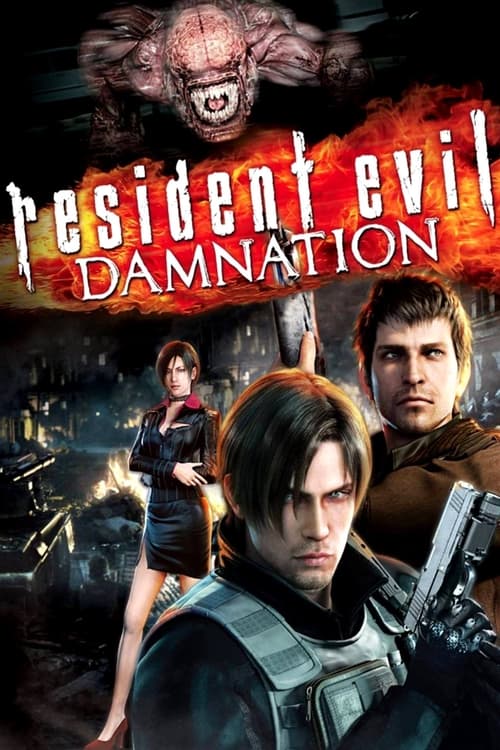












Popular
What role does Leon S. Kennedy play in Resident Evil: Damnation?
How does the character of Ada Wong influence the plot?
What is the significance of the bio-organic weapons in the story?
Who are the main antagonists in Resident Evil: Damnation?
What is the relationship between Leon and the character of the President?
Should I watch it?
Ask Your Own Question

What is the plot?
Sorry, we aren't able to watch and write up a full detailed plot yet. Check back in a few days.









What is the ending?
In the ending of Resident Evil: Damnation, Leon S. Kennedy confronts the true nature of the bio-organic weapon (BOW) crisis in Eastern Europe. After a fierce battle against the mutated creatures and the forces of the antagonist, the President's secret weapon, Leon manages to stop the chaos. However, the film concludes with a sense of unresolved tension as the threat of bioweapons looms large, and Leon reflects on the ongoing struggle against such horrors.
As the climax of Resident Evil: Damnation unfolds, Leon S. Kennedy finds himself in a desolate, war-torn city, the remnants of a fierce battle echoing around him. The air is thick with smoke and the stench of decay, remnants of the bio-organic weapons unleashed upon the populace. Leon, driven by a sense of duty and a desire to protect the innocent, pushes forward, determined to confront the source of the chaos.
In a dimly lit underground facility, Leon encounters the monstrous creature known as the "Licker," a grotesque manifestation of the T-Virus. The creature lunges at him, its long tongue flicking out menacingly. Leon, fueled by adrenaline, engages in a tense battle, narrowly dodging its attacks. The fight is brutal, showcasing Leon's agility and combat skills as he uses his firearms to fend off the creature. The scene is visceral, with the sound of gunfire echoing through the concrete halls, punctuated by the creature's guttural growls.
After defeating the Licker, Leon discovers the truth behind the bio-organic weapons program. He learns that the conflict in the region is being manipulated by the government, which is using the chaos to test and deploy these weapons. This revelation weighs heavily on Leon, who grapples with the moral implications of his mission. He is not just fighting monsters; he is confronting the darker side of humanity itself.
Meanwhile, Ada Wong, who has her own agenda, is also navigating the treacherous landscape. Her motivations are shrouded in mystery, but it is clear that she is not entirely aligned with Leon. As the two cross paths, there is a palpable tension between them, a mix of attraction and distrust. Ada's enigmatic nature adds complexity to the narrative, as she reveals snippets of information that hint at her deeper involvement in the bioweapons trade.
As the story progresses, Leon and Ada find themselves facing off against the film's primary antagonist, the President's secret weapon, who has been transformed into a monstrous entity. The confrontation is intense, with both characters showcasing their skills and determination. Leon's resolve to end the threat is evident as he fights not just for survival, but for the lives of countless innocents caught in the crossfire.
In the final moments, Leon manages to disable the weapon, but not without significant cost. The facility begins to collapse around them, a metaphor for the crumbling world they inhabit. As they escape, Leon is left with a heavy heart, knowing that while he has stopped this particular threat, the war against bioweapons is far from over.
The film concludes with Leon standing amidst the ruins, reflecting on the ongoing struggle against the horrors of bioweapons. He understands that the fight is not just against the monsters created by science, but also against the moral decay that allows such horrors to exist. The screen fades to black, leaving viewers with a sense of unease and the knowledge that the battle is far from finished.
In the aftermath, Leon's fate is one of continued vigilance. He remains a soldier in a world plagued by bioweapons, committed to fighting against the darkness. Ada, on the other hand, slips away into the shadows, her true intentions still unclear, leaving a lingering question about her allegiance. The film closes with the haunting reminder that the threat of bioweapons looms large, and the fight for humanity's survival is an ongoing battle.
Is there a post-credit scene?
In "Resident Evil: Damnation," there is indeed a post-credit scene that adds an intriguing layer to the narrative. After the credits roll, the scene opens in a dimly lit laboratory, where a figure is seen working on a project. The camera pans to reveal a series of test tubes and vials, hinting at ongoing experiments related to bio-organic weapons.
As the scene unfolds, the figure is revealed to be a scientist, who is analyzing a sample that appears to be linked to the events of the film. The atmosphere is tense, filled with a sense of foreboding as the scientist expresses concern over the implications of their work. The dialogue suggests that the experiments are far from over, and there are still threats lurking in the shadows.
The scene concludes with a close-up of a vial containing a mysterious substance, which glows ominously, leaving viewers with a chilling sense of anticipation for future developments in the Resident Evil universe. This moment reinforces the ongoing struggle against bioweapons and the moral dilemmas faced by those involved in such research, setting the stage for potential future conflicts.
What role does Leon S. Kennedy play in Resident Evil: Damnation?
Leon S. Kennedy is the protagonist of Resident Evil: Damnation. He is a government agent sent to investigate the use of bio-organic weapons in Eastern Europe. Throughout the film, Leon grapples with the moral implications of bioweapons and the impact of his mission on innocent lives. His determination to uncover the truth drives him to confront various enemies, including the powerful bio-organic weapon known as the Lickers.
How does the character of Ada Wong influence the plot?
Ada Wong plays a crucial role in Resident Evil: Damnation as a mysterious operative with her own agenda. She initially appears to assist Leon but has her own motives tied to the bio-organic weapons. Her interactions with Leon are charged with tension and ambiguity, as she often blurs the line between ally and adversary. Ada's presence complicates Leon's mission, as he must navigate his feelings for her while trying to stop the chaos caused by the bioweapons.
What is the significance of the bio-organic weapons in the story?
The bio-organic weapons, particularly the Lickers and the new creature known as the 'Ustanak,' serve as central antagonists in Resident Evil: Damnation. They represent the horrors of bioweapons and the ethical dilemmas surrounding their use in warfare. The film explores how these weapons are manipulated by various factions, including the government and rebel forces, highlighting the devastating consequences of their deployment on both soldiers and civilians.
Who are the main antagonists in Resident Evil: Damnation?
The main antagonists in Resident Evil: Damnation include the corrupt government officials who are using bio-organic weapons for their own gain, and the rebel leader, who seeks to use these weapons to fight against oppression. The character of Dr. Alexander Isaacs also plays a significant role as a scientist involved in the creation of the bioweapons, showcasing the moral decay and ambition that drives the conflict.
What is the relationship between Leon and the character of the President?
In Resident Evil: Damnation, Leon S. Kennedy has a complex relationship with the President of the United States, who is depicted as being unaware of the full extent of the bioweapons program. Leon's loyalty to the President is tested as he uncovers the truth about the government's involvement in the creation and deployment of bio-organic weapons. This relationship highlights Leon's internal struggle between duty to his country and the moral implications of his mission.
Is this family friendly?
"Resident Evil: Damnation" is not considered family-friendly due to its intense themes and graphic content. Here are some potentially objectionable or upsetting aspects that may affect children or sensitive viewers:
-
Violence and Gore: The film features numerous scenes of intense violence, including gunfights, hand-to-hand combat, and the use of various weapons. There are graphic depictions of injuries and bloodshed.
-
Monsters and Mutations: The presence of grotesque creatures and mutated beings can be frightening. These monsters often exhibit disturbing physical features and violent behavior.
-
Death and Destruction: The narrative includes scenes of death, destruction, and the aftermath of battles, which may be distressing for younger audiences.
-
Mature Themes: The film explores themes of war, bio-terrorism, and moral ambiguity, which may be complex and unsettling for children.
-
Tension and Suspense: The overall atmosphere is filled with tension and suspense, which can be anxiety-inducing for sensitive viewers.
These elements contribute to a mature rating, making the film more suitable for adult audiences.








