





Popular
Who are the main characters and what are their motivations?
What role does the character of the psychic play in the story?
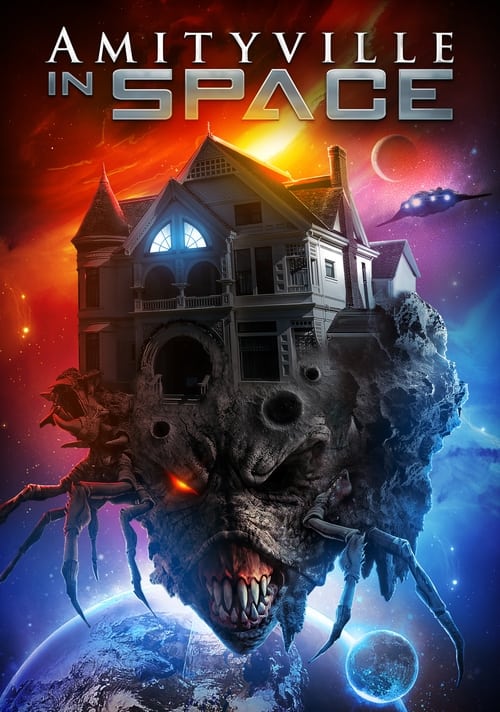
What is the significance of the Amityville house in the context of the space setting?
How does the supernatural element manifest in the space station?
How do the characters react to the escalating horror they face?
Should I watch it?
Ask Your Own Question

What is the plot?
Father Benna begins the story in 1974 at 112 Ocean Avenue in Amityville, standing before the infamous house in the snow and warning a cluster of reporters to get away before he starts the exorcism. He comes to the cursed place with the conviction that he can purge its evil once and for all, but the house is already too far gone, too saturated with malignant force to be cleansed like a normal dwelling. As he enters, the atmosphere turns heavy and unstable, and the ritual immediately goes wrong. Instead of driving the demon out of the house, Father Benna's prayer twists into something far more absurd and catastrophic: he exorcises the entire house itself. The structure tears free from Earth, ripped from 112 Ocean Avenue and flung into outer space, taking Father Benna with it. The doomed priest does not save Amityville; he becomes its first prisoner among the stars.
Centuries pass, and the film jumps ahead to the year 3015. Deep in space, the cruiser Wyoming 227 travels through the blackness on a mission to seek out and destroy rogue black holes. The ship is commanded by Captain Halstead, a cocky, flirtatious officer who talks like someone used to being in control until the universe decides to laugh at him. His superior, Madam Tyse, orders the mission forward, and the crew--each of them filling a standard pulp-science-fiction role with deadpan seriousness--press on toward the anomaly. Dr. Nurmi serves as the ship's medic, Jacowitz handles weapons, Maitland pilots, and the android Vox patrols the ship with a cold, mechanical calm. The crew is already a little uneasy when they detect an impossible sight near the black hole: a familiar house, intact and floating in space like a lost relic from a nightmare they cannot name. They do not yet understand that this is 112 Ocean Avenue, still carrying the same evil that has been festering inside it for hundreds of years.
The discovery hits the crew like a cosmic joke they are not equipped to understand. A house is not supposed to exist in space, let alone drift beside a black hole, and the ship's people treat the thing with a mixture of disbelief and curiosity. Their mission was supposed to be scientific and controlled, but the anomaly pulls them toward the kind of supernatural danger that no amount of future technology can explain. Captain Halstead orders closer investigation, and the crew starts debating what the structure even is. Because the word "house" seems almost quaint in the year 3015, they half-imagine it as an alien ruin, a derelict vessel, or some bizarre dimensional artifact. The horror of it is that they are wrong in a much simpler and much worse way: it is exactly what it looks like, the Amityville house, only now the curse has had centuries to mature in the void.
When the crew finally makes contact, the evil inside the house begins to stir. Father Benna, still trapped in the nightmare he accidentally created, eventually becomes part of the larger confrontation, and the ship's personnel realize that the priest is not merely a witness but the original source of the house's exile into space. The crew is wary of him, especially once it becomes clear that his failed ritual did not end the curse but displaced it. The house itself remains active, alive in a malignant way, as if it has become a habitat for something far more ancient and malevolent than architecture. The film then shifts into a strange blend of haunted-house mechanics and space-mission paranoia: the crew is attacked not by laser fire or alien invaders but by visions, nightmares, whispers, and manifestations that attack their nerves and sanity.
The central evil eventually reveals itself as Legion, the true manifestation of the curse that has been inhabiting the house and infecting the people around it. Legion is not just a ghost or a demon in a conventional sense; it is the name given to the force that uses the house as its vessel and the crew as fresh prey. Once Legion emerges, the story becomes less about whether the house can be destroyed and more about whether the people trapped in this absurd cosmic setting can resist being turned against one another. The evil works through deception, fear, and dreamlike manipulation. Crew members begin to doubt what they see. Hallways feel longer than they should. Shadows seem to move at the edge of the frame. Each person starts to suspect that the danger is not outside in the void but already inside the ship.
The film's tension builds through these layered confrontations. Captain Halstead tries to keep order, but the more he pushes toward rationality, the more the situation slips from him. Dr. Nurmi attempts to treat the afflicted as if their suffering can still be managed medically, but the problem is spiritual and psychological in a way that resists procedure. Jacowitz approaches the threat like something that can be shot into pieces, while Maitland remains caught between fear and duty, trying to keep the ship functioning as the nightmare deepens. Vox, the android, is sent separately to the house, and his mission becomes one of the film's strangest turning points. The crew treats him as the only one who might be able to survive direct contact with the anomaly, but what he finds does not resolve the threat. Instead, the mission only proves that destroying the physical house does not end the curse because the evil is already mobile, already adaptive, already alive in another form.
As Legion's influence spreads, the ship becomes a claustrophobic battleground where every corridor feels contaminated. The crew members are forced to confront the possibility that the house is not merely a location but a conceptual trap, a "domicile" in the most literal and absurd sense. The film leans into the idea that even in the future, even in the vastness of space, the old rules of horror still apply: a cursed home remains cursed no matter where it floats. That realization gives the story a bitter comic edge, but it also sharpens the dread. There is nowhere to escape. The black hole sits nearby like a cosmic mouth, and the house drifts beside it like bait.
The deaths begin piling up as the supernatural force tightens its grip, and the film's later action is a sequence of violent shocks and grotesque payoffs. The available material does not fully preserve a clean, scene-by-scene naming of every victim, but it does confirm that the film includes deaths by shotgun, strangulation, impalement, electrocution, drug overdose, explosion, and car crash. Those killings are part of the movie's gleefully chaotic escalation, and each one reinforces the sense that Legion is not merely haunting the crew but consuming it in increasingly absurd forms. The violence is not elegant. It is messy, blunt, and often so over-the-top that it feels designed to turn the horror into a feverish grindhouse spectacle. The result is that the crew's internal trust collapses as bodies start dropping and the surviving characters are left to interpret each new death as proof that the curse has fully invaded the ship.
One of the film's key revelations is that the crew's scientific mission has become irrelevant. They came to study and destroy black holes, but the black hole is only the backdrop for an older evil that refuses to stay buried, or in this case refuses to stay grounded. The house, once exorcised from 112 Ocean Avenue, has become something like a cursed satellite, circling emptiness while feeding on the fear of anyone who comes near it. The giant fiery pentagram near the black hole deepens the sense that the universe itself has been marked by demonic symbolism. It is as if the curse has found a cosmic language to match its scale. What started as a suburban haunted house now looks like the center of an interstellar ritual.
Father Benna's presence becomes increasingly tragic in this context. He is the man whose attempt to perform good has produced a worse disaster than doing nothing would have. His warning to the reporters at the beginning, telling them to leave before he begins, now reads like the desperate final statement of someone who knows he is about to unleash catastrophe but cannot imagine a better alternative. He has carried the burden of that mistake for centuries, trapped with the house and the evil he failed to expel. When the crew finally understands what he has done, the priest's role shifts from holy warrior to guilty witness. He is both the origin and the warning.
The story's confrontations sharpen toward a final showdown as the crew tries to decide whether the house can be destroyed at all. That question becomes urgent once Legion's influence makes the ship itself feel infected. The evil is no longer contained to the drifting structure. It is in their thoughts, in their dreams, in the choices they make under pressure. Characters confront one another in bursts of suspicion and panic, each conversation carrying the possibility that the person speaking may already be compromised. This is where the film's horror becomes most effective in its own strange way: every human interaction feels unreliable, and the crew's command structure fragments under the weight of invisible possession-like manipulation.
The climax builds around the idea that destroying the house may be the only remaining option, but even that is uncertain because the curse has already spread beyond the walls. Vox's mission, the ship's encounters with the anomaly, and Father Benna's failed exorcism all converge into one final realization: the Amityville evil cannot simply be bullied back into the ground, because it has adapted to every environment it has been forced into. The house is a vessel, Legion is the force inside it, and both are now entangled with the fate of the Wyoming 227. The crew's attempt to survive becomes a race against the supernatural corruption taking hold around them.
The final phase plays out with the kind of chaotic, low-budget cosmic horror energy that defines the film. Legion continues to infect or deceive members of the crew with nightmare visions and manipulations, turning the ship into a psychological minefield. The violent deaths that have already occurred leave the survivors shaken and vulnerable. The crew's confrontations with the evil do not end in clean victories; rather, each one strips away another layer of illusion until they are left with the awful truth that there may be no neat way to win. The house, the curse, and Legion are all part of the same horror, and the only question is whether anyone can outlast it.
The movie's ending does not offer a triumphant purification. Instead, it closes on the sense that the curse has been confronted but not truly erased, with the house's existence in space serving as the ultimate proof that evil can survive displacement, time, and distance. Father Benna's mistake remains the foundational disaster, and the crew's discovery only confirms that the ancient curse has become interstellar. By the time the final scene arrives, the survivors have been dragged through a nightmare that began in 1974 and metastasized into the year 3015, and the film leaves behind the lingering impression that the Amityville horror is no longer tied to one house on one street. It is a roaming, living thing in the void, still hungry, still active, and still waiting for the next foolish soul to look inside.






What is the ending?
In the ending of "Amityville in Space," the remaining crew members confront the malevolent force that has taken over the space station. After a series of intense confrontations, they manage to destroy the entity, but not without significant losses. The film concludes with a sense of ambiguity as the surviving characters grapple with their trauma and the implications of their experiences.
As the climax unfolds, the crew of the space station, having been haunted and hunted by the supernatural presence linked to the Amityville horror, finds themselves in a desperate situation. The atmosphere is thick with tension as they navigate the darkened corridors, the flickering lights casting eerie shadows that seem to come alive.
Scene by scene, the tension escalates. The character of Captain Reynolds, who has been a steadfast leader throughout their ordeal, feels the weight of responsibility for his crew. His determination to protect them is palpable, but as they face the entity, doubt creeps in. He recalls the stories of the Amityville house, the evil that had once plagued it, and realizes that this malevolence has transcended time and space.
In a pivotal moment, the crew gathers in the control room, where they attempt to devise a plan to confront the entity. The atmosphere is charged with fear and uncertainty. Dr. Sarah, the ship's scientist, suggests using the station's systems to create a feedback loop that could potentially disrupt the entity's hold. Her voice trembles with both fear and hope, reflecting her internal struggle as she weighs the risks against the potential for survival.
As they implement the plan, the entity retaliates violently. Crew members are picked off one by one in a series of shocking and gruesome encounters. The camera captures the horror in their eyes, the realization that they are not just fighting for their lives but against an ancient evil that feeds on fear and despair.
In a heart-wrenching moment, Dr. Sarah sacrifices herself to buy the others time, her final act filled with bravery and desperation. The remaining crew members, now reduced to just a few, push forward, their resolve strengthened by her sacrifice. Captain Reynolds, filled with grief yet driven by a newfound determination, leads the charge against the entity.
The climax reaches its peak as they finally confront the entity in the heart of the space station. The confrontation is chaotic, filled with flashes of light and sound, as the crew fights not just for their lives but to end the cycle of horror that has followed them. In a final act of defiance, they manage to activate the feedback loop, causing the entity to writhe and scream in a cacophony of terror.
As the station begins to implode, the surviving crew members make a narrow escape. Captain Reynolds and a few others manage to reach the escape pods, their faces etched with exhaustion and trauma. They watch as the space station, once a symbol of hope and exploration, is consumed by the very evil they sought to escape.
In the aftermath, the surviving characters are left to grapple with their experiences. Captain Reynolds, now haunted by the loss of his crew and the horrors they faced, stares into the void of space, a mix of relief and sorrow washing over him. The film closes on a haunting note, suggesting that while they may have escaped the physical confines of the space station, the psychological scars of their encounter with the Amityville entity will linger, leaving the audience with a chilling sense of unresolved terror.
Is there a post-credit scene?
In "Amityville in Space," there is indeed a post-credit scene that adds an intriguing twist to the film's conclusion. After the credits roll, the screen fades back in to reveal a dark, desolate part of space. The camera slowly pans across the vast emptiness, creating a sense of foreboding.
Suddenly, a flickering light appears in the distance, growing larger as the camera zooms in. It becomes clear that it is a spacecraft, eerily similar to the one featured in the main storyline. As the ship approaches, the viewer can see that it is damaged, with sparks flying from its hull and a faint, ominous glow emanating from within.
Inside the ship, a lone survivor is seen frantically trying to regain control. The character, who is revealed to be one of the crew members thought to have perished, is visibly shaken and haunted by the events that transpired. Their eyes dart around the cockpit, filled with a mix of fear and determination.
As they manage to stabilize the ship, a chilling voice echoes through the cabin, whispering the infamous line, "Get out!" The survivor's face contorts with terror, and just as they turn to look behind them, the screen cuts to black, leaving the audience with a lingering sense of dread and the implication that the malevolent force from the Amityville house may not be contained after all.
This scene effectively sets the stage for potential future installments, hinting that the horror of Amityville has transcended its earthly bounds and continues to haunt the cosmos.
Who are the main characters and what are their motivations?
The main characters include a group of astronauts and scientists who are sent to the space station for research purposes. Each character has their own motivations: some are driven by ambition and the desire for scientific discovery, while others are haunted by personal demons related to the Amityville legacy. Their internal struggles and fears become amplified as they confront the supernatural forces at play.
What role does the character of the psychic play in the story?
The psychic character serves as a crucial link between the living and the supernatural forces aboard the space station. They possess the ability to sense the malevolent presence and provide insights into the history of the Amityville house. Their internal conflict revolves around the burden of their gift and the fear of what they might uncover, ultimately guiding the other characters in their fight against the evil that has followed them.
What is the significance of the Amityville house in the context of the space setting?
In 'Amityville in Space', the Amityville house serves as a haunting presence that transcends its earthly location. The story reveals that the house's malevolent energy has been transported to a space station, where it continues to exert its influence. This connection emphasizes the idea that evil can follow its victims, regardless of their physical location.
How does the supernatural element manifest in the space station?
The supernatural elements in 'Amityville in Space' manifest through eerie occurrences, such as unexplained noises, ghostly apparitions, and the manipulation of the environment within the space station. As the characters delve deeper into their research, they begin to experience terrifying visions and confrontations with the spirits tied to the Amityville house, leading to a gradual unraveling of their sanity.
How do the characters react to the escalating horror they face?
As the horror escalates, the characters experience a range of emotional responses, from disbelief and denial to terror and desperation. Some attempt to rationalize the events, while others succumb to panic. The tension among the group intensifies as trust erodes, leading to conflicts and paranoia, ultimately forcing them to confront their own fears and the reality of the malevolent force they are up against.
Is this family friendly?
"Amityville in Space," produced in 2022, is not considered family-friendly. The film contains several potentially objectionable or upsetting scenes that may be unsuitable for children or sensitive viewers.
-
Graphic Violence: The movie features intense scenes of violence, including bloodshed and gore, which may be disturbing to some viewers.
-
Supernatural Horror Elements: The presence of malevolent spirits and unsettling supernatural occurrences can create a tense and frightening atmosphere.
-
Psychological Terror: Characters experience fear and paranoia, which may evoke anxiety in sensitive viewers.
-
Mature Themes: The film explores themes of possession and madness, which may be unsettling for younger audiences.
-
Language: There may be strong language used throughout the film that could be inappropriate for children.
These elements contribute to a horror experience that is likely to be more suitable for adult audiences.







