




Popular
What motivates the character of Poveda to dedicate his life to education?
How does Poveda's relationship with his family influence his decisions?
What challenges does Poveda face in establishing his educational institution?
How does Poveda's teaching philosophy differ from traditional methods?
What role do Poveda's students play in his journey?
Should I watch it?
Ask Your Own Question

What is the plot?
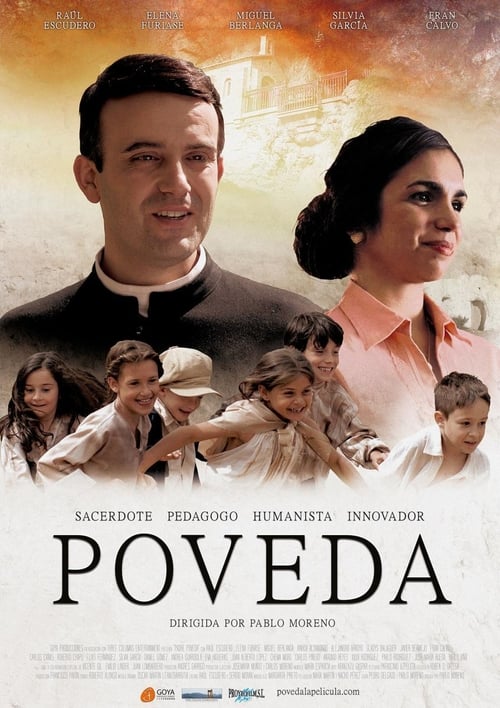
In Madrid in the summer of 1936, as the Spanish Civil War erupts, Pedro Poveda is already in Republican custody, and the film immediately turns his arrest into the frame for everything that follows. He sits under pressure in an interrogation room while a miliciano, Felipe, tries to identify who he really is, and Poveda answers with the calm certainty of a man who has already made peace with his fate: "I am a priest of Christ." From that stark opening, his life unspools in memory, each recollection rising out of the violence of the present, so that the story becomes both a confession and a final witness.
The first great memory carries him back to Guadix, Granada, in 1901, to the caves where the poorest of the poor live in misery, forgotten by everyone except the priest who chooses to enter their world. The caves are not merely a setting; they are the whole moral center of the film's early movement, a landscape of dust, hunger, and neglect where Pedro Poveda begins his priestly work among people the rest of Spain has abandoned. He walks into these shelters with no sense of spectacle, only the conviction that faith without practical mercy is hollow. He sees the children who have no schooling, the adults trapped in ignorance and deprivation, and he begins to work as if education itself might become a sacrament. His ministry is not limited to sermons or rituals. He teaches, listens, organizes, and insists that human dignity can be rebuilt from the ground up. The camera lingers on faces lit by cave firelight and on the priest's quiet determination, so the emotional current is one of austere hope: a man stepping into darkness because he believes light can be made there.
As the years move forward, Poveda's mission widens. He is no longer just a parish priest among the poor; he becomes a reformer whose ideas begin to challenge the social order. The film shows him linking Christian faith to education, especially the education of people who have never been invited into intellectual or spiritual authority. This is where the women around him become central rather than incidental. Pepita Segovia enters his life as one of the key collaborators in his educational vision, and the story expands to include Amelia del Pozo, Doña Eufemia, Doña Dolores Morón, Doña María Linarejos Castroverde, and Emma Álvarez, among others, as part of the circle shaped by his influence. They are not decorative supporting figures. They embody the radical core of his mission: that women must be trusted as teachers, leaders, and agents of Christian renewal. The film makes this clear through conversations in which Poveda treats them not as assistants but as co-workers in a larger calling. His respect for them is one of the film's main revelations, because it shows that his educational project is also a social one, aimed at elevating women in a culture that keeps them at the margins.
This work draws him into contact and tension with ecclesiastical and institutional authority. Don Maximiano, the bishop, stands as one of the important clerical figures in his orbit, along with Don Vicente, Don Rodolfo, Don Fermín, Don Comas, Don Rafael, and Don Juan Zaragüeta, all part of the institutional world that surrounds him and, at times, resists him. Some are sympathetic, some cautious, some openly obstructive, but all of them reflect the pressure that Poveda faces as he tries to move religion out of abstraction and into social transformation. The film never turns these conflicts into melodrama. Instead, it lets them accumulate, showing how every step forward is purchased with patience, persuasion, and a refusal to abandon the poor or the women he believes are essential to the future of the faith. His struggle is ideological long before it becomes political. He is trying to prove that education can be Christian without being narrow, modern without being faithless, and transformative without becoming violent.
One of the defining achievements of his life comes in Oviedo, where he founds the Institution Teresiana. The film treats this not as a bureaucratic milestone but as the embodiment of everything he has been working toward. In Oviedo, his ideas take institutional form. The scattered impulses of compassion, teaching, and spiritual discipline become a structure that can survive beyond a single parish or a single decade. This is the film's great moment of consolidation. The long labor in Guadix, the patient conversations with women teachers, the clashes with skepticism and authority, all lead here. The Teresian Institution represents his conviction that Christian education can enter the world through lay initiative and through women committed to intellectual and moral formation. It is the most important tangible result of his mission, and the film returns to it as proof that his life has not been merely inspirational but constructive.
The narrative keeps moving through different Spanish cities and settings as his reputation grows and so does the resistance around him. Poveda becomes more than a local priest; he becomes a visible symbol of the kind of Catholic reform that unsettles old hierarchies and later becomes dangerous in a polarized nation. As the political atmosphere darkens, the film shows Spain inching toward catastrophe. The abstract social tensions of earlier scenes harden into the unmistakable menace of civil conflict. The world that once merely questioned him now begins to mark him. By the time the Spanish Civil War breaks out on July 18, 1936, the film has already prepared the viewer to understand that Poveda's fate is tied to the collision between his religious convictions and the revolutionary violence that now consumes Madrid.
Back in the frame story, the interrogations in Madrid become more than a device; they become a final spiritual trial. Felipe, the miliciano questioning him, wants identification, but what he receives is testimony. Poveda does not simply defend himself. He narrates a life. Each answer under pressure becomes another flashback, another revelation, another act of witness. The interrogation rooms are cold, morally stripped spaces, and they contrast sharply with the warmth and dirt of Guadix or the organized hope of Oviedo. In them, Poveda's composure becomes almost luminous. He knows that the men questioning him see him as an enemy. He also knows that his faith has already sentenced him in their eyes. Yet he never changes tone. His dignity is the film's quiet climax-building force. The more the interrogators try to reduce him to a political or religious category, the more his memories reveal a man defined by service.
The film's key revelations emerge gradually through these recollections. First, that Poveda's priesthood is inseparable from education. He does not think of teaching as secondary to religion; he sees it as one of the primary ways grace enters the world. Second, that women are indispensable to his mission, not as followers but as collaborators whose minds and labor can reshape society. Third, that his apparent meekness hides a stubborn moral courage. He has been opposing indifference and injustice for decades, and in the end that opposition makes him a target. What looks at first like a story of a saintly priest traveling from one ministry to another is actually the portrait of a man steadily entering conflict with the world around him because he refuses to separate belief from responsibility.
The tension rises as the present-day frame closes in. Madrid in 1936 is no longer just a location; it is a trap. The film draws out the inevitability of what is coming without losing the texture of the man's inner life. The names and faces of the past gather around him, but the present narrows to the walls of captivity and the certainty of execution. The Miliciano Esteban and Miliciano Julio appear as part of the machinery of wartime force, figures in the armed pressure that surrounds him. The interrogation ceases to be about understanding and becomes a prelude to sentencing. Poveda's final answers do not save him; they clarify him.
The most devastating historical detail arrives in the opening and closing movement alike: at dawn on July 28, 1936, a group of paramilitaries comes to search his house, and the story moves inexorably toward the same day's end. He identifies himself without fear, and the line "I am a priest of Christ" becomes the summary of the entire film. It is not just a declaration of identity. It is a statement of allegiance, and it seals his fate. He is condemned to death and taken to be shot by firing squad for his faith and for the cause of Christian education. The film does not disguise the brutality of this ending. It presents it as the final consequence of a life lived in open fidelity to convictions that the surrounding political world cannot tolerate.
The climax comes not with a surprise reversal but with the stark recognition that the man who spent his life teaching others how to live has now become the one being judged by history, ideology, and violence. There is no last-minute rescue. No hidden escape route appears. The final confrontation is between Poveda and the machinery of Republican wartime repression, and its outcome is absolute. He is condemned, led to his execution, and killed. The film's emotional force lies in the fact that this death does not feel like an interruption of his mission but the completion of it. The life that began in the caves of Guadix among the forgotten ends at the cementerio de la Almudena in Madrid, where his body is found martyrized in the early hours of July 28. The circle closes in the same city that opened the frame, but now the man who was once merely arrested has become a witness unto death.
The ending holds on the sense of legacy rather than triumph. Poveda dies, but the film has already shown that what he built survives him: the educational vision, the women he trusted, the Teresian Institution, and the moral example of a priest who refuses to abandon the poor. His death is not treated as a defeat so much as a martyrdom that completes the story begun in memory. The final scene leaves him in the shadow of execution but in the light of conviction, with his life rendered as a continuous act of service that the violence of 1936 can silence but not erase.



What is the ending?
In the ending of "Poveda," the film culminates in the tragic death of the protagonist, Father Poveda, who is executed during the Spanish Civil War. His unwavering commitment to his faith and the education of the youth is highlighted, as he faces his fate with courage. The film closes with a reflection on his legacy and the impact he had on those around him.
As the final scenes unfold, we see Father Poveda in a dimly lit room, surrounded by the chaos of the Spanish Civil War. The atmosphere is tense, filled with the sounds of distant gunfire and the muffled cries of the oppressed. Poveda, portrayed with a deep sense of conviction, is aware of the danger that surrounds him. He has been a beacon of hope for many, advocating for education and the well-being of the youth, particularly in a time of turmoil.
In the next scene, Poveda is confronted by a group of militia members. They are aggressive and filled with hostility, representing the ideological conflict of the time. Poveda stands firm, his faith unwavering, as he speaks to them about love, understanding, and the importance of education. His words are passionate, revealing his deep-seated belief in the goodness of humanity, even in the face of violence.
As the confrontation escalates, the militia members grow impatient. They demand that Poveda renounce his beliefs and abandon his mission. However, he remains resolute, expressing that he cannot betray his calling or the children he has dedicated his life to serving. The tension in the room is palpable, and the audience can feel the weight of his decision.
In a heart-wrenching moment, the militia members decide to execute him. Poveda is taken outside, where the sun casts a stark light on the grim reality of his situation. He walks with dignity, his head held high, embodying the strength of his convictions. The scene is filled with a haunting silence, broken only by the sounds of the world around him.
As he faces his executioners, Poveda offers a final prayer, a moment of peace amidst the chaos. His eyes reflect a mixture of fear and serenity, showcasing his internal struggle yet ultimate acceptance of his fate. The camera captures the expressions of those around him, some filled with anger, others with a sense of loss.
The film concludes with a poignant montage of Poveda's legacy. We see flashbacks of the children he taught, the lives he touched, and the community he built. His impact is felt long after his death, as the film emphasizes the importance of education, compassion, and standing up for one's beliefs, even in the face of overwhelming adversity.
In the final moments, the screen fades to black, leaving the audience with a sense of reflection on the sacrifices made for the greater good. The fate of Father Poveda serves as a powerful reminder of the enduring spirit of those who fight for justice and the transformative power of love and education.
Is there a post-credit scene?
The movie "Poveda," produced in 2016, does not contain a post-credit scene. The film concludes its narrative without any additional scenes or content after the credits roll. The story wraps up with a focus on the life and legacy of Saint Pedro Poveda, emphasizing his dedication to education and the impact he had on the lives of those around him. The ending serves to reinforce the themes of faith, commitment, and the transformative power of love and knowledge, leaving the audience with a sense of closure regarding Poveda's journey.
What motivates the character of Poveda to dedicate his life to education?
Poveda is driven by a deep sense of purpose and a belief in the transformative power of education. His experiences witnessing the struggles of impoverished children fuel his desire to provide them with opportunities for a better future. He feels a moral obligation to uplift those around him, which becomes a central theme in his life.
How does Poveda's relationship with his family influence his decisions?
Poveda's relationship with his family, particularly with his mother, is complex. His mother embodies traditional values and initially struggles to understand his commitment to education over a conventional career. This tension highlights Poveda's internal conflict between familial expectations and his passion for teaching, ultimately shaping his resolve to pursue his mission.
What challenges does Poveda face in establishing his educational institution?
Poveda encounters numerous obstacles, including financial constraints, societal resistance, and bureaucratic hurdles. He faces skepticism from the community and must navigate the complexities of gaining support from local authorities. These challenges test his determination and resilience, showcasing his unwavering commitment to his vision.
How does Poveda's teaching philosophy differ from traditional methods?
Poveda's teaching philosophy emphasizes holistic education, focusing not just on academic achievement but also on moral and social development. He believes in nurturing the whole child, fostering creativity, and encouraging critical thinking, which contrasts sharply with the rote learning prevalent in traditional education systems.
What role do Poveda's students play in his journey?
Poveda's students are central to his journey, serving as both inspiration and motivation. Their struggles and triumphs reflect the impact of his educational approach. As he witnesses their growth and success, it reinforces his belief in the importance of his work, while also presenting emotional challenges as he becomes deeply invested in their lives.
Is this family friendly?
"Poveda," produced in 2016, is a biographical drama that tells the story of the Spanish priest and educator, Saint Pedro Poveda. While the film is generally suitable for family viewing, there are some scenes and themes that may be considered potentially objectionable or upsetting for children or sensitive viewers.
-
Religious Themes: The film delves deeply into religious themes, including discussions of faith, sacrifice, and the challenges faced by those who dedicate their lives to serving others. Some viewers may find these themes heavy or complex.
-
Social Injustice: There are depictions of social inequality and the struggles of marginalized communities. These scenes may evoke feelings of sadness or discomfort as they highlight the harsh realities faced by the less fortunate.
-
Conflict and Tension: The film portrays conflicts between different social groups and the challenges faced by Poveda in his mission. This may include moments of tension that could be intense for younger viewers.
-
Emotional Struggles: Characters experience significant emotional turmoil, including moments of doubt, despair, and loss. These emotional scenes may resonate deeply and could be upsetting for sensitive viewers.
-
Historical Context: The film is set against the backdrop of early 20th-century Spain, which includes references to historical events that may be difficult to understand for younger audiences.
Overall, while "Poveda" carries a positive message about education, compassion, and service, it does contain elements that may require parental guidance for younger viewers.








