





























Popular
Who is the main character in Taxi 5 and what motivates him throughout the film?
What is the significance of the modified taxi in Taxi 5?
How does Sylvain's relationship with his partner evolve throughout the film?
What role does the character of the gang leader play in the plot of Taxi 5?
What are some key action sequences in Taxi 5 that highlight the film's tone?
Should I watch it?
Ask Your Own Question

What is the plot?
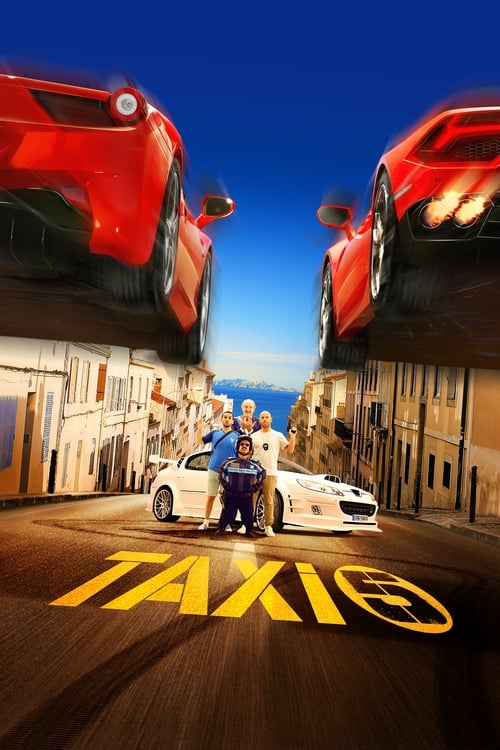
Sylvain Marot begins Taxi 5 in Paris, where he is known as an exceptionally talented police officer and an almost unnervingly gifted driver. He handles high-speed pursuits with instinctive precision, and his greatest ambition is to join France's special forces. That ambition collapses when his private life catches up with him: Sylvain has been having an affair with the mayor's wife. Once the affair is discovered, his professional reputation cannot save him. He is punished with a transfer to the municipal police of Marseille, a posting he regards as a humiliating exile rather than a new opportunity.
Sylvain arrives in Marseille convinced that he is too good for the local force. His first operation immediately exposes both his skill and his recklessness. He pursues a taxi through the city, driving aggressively and refusing to abandon the chase. The pursuit ends disastrously when he loses control of the police vehicle and sends it into the water, drowning the patrol car. No one dies, but Sylvain's arrival is marked by a spectacular failure. The Marseille officers see him as an arrogant Parisian whose confidence is much larger than his common sense.
The municipal police are overseen by Gibert, the former police commissioner from the earlier Taxi films. Gibert has changed careers and is now the mayor of Marseille, but his new position brings a new kind of pressure. Crime is damaging his public image, and his poll numbers are falling. The most serious threat is an organized group of Italian robbers who attack jewelry stores and escape in extremely powerful Ferraris. The gang's speed, discipline, and familiarity with Marseille's roads have made them nearly impossible to catch.
Gibert assigns Sylvain to stop them. He names the police response Operation "Mafia," treating the gang as an organized criminal army rather than a collection of ordinary thieves. Sylvain is unimpressed by the resources available to him, but he accepts the mission because it gives him a chance to prove that his transfer has not diminished his abilities. He soon discovers, however, that talent alone cannot compensate for the police vehicles. Whenever the gang robs a jewelry store, Sylvain and the other officers give chase, but the Ferraris pull away from them almost immediately. The criminals do not merely drive fast; they use practiced routes, carefully timed maneuvers, and the city's streets as if they had designed them themselves.
At the station, Alain Trésor explains the history behind Marseille's most famous vehicle: Daniel Morales's legendary white taxi. Alain recounts the exploits of Daniel and Émilien Coutant, the heroes associated with the earlier cases. But the old partnership is no longer available to rescue the city. Émilien has left the police, Daniel now lives in Miami, and the famous taxi is in Morocco. The information seems at first like a piece of nostalgic history, but Sylvain realizes that the taxi could be exactly what he needs. The police require a vehicle capable of challenging the Ferraris, and the white taxi has already achieved near-mythical status as a machine that can outperform almost anything on the road.
The problem is finding it. Sylvain learns that Daniel's nephew, Eddy Maklouf, is still in Marseille. Eddy works as a private-hire driver, or VTC chauffeur, but he is an almost comically bad driver. He has none of Daniel's confidence or control behind the wheel. His turns are clumsy, his judgment is poor, and his driving repeatedly creates danger for himself and everyone around him. Yet Eddy is the family connection Sylvain needs. If anyone can locate Daniel's taxi, it is Daniel's nephew.
Sylvain therefore forces Eddy into the investigation. Their partnership begins as coercion rather than friendship. Sylvain uses the pressure of possible prosecution or detention to make Eddy cooperate, promising that his situation will improve if he helps recover the vehicle. Eddy has little choice but to agree. Their personalities clash immediately. Sylvain is arrogant, controlled, and obsessed with professional competence; Eddy is nervous, foolish, and chronically incapable of doing anything without making it more complicated.
Eddy's sister, Samia Maklouf, is much more capable and grounded than her brother. She understands Eddy's weaknesses and does not share Sylvain's inflated opinion of himself. Sylvain is attracted to her and tries to use his usual charm, but Samia refuses to be impressed. His flirtation meets blunt rejection, puncturing the confidence he displays in every other part of his life. Their encounters establish that Sylvain may be able to dominate a pursuit, but he cannot simply drive his way into Samia's affection.
Eddy eventually helps Sylvain locate Daniel's white taxi. The discovery is treated like the recovery of a legendary weapon. The vehicle carries the weight of Daniel's reputation, and Sylvain expects it to solve the problem immediately. Instead, the first attempt is a disappointment. The taxi is powerful and specially suited to high-speed driving, but it does not drive itself. Eddy gets behind the wheel and proves that a legendary car cannot compensate for an incompetent driver. His handling is so poor that the Ferraris remain beyond reach.
This failure reveals one of the film's central ideas: Daniel's success came from the combination of the taxi and Daniel's driving ability. The vehicle is not magical. It is a tool whose potential depends on the person controlling it. Sylvain, not Eddy, may be the driver capable of using it properly. But even Sylvain needs more than a famous name and an old engine. The taxi requires work and modification, and the police need better intelligence about the criminals.
That intelligence comes through Rashid, an associate connected to the Italian gang. Sylvain and Eddy meet him and learn that the robbers train at an abandoned racing track. The information changes Sylvain's understanding of the gang. Their escapes are not lucky improvisations. The criminals deliberately practice their routes and techniques, refining their ability to control the Ferraris at speed. Their skill is the result of preparation, not simply wealth or horsepower.
Sylvain and Eddy go to the abandoned track, where they confront the gang's driving culture directly. The encounter becomes a race, with the white taxi challenging the Italians' superior-looking cars. Eddy's limitations remain obvious, but Sylvain's ability begins to reveal what the taxi can really do. The race is tense because the criminals expect the old vehicle to be a joke. Instead, Sylvain outdrives them and wins. The victory does not capture the gang, but it proves that the white taxi can compete when placed in the hands of a genuinely skilled driver. For Sylvain, it is the first moment when Daniel's legacy becomes a practical advantage rather than an old story.
The race also draws Sylvain further into the gang's orbit. One of the criminals is Toni "Dog," a former Formula One driver and one of the gang's most important figures. Dog is not simply a thug who happens to own a Ferrari. He is a professional-level driver who understands racing technique, pressure, and the psychology of pursuit. Impressed by Sylvain's abilities, Dog offers him a job and invites him to a private party. The invitation is both an opportunity and a trap: it gives Sylvain a chance to get close to the gang, but it also places him in a room filled with people who may notice that he does not belong.
The police plan to exploit the connection. Eddy is sent into Dog's office disguised as a waiter. The disguise is intended to allow him to search the criminals' headquarters without attracting attention. Eddy, however, is not naturally suited to undercover work. His nervousness and clumsiness make the operation increasingly unstable. He moves through the office trying to appear casual while searching for anything that will reveal the gang's next target.
He eventually finds the robbery plan. The Italians intend to steal a valuable diamond known as Cassiopeia. This is the breakthrough Sylvain and Gibert need. Rather than waiting for another jewelry robbery to occur, the police can now prepare an interception. The Cassiopeia theft gives Operation Mafia a precise target and transforms the investigation from a series of failed chases into a planned confrontation.
Eddy's success does not last. His inability to maintain the waiter disguise exposes him, and the situation becomes chaotic. Instead of quietly escaping with the information, he behaves foolishly and effectively reveals what he has discovered. One of the gang members realizes that the police are aware of the plan. Eddy's incompetence therefore turns valuable intelligence into a warning. The Italians know that the police are coming, and the final operation becomes far more dangerous.
Despite the compromise, Sylvain and the Marseille police move forward. Their objective is to stop the theft of Cassiopeia and capture the gang before it can escape. The criminals proceed with their plan, relying on their Ferraris, their preparation, and the belief that no police vehicle can match them. Sylvain takes the white taxi, now modified and prepared for the pursuit. It is no longer merely Daniel's old car recovered from storage; it has become the centerpiece of a new plan.
The robbery triggers the film's largest action sequence. The Italian gang flees in its Ferraris, and the police pursue them through Marseille. The streets become a shifting maze of speed, noise, and near collisions. The Ferraris surge ahead, weaving through traffic and taking corners at impossible angles. The police vehicles struggle to remain in the chase, just as they did during the earlier robberies. But this time Sylvain is not driving an ordinary patrol car.
The white taxi joins the pursuit and begins to close the gap. Sylvain's driving is precise where Eddy's is chaotic. He understands how to use the taxi's weight, acceleration, and handling, and he does not waste movement. The gang expects the old car to break under the pressure, but Sylvain uses its peculiar strengths to stay with them. The chase becomes less a contest of raw horsepower than a battle between drivers.
The criminals fire on the taxi, turning the pursuit into a direct attack. Sylvain refuses to stop. Under fire, he activates the taxi's boost, seeking the burst of speed necessary to overtake the Ferraris. The maneuver works, but it also creates a new danger: the taxi accelerates so violently that it is launched off a cliff. For a moment the legendary vehicle is airborne above the road, no longer under conventional control.
The taxi crashes into the back of a yacht. The impact is spectacular but not fatal. The yacht is connected to the gang's escape plan, and Rashid has already claimed the Cassiopeia diamond from the pilot. The seemingly disastrous flight therefore becomes part of the final capture. The gang's escape collapses, and the criminals are arrested. Cassiopeia is recovered and returned.
No principal character dies during the robbery, the shootouts, the races, or the final crash. Sylvain Marot survives, as do Eddy Maklouf, Samia Maklouf, Gibert, Alain Trésor, Rashid, and the members of the Italian gang. Toni Dog is defeated and taken into custody rather than killed. Daniel Morales and Émilien Coutant are not present as active protagonists, and neither is reported to have died; their absence instead emphasizes that a new generation is taking over the story.
The arrests resolve Gibert's immediate political crisis. His administration can claim a major victory, the threat that damaged his standing is removed, and the police have finally demonstrated that the Italian gang can be beaten. Sylvain also proves that his transfer did not destroy his career. Although he begins the film as a disgraced Parisian officer who believes Marseille is beneath him, the case forces him to work with people he initially dismisses. He cannot solve it through ego alone. He needs Eddy's family connection, Samia's practical involvement, Rashid's information, Alain's knowledge, and the legacy of Daniel's taxi.
Eddy, despite remaining a terrible driver, becomes essential to the victory. He helps locate the white taxi, participates in the investigation, enters Dog's office, discovers the Cassiopeia plan, and contributes to the chain of events that brings down the gang. His bungling repeatedly endangers the operation, but it also produces the accidental breakthroughs that keep the case moving. He is not Daniel's replacement as a driver, but he becomes the human link between Daniel's past and the new Marseille team.
In the final resolution, the white taxi passes symbolically from Daniel's generation to Sylvain and Eddy's. It no longer belongs only to the legends described by Alain. It becomes the vehicle through which Sylvain earns a place in Marseille and through which Eddy, despite his incompetence, enters the family tradition. Sylvain's relationship with Samia remains unresolved romantically, since she has resisted his advances, but his attitude toward the Maklouf family has changed. He is no longer treating Eddy merely as a tool.
The film closes without a murder mystery, hidden killer, or tragic death. Its final victory is comic and kinetic rather than mournful: the Ferraris are stopped, the diamond is recovered, the gang is arrested, and the battered white taxi survives its impossible flight onto the yacht. Sylvain and Eddy emerge as an unlikely new police-and-taxi partnership, suggesting that the legend of Daniel Morales's vehicle will continue in Marseille--even if its new driver remains far less reliable than the man who made it famous.




What is the ending?
In the ending of Taxi 5, the main characters successfully capture the notorious criminal gang led by the character known as "The Ghost." Sylvain, the new police officer, along with his team, manages to outsmart the gang using their driving skills and teamwork. The film concludes with a sense of camaraderie and accomplishment among the characters, as they celebrate their victory.
As the climax of Taxi 5 unfolds, the scene shifts to a high-stakes chase through the streets of Marseille. Sylvain, the new recruit, is determined to prove himself as a worthy successor to the legendary taxi driver Daniel. He is joined by his partner, the skilled driver and mechanic, who has been instrumental in modifying the taxi for speed and agility. The tension is palpable as they pursue The Ghost and his gang, who have been wreaking havoc in the city.
The chase escalates, with Sylvain and his partner navigating through narrow alleyways and busy streets, showcasing their driving prowess. The camera captures the adrenaline-fueled moments as they dodge obstacles and outmaneuver the gang's vehicles. Sylvain's internal motivation is clear; he wants to honor the legacy of Daniel while also establishing his own identity as a capable officer.
As they close in on The Ghost, the gang attempts to escape, leading to a dramatic showdown. Sylvain's partner executes a daring maneuver, allowing them to corner The Ghost's vehicle. The tension peaks as Sylvain confronts The Ghost, who is portrayed as a cunning and ruthless adversary. In a moment of bravery, Sylvain manages to outsmart The Ghost, leading to his arrest.
With the gang apprehended, the scene transitions to a celebratory atmosphere. Sylvain and his partner are greeted as heroes by their colleagues and the citizens of Marseille. The camaraderie among the team is evident as they share laughs and reflect on their victory. Sylvain feels a sense of fulfillment, having proven himself not only as a police officer but also as a worthy successor to Daniel's legacy.
In the final moments, the film hints at the possibility of future adventures, as Sylvain and his partner discuss their next moves. The screen fades out, leaving the audience with a sense of hope and excitement for what lies ahead for these characters.
In summary, Sylvain successfully captures The Ghost, solidifying his place in the police force and honoring the legacy of Daniel. The team celebrates their victory, and the film concludes on a high note, suggesting that their journey is far from over.
Is there a post-credit scene?
Yes, "Taxi 5" features a post-credit scene.
As the credits roll, the scene shifts to a familiar setting: the bustling streets of Paris. The camera focuses on a sleek, modified taxi speeding through the city, weaving in and out of traffic with impressive agility. Inside the car, we see the new protagonist, Sylvain Marot, played by Franck Gastambide, who is now fully embracing his role as a taxi driver.
Sylvain is animated and excited, showcasing his newfound confidence and skill behind the wheel. He engages in a light-hearted conversation with his passenger, who is oblivious to the chaos unfolding outside. The taxi maneuvers through tight spaces, and Sylvain's enthusiasm is palpable as he recounts his recent adventures and the thrill of driving.
Suddenly, the scene cuts to a police car in pursuit, sirens blaring. The tension rises as Sylvain glances in the rearview mirror, realizing he is being chased. His expression shifts from joy to determination, and he grips the steering wheel tighter, ready to showcase his driving prowess once again.
The post-credit scene ends on a cliffhanger, leaving viewers with a sense of excitement and anticipation for what Sylvain's next adventure might entail, hinting at the possibility of further escapades in the world of high-speed chases and comedic chaos.
Who is the main character in Taxi 5 and what motivates him throughout the film?
The main character in Taxi 5 is Sylvain Marot, a police officer who is initially portrayed as a somewhat reckless and impulsive individual. His motivation throughout the film is to prove himself as a capable officer and to capture a notorious gang of robbers who are using a modified taxi to commit their crimes. Sylvain's determination is fueled by his desire to restore his reputation after being reassigned to a less prestigious position in the police force.
What is the significance of the modified taxi in Taxi 5?
The modified taxi in Taxi 5 serves as both a tool for the criminals and a symbol of the film's high-octane action. It is equipped with advanced technology and modifications that allow it to perform incredible stunts and evade police capture. The taxi becomes a central element in the chase sequences, showcasing the thrilling cat-and-mouse dynamic between Sylvain and the gang. It also represents the legacy of the original Taxi films, connecting Sylvain's journey to the iconic vehicle.
How does Sylvain's relationship with his partner evolve throughout the film?
Sylvain's relationship with his partner, a young and skilled driver named Eddy, evolves from one of initial skepticism to mutual respect and camaraderie. At first, Sylvain underestimates Eddy's abilities and is frustrated by his lack of experience. However, as they face challenges together, including high-speed chases and dangerous confrontations with the gang, Sylvain begins to recognize Eddy's talent and resourcefulness. This growth in their partnership is marked by moments of teamwork and shared adrenaline, ultimately leading to a strong bond.
What role does the character of the gang leader play in the plot of Taxi 5?
The gang leader, known as 'The Ghost,' plays a pivotal role in the plot of Taxi 5 as the main antagonist. He is cunning, charismatic, and highly skilled, orchestrating a series of elaborate heists that challenge Sylvain and his team. The Ghost's motivations are rooted in a desire for wealth and notoriety, and he uses the modified taxi to execute his plans. His confrontations with Sylvain are intense and filled with tension, driving the narrative forward as Sylvain seeks to outsmart him and bring him to justice.
What are some key action sequences in Taxi 5 that highlight the film's tone?
Key action sequences in Taxi 5 include high-speed chases through the streets of Marseille, where Sylvain and Eddy pursue The Ghost and his gang. One notable scene features a thrilling chase that weaves through narrow alleyways and busy markets, showcasing the taxi's agility and speed. Another significant sequence involves a dramatic showdown at a warehouse, where Sylvain and Eddy must outmaneuver the gang in a series of explosive confrontations. These sequences are characterized by fast-paced editing, dynamic camera angles, and a blend of humor and tension, encapsulating the film's energetic tone.
Is this family friendly?
"Taxi 5," produced in 2018, is a French action-comedy film that features a mix of humor, car chases, and some action sequences. While it is generally light-hearted, there are a few elements that may be considered objectionable or upsetting for children or sensitive viewers:
-
Violence and Action Sequences: The film includes car chases and crashes that may be intense. There are moments of physical confrontations that could be alarming for younger viewers.
-
Language: There are instances of strong language throughout the film, which may not be suitable for all audiences.
-
Criminal Themes: The plot revolves around police work and criminal activities, including theft and heists, which may not be appropriate for younger children.
-
Mild Sexual Content: There are suggestive situations and innuendos that may not be suitable for all viewers, particularly younger audiences.
-
Emotional Tension: Some scenes may evoke feelings of tension or anxiety, especially during high-stakes moments involving the characters.
Overall, while "Taxi 5" is designed to be entertaining, parents may want to consider these aspects when determining its suitability for children or sensitive viewers.






