
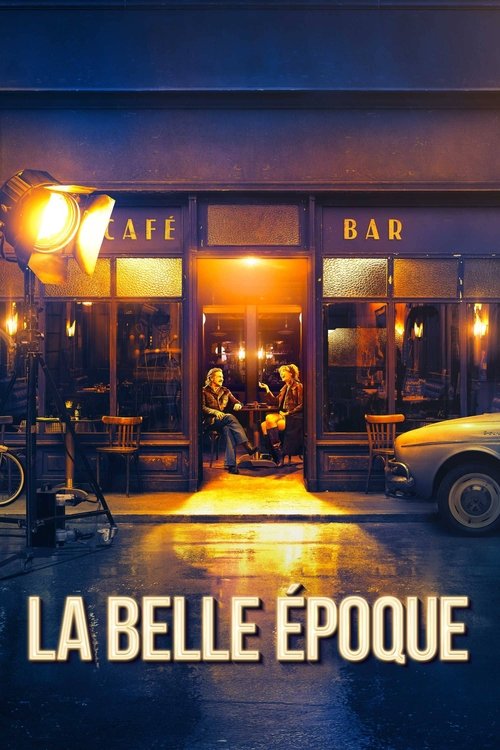
























































Popular
What role does Victor's profession as a cartoonist play in the story?
How does the time travel experience affect Victor's relationship with Marianne?
What is the significance of the character Antoine in Victor's journey?
How does the film portray the theme of nostalgia through Victor's experiences?
What impact does the revelation of Victor's true feelings have on the climax of the story?
Should I watch it?
Ask Your Own Question

What is the plot?
Sorry, we aren't able to watch and write up a full detailed plot yet. Check back in a few days.



What is the ending?
In the ending of "La Belle Époque," Victor, after experiencing a transformative journey back to 1974, confronts his feelings for his estranged wife, Marianne. The film concludes with a poignant moment where Victor and Marianne share a heartfelt connection, suggesting a possibility of rekindling their relationship. Meanwhile, the immersive experience of the past has a lasting impact on Victor, leading him to reflect on his life choices.
As the film draws to a close, Victor's journey culminates in a scene where he stands outside the immersive theater, contemplating the significance of his experiences. He sees Marianne, who has been moved by their shared memories, and they share a moment of understanding. The film ends on an ambiguous note, leaving the audience to ponder the future of their relationship.
Now, let's delve into the ending in a more detailed, chronological narrative.
The final act begins with Victor, played by Daniel Auteuil, having completed his immersive experience in the past, where he relived a week in 1974, a time when he was deeply in love with his wife, Marianne, portrayed by Fanny Ardant. This journey has allowed him to confront his nostalgia and the pain of their separation. As he steps out of the immersive theater, the weight of his emotions is palpable; he is visibly changed, carrying the memories of his past with him.
Victor walks through the streets of modern-day Paris, the city bustling around him, yet he feels a sense of clarity and purpose. He reflects on the moments he shared with Marianne during the immersive experience, the laughter, the love, and the intimacy that had long been absent from his life. His heart is heavy with the realization of what he has lost, but there is also a flicker of hope ignited by the memories.
In a pivotal scene, Victor decides to seek out Marianne. He finds her at a café, where she is sitting alone, lost in thought. The atmosphere is charged with unspoken words and unresolved feelings. As he approaches her, the tension is thick; both characters are aware of the emotional stakes involved. Victor's heart races as he recalls the warmth of their past, and Marianne's expression reveals a mixture of surprise and vulnerability.
They engage in a conversation that is both tentative and deeply emotional. Victor expresses how the experience has made him realize the depth of his feelings for her, and he acknowledges the mistakes he made in their marriage. Marianne listens intently, her eyes reflecting a blend of sadness and longing. The dialogue is rich with the weight of their shared history, and the audience can feel the emotional gravity of their reunion.
As they talk, the camera captures close-ups of their faces, highlighting the subtle shifts in their expressions--hope, regret, and a yearning for connection. The scene is interspersed with flashbacks of their younger selves, reinforcing the bond they once shared. The juxtaposition of their past and present serves to emphasize the enduring nature of their love, despite the years of separation.
In the climax of their conversation, Marianne reveals her own feelings of loss and the impact of their separation on her life. She admits that she has missed Victor, and there is a moment of silence where both characters seem to grasp the possibility of reconciliation. The tension in the air is palpable, and the audience is left hanging on the edge of their seats, wondering if they will take the leap to reconnect.
The film concludes with a scene that encapsulates the essence of their journey. Victor and Marianne share a lingering gaze, filled with unspoken promises and the potential for a new beginning. The camera pulls back, showing them sitting together at the café, a small yet significant step towards healing their fractured relationship. The screen fades to black, leaving the audience with a sense of hope and the realization that love, even when tested by time and circumstance, can find a way to endure.
In summary, Victor emerges from his immersive experience with a renewed sense of purpose and a desire to reconnect with Marianne. Their fate remains open-ended, suggesting that while the past cannot be changed, the future holds the possibility of rekindled love and understanding.
Is there a post-credit scene?
In the movie "La Belle Époque," there is no post-credit scene. The film concludes its narrative without any additional scenes after the credits roll. The story wraps up with a poignant resolution, focusing on the characters' emotional journeys and the choices they make, leaving the audience to reflect on the themes of love, nostalgia, and the impact of memories. The absence of a post-credit scene emphasizes the film's exploration of its central ideas rather than setting up for a sequel or additional content.
What role does Victor's profession as a cartoonist play in the story?
Victor, played by Daniel Auteuil, is a disillusioned cartoonist who feels trapped in his mundane life. His profession is significant as it reflects his creative spirit and longing for the past. Through his cartoons, he expresses his nostalgia and dissatisfaction with the present, which sets the stage for his journey back to a more vibrant time in his life.
How does the time travel experience affect Victor's relationship with Marianne?
Victor's time travel experience allows him to relive a pivotal moment in his life with Marianne, portrayed by Fanny Ardant. As he immerses himself in the past, he begins to confront his feelings of love and loss. This journey not only rekindles his passion but also forces him to reflect on the choices he made, ultimately impacting his understanding of their relationship in the present.
What is the significance of the character Antoine in Victor's journey?
Antoine, played by Guillaume Canet, is the young entrepreneur who creates the immersive experience for Victor. His character serves as a catalyst for Victor's transformation. Antoine's enthusiasm for life and love contrasts sharply with Victor's cynicism, pushing Victor to confront his own regrets and desires, ultimately leading to a deeper understanding of himself.
How does the film portray the theme of nostalgia through Victor's experiences?
The film intricately weaves nostalgia into Victor's experiences as he relives his past with Marianne. The detailed recreation of the 1970s, from the music to the fashion, evokes a sense of longing and warmth. As Victor navigates this world, the film captures his emotional highs and lows, illustrating how nostalgia can be both comforting and painful, as he grapples with the reality of his current life.
What impact does the revelation of Victor's true feelings have on the climax of the story?
As the story reaches its climax, Victor's true feelings for Marianne come to the forefront. This revelation is pivotal as it not only highlights his emotional growth but also serves as a turning point in his character arc. The intensity of his feelings, juxtaposed with the reality of their current lives, creates a poignant moment that encapsulates the film's exploration of love, regret, and the passage of time.
Is this family friendly?
"La Belle Époque" is a romantic comedy-drama that explores themes of love, nostalgia, and the complexities of relationships. While it has a charming premise, there are several elements that may not be suitable for children or sensitive viewers.
-
Mature Themes: The film delves into adult relationships, infidelity, and the emotional turmoil that comes with them, which may be difficult for younger audiences to understand.
-
Sexual Content: There are scenes that include suggestive situations and discussions about sexuality, which may be inappropriate for children.
-
Emotional Distress: Characters experience significant emotional pain, including heartbreak and existential crises, which could be upsetting for sensitive viewers.
-
Language: The film contains some strong language that may not be suitable for younger audiences.
-
Depictions of Conflict: There are moments of tension and conflict between characters that may be intense or uncomfortable for some viewers.
Overall, while "La Belle Époque" has a whimsical and nostalgic tone, its exploration of adult themes and relationships makes it more appropriate for mature audiences.








