



















Popular
How does Izi first meet Benji, and why does Benji start following him?
Why does Izi leave Benji behind to move into the luxury apartment, and what changes after he comes back?
Who is Staples, and what is his connection to Benji?
What is Izi’s job at Life After Life, and how does it connect to Benji’s mother?
What happens when the police raid The Kitchen and Izi’s apartment?
Should I watch it?
Ask Your Own Question

What is the plot?
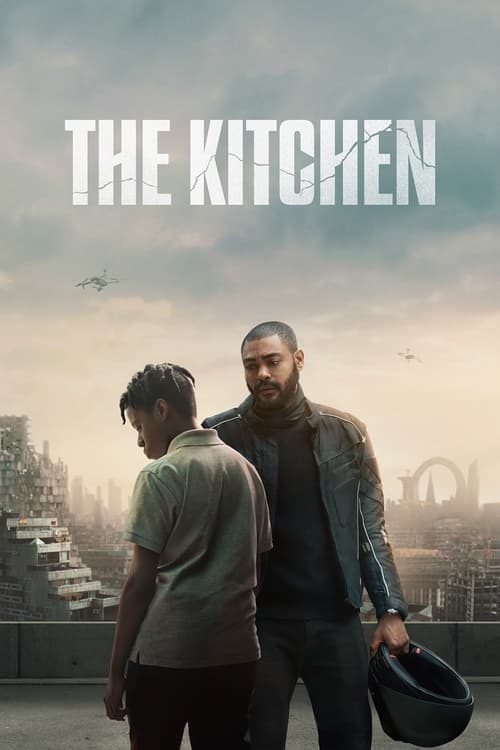
In 2044 London, where social housing has been stripped away and the last surviving estate, The Kitchen, is being systematically pushed toward demolition, the film begins with a city that already feels like it is erasing itself. The estate stands as a dense, overburdened refuge surrounded by wealth, surveillance, and state pressure, a place the authorities speak about as if it is already gone. Drones and broadcast messages hover over the community like instruments of inevitability, while the residents cling to one another under the constant threat of eviction and violence.
At the center of this world is Izi, a man who works at Life After Life, a futuristic funeral service that turns death into a grimly practical transaction. For families too poor to afford a conventional burial, the company offers a system in which the dead are transformed into trees, something the living can visit until the remains are planted elsewhere. The idea is grotesque and tender at once, and it fits the film's bleak logic: in this society, even mourning is shaped by scarcity. Izi moves through that world with a hard, restless ambition. He is not a revolutionary and does not present himself as a hero. He is someone who has learned to survive by keeping his head down, speaking carefully, and trying to claw his way out of the estate that made him.
That guarded life changes when he encounters Benji, a 12-year-old boy who has just lost his mother. Benji arrives at the funeral chapel and notices Izi slipping inside, then asks him whether he knew his mother. Izi answers that he met her years earlier, but he does not explain how or why, and the evasiveness immediately gives the moment emotional weight. Benji is grieving, but he is also alert, probing at the edge of a mystery he instinctively senses matters more than the adults are admitting. Izi, in turn, tries to remain detached, but the boy keeps pressing into his life with the persistence of someone who has already been abandoned too many times to accept another disappearance.
Benji is not simply alone; he is staying with Staples, the leader of a group of vigilante activists who have become part of the estate's fractured resistance. Staples stands for the angrier, more direct kind of survival in The Kitchen, where anger has hardened into tactics and the community's desperation is turning toward open confrontation. That backdrop matters because Benji is being pulled in two directions at once: toward the scrappy, militant energy of the older residents and toward the strange, reluctant tenderness Izi offers him. At first, Izi rejects the boy's attempts to get close. He keeps his distance, unwilling to be drawn into responsibility, unwilling perhaps to be reminded of the life he has already failed to protect.
Yet Benji does not go away. He keeps circling Izi, and over time the film allows the relationship to develop into something like a father-son bond. Izi begins bringing Benji into his orbit at Life After Life, eventually getting him to help with work at the funeral company. The scenes at the funeral service are among the film's most striking because they make grief feel procedural and intimate at the same time. Bodies are handled not with grandeur but with careful, exhausted necessity, and the tree-burial practice becomes a recurring visual reminder that the poor must turn even loss into something useful. In that setting, Izi becomes a teacher of sorts, showing Benji the mechanics of the job, while Benji in return forces Izi into the role of caretaker. Their bond grows not through speeches but through routine, proximity, and the awkward tenderness that comes from sharing labor in a place built on mourning.
But the story keeps tightening around them. The Kitchen itself is under siege, its residents pressured to leave because the land has become too valuable for the poor to keep occupying. This pressure is not abstract. It comes in the form of police raids, official messaging, and the constant sense that the state considers the community disposable. The estate is surrounded by a system that has already removed social housing everywhere else, and The Kitchen survives only as a last remnant that the rich and powerful are eager to erase. The film repeatedly returns to the estate's corridors, courtyards, and apartments, showing them as lived-in spaces full of memory and solidarity, but also as vulnerable territory under occupation. The DJ voice of Lord Kitchener, voiced by Ian Wright, becomes one of the community's emotional anchors, a steady presence that helps knit the residents together when the outside world presses in.
Izi's personal conflict becomes sharper as he starts wanting more for himself. He is disenchanted with being trapped at the bottom of the social order, and he dreams of escaping the estate entirely. One account of the film describes him as willing to compromise his morals and his people for the chance to get into a single-room flat, and another source notes that he is desperate to leave The Kitchen behind for a more luxurious apartment outside it. That desire is crucial to understanding him: he does care, but he also wants out so badly that caring becomes inconvenient. He does not merely want a better life; he wants distance from the entire social reality that made him. The film treats this not as a clean moral failure but as a bitter contradiction. Izi is nurturing with Benji one moment and self-protective the next, always torn between the pull of responsibility and the lure of escape.
At some point in that middle stretch, the emotional center of the film begins to shift from survival to betrayal. Izi considers giving up the apartment he has long wanted so that it could accommodate both him and Benji, suggesting that he is finally ready to choose connection over ambition. But the impulse does not hold. His selfishness wins out, and he leaves Benji behind without explanation to move into the luxurious apartment outside The Kitchen that he has worked so hard to obtain. The abandonment lands like a cut. It is not just that Izi leaves; it is that he leaves in the middle of a collapse, after teaching the boy to trust him. Benji is not merely disappointed. He is once again stranded in a place that the state is preparing to obliterate, now without the one adult who seemed to be stepping toward him.
What follows is a devastating sequence of parallel pressures. As Izi sits in his new single-room comfort, police raid The Kitchen with renewed force, violently attacking residents in order to clear the area for redevelopment. The state's language of order and progress masks what is plainly happening: a poor community is being beaten out of existence so that wealth can replace it. The film makes the raids feel like a physical manifestation of abandonment. Sirens, pounding doors, shouting, and the oppressive presence of armed force fill the estate, while the residents scramble to protect one another and their homes. The Kitchen is no longer just endangered; it is actively being broken.
Benji, meanwhile, gets pulled deeper into resistance. He is inducted into Staples' group and joins a counterstrike against the upper-class commercial district of Burlington Arcade, where displaced residents lash out at the structures that benefit from their eviction. The contrast is powerful: one side holds mourning services and sings hymns, while the other smashes shop windows and strikes back at the glittering world that profits from their removal. During the intercut sequence, mourners from The Kitchen attend the funeral service for Lord Kitchener at Life After Life, singing "How Great Thou Art" and welcoming Izi with a warmth that visibly moves him. The music and the communal grief shake him out of his self-protective shell. He sees, perhaps for the first time, that the people he has tried to outgrow are also the people who would embrace him if he let them. The emotional pressure of that scene forces a shift in him, and he begins to realize how deeply he has isolated himself.
Benji's movement through the rebellion is less triumphant than frightening. As the youths attack the district, he looks on in fear rather than exhilaration, and the film makes clear that he does not fully understand the violence into which he has been folded. He is a child carrying grief, anger, and confusion, being pushed into adult conflicts by a world that has already taken his mother and threatened his home. When the chaos subsides, he runs back, and Izi finds him. Their reunion is not clean or ceremonial. It is desperate, the kind of collision that occurs when people who have hurt each other are forced to recognize they cannot remain apart.
In that reunion, the film reveals the deepest truth binding them together. Benji has been telling Izi what his mother said about his father, and the implication has hovered over the relationship long before it is spoken aloud. The revelation finally lands when Izi admits what he has been refusing to say: he is Benji's father. The moment is not staged as a grand melodramatic confession. It comes as a late, raw surrender, a man finally giving in to the truth after spending the entire film trying to outrun it. This is the film's central twist and moral revelation. Izi's connection to Benji is not accidental, not metaphorical, but biological and deeply personal. That fact recontextualizes everything: his discomfort in the chapel, his reluctance, his inability to fully abandon the boy, and the guilt that has shadowed every attempt to escape.
The confession does not undo what has already happened. If anything, it makes the damage more painful. Izi tells Benji that he wants to be whatever the boy needs, but that admission comes at the worst possible moment, with the outside world crashing in around them. The police have returned again, and this time the violence is more immediate, more relentless. The residents fight back as the enforcement effort escalates, and the estate becomes a battlefield in the full sense of the word. In one account of the climax, Izi has to kill a police officer to pull Benji into his former loft, underscoring how far he is dragged from passivity into direct, lethal struggle. The act is not presented as heroic, only necessary in the moment, a desperate protective choice made in the middle of collapse.
Then the narrative compresses into the final siege. Izi and Benji end up hiding in Izi's apartment in The Kitchen as police arrive to raid the buildings. The apartment, which should have represented escape and aspiration, becomes a trap and then a refuge. The luxurious future Izi chose outside the estate cannot hold him; he is physically pulled back into the very place he tried to leave, and back into the relationship he nearly destroyed. In the final stretch, the emotional truth of the film comes into focus: Izi was always tied to these people, to this home, to this child. His dream of becoming separate from them was built on denial.
The ending is deliberately brutal in its uncertainty. One source states that the police break into Izi's apartment and the screen cuts to black, leaving Izi and Benji's fates unknown. Another account emphasizes that the final scene is built around their last conversation, with pounding in the hallway growing louder as they hold each other's attention in a fragile pocket of time. Izi's apology and confession land too late to stop the forces closing in, but they matter because they are the first fully honest words he has spoken to Benji. He tells the boy, in effect, that he is ready to be present, ready to be a father, ready to be whatever is needed. The film does not show a rescue, and it does not grant the audience relief. It leaves the pair on the threshold of impact, with unseen assailants breaking through the door as the world they live in finally catches them.
What makes the ending so haunting is that the external plot and the emotional plot converge at the same instant. The estate's destruction is not separate from Izi's failure as a father; it is the same logic expressed at different scales. A community is being evicted because it is poor, and a child is being abandoned because his father is frightened of remaining poor. By the time the door breaks down, the film has already shown its hand. The system is larger than individual redemption, but the relationship between Izi and Benji has still changed. Izi no longer sees the boy as an inconvenience or a passing connection. He sees him as his son, and that knowledge arrives just as the walls close in.
The final scene refuses to tell the audience whether they survive the raid. The camera does not grant a comforting answer. Instead, it ends on the sound and force of intrusion, on the moment before the violence lands, preserving the uncertainty as part of the film's emotional design. That unresolved ending is not a dodge so much as the film's final statement: in a world built to erase people like the residents of The Kitchen, survival itself has become unstable, and the most important act may be the refusal to let the system define the meaning of family, home, or belonging even as it tries to tear all three apart.









What is the ending?
In the ending of The Kitchen, Izi brings Benji back to The Kitchen, and the two finally talk honestly about their bond, with Izi admitting that he wants to be Benji's father. While they are inside Izi's old apartment, the police launch another violent raid on the estate, and the film ends as the pounding at the door grows louder and the screen cuts off before the outcome is shown.
Izi, after spending much of the film trying to move away from The Kitchen, reaches a final turning point and chooses Benji over his separate life. Benji, who had earlier run away after rejecting the violent path around him, returns to Izi and asks the question that has been hanging over them: whether Izi is his dad. Izi does not answer with a simple declaration at first, but he does ask Benji if he would want him to be, and that moment becomes the emotional center of the ending.
Earlier in the final stretch, Benji has already turned away from the gang violence he was drawn into, and Izi has already shifted from self-protective distance toward responsibility. The two of them go back to The Kitchen together, and one account says Izi gives Benji the plant said to have grown from Benji's mother's ashes before returning with him to plant it on the communal terrace. That act is presented as a return to shared life and shared memory, rather than the isolated future Izi had been chasing.
The last scene stays inside the apartment as the outside conflict closes in. The police assault on The Kitchen intensifies, the noise at the door gets louder, and then the film cuts to black before showing whether the officers break in or what happens next. The fate of Izi and Benji is left unresolved on screen, but the ending clearly places them together, trapped in the apartment, facing the raid as the final image and sound.
Is there a post-credit scene?
No. The Kitchen (2023) does not have a post-credit scene.
The film ends with its final scene, and the available explanation of the ending does not indicate any mid-credits or post-credits stinger. IMDb's synopsis also identifies the film as the dystopian London story centered on Izi and Benji, but it does not list any post-credit sequence for it.
How does Izi first meet Benji, and why does Benji start following him?
Izi meets Benji at the funeral home where he works, after Benji has come to say goodbye to his mother. Benji notices Izi's quiet presence and asks whether he knew his mother, and Izi answers only that he met her years earlier. Benji then latches onto Izi because he has lost his mother and has no clear guardian or stable home, which is part of why Izi is drawn into Benji's life despite initially resisting him.
Why does Izi leave Benji behind to move into the luxury apartment, and what changes after he comes back?
Izi leaves because he has worked hard to secure a better apartment outside The Kitchen and wants a life beyond the estate. After he returns, the situation has worsened: he and Benji are forced to hide in Izi's apartment in The Kitchen when the police arrive to raid the buildings, turning Izi's attempt to escape into a desperate return to the community he tried to leave.
Who is Staples, and what is his connection to Benji?
Staples is the leader of a group of vigilante activists, and Benji is staying with him when Izi learns more about the boy's situation. That connection is important because it explains why Benji is not simply alone in the street; he is tied to a larger, more confrontational resistance presence inside The Kitchen.
What is Izi’s job at Life After Life, and how does it connect to Benji’s mother?
Izi works at Life After Life, a futuristic funeral service where families who cannot afford a traditional burial can have their loved ones turned into trees that they can visit before the remains are planted elsewhere. Benji comes to this funeral home to say goodbye to his mother, which is the setting for Izi and Benji's first meaningful interaction and the point where Benji begins orbiting Izi's life.
What happens when the police raid The Kitchen and Izi’s apartment?
When the police arrive to raid the buildings, Izi and Benji are trapped hiding in Izi's apartment in The Kitchen. Izi pulls Benji close and keeps him from turning toward the door while the police hammer against it, and then the police break in as the film cuts to black, leaving their immediate fate unresolved.
Is this family friendly?
No--The Kitchen (2023) is not especially family friendly, and it carries an R rating for language.
Potentially objectionable or upsetting elements for children or sensitive viewers include: - Frequent strong profanity, especially repeated use of the F-word. - Violence and rough physical aggression, including people being beaten and violently arrested by riot police. - Intense social-dystopian themes, with a bleak setting centered on poverty, housing insecurity, and hardship. - Some drug and smoking content, including smoking and some drinking. - Mild frightening or tense scenes, according to IMDb's parental guide.
If you want, I can also give you a more detailed parent-style breakdown by category without spoilers.








