
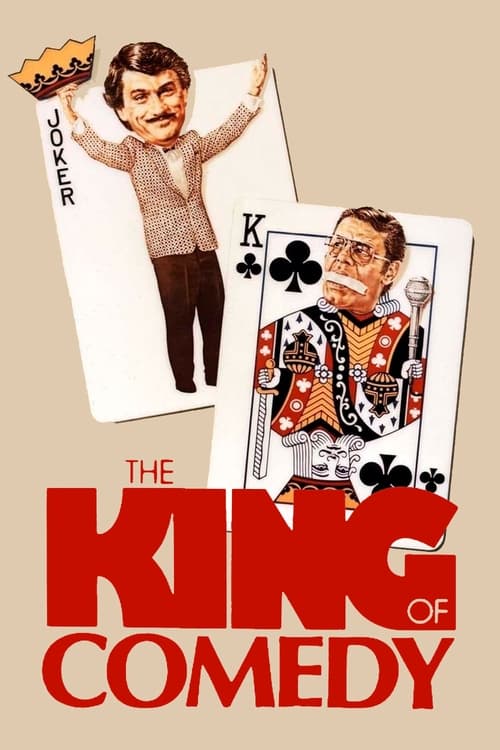


























Popular
What motivates Rupert Pupkin to kidnap Jerry Langford?
How does Rupert's relationship with his mother influence his actions?
What role does Masha play in Rupert's pursuit of fame?
How does Rupert's perception of reality differ from that of others?
What is the significance of the talk show setting in Rupert's journey?
Should I watch it?
Ask Your Own Question

What is the plot?
Sorry, we aren't able to watch and write up a full detailed plot yet. Check back in a few days.









What is the ending?
In the ending of "The King of Comedy," Rupert Pupkin, after a series of desperate attempts to gain fame, finally gets his moment in the spotlight by kidnapping the famous talk show host Jerry Langford. The climax unfolds during a live broadcast where Rupert, having taken control of the situation, delivers a monologue that captivates the audience. Ultimately, he is arrested, but the film concludes with him receiving the fame he always desired, as he is celebrated for his performance.
Now, let's delve into the ending in a more detailed, chronological narrative.
As the film approaches its climax, Rupert Pupkin, played by Robert De Niro, has become increasingly desperate to achieve his dream of becoming a successful comedian. He has been fixated on Jerry Langford, the renowned talk show host portrayed by Jerry Lewis. In a bold and reckless move, Rupert decides to kidnap Jerry to force him to give him a chance on his show.
The scene shifts to a dimly lit room where Rupert, along with his accomplice Masha, played by Sandra Bernhard, has taken Jerry hostage. The tension is palpable as Rupert, with a mix of anxiety and excitement, prepares for the moment he has long awaited. He is both nervous and exhilarated, embodying the duality of his character--an insecure man desperate for validation and a delusional dreamer who believes he is destined for greatness.
As the live broadcast of Jerry's show approaches, Rupert's internal conflict becomes evident. He oscillates between fear of failure and the thrill of finally being in the spotlight. The scene transitions to the studio, where the audience is unaware of the unfolding drama. Rupert, now in control, is determined to seize this opportunity. He steps onto the stage, and the audience erupts in applause, mistaking him for a guest.
Rupert begins his monologue, and the camera captures his transformation from a nervous kidnapper to a confident performer. He delivers his lines with a mix of humor and desperation, and the audience is captivated. The scene is electric, filled with laughter and applause, as Rupert basks in the attention he has always craved. His performance is a culmination of his dreams, and for a moment, he feels like a king.
However, the reality of his actions looms over him. As the show progresses, the police are alerted to Jerry's kidnapping, and the tension builds. Rupert's moment of triumph is juxtaposed with the impending consequences of his crime. The audience, still unaware of the true situation, continues to cheer him on, further feeding his delusions of grandeur.
As the broadcast concludes, the police storm the studio, and Rupert is apprehended. The scene shifts to a stark, cold interrogation room where Rupert sits, handcuffed but still wearing a smug smile. He has achieved his goal of fame, albeit through criminal means. The irony of his situation is palpable; he is now a household name, but at what cost?
In the final moments of the film, Rupert is seen in a prison cell, reflecting on his journey. He is still filled with a sense of accomplishment, believing that he has finally made it. The film closes with a montage of his face, a mix of pride and delusion, as he envisions a future where he is celebrated as a star. The screen fades to black, leaving the audience to ponder the nature of fame, ambition, and the lengths one will go to achieve their dreams.
In summary, Rupert Pupkin's fate is one of ironic success; he becomes famous but is imprisoned for his actions. Jerry Langford, the victim of Rupert's obsession, is left traumatized but ultimately unharmed. Masha, who has been complicit in Rupert's scheme, fades into the background, her fate left ambiguous. The film concludes with a stark commentary on the pursuit of fame and the thin line between ambition and madness.
Is there a post-credit scene?
The King of Comedy, produced in 1982, does not have a post-credit scene. The film concludes without any additional scenes or content after the credits roll. The story wraps up with Rupert Pupkin, played by Robert De Niro, achieving his dream of becoming a successful comedian, albeit through unconventional and morally questionable means. The ending leaves viewers with a sense of ambiguity regarding his future and the nature of fame, but there are no further scenes to explore these themes after the credits.
What motivates Rupert Pupkin to kidnap Jerry Langford?
Rupert Pupkin, played by Robert De Niro, is driven by an intense desire for fame and recognition. He believes that by kidnapping the famous talk show host Jerry Langford, he will force Jerry to acknowledge his talent and give him the opportunity to perform on his show. Rupert's obsession with becoming a successful comedian blinds him to the moral implications of his actions, as he is consumed by his fantasies of stardom.
How does Rupert's relationship with his mother influence his actions?
Rupert's relationship with his mother is complex and deeply intertwined with his motivations. He lives with her and often seeks her approval, which he equates with validation of his dreams. His mother, who is supportive yet delusional about his potential, reinforces his belief that he is destined for greatness. This dynamic fuels Rupert's desperation to achieve fame, as he wants to prove himself not only to the world but also to her.
What role does Masha play in Rupert's pursuit of fame?
Masha, portrayed by Sandra Bernhard, is an obsessive fan of Jerry Langford who becomes entangled in Rupert's plans. Her infatuation with Jerry mirrors Rupert's obsession, and she initially sees Rupert as a kindred spirit. Masha's unpredictable behavior and her own fixation on Jerry add a layer of chaos to Rupert's scheme, as she becomes both an ally and a potential threat to his plans, ultimately complicating his pursuit of fame.
How does Rupert's perception of reality differ from that of others?
Rupert Pupkin's perception of reality is heavily skewed by his fantasies of fame and success. He lives in a world where he believes he is destined to be a star, often rehearsing his stand-up routines in front of a mirror and imagining himself in the spotlight. This disconnect from reality is starkly contrasted with how others view him, as they see him as a delusional outcast. His inability to recognize this difference drives many of his misguided actions throughout the film.
What is the significance of the talk show setting in Rupert's journey?
The talk show setting serves as a critical backdrop for Rupert's journey, symbolizing the pinnacle of success he yearns for. Jerry Langford's show represents the ultimate platform for recognition, and Rupert's obsession with it highlights his desperation to break into the entertainment industry. The talk show becomes a stage for Rupert's fantasies, where he imagines himself as a celebrated comedian, and ultimately, it is the site of his climactic confrontation with Jerry, encapsulating his struggle for validation.
Is this family friendly?
"The King of Comedy," directed by Martin Scorsese, is not considered family-friendly and contains several elements that may be objectionable or upsetting for children or sensitive viewers. Here are some aspects to consider:
-
Dark Themes: The film explores themes of obsession, fame, and the lengths one might go to achieve success, which can be unsettling.
-
Violence: There are scenes that depict violence, including a moment where a character is threatened, which may be distressing.
-
Mental Health Issues: The protagonist, Rupert Pupkin, exhibits signs of delusion and obsession, which may be uncomfortable for viewers sensitive to mental health portrayals.
-
Language: The film contains strong language and adult dialogue that may not be suitable for younger audiences.
-
Social Isolation: The film portrays feelings of loneliness and desperation, which could be upsetting for some viewers.
-
Manipulative Behavior: The protagonist engages in manipulative and unethical behavior to achieve his goals, which may be troubling for some audiences.
These elements contribute to the film's mature themes and overall tone, making it more appropriate for adult viewers.









