










Popular
How does Jack first approach Oliver at Spring Manor, and what does he want from him?
What is special about the bottle of pills Oliver receives, and how does it affect his life?
Who is Oliver’s wife Caroline, and what role does she play in the story?
What happens to Oliver’s daughter, and how does her disappearance change his situation?
Who is the unscrupulous business partner tied to Oliver’s deal, and what is his connection to the story?
Should I watch it?
Ask Your Own Question

What is the plot?
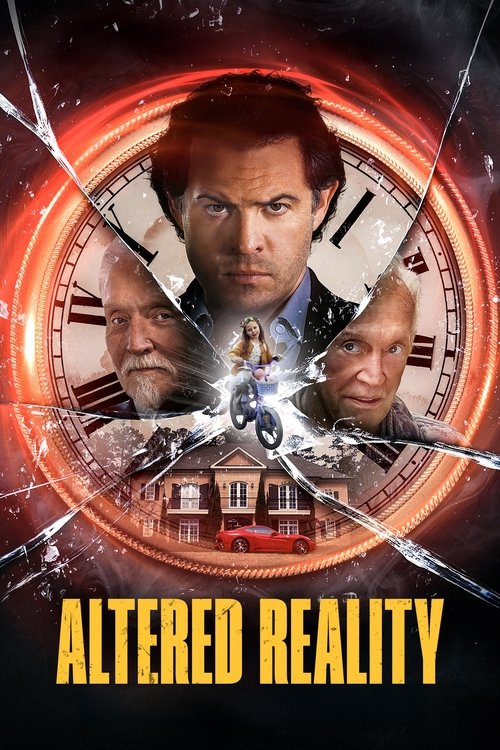
Altered Reality opens at Spring Manor, where Oliver Cook is already living inside the emotional wreckage of a ruined marriage and a family crisis he cannot outrun. He is a wealthy businessman, but wealth has not protected him from grief, suspicion, or the sense that something in his life has gone terribly wrong. At the manor, he crosses paths again with Jack, the old caretaker from his past, whose presence feels less like a coincidence than a summons from fate itself.
Jack's reappearance is the first crack in the film's reality. He does not come as a friendly visitor, but as a man carrying a burden of knowledge, someone who speaks to Oliver as if they have unfinished business that reaches far beyond the present moment. According to the most reliable synopses, Jack makes Oliver an impossible request, and when Oliver refuses, Jack simply vanishes, leaving behind a bottle of pills marked with alien symbols--a medicine that "doesn't yet exist." The moment is uncanny and clinical at once: a small object in Oliver's hand, harmless-looking except for the eerie markings, but loaded with the implication that time itself has been bent around it. Oliver is standing at the edge of a deal he does not understand, and he is about to step through it anyway.
Oliver takes the medicine, and the film's central premise activates. The pill is not just a cure; it is a miracle drug from outside ordinary time, and once Oliver commits to it, his life begins changing at impossible speed. The change is seductive at first. His financial prospects explode, and the story describes him and his wife Caroline Cook becoming billionaires after he decides to mass-produce and sell the product. What begins as a possible escape from desperation becomes a wholesale rewrite of his world. The home that once held tension now becomes a place of sudden power and luxury, but the glitter of success only makes the fracture lines in the marriage more visible. Caroline, already strained by Oliver's emotional distance, now watches him with growing unease as the strange new life around him grows harder to explain.
The film carefully lets the material signs of success coexist with emotional decay. Oliver's riches do not heal anything; they intensify everything. The marital damage that was already there deepens, and the story suggests that Oliver's habit of burying himself in work has already left his family exposed before the supernatural bargain even begins. Caroline believes Oliver is cheating on her, and the suspicion does not come from nowhere. As Oliver's life becomes more chaotic, "seductive women" begin appearing around him, and Caroline reads their presence as part of a manipulation game designed to make her think the worst of him. Whether these women are genuinely involved, engineered distractions, or manifestations of the film's twisting reality remains part of the atmosphere of distrust, but the effect is immediate: Caroline and Oliver are no longer merely unhappy spouses. They are opponents trying to interpret the same collapsing world from opposite sides.
At the same time, the miracle drug has bought Oliver a kind of public triumph that cannot last. His business success creates wealth, but wealth does not bring stability. It creates exposure. It creates dependence. It creates the sense that something borrowed from the future is now demanding repayment in the present. The alien-marked bottle is the film's central object of temptation, but also its warning label. The synopsis repeatedly frames the story as one about changing the past and suffering consequences, and the more Oliver tries to force his life into a better shape, the more reality seems to slip out of alignment around him.
Then comes the film's most devastating blow: Oliver and Caroline's daughter vanishes. The exact public summaries do not preserve every detail of the disappearance, but they consistently identify it as the emotional center of the film, the event that transforms the supernatural bargain into a full-scale tragedy. One description says the daughter goes missing "without any clues," and another frames the story as Oliver solving the mystery after "his daughter vanishes," leaving him with riches that offer no solace. The loss is what strips the glamour from the miracle. What looked like an answer now looks like a curse. The money is suddenly useless against the one thing Oliver wants back most. The film tightens around this absence, turning every scene into an effort to understand whether the girl is dead, kidnapped, or hidden by some larger manipulation of time and memory.
Oliver's emotional response is not a clean turn toward heroism. He is still a man corrupted by success, secrecy, and guilt. But the disappearance of his daughter forces him into motion. He turns to his attorney, Cooper, for help, making Cooper a key ally in the unfolding crisis. The available plot summaries do not fully clarify whether Tobin Bell's character is Cooper or an unscrupulous business partner in some accounts, but the most detailed public synopsis identifies him as Oliver's attorney and handler once the situation deteriorates. That ambiguity itself fits the film's broader uncertainty: trustworthy names and stable roles keep sliding under pressure. Oliver cannot even be sure who is helping him and who is using him.
As Oliver searches for answers, the world around him grows increasingly warped. He is followed by seductive women, his marriage becomes more fragile, and his relationship with Caroline deteriorates under the weight of accusation and fear. The atmosphere turns paranoid. Every encounter feels like it may be staged. Every conversation seems to have a second meaning. The film's marketing and reviews emphasize "morphing of past and present," and that is how the story appears to unfold: not in a straight line, but as a series of emotional and temporal collisions in which Oliver's present desperation keeps slamming into unresolved choices from earlier in his life.
The most important revelation the film withholds, and then slowly pushes toward, is that Oliver's past actions may hold the key to the daughter's fate. The sources do not provide a scene-by-scene account of every reveal, but they agree that the mystery is not simply whether the daughter was murdered or kidnapped; it is whether Oliver's own history caused the entire catastrophe. That is what makes the story more than a missing-child thriller. It becomes a moral reckoning. The miracle drug does not merely grant power; it forces Oliver to confront the cost of every choice that brought him here.
Caroline, who begins the film as a spouse reacting to betrayal and emotional neglect, gradually shifts from suspicion to shared purpose. The marriage has been strained almost to breaking, but as the reality around them fractures, the couple eventually moves from recrimination toward joint investigation. Their conflict does not disappear; it changes form. Instead of fighting over whether Oliver is cheating, they are forced to confront the possibility that the thing destroying them is bigger than infidelity, bigger than business, even bigger than grief. They need each other to understand what happened to their daughter, and that need becomes the first real bridge back across the gulf between them.
The film introduces a second major antagonist or disruptive force in Alex, who enters Oliver's path later and deepens the threat surrounding the investigation. The public summaries do not specify Alex's full function with the same clarity as Oliver, Caroline, Jack, or Cooper, but they identify Alex as a major obstacle or villain figure who becomes part of the escalating conflict. With Alex in play, the story is no longer just about internal collapse. It becomes a contest involving people who may want the drug, the money, the secrets of the past, or all three. Oliver is now trapped between the supernatural bargain at Spring Manor and the human predators drawn to the power it creates.
The deeper Oliver pushes into the mystery, the more the film appears to blur the line between the daughter's disappearance and the world that drug helped build. The summaries hint that the story's central question is whether the child was murdered or kidnapped, but they also suggest that the answer is tied to Oliver's past and possibly to the time-bending nature of the miracle medicine itself. That means the investigation is not just a search for a missing girl. It is a search through altered memory, altered consequence, and altered identity. Oliver is trying to determine whether he can reclaim his daughter, but the story keeps making the same point in different ways: the past is not inert here. It is active. It is changing shape around him.
The tension builds through confrontations that the public summaries outline only in broad strokes. Oliver first confronts Jack at Spring Manor when Jack presents the impossible request and leaves the medicine behind. That encounter establishes the rules of the film's supernatural bargain. Later, Oliver and Caroline confront each other as the marriage buckles under wealth, suspicion, and the strange women circling Oliver's life. Then Oliver confronts the practical and moral consequences of mass-producing the drug, with Cooper at his side as the story moves into the dangerous terrain of business, secrecy, and exploitation. Finally, Oliver and Caroline confront the truth about their daughter, though the sources do not disclose the exact mechanics of the confrontation or the full chain of discoveries leading into it.
Because the available summaries do not give a precise death count, the film's death toll cannot be responsibly reconstructed in full. The one fatality mentioned in a review is Oliver's young daughter, described there as having died under "some strange circumstances" months earlier, though that conflicts with other summaries that describe her as missing rather than dead. The safest reading is that the movie deliberately keeps her fate unstable in the public record, using the uncertainty itself as part of the mystery. What is clear is that the film's core tragedy is the loss of the child, whether through death, abduction, or some altered sequence of events that makes the two states difficult to separate. Beyond that, the public plot descriptions do not provide enough reliable detail to name additional deaths or their causes.
As the story moves toward its climax, Oliver's desperation becomes the engine of the final act. He wants his old life back, but "old life" now means more than money or status. It means repairing the catastrophe that followed the miracle. It means returning to a reality in which his daughter is safe, his marriage is not poisoned by suspicion, and his choices have not generated this maze of consequences. That desire gives the film its emotional shape. Oliver is not just chasing a missing person; he is trying to undo the moment when he accepted a future he did not understand.
The climax, as the public sources describe it, centers on Oliver's continuing attempt to understand the pact, the drug, and the disappearance of his daughter while confronting the moral consequences of trying to change the past. The exact final confrontation is not spelled out in the available summaries, but the structure is clear enough to see the thematic resolution. The film is not interested in a simple victory. It is interested in the price of getting what you want. By the end, Oliver has to face the fact that the miracle that made him rich also destabilized his family and opened the door to irreversible loss.
What the film does resolve is its emotional trajectory. Oliver and Caroline's marriage, broken by accusation and grief, is forced into a new kind of honesty as they work together to uncover the truth. The supernatural bargain at Spring Manor no longer looks like a gift; it looks like a trap dressed as salvation. Jack's role as the mysterious caretaker becomes the origin point of the tragedy, the man who introduces Oliver to the impossible and then vanishes, leaving him to deal with the fallout. Cooper remains the practical ally in the midst of chaos, but even he cannot turn the story into something safe or manageable. Alex's arrival adds pressure and danger, reinforcing that the forces around Oliver are not merely emotional but adversarial.
The final emotional note, according to the reliable summaries, is one of redemption and choices rather than triumph. The film closes on the idea that altering reality carries consequences, and those consequences cannot simply be wished away. Oliver's wealth never becomes a substitute for love, and his attempt to use a miracle to control loss only magnifies it. The ending therefore preserves the story's central wound: a father who wanted to fix everything finds that fixing one thing may have broken everything else. Caroline's role in that ending is crucial because she is not merely a victim of Oliver's decisions; she becomes part of the search for truth, part of the confrontation with what the family has become, and part of the possibility--however limited--of surviving what the past has done to them.
So the film begins in eerie stillness at Spring Manor, with Jack appearing like a memory that should not be alive, and it ends with Oliver trapped inside the moral and emotional aftermath of accepting a medicine that "doesn't yet exist." Between those moments, wealth rises, trust collapses, a daughter vanishes, a marriage fractures, and reality itself seems to fold around the choices Oliver tries so hard to outrun.








What is the ending?
The ending is a happy resolution in which Oliver gets a second chance to fix the damage in his life, and the loss that drives the story is ultimately undone.
At the end of the film, Oliver's desperate wish to recover his family life is answered through the altered reality created by the mysterious pills and Jack's intervention. The story closes with Oliver no longer trapped in the bleak version of events that followed his rise in fortune and the disappearance of his daughter, and the film leaves him in a more hopeful place with his family situation restored rather than broken.
Scene by scene, the ending plays out like this:
Oliver reaches the point where the consequences of the miracle drug and the deal behind it can no longer be ignored. His daughter's disappearance has left him devastated, and the wealth that once seemed to solve his problems gives him nothing in return. In the final stretch, the story turns toward reversal rather than punishment, with the altered timeline and supernatural bargain resolving in Oliver's favor.
Jack, the caretaker tied to the pills and the earlier offer, is part of the final movement of the story that pushes Oliver toward redemption rather than destruction. The film frames Jack as the figure connected to the chance Oliver was given, and the ending uses that connection to bring the family conflict to a close.
Oliver's fate is survival and restoration: he ends the film having been given a way back from the ruined version of his life. Caroline's fate is also resolved by the ending's reversal, since the film's central loss is the disappearance of Oliver's daughter, and the ending restores the family outcome instead of leaving her missing. Jack's role ends as the catalyst for that change, with his influence completed once Oliver's reality is set right.
If you want, I can also give you a more detailed "last 10 minutes only" version in the same simple narrative style.
Is there a post-credit scene?
I could not verify any post-credit scene for Altered Reality (2024) from the available sources. The film's listings and synopsis describe the plot and credits, but none of the provided sources mention an extra scene after the credits.
If you want, I can also help you check whether the movie has a mid-credit scene versus a true post-credit scene.
How does Jack first approach Oliver at Spring Manor, and what does he want from him?
According to the film's plot description, Jack is a mysterious caretaker who approaches Oliver while Oliver is isolated at Spring Manor and makes him an impossible request. When Oliver refuses, Jack vanishes, leaving behind a bottle of medicine that does not yet exist.
What is special about the bottle of pills Oliver receives, and how does it affect his life?
The pills are described as a miracle drug marked with alien symbols or as medicine that does not yet exist. Taking them gives Oliver sudden wealth and healing power, but it also triggers major consequences that strain his family life and set the story's central conflict in motion.
Who is Oliver’s wife Caroline, and what role does she play in the story?
Caroline is Oliver's wife, and the story follows how the couple deals with the fallout of Oliver's sudden success and the chaos that follows their family crisis. One review notes that the film spends much of its runtime showing Oliver and Caroline reckoning with the consequences of fame, wealth, and outside pressure on their marriage.
What happens to Oliver’s daughter, and how does her disappearance change his situation?
Oliver's daughter disappears during a family outing at Spring Manor after his fortunes improve. Her disappearance becomes the central crisis of the story, leaving Oliver devastated and forcing him to confront the cost of the deal he made and the consequences of trying to get his old life back.
Who is the unscrupulous business partner tied to Oliver’s deal, and what is his connection to the story?
The plot summary identifies an unscrupulous business partner, played by Tobin Bell, as part of the pact Oliver unwittingly enters after taking Jack's medicine. This character is tied to the dark side of Oliver's new fortune and the supernatural bargain driving the narrative.
Is this family friendly?
Altered Reality (2024) does not appear to be a family-friendly movie for young children. It is a sci-fi/mystery/thriller centered on a man, a miracle drug, moral compromise, and a missing child, which suggests emotional intensity and upsetting subject matter rather than light or broadly kid-appropriate content.
Potentially objectionable or upsetting aspects may include: - A child going missing / a family crisis involving a daughter, which could be distressing for sensitive viewers. - Mature family conflict, including strain in the marriage and emotional breakdowns tied to grief and trust issues. - Thriller/supernatural tension, with suspenseful and possibly frightening scenes built around an uncanny caretaker, strange pills, and altered reality elements. - Themes of greed, moral compromise, and consequences, which are more suited to teens and adults than young children. - Possible implied death or past tragedy involving the family, based on reviews discussing a deceased young daughter and unresolved grief.
If you want, I can also give you a simple age-suitability recommendation like "okay for older teens," "not for kids under 13," or "best for adults only."








