


















Popular
How does Bosco first plan his prison escape, and what role does the lonely-hearts ad play in it?
Who is the woman Bosco meets through the personal ad, and how does she help him?
What is The Bull’s role in Bosco’s escape plan?
Why is Bosco so desperate to escape before the trial or sentencing period is over?
What kind of prison is Bosco held in, and why does that matter to the escape story?
Should I watch it?
Ask Your Own Question

What is the plot?
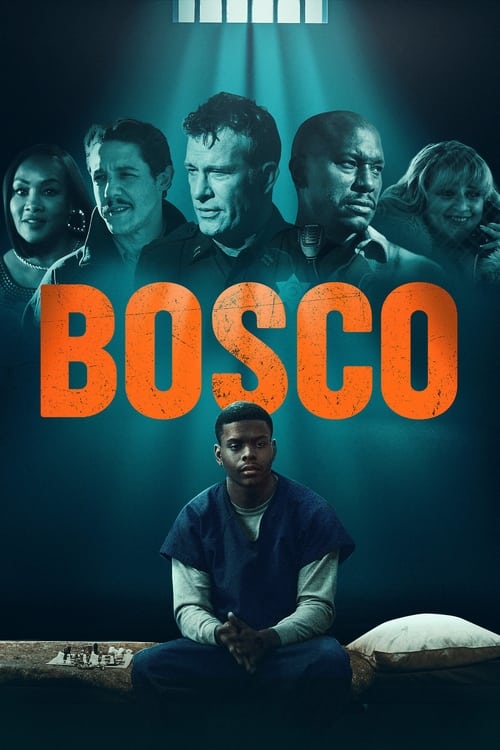
Bosco opens in 1985, with a young Quawntay Adams--the boy who will one day become known as Bosco--absorbing a brutal lesson from his father about how to survive on the streets. The advice is harsh and stripped of tenderness, and it establishes the emotional DNA of the film immediately: Bosco is being raised in a world where violence, fear, and self-protection are treated as necessary skills. In the flashbacks that follow, his mother appears as the counterweight to that world, trying to shield him from the criminal influence of his father and the path that seems to be waiting for him. The film uses those early scenes to show that Bosco's later choices are not born in a vacuum; they are the product of a childhood shaped by instability, tough love, and the kind of survival logic that corrodes innocence before it can fully take root.
Time moves forward, and Bosco's life narrows into the fate the opening has been warning about. As an adult, Quawntay "Bosco" Adams is sentenced to 35 years for a marijuana-related offense--described across sources as attempted possession or possession of marijuana--and he is sent to a federal maximum-security prison where the story's main action unfolds in 2006. The prison is a gray, punishing machine of control, and Bosco is trapped inside one of its most suffocating spaces: solitary-style confinement, under constant surveillance, cut off from normal life and reduced to a body measured by guards, routines, and the walls of his cell. The film makes the prison feel less like a setting than a pressure chamber, a place where time itself becomes hostile. Bosco's days are marked by isolation, frustration, and the grinding humiliation of being watched while trying not to break.
The prison hierarchy is ruled by cruelty. The sadistic guard Hunt and his deputy/partner Ramos become the most immediate human obstacles in Bosco's path, using humiliation and force to enforce their authority over the inmates. Their presence gives the film much of its tension because they do not merely represent the institution; they embody its indifference. Bosco's suffering is not accidental in this environment. It is manufactured and repeated, and every interaction with Hunt or Ramos reinforces how little dignity the prison offers to the men inside it. The film's emotional center is therefore not action in the conventional sense but endurance: Bosco surviving one day, then another, while holding onto a reason not to collapse.
That reason arrives with devastating clarity when Bosco learns that his girlfriend is pregnant. The news changes the shape of the story instantly. Until then, his desire for escape is tied to survival, pride, and the basic human urge for freedom. After the pregnancy revelation, his escape becomes something more urgent and more intimate: he wants to be there for the birth of his first child. The film frames this as a turning point that gives Bosco a future to fight for. He is no longer escaping only because prison is unbearable. He is escaping because a life is coming into the world beyond those walls, and if he does nothing, he will miss it forever.
Bosco's path toward that escape begins in an unexpectedly fragile place: a Lonely Hearts ad. His neighboring cellmate, Bull, discovers the ad and pushes Bosco toward it, effectively nudging open the only door the prison cannot fully lock. The ad becomes a bridge between isolation and possibility, between one trapped person and another on the outside who is also searching for connection. Through that ad, Bosco meets Tammy, a woman whose role is initially ordinary and then increasingly pivotal. She begins as a voice on the other end of a line, but over time she becomes the person who will help make the escape real. Their relationship is one of the film's most important emotional threads. It is built on desperation, trust, and the strange intimacy that can grow when two lonely people recognize something honest in each other.
The film makes clear that the communication between Bosco and Tammy is both practical and deeply symbolic. On the practical side, she becomes the outside help he needs to move beyond the prison walls; on the symbolic side, she represents a human connection that survives the machinery of confinement. Their conversations carry the weight of the impossible. Bosco is a man speaking from inside the most controlled environment in the story, yet through Tammy he begins to imagine movement again. The Lonely Hearts ad is not just a plot device. It is a reminder that people in the worst circumstances still reach outward, still hope to be seen, still try to be chosen.
At the same time, the prison is tightening around him. Bosco's efforts to plan an escape are met by the constant threat of discovery, and the film emphasizes how precarious every step is. He manages to cut a hole in the ceiling, but when he ventures into the vents, he cannot initially find a suitable way out. The sequence plays as a slow accumulation of frustration rather than a triumphant breakthrough. He climbs, searches, and fails, trapped in the literal in-between space of the prison's hidden architecture. It is a powerful visual metaphor: even when he rises above his cell, he is still not free. The walls have simply changed form.
The pressure becomes unbearable when the young drug addict in the adjacent cell ends his life. The sources do not specify the method beyond that, but they make clear that the death is crucial to the emotional escalation of the story. Bosco's fury is aimed at Hunt's negligence, and that rage lands him in solitary confinement for a month. This is one of the film's major turning points because it strips Bosco down further while also hardening his determination. The death around him is not treated as a detached plot point; it is experienced as another proof of the prison's moral rot. The system kills through indifference as much as through force, and Bosco is punished for reacting like a human being.
Solitary confinement deepens his isolation, but it also deepens the emotional stakes with Tammy. During this period, Tammy begins to believe Bosco is cheating on her with another girl. The misunderstanding adds another layer of tension because it threatens the fragile trust that his escape depends on. The film uses this conflict to show how easily hope can be distorted when all communication happens under pressure and uncertainty. Bosco is fighting to preserve a future outside the prison while also trying to keep his connection to Tammy from collapsing under suspicion. For a while, the escape plan feels as unstable as the relationship supporting it.
Still, Bosco does not stop. As hope starts to thin, he eventually discovers a vent leading right outside. This is the breakthrough the film has been delaying, and it arrives with the force of revelation. The escape is finally possible, but possibility is not the same as success. Bosco now has a route, but he still needs the outside world to meet him at the other end. The plan comes together with Tammy waiting outside in her car, ready to pick him up once he gets through the vent. The image is simple and tense: prison on one side, freedom on the other, and a single human being carrying the line between them.
The night of the escape arrives, and the film tightens into a breathless near-success. Bosco prepares to jump through the vent and complete the break. The timing is exquisite and cruel, because just as everything is in motion, Ramos gets "randomly hit by an ounce of compassion"--the phrase used in the source to describe the unexpected event that disrupts the final moments of the plan. The result is that the guards are not oblivious long enough for Bosco to simply vanish cleanly. The escape does not unfold as a straight sprint to freedom; instead, it becomes a moral and psychological turning point. The prison system that has been brutal and inflexible suddenly benefits from one small shift in human behavior, and Bosco must decide what freedom will actually mean now that the obvious route is no longer the only thing at stake.
Even after getting out, Bosco does not experience freedom as a clean triumph. That is the film's final major revelation: there is more to freedom than being outside a cell. Bosco's escape succeeds, but what comes after is not simple victory. He encourages Tammy to go home and tell the police that she only picked him up because she believed he had been released. That instruction reveals how much Bosco understands the danger still circling them. He can run, but he can also see that his running would drag Tammy deeper into the consequences. He chooses, in effect, to protect the person who helped him. The emotional significance of that choice is enormous: his escape is no longer just about himself or even his daughter. It has become about responsibility.
The final confrontation is not with Hunt or Ramos, but with the idea of continued flight. Bosco could keep running because Tammy will lead the police to his motel room. Instead, he sits on the bed and waits as the authorities arrive. The scene is quiet, almost stunned in its stillness, and it transforms the story from a prison break into a meditation on identity. Bosco is no longer the man clawing for escape at any cost. He is the man who has realized that being physically outside prison does not automatically make him free if he is still acting from fear, impulse, and the wreckage of the past. In a powerful voiceover, he explains that he will never be truly free if he keeps running without a purpose. That line is the film's philosophical endpoint, the moment where the escape plot gives way to self-understanding.
The ending then widens beyond the dramatized story into real-life epilogue material. The film notes that Quawntay Adams was eventually released in 2020 after serving 16 years, and that since then he has been helping his community and other inmates while spending much of his time with his daughter so she can have the "chances he never did." That ending reframes everything that came before it. The escape is no longer just a thrilling prison-break success story. It becomes the beginning of a different kind of freedom--one rooted in accountability, fatherhood, and service. The movie closes with the sense that Bosco's greatest prison was never only the concrete and steel around him. It was also the life of damage, recklessness, and inherited survival that he had to confront before he could truly live.
No source provided enough detail to support a full account of every death or every blow-by-blow confrontation beyond the key events above, so the most reliable reading of the film is that its main violent turning points are the death of the adjacent-cell addict, Bosco's clash with the prison system through Hunt's negligence, and the final standoff of whether he will flee or accept the consequences. What is certain is that Bosco ends not with a conventional victory lap, but with a hard-earned moral choice. Bosco gets out, but he also stops running. He chooses to face the moment, to protect Tammy, and to begin the next part of his life not as a fugitive but as a father trying, finally, to do something with the freedom he has spent so long trying to seize.







What is the ending?
In the end, Bosco gets out of prison, reaches his daughter's birth, and then tries to survive after the escape. The story closes by showing that he is able to keep going, but the cost of his choices and the prison system around him stays with him.
Bosco ends with Quawntay "Bosco" Adams still centered on one goal: getting to his child and coming back to his family's life. The escape has already happened, and the final stretch follows the immediate consequences of that decision rather than the escape itself.
Scene by scene, the ending moves in this order:
Bosco is in motion after the prison break, no longer trapped in the cell that held him under constant watch. His focus is not on freedom in the abstract, but on the urgent, personal reason that pushed him to escape in the first place: his child and the family he wants to reach.
The woman who helped him through the lonely-hearts connection remains part of the escape's foundation. The ending keeps that help in the background as part of the chain of events that made the escape possible, but the story's attention stays on Bosco and the family he is trying to return to.
Bosco reaches the point where the birth of his child matters most to him. The film's ending ties that moment directly to his emotional drive: he is not running simply to run, but to be present for his first child's arrival and to reconnect with a future outside prison.
After that, the ending turns to what the escape means for him now. He is no longer only a man escaping confinement; he is also a father, a son, and someone forced to face the life that led him into prison. The film leaves him with the burden of what he has done and the hope that he can still build something different.
Bosco's fate at the end is that he survives the escape and continues forward with the possibility of a family life, but he does not simply walk away from the consequences. The story leaves him defined by both his determination and the cost of that determination.
For the other main characters at the end:
His daughter is born, and that birth is the emotional center of the ending.
The woman who helped him through the personal ad has fulfilled her role in helping him escape, and the story leaves her connected to that act of aid.
Bosco's father remains part of the background of the story as the influence that helped shape Bosco's earlier choices, but the ending's focus is on Bosco breaking away from that path.
The prison system remains what it has been throughout the film: the force that held him, pursued him, and framed the entire conflict.
The ending is built around a simple sequence of events: Bosco escapes, reaches the moment he was risking everything for, and then faces the aftermath of that choice as a father trying to move forward.
Is there a post-credit scene?
There is no confirmed post-credit scene for Bosco (2024) in the search results provided. The available results do not include a source specifically covering Bosco, so I can't verify that it has any extra scene after the credits.
If you want, I can help you check whether Bosco has: - a mid-credits scene, - a post-credits scene, or - nothing extra at all
using a more targeted source search.
How does Bosco first plan his prison escape, and what role does the lonely-hearts ad play in it?
Bosco's escape begins with a practical goal: he wants to get out of a federal maximum-security prison in time to be present for the birth of his first child. The lonely-hearts ad becomes the key opening that connects him to a woman outside prison, and that relationship gives him the outside help he needs to build the escape plan.
Who is the woman Bosco meets through the personal ad, and how does she help him?
The film's central outside helper is Tammy, a lonely Missouri woman Bosco connects with after replying to a personal ad. She becomes part of the escape plan, and the story presents her as the person whose relationship with Bosco helps make the prison break possible.
What is The Bull’s role in Bosco’s escape plan?
The Bull is Bosco's neighboring inmate, and he helps Bosco secure the materials needed for the escape. He is part of the practical prison-side support system Bosco relies on while preparing to break out.
Why is Bosco so desperate to escape before the trial or sentencing period is over?
Bosco is driven by the desire to see his newborn daughter for the first time. He is serving a 35-year sentence for a marijuana-related conviction and is under 24-hour surveillance in solitary confinement or a supermax environment, which makes his urgency feel immediate and personal rather than abstract.
What kind of prison is Bosco held in, and why does that matter to the escape story?
Bosco is held in a federal maximum-security prison wing, described in some coverage as a supermax setting, where he is under constant 24-hour surveillance. That level of security matters because the escape is not just a breakout from a regular facility; it is a high-risk attempt to beat extreme monitoring and controls.
Is this family friendly?
No, it is not especially family-friendly. Bosco is rated TV-MA, which signals mature content, and it is a prison-break thriller built around an adult criminal storyline.
Potentially objectionable or upsetting elements for children or sensitive viewers may include:
- Prison violence and peril: the film is set in a federal maximum-security prison and centers on an escape attempt, so tense confinement, threats, and danger are likely prominent.
- Adult crime themes: the story involves incarceration, criminal conduct, and the consequences of a serious drug-related conviction.
- Mature language and violent content: Rotten Tomatoes lists the TV-MA rating with "L|V," indicating strong language and violence.
- Emotional family material: the story involves a father trying to reach his child's birth and dealing with his past, which may be upsetting or heavy for younger viewers.
- Relationship abuse context: one source notes a woman in an abusive relationship is part of the story, which may introduce emotionally difficult subject matter.
If you want, I can also give a very short parent-style recommendation by age group, such as "okay for teens" or "not for kids under 16," based on the available content indicators.








