


























Popular
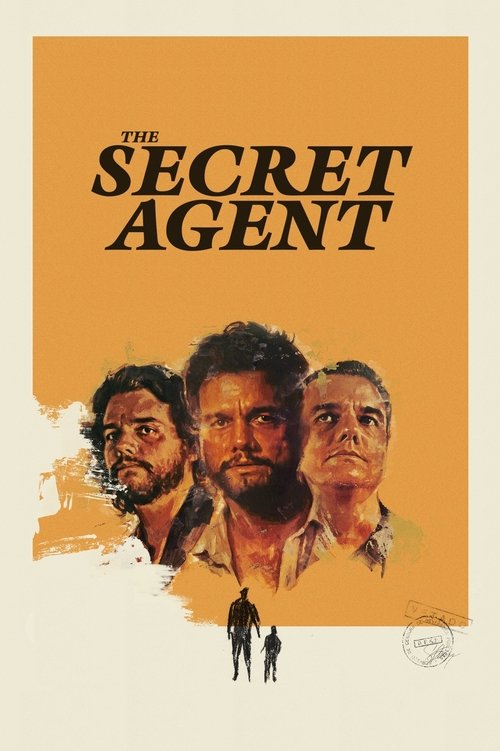
Who is Marcelo/Armando, and why is he on the run in The Secret Agent (2025)?
Who is Dona Sebastiana, and what role does her refuge play in the story?
Who are Claudia, Haroldo, and the Angolan refugees, and how are they connected to Marcelo?
Who are Euclides, Sergio, and Arlindo, and what are they investigating?
What is the relationship between Marcelo and his son Fernando in the film?
Should I watch it?
Ask Your Own Question

What is the plot?
The film opens in Brazil in 1977, during the Carnival week of the military dictatorship. Armando Solimões drives into a provincial gas station and finds a corpse lying in the open, covered by a newspaper. The attendant tells him the man was shot while trying to steal; police have not processed the scene because of the holiday. A local sergeant approaches, inspects Armando's car, and releases him to continue northward.
Armando arrives in Recife and makes his way to a modest house run by Dona Sebastiana, a former anarcho-communist who shelters political exiles and dissidents. Inside, he meets Clovis, Claudia, Haroldo, Thereza Vitória and her husband Antonio; they exchange news and food, and Armando takes the name "Marcelo Alves" to blend in. He goes to see his young son Fernando, who has been living with Armando's in-laws -- Sr. Alexandre and Dona Lenira -- since the death of Armando's wife Fátima. Armando allows Fernando to believe that Fátima died of pneumonia, though the account implies she was killed. Armando tells no one his full plan: he intends to secure a route out of Brazil and take Fernando with him.
Outside of Recife, a pair of hired guns in São Paulo -- Bobbi and Augusto Borba -- shoot a body placed in a car trunk and then dump the corpse into a river. The two then travel to meet with Henrique Ghirotti, former executive director of Eletrobras. Ghirotti recounts past slights and grievances against Armando and, in the meeting, hires Bobbi and Augusto to eliminate him.
The narrative briefly cuts to the present day. Two university students, Flavia and Daniela, sit in a small archival room listening to audio tapes of conversations between Dona Sebastiana and other members of the resistance, including a woman named Elza. The recordings will later guide Flavia's investigation into what happened in Recife decades earlier.
Back in 1977, Armando's network places him at the city's identification office so he can work under the alias Marcelo. He is instructed to pass on information to Euclides, the provincial civil police chief, who has a public face of authority but conducts himself with arrogance and cruelty. Euclides arrives at the office with his sons Arlindo and Sergio when a shark carcass consumed by the sea is opened at a local station: inside the shark, a severed human leg has been discovered. The news sends a ripple through the town. At the identification office, Armando watches with others as a deposition unfolds involving a woman whose housekeeper's daughter was struck and killed; the girl's mother, misled about schedule changes, bursts into the room and accuses her former employer, who cowers behind a door. Euclides presides with a grin, tormenting Hans, a Holocaust survivor whom Euclides insists might be a Nazi hiding in Brazil. Armando restrains his anger but takes note of Euclides's impulses and of the men around him.
A colleague, João, pulls Armando aside and warns him he has become a target of Ghirotti's vendetta. João arranges a private meeting with Elza, leader of a resistance group active in the northeast. Armando slips into Alexandre's old cinema while The Omen plays and makes the call. He meets Elza in a hotel room; tapes later capture the meeting. Armando recounts sitting at a dinner years before in which Ghirotti demeaned his wife Fátima and insulted their social origins. The argument escalates and ends with Armando in a physical scuffle with Ghirotti and his son; Armando remembers how Fátima stood up to Ghirotti's arrogance. Elza tells Armando that Ghirotti has contracted Bobbi and Augusto to assassinate him. She urges him to leave the country at once. Armando exits the hotel into the chaos of Carnival, staying in crowds to hide his departure.
Meanwhile, Sergio and Arlindo take the severed leg from the morgue and replace it with an animal limb. They discard the human limb into the Capibaribe River. The discarded leg washes ashore and, in an uncanny sequence that local papers will dramatize, reanimates and attacks visitors to a city park, where men meet for clandestine encounters. The episodes of violence spark sensationalist headlines and the urban myth of the "Hairy Leg" sweeps the city; citizens whisper and the press splashes lurid images across front pages, a distraction from official brutality.
Augusto and Bobbi arrive in Recife and confer with Euclides and his sons. Bobbi conducts surveillance on Sr. Alexandre, who still works in the projection booth of the old cinema. Armando spends a last evening at Dona Sebastiana's house. He drinks with the others, shares jokes and plans, and makes quiet decisions about leaving. That night he wakes screaming from a nightmare -- the gas station corpse returns in his sleep -- and Claudia, with whom he has a sexual relationship, soothes him.
Bobbi and Augusto hire Vilmar, a local impoverished gunman, to track Armando and act as muscle on the ground. Bobbi tails Alexandre to learn the family's movements. Vilmar shows up at the identity office and, after scanning faces, points at Armando. Armando does not respond to the accusation; instead he tries to slip away quietly. He goes to Euclides, warns him that someone is after him and that he needs protection. Euclides agrees to let Arlindo and another uniformed officer step outside and investigate.
On the street, Vilmar opens fire, killing Arlindo and the accompanying policeman. Vilmar himself sustains a gunshot wound to the leg in the exchange. Panic erupts in the city center as police scramble and onlookers scatter. Bobbi tracks the fleeing Vilmar into a barbershop. There, after an earlier insult that Bobbi took personally, Vilmar shoots Bobbi dead; Bobbi collapses to the floor from gunshot wounds. Augusto is not present during Bobbi's final moments. In the chaos, Armando manages to evade immediate capture and slips away into Recife's congested streets.
The film cuts back to the present. Flavia pores over old newspaper clippings and turns a brittle page to a photograph of Armando's corpse on a street. The headline details his death and the authorities' framing of him as a corrupt professor. The image shows a body, and the caption claims the university man's demise is the result of his own misdeeds. Flavia collects recordings, microfilm and notes onto a data drive and decides to follow the trail.
Flavia travels to Recife to seek out Fernando, who is now a middle-aged doctor working in what was once Alexandre's cinema, repurposed as a clinic and blood bank. Before meeting him, Flavia sits in the clinic and donates blood; the staff process her sample, and she signs consent forms that allow her access to some records. Fernando welcomes her into a small consultation room. Flavia plays the recordings she has compiled: the tapes of Dona Sebastiana, Elza and the other dissidents recounting events and naming names. She asks Fernando about his father, about Armando's alias Marcelo, about the search Armando had been making for the identity of his mother, India, in the identification office files.
Fernando answers with restraint. He tells Flavia he has few concrete memories of Armando; the only vivid recollection is being taken by his grandfather Alexandre to see Steven Spielberg's Jaws when he was a boy, staring up at the shark on the poster even as it frightened him. He recalls the cinema's scent, the velvet seats, and Alexandre's hand in his. The rest of his memories of his father are fragmented and blurred. Fernando says he has moved on with life and is not eager to reopen old wounds. He declines to take the tapes seriously and refuses to be drawn into a public inquiry.
Flavia presses, asking whether Armando ever found the records on India, whether he managed to get papers to flee. Fernando admits he does not know; he has no evidence of those files in his father's name. He acknowledges that newspapers later portrayed Armando as a corrupt academic, though Fernando says he has doubts about that characterization. Flavia leaves with copies of notes and the recording drive; before she goes, Fernando thanks her for coming and returns to his duties.
The narrative returns to archival material: the recorded testimony in which Armando explains his history with Ghirotti and the humiliation he and Fátima suffered at that pivotal dinner. Armando says he believed Ghirotti used his power to ruin them, to limit Armando's opportunities in the southeast while Armando's own work supported communities in the northeast. He says that, after Ghirotti's insult and the subsequent fight, he feared retaliation. Elza has taped this and preserved it for the future.
The film's final scenes show Flavia closing a file drawer and standing a moment in front of the clinic's painted facade. She watches Fernando step into the clinic's interior and resume his work in the blood bank, moving from donor bed to donor bed. He smiles politely at a colleague and adjusts supplies, then pulls on gloves and returns to treating patients. Flavia walks away down the street holding the drive that contains the voices of those who lived through 1977; she carries the knowledge that Armando was killed on a city street and later labeled by authorities as a corrupt professor, even though the tapes she has gathered contradict that narrative. The film ends with Fernando continuing his shift inside the repurposed cinema, while outside Flavia fades into Recife's living cityscape, the archive of the past now in her hands.



What is the ending?
The Secret Agent (2025) - Ending Summary
Marcelo attempts to escape the city as hired killers close in. During a violent confrontation, the gunman hired to find him is ambushed by police, shoots two officers, and flees. One of the hitmen pursuing Marcelo is killed by this gunman. As the criminals turn against each other in chaos, Marcelo seizes the opportunity to gather his belongings and flee town immediately. Years later, a history student named Flavia meets with Fernando, now a middle-aged doctor, to discuss his father Marcelo's fate--revealing through her research that Marcelo was murdered and his death was falsely framed as corruption by a corrupt professor.
Expanded Narrative of The Secret Agent Ending
The final section of the film, titled "Blood Transfusion," unfolds as a violent collision of all opposing forces that have been building throughout the narrative. Marcelo finds himself trapped in an intense game of cat and mouse with multiple adversaries converging on his location simultaneously.
The hired gunman Vilmar, who was subcontracted by the hitmen Bobbi and Augusto to locate and kill Marcelo, becomes ambushed by police during his search. In the chaos of this encounter, Vilmar shoots two police officers and manages to escape into the streets. His actions create a cascading series of violent consequences. One of the two hitmen--Augusto, the gruff elder of the pair--follows in Vilmar's wake, apparently attempting to clean up the mess and maintain control of the situation. However, Vilmar kills Augusto during this pursuit, eliminating one of the primary threats against Marcelo's life.
As the criminal elements turn violently against one another rather than maintaining their coordinated effort, Marcelo recognizes the window of opportunity this chaos provides. He moves quickly through his surroundings, gathering his possessions and preparing for immediate departure. The moment crystallizes when he picks up a telephone and announces with urgency that he must leave town immediately. This represents his final act of agency within the film's present-day timeline--a desperate escape attempt born from the violent disorder surrounding him.
The narrative then shifts forward in time to the present day, where the true scope of Marcelo's fate becomes apparent through an entirely different lens. A history student named Flavia has been conducting research into the resistance network led by Elza, studying audio recordings and newspaper archives documenting that era of Brazilian history. Through her archival work, Flavia discovers that Marcelo was murdered. More significantly, the official historical record falsely frames his death as that of a corrupt professor rather than acknowledging the truth of his circumstances.
Flavia travels to Recife and locates Fernando, Marcelo's son, who has grown into adulthood and now works as a doctor in a hospital. The two meet at Fernando's workplace after Flavia donates blood there. Their conversation becomes a moment of profound connection and revelation. Through Flavia's access to Marcelo's recordings and testimonies preserved in the resistance archives, Flavia has come to know Marcelo's story more intimately than Fernando himself knows his own father. The meeting represents a bittersweet reunion of sorts--not between father and son, but between a son and a stranger who carries the memory of his father more completely than he does.
The film's final revelation comes through a black and white newspaper photograph, a grainy image that documents Marcelo's death and reduces his lived experience to historical artifact. Wagner Moura's character, who has moved through the film with quiet intensity and careful deliberation, becomes absorbed into the machinery of time and official forgetting--one more image lost to the historical record, one more victim of a system designed to erase inconvenient truths.
Who dies?
Yes. In The Secret Agent (2025), multiple characters die, but the film does not always show the deaths directly; some are revealed later through dialogue, headlines, or investigation.
-
Marcelo Alves / Armando Solimões: He is the main target of a political assassination in Recife during Carnival week in 1977. The ending reveals that he did not escape after all; he was shot and killed off-screen, likely by the hired killer Vilmar, after being hunted by forces tied to the regime. The reason is political: his survival and attempted escape threaten the people pursuing him, and the later revelation confirms he was murdered rather than disappeared.
-
Vilmar: The hired killer who is pursuing Marcelo/Armando is later killed by Bobbi after being chased through downtown Recife. The account describes Vilmar as wounded and bleeding, then tracked down and killed in a barbershop during the final stretch of the manhunt. His death happens because the violence he was unleashing turns back on him.
-
Arlindo: He is shot and killed during the attempt to eliminate Armando; one account says Vilmar fails to kill Armando and instead wounds Arlindo and a police officer, while another says Arlindo dies on the spot in the broader violence connected to the regime's killings. The death occurs amid the hit operation and the chaos around the political crackdown.
-
Marcus: One ending explanation says Arlindo and Marcus died on the spot during the same violent episode connected to the regime's murder operation. The source gives little detail beyond that they were killed immediately in the attack.
-
The unidentified thief at the gas station: Early in the film, Armando encounters a dead body lying near a gas station. The attendant explains that the man was a thief who had been shot dead days earlier for stealing from the shop. This death is part of the film's wider atmosphere of casual, normalized violence.
-
Fernando's mother / Marcelo's wife, Fatima: One review refers to Marcelo's deceased wife and calls her death tragic, but the available results do not provide the exact circumstances, timing, or method of her death. So it is clear she is dead by the time of the film, but the search results do not fully explain how she died.
If you want, I can also separate the deaths into shown on-screen, implied off-screen, and confirmed only later by dialogue/news.
Is there a post-credit scene?
No. According to a 2026 report discussing the film's ending, there is no scene after the end credits of The Secret Agent, and the credits instead open with an untranslated Portuguese dedication that includes the number 1,300.
If you want, I can also describe the film's actual ending and what that dedication appears to be referring to.
Who is Marcelo/Armando, and why is he on the run in The Secret Agent (2025)?
Marcelo is the identity Armando uses after arriving in Recife during Carnival, where he is hiding from danger and trying to survive the political chaos around him.
Who is Dona Sebastiana, and what role does her refuge play in the story?
Dona Sebastiana runs a makeshift refuge for political dissidents, giving Armando shelter, a new name, and a fragile sense of safety among other outcasts.
Who are Claudia, Haroldo, and the Angolan refugees, and how are they connected to Marcelo?
They are fellow residents of the refuge whom Marcelo befriends, forming a small network of people bound together by displacement, fear, and political resistance.
Who are Euclides, Sergio, and Arlindo, and what are they investigating?
Euclides is a corrupt Civil Police chief, and Sergio and Arlindo are his sons; together they are drawn into investigating a severed human leg found inside a captured tiger shark.
What is the relationship between Marcelo and his son Fernando in the film?
Marcelo's main emotional drive is to reunite with his young son Fernando, who is being raised elsewhere, and that hope shapes his decisions throughout the story.
Is this family friendly?
No -- The Secret Agent (2025) is not family friendly; it is rated R for strong bloody violence, sexual content, language, and some full nudity.
Potentially upsetting content for children or sensitive viewers includes: - Graphic violence and gore, including bloody injury detail and violent deaths. - Sexual content and nudity, including some full nudity and brief sexual activity. - Strong profanity and coarse language throughout the film. - Intense, disturbing, and tense scenes with a bleak, unsettling tone. - Alcohol, smoking, and possible drug-related content in a mature setting. - Political oppression, corruption, and death-related themes that may be emotionally heavy even when not graphically shown.
If you want, I can also give you a very short "kid-suitability by age" recommendation.









