












Popular
Why does Anne seem to know Tom already when she arrives at the resort?
What happened to Dave after he disappears?
Did Tom know Anne or her family before they came to the island?
Why does the police suspect Tom after Dave goes missing?
How does Tom’s relationship with Anne change after Dave disappears?
Should I watch it?
Ask Your Own Question

What is the plot?
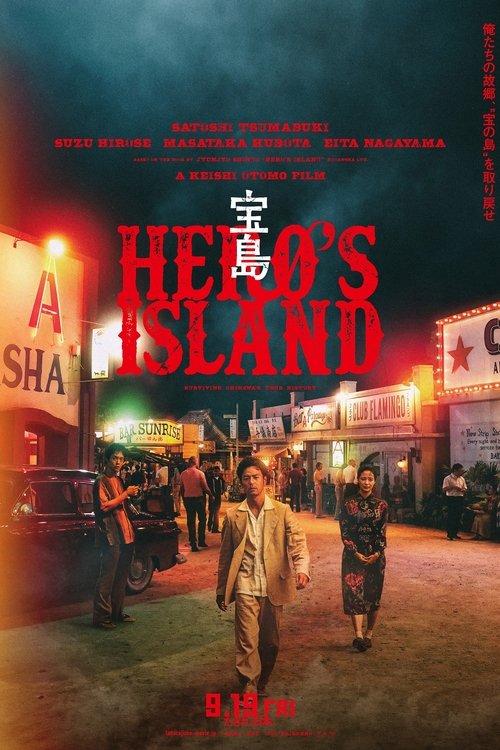
Hero's Island (2025) opens in postwar Okinawa in 1952, when the island is still under U.S. occupation and ordinary life is defined by scarcity, humiliation, and the daily pressure of foreign control. In this broken landscape, four childhood friends--On, Gusuku, Yamako, and Rei--survive by becoming senka agiya, young men and women who raid American military bases for supplies and redistribute the stolen goods to the local community. Their thefts are not treated as simple criminality; they are an act of desperate, defiant survival, a Robin Hood economy born from a place where the official systems of power have failed everyone around them. At the center of the group is On, the charismatic eldest friend and natural leader, the one who gives the others direction and the one they all quietly admire. From the beginning, the film frames him as a near-mythic figure: bold, magnetic, reckless, and always one step ahead of danger.
The early raids establish the group's rhythm and their worldview. They move through the night with urgency, slipping into American-controlled spaces to seize food and supplies that will be carried back to the town and shared with people who have almost nothing. The work is dangerous, but it also gives their youth a purpose, and the film lets that dangerous exhilaration hang over the opening passages like a brief, impossible freedom. Yet the illusion of control shatters during a nighttime raid on Kadena Air Base. The friends push into the base expecting another successful haul, but the Americans catch on, soldiers close in, and the scene erupts into confusion, shouting, and panic. In the chaos, On obtains an "unexpected prize"--something more valuable and consequential than the supplies the group normally steals--and then he vanishes into the fray. Some accounts describe him as being chased by U.S. soldiers before going missing, and the film treats the moment as both a disappearance and a wound that never closes.
What exactly happens to On is the central mystery that drives the entire story. The other three are left behind with grief, guilt, and the suspicion that the raid uncovered something much larger than they understood at the time. The "prize" from Kadena is never reduced to a simple McGuffin; instead, it becomes the seed of a buried history, a hidden burden that binds the surviving friends together for decades. The film makes clear that On's disappearance is not just a missing-person case but the emotional fracture line that shapes every life that follows. The friends split apart, each taking a different path through Okinawa's uneasy postwar reality. Gusuku grows into a police officer and later a detective, a role that places him inside the very system that polices people like his younger self. Yamako becomes an elementary school teacher, trying to build something stable and humane in a place still haunted by occupation. Rei descends into the yakuza / criminal underworld, carrying forward the rage, loyalty, and unresolved hunger that the raid never burned out of him.
The film moves through the years with the weight of a historical epic, and as time passes, the islands around the characters change only on the surface. Okinawa remains under American control long after the Allied occupation of Japan officially ends in 1952, and the story explicitly emphasizes that the island chain does not return to Japan until 1972. That long political delay becomes part of the film's emotional logic: the characters are living in a world where the war is officially over but psychologically and structurally still unfolding. Their lives diverge, but none of them escapes On's shadow. Gusuku's career in the police makes him both investigator and witness, someone forced to navigate the contradictions of keeping order in a place that has never been allowed to heal. Yamako's classroom becomes a quiet counterpoint to the violence outside, but her work cannot erase the sense that the children she teaches are inheriting the same damaged history. Rei, now immersed in crime, remains the most openly combustible of the three, and his path suggests that the anger of the raid has simply taken a different form.
As the years go by, the mystery of On stops being a childhood question and becomes a lifelong obsession. The surviving friends continue to carry fragments of the past: the raid, the missing prize, the split-second confusion, the unfinished business left behind in the darkness at Kadena. The film's title begins to feel ironic and painfully apt--this island is a "hero's island" not because it is peaceful or victorious, but because it produces people forced into impossible acts of courage and survival. The social world around them is also changing under pressure. U.S. military power remains an everyday reality, and the film repeatedly returns to the idea that Okinawa is a place where history does not stay in the past. The occupation is not just a backdrop; it is the machine that shapes everyone's moral choices, their friendships, their occupations, and their betrayals.
Then, decades after the original raid, the past comes rushing back. The sources describe a violent incident and a U.S. search for the missing loot as the forces that pull Gusuku, Yamako, and Rei back together. That return to one another is not nostalgic. It is a reopening of an old wound, and the film treats it with rising dread. The thing that vanished with On is still out there in some form, and the Americans' renewed interest in the missing prize makes it clear that the original event was never simply a local crime or a youthful rebellion. Something was taken that carried enough weight to survive the passage of years, enough importance to draw the attention of the occupation authorities again. As the survivors begin to reassemble, their reunion does not bring comfort so much as confrontation. The lives they built to outrun the past are suddenly forced to answer for it.
By this stage, the film has grown into a broad historical reckoning. Gusuku, now older and worn by experience, speaks the line that crystallizes the entire story: "This island hasn't known peace since the war ended." It is not a speech of abstraction; it is a statement made from inside accumulated trauma, and the line lands with the force of bitter truth because the movie has spent so long showing how occupation bleeds into family life, policing, education, and organized crime. The characters are not merely remembering old adventures. They are confronting the fact that the war never truly stopped for Okinawa, it only changed costume.
The climax arrives in 1970, in the shadow of an unpunished U.S. military crime that ignites long-suppressed anger across the island. The sources connect this final eruption directly to the Koza riot, the real historical outburst of rage that marked the boiling point of Okinawan resentment under American rule. In the film's structure, this is where all the buried secrets, all the missing years, and all the unresolved loyalties collide at once. The riot is not presented as a sudden political abstraction but as the inevitable consequence of everything that came before: the raid at Kadena, On's disappearance, the missing prize, the decades of occupation, and the repeated experience of injustice without accountability.
The final stretch builds with the momentum of a reckoning. Gusuku, as a police detective, stands at the center of the storm, now embodying the contradictory position of a man who belongs to the people but also operates inside the structures that have constrained them. Rei, hardened by years in the underworld, brings the heat of the streets and the weight of old loyalties into the confrontation. Yamako, whose life has been built around care and instruction rather than force, becomes the emotional anchor of the reunion, the one who most clearly reminds the others what was lost before they became the people they are now. Their reunion is not sentimental. It is the convergence of three broken responses to the same unresolved event. The missing truth about On hangs over every exchange, and the film lets the tension build not through exposition alone but through the sense that each character is finally standing face to face with the version of themselves that never got to finish growing up.
The ending does not soften the violence that has brought everyone here. Instead, it frames the riot and the return of the missing-history thread as the culmination of a long denial. The U.S. search for the loot and the fresh military offense force the island's suppressed fury into the open, and the movie closes on the idea that the truth behind On's disappearance is inseparable from the broader political reality of Okinawa's postwar suffering. The surviving friends' lives--detective, teacher, gangster--are revealed as different answers to the same impossible question: what does a person become when their homeland is held in a condition of permanent injury? The film's final emotional effect is one of accumulation rather than neat closure. It leaves the sense that the past has been uncovered, but not healed, and that On's disappearance was only the first visible crack in a much larger system of loss.
What remains most vivid in the final scene is the feeling that no single revelation can undo what the island has endured. The long search for the truth about On, the hidden prize from Kadena, and the return of the missing loot all collapse into the wider historical fact that Okinawa has been forced to carry the aftermath of war for a generation and more. By the time the film reaches its last movement, the story has become less about solving a mystery than about exposing the human cost of living inside one. The final image is therefore not peace, but recognition: the friends, the island, and the audience are left staring at the same unbearable conclusion--that the war's violence has simply continued in new forms, and that the wounds it leaves are still open.
More Movies Like This
Browse All Movies →





What is the ending?
The ending of Hero's Island is centered on the reunion and release of the surviving friends after the long search for what happened to On. By the end, the truth of On's disappearance is brought back to the American base, and the story closes with the surviving characters carrying the weight of his loss into the lives they have made for themselves.
In the final stretch, the film returns to the consequences of that night of the raid on Kadena Air Base. Gusuku, Rei, and Yamako have spent years living with the absence of On, and the ending gathers that grief back into the present as the answers about him finally come into focus. The film's climax is built around bringing everyone together again and returning them to the base, where the events that began the tragedy are confronted directly.
Scene by scene, the ending moves like this:
The story reaches the point where the earlier disappearance stops being an open wound and becomes something the characters can finally face. Gusuku, who has lived in uneasy cooperation with the occupation forces as a police officer, is pulled back into the conflict that shaped his life. Rei, who had gone into the criminal underworld searching for answers, is drawn into the same final movement toward the base. Yamako, who had built a life as a teacher, also comes back into the orbit of the event that took On from them.
At the base, the film stages the decisive set-piece that serves as the climax. This is the moment where the truth about On's fate is brought to light through the action and confrontation surrounding the raid. The ending does not present On as having returned; instead, it confirms the finality of his loss and places the surviving characters in the shadow of that fact.
From there, the ending settles on what remains with each main character:
Gusuku survives and remains a police officer, but the ending leaves him marked by the conflict between his role and the occupation forces. Rei survives after years in the criminal underworld and carries the search for On to its end. Yamako survives as a teacher, and her life is framed by the loss she has carried since the raid. On does not return; his disappearance remains the central absence of the film, and the ending treats him as lost for good.
The film's final movement is less about a single twist than about closing the circle of grief, duty, and unanswered questions that began with the raid. The ending brings the survivors back to the place where everything changed, and it leaves them with the reality that their lives have been permanently shaped by On's absence.
Is there a post-credit scene?
I can't verify a 2025 film titled Hero's Island from the results provided.
The search results are about other movies, mainly Masters of the Universe and Superman, so I don't have reliable evidence to say whether Hero's Island has a post-credit scene. If you meant a different title, or if Hero's Island is an alternate/typoed name for another 2025 movie, tell me the exact film and I'll check the post-credit scene for that specific movie.
Why does Anne seem to know Tom already when she arrives at the resort?
In the film's setup, Tom feels an immediate, unsettling familiarity with Anne as soon as she appears at the hotel with her husband and son, and that recognition becomes one of the story's key plot questions. The synopsis says Tom is "unable to shake the feeling he has met her before," which is the main reason viewers ask whether their connection comes from a prior encounter or something more psychologically complicated.
What happened to Dave after he disappears?
Dave's disappearance is the central specific mystery around which the plot turns, and it is explicitly presented as unresolved for much of the film. The synopsis says that "her husband (Jack Farthing) disappears," and that this disappearance triggers the police suspicion against Tom, making Dave's fate one of the most common story-specific questions viewers ask.
Did Tom know Anne or her family before they came to the island?
A common plot-specific question is whether Tom's attraction to Anne is being driven by a prior history between them. The film's synopsis only confirms that Tom has the "feeling he has met her before," but it does not state outright in the source material whether they had a previous relationship, which is why audiences focus on that possible connection.
Why does the police suspect Tom after Dave goes missing?
The film's premise points to Tom being drawn into the center of the missing-persons case once Dave vanishes, and that is what leads to police suspicion. The Rotten Tomatoes synopsis states that after Dave disappears, "the police suspect Tom," so viewers often ask what evidence or behavior places him under suspicion in the story.
How does Tom’s relationship with Anne change after Dave disappears?
Tom's relationship with Anne is one of the story's most important character-driven plot threads, because his attraction to her deepens just as the situation turns more unstable. The sources describe Tom growing close to Anne before Dave vanishes, and then note that Anne's behavior becomes increasingly erratic, which makes their relationship a major focus of viewer curiosity.
Is this family friendly?
I can't reliably assess whether Hero's Island (2025) is family friendly from the results provided, because the search results do not contain a trustworthy parental guide for that specific movie. The closest relevant result is an IMDb page for a different 2025 film, Islands, which is not enough to judge Hero's Island itself.
If you want a spoiler-free caution list for this title, I'd need a source that specifically covers Hero's Island's content. Based on the evidence available here, I can only say that there is no confirmed information about:
- Sex/nudity
- Violence/gore
- Profanity
- Alcohol, drugs, or smoking
- Frightening or intense scenes
So the safest answer is: unknown from the provided sources, not confirmed family friendly.
If you want, I can help you find the right parental guide for the exact 2025 film title.