











































































Popular
Should I watch it?
Ask Your Own Question

What is the plot?
Sorry, we aren't able to watch and write up a full detailed plot yet. Check back in a few days.





What is the ending?
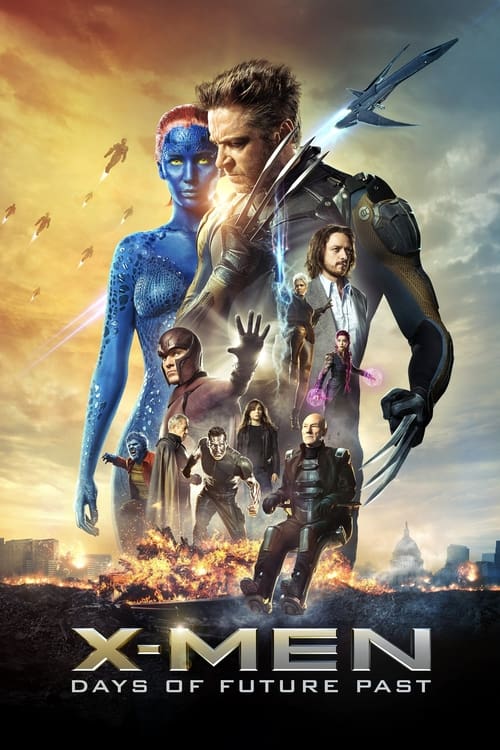
At the end of X-Men: Days of Future Past, Wolverine successfully prevents Mystique from assassinating Bolivar Trask, which alters the timeline and prevents the rise of Sentinels. The future is changed, and the surviving mutants find themselves in a more hopeful world. Wolverine wakes up in a new timeline where the X-Men are alive and well, including Jean Grey, Cyclops, and Professor X.
As Wolverine takes in this new reality, he is filled with a sense of relief and joy, realizing that the sacrifices made by his friends were not in vain. The film concludes with a sense of hope for the future of mutants and humans alike.
The film's climax unfolds in a series of intense and pivotal scenes. After a harrowing journey through time, Wolverine, having been sent back to 1973, finds himself in a world where the X-Men are fragmented and struggling against the oppressive forces of humanity. The stakes are high as he and the younger versions of Professor X and Magneto devise a plan to stop Mystique from killing Bolivar Trask, the man responsible for creating the Sentinels, which would lead to a future where mutants are hunted and exterminated.
In the final act, the scene shifts to the Washington D.C. area, where the assassination attempt is set to take place. Tension mounts as Wolverine, Professor X, and Magneto work together to intercept Mystique. The atmosphere is charged with urgency; they know that the fate of their kind hangs in the balance. Wolverine, driven by a deep sense of responsibility and the weight of his own past, races against time to reach Mystique.
As the scene unfolds, we see Mystique, poised and determined, ready to carry out her mission. She is conflicted, torn between her desire for vengeance and her hope for a better future. Wolverine confronts her, pleading with her to reconsider her actions. The emotional stakes are palpable as he shares his own experiences and the pain of loss, trying to reach the part of her that still believes in a peaceful coexistence.
In a moment of high tension, just as Mystique is about to pull the trigger, Wolverine intervenes. He uses his own body to shield her from the consequences of her actions, showcasing his willingness to sacrifice himself for her and for the greater good. This act of selflessness resonates deeply with Mystique, and she hesitates, allowing the moment of violence to pass.
The timeline shifts dramatically as Mystique ultimately decides to spare Trask's life. This pivotal choice alters the course of history, preventing the rise of the Sentinels and the ensuing war against mutants. The scene transitions to a montage of the future, where we see the consequences of their actions unfold. The Sentinels are never created, and the world is a safer place for mutants.
As the film draws to a close, Wolverine awakens in a new timeline, a stark contrast to the bleak future he had previously experienced. He finds himself in the X-Mansion, where he is greeted by familiar faces: Jean Grey, Cyclops, and Professor X, all alive and well. The joy and relief wash over him as he realizes that the sacrifices made by his friends have led to a brighter future.
The final moments are filled with a sense of hope and renewal. Wolverine, now more at peace with himself and his past, reflects on the journey that brought him here. The film ends on a note of optimism, suggesting that while the struggle for acceptance and understanding continues, there is a possibility for a better tomorrow for both mutants and humans. Each character's fate is intertwined with this new reality, highlighting the importance of choices and the impact they have on the future.
Is there a post-credit scene?
Yes, "X-Men: Days of Future Past" features a post-credits scene.
As the credits roll, the scene opens in a vast, ancient-looking temple in Egypt. The camera pans to reveal a group of people gathered around a large stone structure. In the center stands a figure, cloaked in shadows, who is revealed to be En Sabah Nur, also known as Apocalypse. He is depicted as a powerful mutant with a commanding presence, and he raises his arms, summoning the pyramids to rise around him, showcasing his immense power.
The scene is visually striking, with the backdrop of the pyramids and the desert landscape, emphasizing the ancient and formidable nature of Apocalypse. As he stands there, the camera zooms in on his face, hinting at his role as a significant antagonist in the future of the X-Men universe. The scene concludes with a sense of foreboding, setting the stage for the next installment in the franchise, which would explore the rise of Apocalypse and his impact on the mutant world.
This post-credits scene serves to excite fans about the future of the series while also connecting the events of "Days of Future Past" to the larger narrative of the X-Men saga.
How does Wolverine's consciousness travel back in time?
In 'X-Men: Days of Future Past', Wolverine's consciousness is sent back to 1973 through a process called 'mind transfer'. This is facilitated by the mutant Kitty Pryde, who uses her phasing ability to send Wolverine's mind back into his younger body, allowing him to influence past events and prevent a dystopian future.
What motivates Mystique to assassinate Bolivar Trask?
Mystique, portrayed by Jennifer Lawrence, is driven by a desire to protect her fellow mutants and assert their rights. After witnessing the oppression and violence against mutants, she believes that assassinating Bolivar Trask, the creator of the Sentinels, will prevent the creation of the mutant-hunting robots and ultimately save her kind from extermination.
What is the significance of the Sentinels in the story?
The Sentinels are pivotal to the plot as they represent the ultimate threat to mutantkind. Created by Bolivar Trask, these giant robots are designed to hunt and eliminate mutants. Their development is a direct response to the fear and hatred of mutants in society, and their existence leads to a future where mutants are nearly extinct, driving the urgency of Wolverine's mission to change the past.
How does Professor X regain his ability to walk?
In the film, Professor Charles Xavier, played by James McAvoy, initially struggles with his powers and is unable to walk due to the trauma of losing his friends and the burden of his responsibilities. However, through his interactions with Wolverine and the younger version of Magneto, he learns to embrace hope and the potential of his abilities, ultimately regaining his ability to walk by the end of the film.
What role does Magneto play in the events of the past?
Magneto, portrayed by Michael Fassbender, plays a crucial role in the events of 1973. Initially, he is reluctant to help Wolverine and the X-Men due to his distrust of humans. However, as the threat of the Sentinels becomes more apparent, he joins forces with them to stop Mystique from assassinating Trask, believing that their combined efforts can change the course of history and protect mutantkind.
Is this family friendly?
"X-Men: Days of Future Past" contains several elements that may be considered objectionable or upsetting for children or sensitive viewers. Here are some aspects to be aware of:
-
Violence: The film features intense action sequences, including battles between mutants and Sentinels, which may include graphic depictions of injury and destruction.
-
Death: Characters face significant threats, and there are scenes depicting the deaths of both major and minor characters, which could be distressing.
-
Dark Themes: The overarching narrative deals with themes of persecution, fear, and the consequences of war, which may be heavy for younger audiences.
-
Mature Language: There are instances of strong language that may not be suitable for all viewers.
-
Emotional Turmoil: Characters experience deep emotional struggles, including loss, betrayal, and existential dread, which could be intense for sensitive viewers.
-
Disturbing Imagery: Some scenes may include unsettling visuals, particularly those depicting the Sentinels and their actions against mutants.
These elements contribute to a tone that may not be appropriate for all children, and parental discretion is advised.





