




























Popular
What is the significance of the drone strike in the film?
How does Colonel Katherine Powell's character evolve throughout the film?
What role does the character of Lieutenant General Frank Benson play in the decision-making process?
How does the presence of the young girl, Alia, impact the characters' decisions?
What is the role of the legal advisor, Rebecca, in the film?
Should I watch it?
Ask Your Own Question

What is the plot?
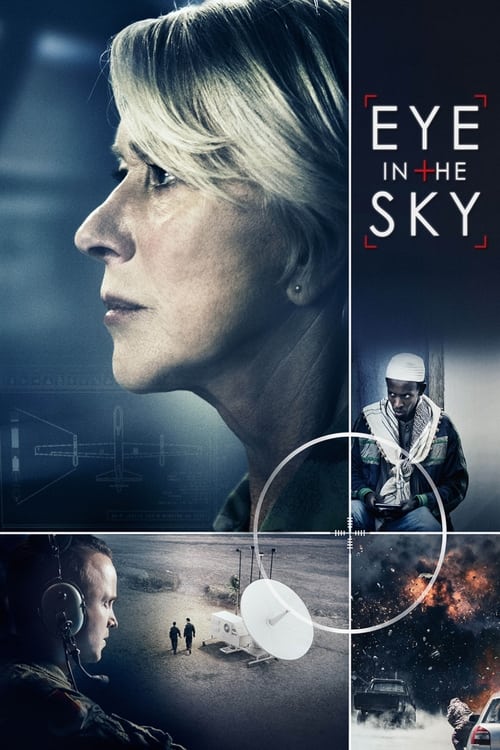
In the shadowed underbelly of Nairobi, Kenya, an undercover British-Kenyan agent meets a brutal end at the hands of Al-Shabaab terrorists, his body discovered by intelligence feeds that crackle into life at Northwood Headquarters outside London. British Army Colonel Katherine Powell, a steely veteran with years of obsession etched into her features, steps into the dimly lit command center, her face illuminated by the glow of multiple screens. She has tracked a elusive female terrorist--her white whale--for six long years, and now intelligence confirms this woman, ranked among Al-Shabaab's top leaders, is converging with two others: the third and fourth most-wanted North Africans, including a radicalized American citizen, inside a nondescript safe house in a volatile Nairobi neighborhood. The mission, Powell declares to her team, shifts from mere surveillance to capture--a high-stakes snatch-and-grab to dismantle the cell responsible for the agent's murder.
Screens flicker with drone footage from high above, Reaper drones humming invisibly in the Kenyan sky, their unblinking eyes feeding real-time video to operators scattered across the globe. In a sterile room at a USAF base in Las Vegas, Lieutenant Steve Watts, a young American drone pilot with steady hands and a growing unease in his eyes, pilots the surveillance craft alongside his sensor operator. "Eyes on target building," Watts confirms into his headset, his voice calm but laced with the detachment of remote warfare. Half a world away in London, at a COBRA meeting in a Whitehall conference room, Lieutenant General Frank Benson, Deputy Chief of the Defence Staff, brokers tense deliberations among politicians. The Foreign Secretary fidgets, the Attorney General pores over legal briefs, and a risk-assessment officer crunches numbers. "This is Kenya," one minister protests, "a friendly nation not at war. We can't just bomb it."
On the ground in Nairobi, Kenyan undercover agent Jama Farah, lean and watchful, slips through dusty alleys, his tiny bug camera disguised as a toy plane buzzing toward the safe house wall. He perches it expertly, the feed bursting onto screens at Northwood. Powell leans forward, her breath catching as the camera reveals the horror inside: the female terrorist, her face a match for years of Powell's nightmares, huddles with the two North African leaders and the American. But the revelation escalates--two conspirators, wide-eyed suicide bombers, kneel as the leaders strap explosive vests around their torsos, arming the devices with meticulous care. "They're preparing for an attack," Powell snaps, her voice slicing through the room. "Up to eighty civilian deaths if those vests detonate in a market." The mission pivots instantly: capture becomes kill. "Prepare Hellfire," she orders Watts over the encrypted line.
Tension coils as Powell seeks legal clearance, her British Army legal counsel urging her to "refer up" the chain of command. Video links multiply--Northwood to Whitehall, Sussex military base, even Hawaii, where a facial recognition specialist confirms the American target's identity. The buck passes to the US Secretary of State, Michael O'Keefe, mid-game at a ping-pong tournament in Beijing, China. A aide thrusts a tablet under his nose; he glances at the feed, nods curtly--"Approved"--and returns to his paddle, a fleeting smirk betraying his impatience with British dithering.
But fate intervenes with heartbreaking precision. Drone cameras zoom on a spot just outside the safe house: young Alia Mo'Allim, no older than nine, with wide curious eyes and a bright hijab, arranges her mother's fresh-baked bread in a woven basket on a rickety stand. She lives next door, her family's modest home a stone's throw from terror. Watts spots her first, his face paling in the Las Vegas glow. "We've got a girl right outside the blast radius," he reports, voice cracking. "She's selling bread. Risk of civilian casualties just went through the roof."
Powell's jaw tightens; the vests inside gleam lethally, the bombers' hands steady on detonators. "She'll move," Powell insists, but Alia lingers, chatting with passersby, her small frame a vivid emblem of innocence amid the dust. The politicians in London erupt-- "A child? In a non-warzone?"--while lawyers cite proportionality under international law. Benson, ever the mediator, presses the room: "If those bombers walk out, eighty innocents die today. Is one girl's life worth that?" The Foreign Secretary hems, the Attorney General demands fresh assessments. Minutes stretch into an agonizing half-hour, the "referring up" process ballooning the chain: emails ping, video calls cascade, risk probabilities debated in sterile terms.
Farah, cover intact for now, receives orders via earpiece: "Buy her bread. Get her out of there." He approaches Alia cautiously, smiling to blend in. "How much for all of it?" he asks in Swahili, peeling off bills. Alia's eyes light up--her big sale--but a watchful conspirator from the safe house peers out, suspicion flaring. "Who are you?" the man barks. Farah's cover shatters; he bolts into the alleys, heart pounding, pursued by shouts but evading capture, his bug camera left behind but still transmitting.
Back in Northwood, Powell corners her risk-assessment officer, a nervous major. "Give me parameters for a lower collateral estimate." He recalculates frantically: "45 to 65% chance the girl dies, ma'am." Powell's eyes bore into him. "Quote only the 45%. Confirm it." He swallows hard, complies. The fudged figure ripples up the chain, greasing the wheels. Benson, in the COBRA room, faces down waffling ministers: "This is war, fought from armchairs. But it's still war." Authorization trickles down--first missile greenlit.
Watts hesitates, fingers hovering over the fire button in Las Vegas. "Confirming target," he says, sweat beading despite the AC chill. Powell's voice cuts through: "Fire now, Lieutenant." The Hellfire missile streaks from the Reaper, a silent harbinger plummeting 20,000 feet. It slams into the safe house roof with cataclysmic force--flames erupt, walls crumple, debris hurls skyward. Inside, the three high-level Al-Shabaab leaders--Powell's female quarry, the third-most-wanted North African, the fourth-most-wanted North African, and the radicalized American--vaporize instantly in the blast, their bodies torn apart by the precision warhead. Watts exhales shakily: "Splash on primary targets. Building destroyed."
But victory sours. Smoke clears on drone feed: one suicide bomber conspirator, bloodied and staggering, crawls from the rubble, clutching his partially armed vest. Worse--Alia lies crumpled yards away, bread basket shattered, shrapnel embedded in her tiny body, blood staining the dirt. She twitches faintly, alive but grievously wounded. Her parents burst from the adjacent home, screams piercing the audio feed. Watts's face crumples. "Girl is hit. She's a child!" Powell, unyielding: "Survivor's got a vest. Arm another Hellfire."
Pandemonium erupts anew. London recoils--"You've already injured her!"--but Benson steels them: "One bomber lives. Eighty dead tomorrow." The chain reactivates, politicians agonizing as Alia's father cradles her, her mother wailing, stroking her bloodied face. "Mama," Alia whispers weakly, eyes fluttering. Watts pleads: "They're reaching her. Can't we wait?" Powell's response is ice: "Fire." Clearance comes; Watts, tears streaking, triggers the second Hellfire. It hurtles down, detonating amid the debris just as Alia's parents huddle over her. The blast shreds the surviving suicide bomber conspirator, his vest igniting in a secondary explosion that ensures his death. But the shockwave engulfs Alia--her small body convulses once, then stills, life extinguished in the firestorm. Her parents survive, shielded by position, but their grief echoes through the feeds as they scoop her broken form.
In a Nairobi hospital, medics rush Alia on a gurney, monitors beeping frantically before flatlining. "Time of death: 14:27," a doctor pronounces gravely, the screen feeding the finality back to Northwood. Powell stares at the monitors, her triumph hollow, eyes glistening for a fleeting moment before steel returns. "Targets neutralized. Mission accomplished," she reports flatly.
The screens go dark. Hours later, in a quiet London toy shop, General Benson browses shelves lined with stuffed animals. He selects a fluffy tortoise, handing it to the salesgirl with a wry half-smile. "Do you have children?" she asks. "Grandchildren," he replies. As she wraps it, she adds innocently, "Never tell a 5-year-old they can't do something." Benson pauses, the weight of the day crashing down--Alia's face, the vests, the missiles, the armchair generals. "Yes," he says softly, his voice carrying the toll of drone warfare's moral abyss, "never tell a soldier that either." He walks out into the rain-slicked street, toy in hand, the tactical success a pyrrhic echo amid the controversy of one girl's death.
The operation ends as it began--in shadows. The undercover British-Kenyan agent lies dead from the opening Al-Shabaab murder, throat slit or worse in some unshown brutality. The three Al-Shabaab leaders perish in the first missile's inferno, authored by Watts under Powell's iron command. The lone surviving suicide bomber meets his end in the second blast, courtesy of the same Hellfire precision. Alia Mo'Allim becomes the collateral tragedy, her death indirectly sealed by Powell's relentless orders, Benson's brokering, and Watts's reluctant trigger finger. No other souls are claimed, but the survivors--Powell, haunted by her quarry's ghost; Benson, bearing the ethical scars; Watts, questioning his joystick soul; Farah, vanished into Nairobi's streets--carry the invisible wounds. Politicians scatter to spin the "success," lawyers file reports, drones return to base. In the end, eighty potential deaths averted, one innocent life forfeit, the machine of modern war grinding on without pause.








What is the ending?
In the ending of "Eye in the Sky," Colonel Katherine Powell faces a moral dilemma as she must decide whether to proceed with a drone strike that could kill a high-value target and potentially innocent civilians. After a tense deliberation, the strike is authorized, but the outcome is tragic, resulting in the death of a young girl. The film concludes with the characters grappling with the consequences of their decisions, highlighting the complexities of modern warfare.
As the final act unfolds, the tension escalates in the command center where Colonel Katherine Powell, played by Helen Mirren, is anxiously monitoring the situation in Nairobi, Kenya. The drone operators, under the command of Lieutenant General Frank Benson, are prepared to execute a strike on a house where a group of terrorists, including a high-value target, are gathered. However, the presence of a young girl, Alia, who is selling bread nearby, complicates the decision.
Scene by scene, the narrative unfolds with Colonel Powell receiving updates from her team. The drone pilot, Steve Watts, is in the cockpit, his hands poised over the controls, filled with a mix of determination and dread. As they observe Alia playing innocently, the moral weight of the decision becomes palpable. Powell argues passionately for the strike, emphasizing the threat posed by the terrorists, while her superiors, including General Benson, express their concerns about collateral damage.
The clock ticks down as the team grapples with the implications of their actions. The tension is further heightened when they receive a call from the British government, which is concerned about the political fallout of the strike. The decision-making process is fraught with urgency, as Powell and her team are aware that every moment they delay could allow the terrorists to escape.
As the situation intensifies, Powell receives the green light to proceed with the strike. The drone is armed, and the countdown begins. However, just as they are about to execute the strike, they receive a last-minute update that Alia is now in the direct line of fire. The team is thrown into chaos, with Powell desperately trying to halt the strike, but the decision has already been made.
In a heart-wrenching moment, the drone strike is executed, and the screen goes dark. The aftermath reveals the tragic consequences of their decision: Alia is killed in the explosion, and the terrorists are eliminated. The emotional fallout is immediate and devastating. Colonel Powell is left to confront the reality of her choices, grappling with the loss of innocent life in the pursuit of a greater good.
The film concludes with a somber reflection on the nature of warfare in the modern age. Colonel Powell, now burdened with the weight of her decision, faces the camera with a look of profound sorrow. The final scenes depict the characters dealing with the ramifications of their actions, leaving the audience to ponder the moral complexities of military operations and the cost of war. Each character, from Powell to General Benson, is left to navigate their own sense of guilt and responsibility, underscoring the film's exploration of the ethical dilemmas faced in combat.
Is there a post-credit scene?
The movie "Eye in the Sky," produced in 2015, does not have a post-credit scene. The film concludes with a powerful and thought-provoking ending that leaves the audience reflecting on the moral complexities of drone warfare and the decisions made in the heat of conflict. After the final credits roll, there are no additional scenes or content that follow. The film's focus remains on the intense ethical dilemmas faced by the characters throughout the narrative, culminating in a poignant conclusion that emphasizes the weight of their choices.
What is the significance of the drone strike in the film?
The drone strike is central to the film's narrative, representing the moral and ethical dilemmas faced by military and government officials. It is intended to eliminate a high-profile terrorist target, but the presence of a young girl in the strike zone complicates the decision-making process, highlighting the tension between military objectives and civilian safety.
How does Colonel Katherine Powell's character evolve throughout the film?
Colonel Katherine Powell, played by Helen Mirren, is initially portrayed as a determined and focused military officer, committed to her mission. As the situation escalates and the potential collateral damage becomes apparent, her emotional state shifts from resolute to conflicted, showcasing her internal struggle between duty and the moral implications of her orders.
What role does the character of Lieutenant General Frank Benson play in the decision-making process?
Lieutenant General Frank Benson, portrayed by Alan Rickman, serves as a voice of reason and authority in the film. He is deeply aware of the consequences of the drone strike and attempts to balance the military's objectives with the ethical considerations of civilian casualties. His character embodies the tension between military protocol and humanitarian concerns.
How does the presence of the young girl, Alia, impact the characters' decisions?
Alia, the young girl who is unknowingly in the strike zone, becomes a pivotal figure in the film. Her presence forces the characters, particularly Colonel Powell and Lieutenant General Benson, to confront the harsh realities of their decisions. The emotional weight of potentially harming an innocent child leads to intense debates and highlights the moral complexities of warfare.
What is the role of the legal advisor, Rebecca, in the film?
Rebecca, played by Helen McCrory, serves as the legal advisor who provides crucial insights into the legality of the drone strike. Her character is essential in navigating the legal ramifications of the military's actions, emphasizing the bureaucratic and legal challenges that accompany modern warfare. She often finds herself at odds with the urgency of the military's objectives, adding another layer of tension to the decision-making process.
Is this family friendly?
"Eye in the Sky" is a tense military thriller that deals with complex moral dilemmas surrounding drone warfare. While it is a thought-provoking film, it contains several elements that may not be suitable for children or sensitive viewers.
-
Violence and Warfare: The film includes scenes depicting military operations, including discussions of drone strikes and the potential for civilian casualties. There are tense moments that involve the threat of violence.
-
Moral Dilemmas: The characters grapple with difficult ethical decisions regarding life and death, which may be distressing for younger audiences. The emotional weight of these decisions is a central theme.
-
Emotional Tension: The film builds significant suspense and anxiety as characters face high-stakes situations, which could be unsettling for some viewers.
-
Casualties: There are references to potential casualties, including children, which may be particularly upsetting for sensitive viewers.
-
Realistic Portrayal of War: The film presents a stark and realistic view of modern warfare, which may be intense and disturbing for younger audiences.
Overall, "Eye in the Sky" is more suited for mature viewers who can engage with its complex themes and emotional depth.








