
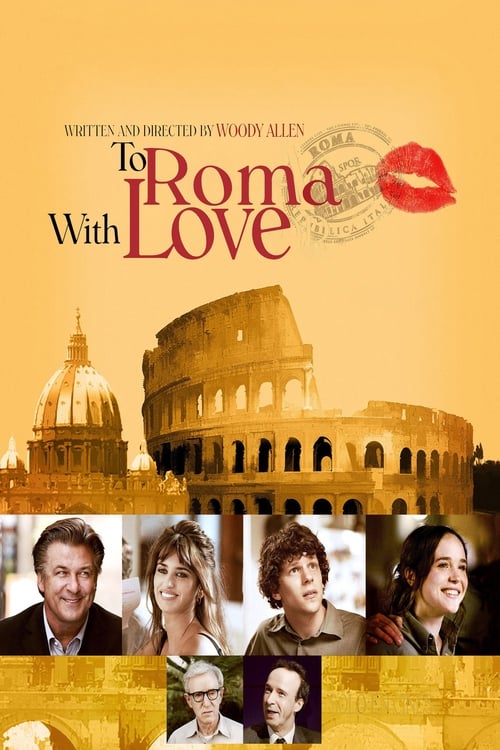







































































Popular
What is the significance of the character Leopoldo Pisanello in the film?
How does the relationship between Hayley and Michel develop throughout the film?
What role does the character of Jerry play in the story?
How does the storyline of the American couple, Jack and Sally, unfold in Rome?
What is the dynamic between Giancarlo and his wife, and how does it affect the plot?
Should I watch it?
Ask Your Own Question

What is the plot?
Sorry, we aren't able to watch and write up a full detailed plot yet. Check back in a few days.









What is the ending?
In the ending of "To Rome with Love," the various storylines converge in a series of humorous and poignant moments. The characters find resolutions to their respective arcs, with some experiencing unexpected outcomes. The film concludes with a sense of whimsy and the idea that life is unpredictable, leaving the audience with a blend of laughter and reflection.
As the film approaches its conclusion, we see the characters' stories intertwining in the vibrant backdrop of Rome.
First, we revisit the story of Jerry and Phyllis, an American couple played by Woody Allen and Judy Davis. Jerry, who has been enamored with the idea of his Italian opera singer, is finally confronted with the reality of his fantasies. After a series of comedic misadventures, including a disastrous audition for his opera singer, Jerry realizes that his infatuation is not as fulfilling as he imagined. Phyllis, who has been supportive yet skeptical, ultimately helps Jerry see the absurdity of his dreams. They share a moment of understanding, and while their relationship remains complex, they seem to find a renewed connection.
Next, we turn to the young couple, Hayley and Michel, who are navigating their own romantic journey. Hayley, played by Alison Pill, is in Rome to visit her parents, and her relationship with Michel, a local Italian, is tested by cultural differences and misunderstandings. In the end, they decide to part ways amicably, realizing that their love, while genuine, may not be sustainable across the ocean. Their farewell is bittersweet, filled with the promise of growth and the acceptance of their different paths.
Meanwhile, we follow the story of Leopoldo, a middle-class man who unexpectedly becomes a celebrity overnight. After experiencing the highs and lows of fame, Leopoldo finds himself disillusioned by the superficiality of celebrity life. In the final scenes, he chooses to return to his ordinary life, rejecting the allure of fame. This decision reflects a deeper understanding of what truly matters to him, emphasizing the film's theme of authenticity versus illusion.
Lastly, we see the older couple, the parents of Hayley, who have their own comedic subplot involving a mix-up with their daughter's romantic interests. They navigate their own relationship dynamics, ultimately reaffirming their love for each other amidst the chaos. Their story concludes with a sense of warmth and humor, showcasing the enduring nature of love even in the face of confusion.
As the film wraps up, the characters find themselves in various states of acceptance and realization. The final scenes are filled with laughter, as the characters reflect on their experiences in Rome. The film ends on a light-hearted note, with the characters embracing the unpredictability of life and love, leaving the audience with a sense of joy and contemplation about the nature of relationships and the adventures that life brings.
Is there a post-credit scene?
In "To Rome with Love," there is no post-credit scene. The film concludes without any additional scenes or content after the credits roll. The narrative wraps up the various intertwined stories of love, ambition, and the quirks of life in Rome, leaving the audience with a sense of closure regarding the characters' journeys. The film's charm lies in its exploration of relationships and the whimsical nature of life in the city, rather than in any extended or hidden scenes after the main story concludes.
What is the significance of the character Leopoldo Pisanello in the film?
Leopoldo Pisanello, played by Roberto Benigni, is a middle-class man who unexpectedly becomes a celebrity overnight. His rise to fame is both bewildering and humorous, as he navigates the absurdities of sudden notoriety. Leopoldo's character serves as a commentary on the nature of fame and the media's obsession with celebrity culture. His internal struggle revolves around the desire for privacy versus the allure of public attention, leading to moments of both joy and existential confusion.
How does the relationship between Hayley and Michel develop throughout the film?
Hayley, portrayed by Alison Pill, is an American woman who travels to Rome with her fiancé, Michel, played by Flavio Parenti. Their relationship is tested when Hayley meets Michel's father, Giancarlo, who becomes infatuated with her. This love triangle creates tension, as Hayley is torn between her loyalty to Michel and the unexpected attention from Giancarlo. The emotional stakes rise as Hayley grapples with her feelings, leading to moments of jealousy and confusion, ultimately forcing her to confront her true desires.
What role does the character of Jerry play in the story?
Jerry, played by Woody Allen, is a retired opera director who travels to Rome with his wife, Phyllis. He becomes fascinated by a young opera singer named Anna, who has a beautiful voice but is not conventionally attractive. Jerry's internal conflict revolves around his artistic ambitions and the ethical implications of his feelings for Anna. His character explores themes of desire, artistic integrity, and the complexities of love, culminating in a humorous yet poignant exploration of the intersection between art and personal relationships.
How does the storyline of the American couple, Jack and Sally, unfold in Rome?
Jack, played by Jesse Eisenberg, is a young architect who is in love with Sally, portrayed by Greta Gerwig. Their storyline begins with Jack's infatuation with a beautiful actress, Monica, who complicates his relationship with Sally. As Jack navigates his feelings for both women, he experiences a whirlwind of emotions, from excitement to guilt. The tension escalates when Sally discovers Jack's flirtation, leading to a confrontation that forces Jack to reevaluate his priorities and ultimately choose between fleeting desire and genuine love.
What is the dynamic between Giancarlo and his wife, and how does it affect the plot?
Giancarlo, played by Antonio Albanese, is a successful architect who becomes enamored with Hayley, leading to a comedic yet tense love triangle. His wife, who is oblivious to his infatuation, represents the stability and routine of Giancarlo's life. The dynamic between them is strained as Giancarlo's secret obsession with Hayley grows, creating a rift in his marriage. This subplot adds layers of complexity to the narrative, highlighting themes of fidelity, desire, and the consequences of pursuing unattainable love, ultimately affecting the decisions and emotional states of all characters involved.
Is this family friendly?
To Rome with Love, directed by Woody Allen, contains several elements that may be considered objectionable or upsetting for children or sensitive viewers. Here are some aspects to be aware of:
-
Sexual Themes: The film includes discussions and situations involving infidelity, sexual relationships, and romantic entanglements that may not be suitable for younger audiences.
-
Nudity: There are scenes that feature nudity, particularly in the context of a character's profession, which may be inappropriate for children.
-
Language: The dialogue includes some mild profanity and suggestive language that could be considered unsuitable for younger viewers.
-
Mature Situations: The film explores complex adult relationships, including themes of jealousy, betrayal, and existential musings, which may be difficult for children to understand.
-
Cultural References: Some humor and situations may rely on cultural references or adult experiences that might not resonate with younger audiences.
Overall, while the film has comedic elements and a light-hearted tone, its mature themes and content may not make it entirely family-friendly.







