

































Popular
What motivates Gordon Gekko to reconnect with his daughter Winnie in the film?
How does Jacob Moore's relationship with Winnie Gekko evolve throughout the film?
What role does the financial crisis of 2008 play in the story of Wall Street: Money Never Sleeps?
What is the significance of the character Bretton James in the film?
How does the theme of mentorship manifest in the relationship between Gekko and Jacob?
Should I watch it?
Ask Your Own Question

What is the plot?
Sorry, we aren't able to watch and write up a full detailed plot yet. Check back in a few days.





What is the ending?
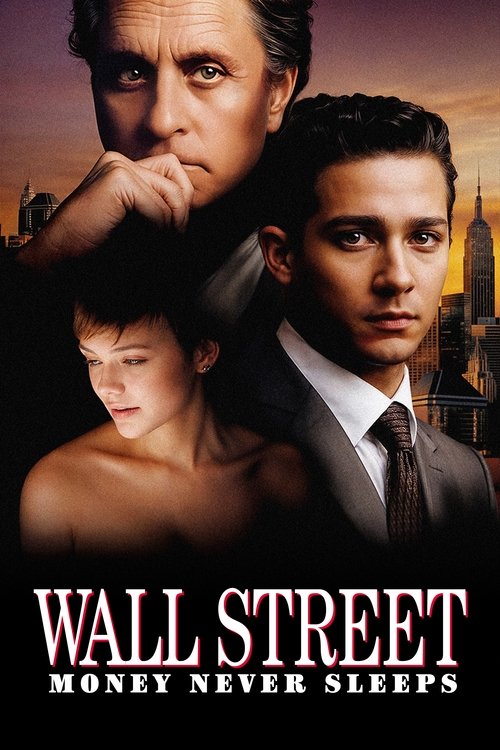
In the ending of "Wall Street: Money Never Sleeps," Gordon Gekko reconciles with his daughter, Winnie, and they begin to mend their strained relationship. Jacob Moore, who has been navigating the treacherous waters of Wall Street and dealing with the fallout from his mentor's actions, finds a sense of closure and purpose. The film concludes with a sense of hope for the future, as the characters reflect on their choices and the lessons learned from the financial turmoil.
As the film approaches its conclusion, we find ourselves in a tense atmosphere filled with uncertainty and emotional stakes. Jacob Moore, played by Shia LaBeouf, is deeply entrenched in the world of finance, driven by a desire to prove himself and to protect his fiancée, Winnie Gekko, portrayed by Carey Mulligan. The narrative builds towards a climax as Jacob confronts the consequences of his mentor Gordon Gekko's past actions, which have cast a long shadow over his life.
In a pivotal scene, Jacob meets with Gekko, played by Michael Douglas, who has just been released from prison. Gekko is attempting to reconnect with his daughter, Winnie, and Jacob is torn between his admiration for Gekko's financial acumen and his protective instincts towards Winnie. The tension is palpable as Jacob grapples with the legacy of greed that Gekko represents, while also recognizing the potential for redemption.
As the story unfolds, Jacob discovers that the financial firm he works for is involved in unethical practices, leading to a catastrophic collapse. This revelation forces him to confront the moral implications of his career and the impact it has on those he loves. In a desperate bid to save his relationship with Winnie and to stand up against the corruption in the financial world, Jacob takes bold actions that ultimately lead to a confrontation with the powerful figures in Wall Street.
In the final act, the emotional stakes reach their peak when Jacob and Winnie have a heart-to-heart conversation with Gekko. The three characters are in a tense yet cathartic moment, where Gekko expresses his desire to be a better father and to make amends for his past mistakes. Winnie, initially resistant, begins to see the possibility of reconciliation, and Jacob stands as a bridge between them, advocating for understanding and healing.
The film culminates in a scene where Jacob's actions lead to a significant shift in the financial landscape, and he emerges as a more principled individual, having learned from the tumultuous events around him. Gekko, too, experiences a transformation, as he acknowledges the importance of family over wealth. The final moments depict a sense of hope, as Jacob and Winnie walk together, symbolizing a new beginning for their relationship, while Gekko watches from a distance, reflecting on his journey and the choices he has made.
In the end, Jacob Moore finds a renewed sense of purpose, having navigated the treacherous waters of Wall Street and emerged with a clearer understanding of what truly matters. Winnie Gekko begins to rebuild her relationship with her father, suggesting that healing is possible even after deep-seated wounds. Gordon Gekko, while still embodying the complexities of his character, shows signs of growth, hinting at the possibility of redemption in a world often driven by greed. The film closes on a note of cautious optimism, leaving the audience to ponder the lessons learned amidst the chaos of financial ambition.
Is there a post-credit scene?
In "Wall Street: Money Never Sleeps," there is no post-credit scene. The film concludes with a final scene that encapsulates the themes of ambition, redemption, and the cyclical nature of the financial world. The story wraps up with Gordon Gekko, played by Michael Douglas, reflecting on his past and the lessons learned, while Jake Moore, portrayed by Shia LaBeouf, contemplates his future in the financial industry. The absence of a post-credit scene emphasizes the film's focus on the characters' journeys and the moral implications of their choices rather than leaving the audience with a cliffhanger or additional content.
What motivates Gordon Gekko to reconnect with his daughter Winnie in the film?
Gordon Gekko, played by Michael Douglas, is motivated to reconnect with his daughter Winnie primarily due to his desire for redemption and to mend their fractured relationship. After serving time in prison for insider trading, Gekko seeks to re-establish himself in the world of finance and to prove that he has changed. His longing for a connection with Winnie, portrayed by Carey Mulligan, is also driven by a sense of loneliness and the realization that family is important, despite his past mistakes.
How does Jacob Moore's relationship with Winnie Gekko evolve throughout the film?
Jacob Moore, played by Shia LaBeouf, initially enters a romantic relationship with Winnie Gekko, which is marked by passion and ambition. As the story unfolds, Jacob's motivations become increasingly intertwined with his desire to impress Gekko and to succeed in the financial world. However, as Jacob learns more about Gekko's manipulative nature and the consequences of his actions, his relationship with Winnie becomes strained. Jacob's internal conflict between his love for Winnie and his ambition leads to tension, ultimately culminating in a pivotal moment where he must choose between his career aspirations and his commitment to Winnie.
What role does the financial crisis of 2008 play in the story of Wall Street: Money Never Sleeps?
The financial crisis of 2008 serves as a critical backdrop for Wall Street: Money Never Sleeps, influencing the motivations and actions of the characters. The crisis creates a sense of urgency and instability in the financial markets, which affects Jacob Moore's career as a trader. It also serves as a catalyst for Gekko's return to the financial scene, as he attempts to capitalize on the chaos. The crisis highlights themes of greed, corruption, and the consequences of unchecked ambition, forcing characters to confront their values and the impact of their decisions on both their personal lives and the broader economy.
What is the significance of the character Bretton James in the film?
Bretton James, portrayed by Josh Brolin, is a key antagonist in Wall Street: Money Never Sleeps. As a powerful and ruthless investment banker, he embodies the cutthroat nature of Wall Street. His character represents the new generation of financiers who prioritize profit over ethics. Bretton's actions directly impact Jacob Moore's career and personal life, as he is involved in the corporate machinations that lead to significant financial turmoil. The rivalry between Jacob and Bretton escalates throughout the film, culminating in a confrontation that forces Jacob to confront the moral implications of his ambitions.
How does the theme of mentorship manifest in the relationship between Gekko and Jacob?
The theme of mentorship is intricately woven into the relationship between Gordon Gekko and Jacob Moore. Initially, Jacob idolizes Gekko, viewing him as a mentor who can guide him through the complexities of the financial world. Gekko, in turn, sees Jacob's ambition and potential, which he seeks to exploit for his own gain. However, as their relationship develops, Jacob begins to question Gekko's ethics and motivations, leading to a complex dynamic where mentorship becomes a double-edged sword. Jacob's journey reflects the struggle between learning from a master and recognizing the moral pitfalls of their teachings, ultimately forcing him to define his own path.
Is this family friendly?
"Wall Street: Money Never Sleeps" is not considered family-friendly due to several potentially objectionable elements. Here are some aspects that might be upsetting for children or sensitive viewers:
-
Strong Language: The film contains frequent use of profanity, which may not be suitable for younger audiences.
-
Drug Use: There are scenes depicting drug use and references to substance abuse, which could be disturbing for some viewers.
-
Intense Themes: The film explores heavy themes such as greed, betrayal, and the moral dilemmas of the financial world, which may be complex and unsettling for children.
-
Violence and Threats: There are moments of implied violence and aggressive confrontations that could be distressing.
-
Emotional Turmoil: Characters experience significant emotional distress, including loss and betrayal, which may be difficult for sensitive viewers to process.
-
Romantic Relationships: The film includes adult romantic relationships that may involve infidelity and manipulation, which may not be appropriate for younger audiences.
These elements contribute to a mature tone that may not be suitable for children or those who are sensitive to such content.









