
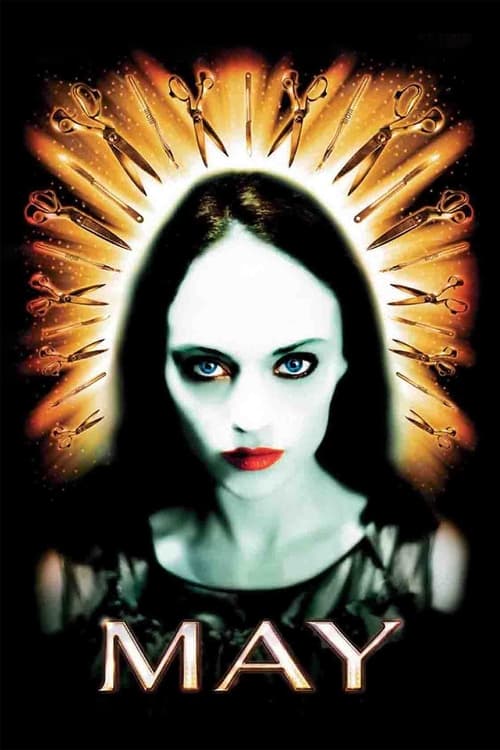




















Popular
What motivates May to create her doll, and how does it reflect her emotional state?
How does May's relationship with her childhood friend, Polly, evolve throughout the film?
What role does the character of Adam play in May's life, and how does their relationship develop?
What is the significance of May's eye patch, and how does it relate to her character development?
How does the theme of isolation manifest in May's interactions with her coworkers?
Should I watch it?
Ask Your Own Question

What is the plot?
Sorry, we aren't able to watch and write up a full detailed plot yet. Check back in a few days.




What is the ending?
In the ending of "May," the protagonist, May, confronts her loneliness and desire for connection in a tragic and violent manner. After a series of failed relationships and deepening isolation, she ultimately decides to create her own companion from the body parts of those she has killed. The film concludes with May embracing her creation, a grotesque figure that embodies her longing for companionship, as she succumbs to her own madness.
Expanding on this, the final scenes of "May" unfold with a palpable tension that has been building throughout the film.
Scene 1: May's apartment is dimly lit, filled with remnants of her past relationships. The walls are adorned with photographs of her friends and lovers, but they only serve as a reminder of her profound loneliness. May, portrayed by Angela Bettis, is increasingly unstable, her mental state deteriorating as she grapples with her inability to connect with others. She has already lost her friend Polly, who was one of the few people she felt close to, and her romantic interest, Adam, has also distanced himself from her.
Scene 2: In a moment of desperation, May decides to take drastic action. She lures Adam to her apartment under the pretense of wanting to reconcile. The atmosphere is thick with tension as she prepares for what she believes will be a moment of intimacy. However, her intentions are far more sinister. As Adam arrives, he is unaware of the dark turn the evening will take. May's internal conflict is evident; she oscillates between her desire for love and her overwhelming fear of rejection.
Scene 3: The confrontation escalates when May reveals her true intentions. In a shocking and violent act, she kills Adam, her face a mask of both anguish and determination. This moment is pivotal, as it marks the culmination of her isolation and her desperate need for companionship. The act is not just one of violence; it is a twisted attempt to create the connection she has longed for.
Scene 4: Following Adam's death, May begins to assemble her creation. The scene is hauntingly graphic, showcasing her meticulousness as she gathers body parts. Each piece she adds is a reflection of her desire to build the perfect companion, one that will not abandon her. The grotesque nature of her actions highlights her complete descent into madness, as she is no longer capable of distinguishing between love and violence.
Scene 5: The climax of the film occurs when May finally completes her creation. She stands before her assembled figure, a patchwork of body parts that she has stitched together. In this moment, she experiences a fleeting sense of joy and fulfillment, believing she has finally achieved the companionship she so desperately craved. However, this moment is short-lived, as the reality of what she has done begins to sink in.
Scene 6: The film concludes with May embracing her creation, a chilling image that encapsulates her tragic fate. She has become a monster, both in her actions and in the physical manifestation of her desires. The final shot lingers on her face, a mixture of sorrow and twisted satisfaction, as she realizes that her quest for connection has led her to a place of irrevocable loss.
In the end, May is left alone with her creation, a reflection of her own fractured psyche. The fate of Adam is sealed with his death, while May's future is uncertain, trapped in a cycle of her own making. The film closes on a haunting note, leaving the audience to ponder the depths of her loneliness and the lengths to which she has gone to escape it.
Is there a post-credit scene?
The movie "May," produced in 2003, does not have a post-credit scene. The film concludes with a haunting final sequence that encapsulates the protagonist's emotional turmoil and descent into madness. After the climactic events, the credits roll without any additional scenes or content following them. The focus remains on the intense and unsettling narrative that unfolds throughout the film, leaving the audience with a lingering sense of unease and reflection on May's tragic journey.
What motivates May to create her doll, and how does it reflect her emotional state?
May, portrayed by Angela Bettis, is a socially awkward young woman who struggles with her inability to connect with others. Her motivation to create a doll, which she names 'Anita,' stems from her deep-seated loneliness and desire for companionship. The doll represents her ideal friend, someone who is perfect and will never betray her. As May's emotional state deteriorates, her attachment to the doll intensifies, reflecting her growing desperation for connection.
How does May's relationship with her childhood friend, Polly, evolve throughout the film?
May's relationship with Polly, played by Anna Faris, begins with a sense of hope and excitement for May. Polly is initially drawn to May's quirky personality, and they share a moment of intimacy when May confesses her feelings. However, as May's obsession with perfection and her inability to maintain relationships become apparent, Polly grows uncomfortable. The relationship ultimately deteriorates, leading to a heartbreaking confrontation that highlights May's emotional instability and fear of rejection.
What role does the character of Adam play in May's life, and how does their relationship develop?
Adam, portrayed by Jeremy Sisto, enters May's life as a potential romantic interest. He is initially intrigued by May's uniqueness and offers her a sense of normalcy and acceptance. However, as May's mental state unravels, Adam becomes increasingly wary of her erratic behavior. Their relationship develops from flirtation to a more serious connection, but ultimately, Adam's inability to understand May's deeper issues leads to a tragic fallout, showcasing May's struggle to maintain meaningful relationships.
What is the significance of May's eye patch, and how does it relate to her character development?
May's eye patch serves as a physical manifestation of her insecurities and feelings of being an outsider. It symbolizes her perceived flaws and her struggle to fit in with societal norms. Throughout the film, the eye patch becomes a focal point of her identity, representing both her vulnerability and her desire for acceptance. As her character develops, the eye patch also reflects her descent into madness, culminating in her drastic actions as she seeks to create her own version of companionship.
How does the theme of isolation manifest in May's interactions with her coworkers?
May's interactions with her coworkers are marked by her profound sense of isolation and inability to connect. She is often seen as the odd one out, with her quirky behavior and lack of social skills alienating her from her peers. This isolation is exacerbated by her coworkers' dismissive attitudes, which further alienate her. The stark contrast between her longing for friendship and the coldness she experiences at work highlights her emotional turmoil and sets the stage for her tragic descent into madness.
Is this family friendly?
The movie "May," produced in 2003, is not family-friendly and contains several potentially objectionable or upsetting scenes and aspects that may be distressing for children or sensitive viewers. Here are some key points:
-
Graphic Violence: The film includes scenes of self-harm and violence, which are depicted in a visceral manner that can be unsettling.
-
Disturbing Themes: The central themes revolve around isolation, mental illness, and the quest for connection, which may be heavy and difficult for younger audiences to process.
-
Body Horror: There are moments that involve body horror, including graphic imagery related to dismemberment and the manipulation of body parts, which can be quite shocking.
-
Sexual Content: The film contains sexual situations and implications that may not be appropriate for younger viewers.
-
Psychological Distress: The protagonist, May, experiences significant emotional turmoil and mental instability, which is portrayed in a raw and intense manner.
-
Dark Humor: The film employs dark humor that may not resonate well with all viewers, particularly those who are sensitive to macabre or unsettling jokes.
Overall, "May" delves into complex and dark themes that are better suited for mature audiences.







