





























Popular
What happens during Chris's first visit to the Armitage family home?
What is the significance of the deer incident in the beginning of the film?
How does Chris react to the behavior of the Black servants in the Armitage household?
What role does the 'Sunken Place' play in Chris's experience?
What is the significance of the party scene at the Armitage home?
Should I watch it?
Ask Your Own Question

What is the plot?
Sorry, we aren't able to watch and write up a full detailed plot yet. Check back in a few days.





What is the ending?
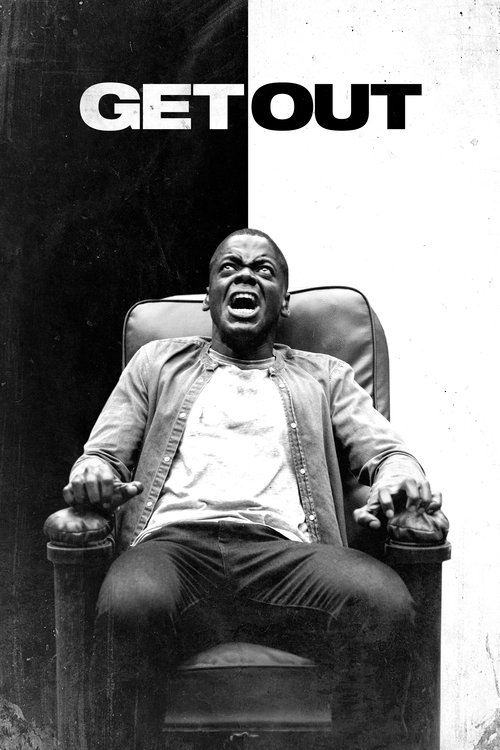
In the ending of "Get Out," Chris fights back against his captors, ultimately escaping the clutches of the Armitage family. He confronts and kills his captors, but just as he is about to be free, he is nearly run over by a car driven by his friend Rod. The film concludes with Rod rescuing Chris, and they drive away together, leaving the horrors of the Armitage estate behind.
Now, let's delve into the ending in a more detailed narrative fashion:
As the climax of the film unfolds, Chris Washington finds himself in a desperate struggle for survival. After discovering the horrifying truth about the Armitage family's sinister intentions--using hypnosis and surgery to transplant the consciousness of white individuals into black bodies--Chris is determined to escape. He manages to free himself from the chair where he was restrained, using the flash of his phone to disrupt the hypnosis that had been placed upon him.
In a tense sequence, Chris fights against Jeremy Armitage, the family's aggressive son. The struggle is visceral, filled with raw emotion as Chris channels his fear and anger into a desperate fight for his life. He ultimately overpowers Jeremy, killing him in a brutal confrontation. The stakes are high, and Chris's determination to escape is palpable as he navigates the dark, eerie house, filled with the remnants of the family's horrific experiments.
Chris then confronts Missy Armitage, the matriarch, who attempts to use her hypnosis against him once more. However, Chris, now fully aware of her manipulative tactics, fights back. He manages to stab her, a moment that signifies his reclaiming of power and agency. The house, once a place of terror, becomes a battleground where Chris asserts his will to survive.
As he makes his way outside, Chris encounters Dean Armitage, the patriarch, who tries to reason with him, but Chris is resolute. In a final act of defiance, Chris kills Dean, ensuring that no member of the Armitage family will continue their horrific legacy.
Just as Chris believes he has escaped the nightmare, he is nearly struck by a car. The vehicle screeches to a halt, and to his relief, it is Rod Williams, his friend and TSA agent, who has come to rescue him. Rod's arrival is a moment of relief and camaraderie, contrasting sharply with the horror Chris has just endured. They share a brief moment of understanding, and Chris, battered but alive, is finally free from the clutches of the Armitage family.
The film concludes with Chris and Rod driving away from the estate, the weight of the traumatic experience still heavy on Chris's shoulders. The camera lingers on the Armitage house, now a symbol of the horrors that transpired within its walls, as the screen fades to black.
In this ending, Chris's fate is one of survival, but it is also marked by the trauma he has endured. Rod, as his ally, represents a glimmer of hope and friendship amidst the darkness. The film closes on a note of tension, leaving the audience to reflect on the implications of the events that have unfolded.
Is there a post-credit scene?
In the movie "Get Out," there is no post-credit scene. The film concludes with the intense climax where Chris Washington, played by Daniel Kaluuya, confronts the horrors of the Armitage family's sinister intentions. After a harrowing escape, the film ends with Chris being hit by a car, but he ultimately fights back and manages to kill his captors.
As the film reaches its conclusion, Chris is finally rescued by his friend Rod, who arrives in a TSA vehicle. This moment serves as a relief after the tension and horror that Chris has endured throughout the film. The final scene emphasizes the themes of friendship and survival, leaving the audience with a sense of closure without any additional scenes or twists during the credits. The absence of a post-credit scene reinforces the film's focus on its central narrative and the resolution of Chris's harrowing experience.
What happens during Chris's first visit to the Armitage family home?
During Chris's first visit to the Armitage family home, he is greeted warmly by his girlfriend Rose's parents, Dean and Missy. The atmosphere is initially friendly, but Chris feels a sense of unease due to the family's overly accommodating behavior and the presence of their Black servants, Walter and Georgina, who act strangely. Missy, a psychiatrist, offers to hypnotize Chris to help him quit smoking, which he reluctantly agrees to. The hypnosis scene is pivotal, as it reveals Missy's ability to manipulate Chris's mind, leading to a traumatic experience where he is trapped in a dark void, symbolizing his loss of control.
What is the significance of the deer incident in the beginning of the film?
The deer incident at the beginning of the film serves as a foreshadowing device and a metaphor for the racial tensions that permeate the story. Chris and his friend Rod are driving through the woods when they hit a deer, which symbolizes innocence and vulnerability. The deer's death reflects the predatory nature of the Armitage family and the dangers that await Chris. This moment also establishes Chris's emotional connection to animals and foreshadows his own struggle for survival against the Armitage family's sinister intentions.
How does Chris react to the behavior of the Black servants in the Armitage household?
Chris is initially confused and disturbed by the behavior of the Black servants, Walter and Georgina. He notices their odd mannerisms and the way they seem to be trapped in their roles, which makes him uncomfortable. Walter's forced smile and Georgina's emotional breakdown during a conversation about her past hint at a deeper, sinister reality. Chris's discomfort grows as he realizes that their behavior is not just a result of the family's control but also a reflection of the horrific fate that awaits him. This realization heightens his sense of isolation and fear.
What role does the 'Sunken Place' play in Chris's experience?
The 'Sunken Place' is a crucial element in Chris's experience, representing his loss of agency and the psychological manipulation he undergoes. When Missy hypnotizes him, she sends him into the Sunken Place, a dark, void-like state where he is unable to move or speak, forced to watch his body act against his will. This experience embodies the theme of control and the exploitation of Black bodies, as Chris is rendered powerless while his consciousness remains aware. The Sunken Place becomes a symbol of the systemic oppression faced by Black individuals, making Chris's struggle for freedom all the more poignant.
What is the significance of the party scene at the Armitage home?
The party scene at the Armitage home is significant as it highlights the bizarre and unsettling dynamics of the white guests' fascination with Chris as a Black man. The guests engage in superficial conversations, expressing their admiration for Black culture while simultaneously objectifying Chris. This scene amplifies the film's commentary on racism, as the guests' behavior reveals their ignorance and entitlement. Chris's discomfort escalates as he feels like a spectacle, culminating in a moment where he is forced to perform for the guests, further emphasizing his alienation and the predatory nature of the Armitage family's intentions.
Is this family friendly?
"Get Out," produced in 2017, is not considered family-friendly due to its intense themes and graphic content. Here are some potentially objectionable or upsetting aspects that may affect children or sensitive viewers:
-
Violence and Gore: The film contains scenes of physical violence, including bloodshed and graphic injuries that can be disturbing.
-
Psychological Horror: The film explores themes of manipulation, control, and psychological trauma, which may be unsettling for younger audiences.
-
Racial Tension: The narrative delves into issues of racism and exploitation, presenting uncomfortable social commentary that may be difficult for children to understand.
-
Disturbing Imagery: There are moments of surreal and unsettling imagery that can evoke fear and anxiety.
-
Strong Language: The film includes profanity and strong language that may not be suitable for younger viewers.
-
Sexual Content: There are scenes that imply sexual situations and themes that may be inappropriate for children.
Overall, the film's combination of horror, social commentary, and intense emotional experiences makes it more suitable for mature audiences.







