
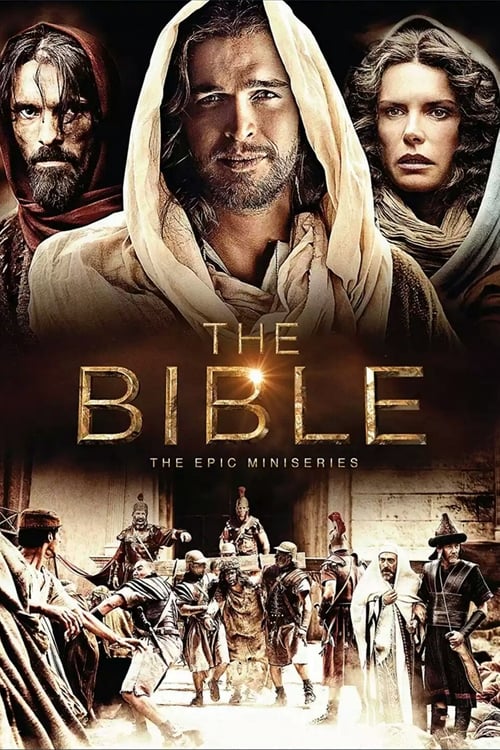



















Popular
Should I watch it?
Ask Your Own Question

What is the plot?
The Bible begins with the creation of the world, depicting God creating light, the heavens, the earth, and all living creatures over six days. The scenes are filled with vibrant visuals of nature, animals, and the first humans, Adam and Eve, who are placed in the Garden of Eden. They live in harmony with God, enjoying the beauty of creation. However, the tranquility is shattered when the serpent tempts Eve to eat the forbidden fruit from the Tree of Knowledge. She shares the fruit with Adam, leading to their realization of their nakedness and subsequent shame. As a consequence of their disobedience, God expels them from Eden, marking the beginning of humanity's struggle.
The narrative shifts to the story of Cain and Abel, the sons of Adam and Eve. Cain, a farmer, becomes envious of his brother Abel, a shepherd, after God favors Abel's offering over his. In a fit of rage, Cain murders Abel, leading to his own punishment as he is marked by God and becomes a wanderer. This act of violence sets a tone of conflict and sin that permeates human history.
The story then transitions to Noah, who is chosen by God to build an ark in preparation for a great flood that will cleanse the earth of its wickedness. Despite the ridicule from his neighbors, Noah remains steadfast in his faith and completes the ark. When the flood comes, Noah, his family, and pairs of every animal enter the ark. The floodwaters rise, destroying all life outside the ark. After many days, the waters recede, and Noah sends out a dove, which returns with an olive branch, signaling the end of the flood. God establishes a covenant with Noah, promising never to flood the earth again, symbolized by a rainbow.
The narrative then moves to the Tower of Babel, where humanity, speaking a single language, attempts to build a tower to reach the heavens. God confounds their language, causing confusion and scattering the people across the earth, which explains the diversity of languages and cultures.
Next, the focus shifts to Abraham, who is called by God to leave his homeland and journey to a new land, Canaan. God promises Abraham that he will be the father of a great nation. Abraham's faith is tested when he and his wife Sarah, who is barren, are promised a son. In their impatience, Sarah gives her maid Hagar to Abraham to bear a child, resulting in the birth of Ishmael. Later, God fulfills His promise, and Sarah gives birth to Isaac. Abraham's faith is further tested when God commands him to sacrifice Isaac. Abraham obeys, but at the last moment, an angel stops him, providing a ram as a substitute sacrifice.
The story continues with Isaac's marriage to Rebekah, who bears twin sons, Esau and Jacob. Jacob, with the help of his mother, deceives Isaac into giving him the blessing meant for Esau. This act of deception leads to Jacob fleeing to avoid Esau's wrath. In his journey, Jacob has a dream of a ladder reaching to heaven, where God reaffirms His covenant with him. Jacob eventually marries Leah and Rachel, having many children who become the tribes of Israel.
The narrative then follows Joseph, one of Jacob's sons, who is favored by his father. His brothers, envious of his dreams and status, sell him into slavery in Egypt. Despite his hardships, including being falsely accused and imprisoned, Joseph rises to power in Egypt by interpreting Pharaoh's dreams, predicting a coming famine. He becomes the second-in-command and prepares Egypt for the famine.
When the famine strikes, Jacob sends his sons to Egypt for food. They encounter Joseph, who recognizes them but conceals his identity. After a series of tests, including framing Benjamin for theft, Joseph reveals himself to his brothers. The family is reunited, and Joseph invites them to live in Egypt, where they prosper.
The story then shifts to Moses, born during a time when Pharaoh orders the death of Hebrew male infants. Moses is saved by being placed in a basket in the Nile, where he is found and adopted by Pharaoh's daughter. As an adult, Moses witnesses the suffering of his people and kills an Egyptian overseer. Fleeing to Midian, he encounters God in the form of a burning bush, where he is commanded to return to Egypt and lead the Israelites to freedom.
Moses confronts Pharaoh, demanding the release of the Israelites. Pharaoh refuses, and God sends ten plagues upon Egypt, culminating in the death of the firstborn. The Israelites are instructed to mark their doors with lamb's blood to be spared. After the final plague, Pharaoh relents, and the Israelites leave Egypt, crossing the Red Sea as God parts the waters for their escape.
In the wilderness, the Israelites face challenges, including hunger and thirst. God provides manna and quail for food and water from a rock. Moses receives the Ten Commandments on Mount Sinai, establishing the covenant between God and His people. However, the Israelites struggle with faith, creating a golden calf to worship while Moses is on the mountain. Upon his return, Moses shatters the tablets in anger but later intercedes for the people, and God renews the covenant.
The narrative continues with the Israelites' journey to the Promised Land, marked by disobedience and lack of faith. They send spies to scout the land, but fear leads to rebellion against God's promise. As a result, they wander in the desert for forty years until the disbelieving generation dies out.
The story culminates with Joshua leading the Israelites into the Promised Land after Moses' death. They conquer Jericho through faith and obedience, marching around the city until its walls fall. The land is divided among the tribes of Israel, fulfilling God's promise to Abraham.
The final scenes depict the cycle of sin and redemption as the Israelites struggle to remain faithful to God, leading to the rise of judges and eventually the establishment of a monarchy with Saul, David, and Solomon. David's reign is marked by his deep faith, his sin with Bathsheba, and his heartfelt repentance. Solomon builds the Temple in Jerusalem, a symbol of God's presence among His people.
The narrative concludes with the division of the kingdom, the fall of Israel and Judah, and the prophetic warnings of exile. Despite the consequences of their actions, the story ends with a message of hope for redemption and restoration through the coming of a Messiah.









What is the ending?
In the ending of the 2013 miniseries "The Bible," the story culminates with the resurrection of Jesus Christ, his ascension into heaven, and the spread of his teachings by his disciples. The series concludes with a vision of hope and faith, emphasizing the transformative power of belief.
As the final episodes unfold, we see the aftermath of Jesus' crucifixion. The scene opens with Mary Magdalene and other women visiting the tomb where Jesus was laid. They are met with shock and confusion when they find the stone rolled away and the tomb empty. An angel appears to them, proclaiming that Jesus has risen from the dead. The women are filled with a mix of fear and joy as they rush to tell the disciples the miraculous news.
The narrative shifts to the disciples, who are initially in hiding, grappling with their grief and fear following Jesus' death. However, their despair transforms into hope when Jesus appears to them, showing them his wounds and affirming his resurrection. This moment is filled with emotional intensity as the disciples experience a profound sense of relief and renewed purpose. Jesus reassures them, telling them to spread his teachings to all nations, instilling in them a sense of mission.
In the following scenes, we witness the ascension of Jesus. He gathers his disciples on a mountaintop, where he gives them final instructions. As he speaks, he begins to rise into the sky, enveloped in a cloud. The disciples watch in awe, their faces a mixture of wonder and determination. This moment signifies the completion of Jesus' earthly ministry and the beginning of the disciples' journey to spread his message.
The series concludes with a montage of the disciples traveling to various regions, preaching the gospel, and performing miracles in Jesus' name. We see Peter boldly proclaiming the message of Christ, while Paul, who is introduced earlier in the series, begins his mission to spread Christianity beyond the Jewish community. The final scenes are filled with images of hope, faith, and the transformative power of belief, as the disciples face challenges but remain steadfast in their commitment to their mission.
In terms of character fates, Mary Magdalene becomes a key figure in the early Christian community, embodying the role of a devoted follower. Peter emerges as a leader among the disciples, taking on the responsibility of guiding the early church. Paul, who initially persecuted Christians, undergoes a profound transformation and becomes one of the most influential apostles, spreading the teachings of Jesus far and wide. The series ends on a note of hope, emphasizing the enduring impact of Jesus' life and teachings on humanity.
Is there a post-credit scene?
The Bible, produced in 2013, does not contain a post-credit scene. The series concludes with the final episode, which wraps up the narrative arcs of the key biblical figures and events depicted throughout the show. The last moments focus on the resurrection of Jesus and the impact of his teachings, leaving viewers with a sense of closure regarding the stories of faith, sacrifice, and redemption that have been explored throughout the series. The emphasis is on the significance of these events rather than any additional scenes or content after the credits.
What role does Moses play in the story of The Bible?
Moses is a central figure in The Bible, depicted as a reluctant leader chosen by God to free the Israelites from slavery in Egypt. His journey begins with a divine encounter at the burning bush, where he is commanded to confront Pharaoh. Throughout the series, Moses struggles with self-doubt and fear, yet he is driven by a deep sense of purpose and faith. His emotional turmoil is palpable as he grapples with the enormity of his mission, leading to the dramatic plagues that befall Egypt and the eventual Exodus. The series captures his internal conflict, his relationship with God, and his role as a mediator between the divine and the people.
How is the character of David portrayed in The Bible?
David is portrayed as a complex character, beginning as a humble shepherd boy with a deep faith in God. His journey to kingship is marked by significant emotional highs and lows, including his anointing by Samuel, his defeat of Goliath, and his tumultuous relationship with King Saul. The series highlights David's bravery and charisma, but also his flaws, such as his moral failings with Bathsheba and the resulting family strife. His internal struggles with guilt and redemption are vividly depicted, showcasing his deep connection to God through psalms and prayer, ultimately establishing him as a man after God's own heart.
What is the significance of the character of Jesus in The Bible?
Jesus is depicted as the central figure of the New Testament, embodying compassion, wisdom, and divine authority. The series portrays his birth, ministry, and crucifixion with emotional depth, emphasizing his relationships with his disciples and the marginalized. His teachings, miracles, and parables are illustrated with a focus on their transformative impact on those around him. The emotional weight of his sacrifice is palpable during the Last Supper and the crucifixion, where his humanity and divinity collide. The series captures the profound love and pain he experiences, ultimately leading to the resurrection, which serves as a pivotal moment of hope and redemption for humanity.
How does the story of Noah unfold in The Bible?
Noah's story is depicted with a focus on his unwavering faith in God amidst a corrupt world. The series begins with Noah receiving a divine warning about the impending flood, showcasing his internal conflict as he grapples with disbelief from his community. His determination to build the ark, despite ridicule, highlights his steadfastness and commitment to God's command. The emotional weight of losing his friends and neighbors is palpable as he prepares for the flood. The scenes of the flood itself are visually striking, filled with chaos and despair, contrasting with the hope represented by Noah's family and the animals aboard the ark. The aftermath reveals Noah's struggle to rebuild and the covenant God establishes with him, symbolizing renewal and faith.
What is the relationship between Abraham and Isaac in The Bible?
The relationship between Abraham and Isaac is portrayed as one of deep love and profound testing. Abraham, having waited many years for the birth of his son Isaac, experiences immense joy and fulfillment. However, this joy is challenged when God commands Abraham to sacrifice Isaac as a test of faith. The emotional turmoil is vividly depicted, showcasing Abraham's internal conflict between his love for his son and his obedience to God. The series captures the heart-wrenching moment of Abraham preparing to sacrifice Isaac, filled with tension and despair. Ultimately, the intervention of an angel and the provision of a ram highlight themes of faith, obedience, and divine mercy, solidifying their bond and Abraham's legacy as the father of many nations.
Is this family friendly?
The Bible, produced in 2013, is generally considered family-friendly, but it does contain some scenes and themes that may be upsetting or objectionable for children or sensitive viewers. Here are some aspects to be aware of:
-
Violence and Warfare: The series depicts various battles and conflicts, including scenes of war, bloodshed, and the aftermath of violence. This includes the destruction of cities and the suffering of people during these events.
-
Death and Sacrifice: There are moments that involve the death of significant characters, including the crucifixion of Jesus, which may be emotionally intense for younger viewers.
-
Suffering and Betrayal: The series explores themes of betrayal, such as Judas Iscariot's betrayal of Jesus, which can evoke feelings of sadness and distress.
-
Dramatic Emotional Moments: Characters experience intense emotional struggles, including despair, loss, and grief, which may be heavy for sensitive viewers.
-
Depictions of Sin and Moral Conflict: The show addresses themes of sin, temptation, and moral dilemmas, which may raise questions or discomfort for younger audiences.
-
Supernatural Elements: The portrayal of miracles and divine interventions may be confusing or unsettling for some viewers, depending on their beliefs.
Overall, while The Bible aims to present its stories in a respectful and educational manner, parents may want to preview the series or discuss its themes with their children to provide context and support.