
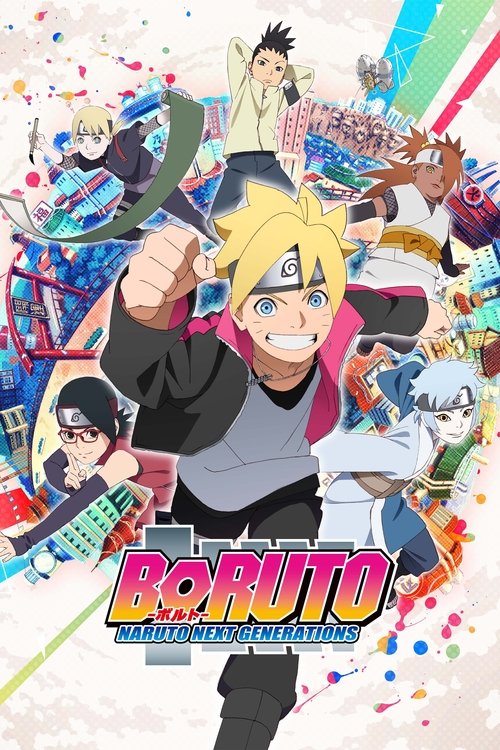








Popular
What is Boruto's relationship with Naruto and how does it evolve throughout the series?
How does Sarada Uchiha's character develop in relation to her goals of becoming Hokage?
What role does Mitsuki play in Boruto's journey and how does his background influence his character?
What are the implications of Boruto using the Kote during the Chunin Exams?
How does the introduction of the Otsutsuki clan affect the dynamics of the story?
Should I watch it?
Ask Your Own Question

What is the plot?
The story begins in the Hidden Leaf Village, where Boruto Uzumaki, the son of Naruto Uzumaki, the Seventh Hokage, is introduced. Boruto is frustrated with his father's busy schedule and feels neglected. He is determined to surpass Naruto and seeks to make a name for himself. During the Chunin Exams, Boruto uses scientific ninja tools to gain an advantage, which leads to a confrontation with his teammates, Sarada Uchiha and Mitsuki, who are unaware of his actions.
As the Chunin Exams commence, Boruto's team faces off against other genin teams. Boruto's use of scientific tools allows him to perform well, but he struggles with the ethics of cheating. Sarada and Mitsuki are conflicted about Boruto's methods but support him nonetheless. The first round of the exams involves a written test, where Boruto's team manages to pass, albeit through questionable means.
In the second round, a survival exercise takes place in the Forest of Death. Boruto's team encounters other teams, including Shinki's team from the Sand Village. Shinki, a powerful user of magnet release, showcases his abilities, and Boruto is both impressed and intimidated. The tension escalates when Boruto's team is ambushed, leading to a fierce battle. Boruto's reliance on scientific tools becomes a point of contention, as Sarada and Mitsuki express their concerns about his choices.
The final round of the Chunin Exams is a tournament-style battle. Boruto faces Shinki in a one-on-one match. During the fight, Boruto initially struggles against Shinki's overwhelming power. However, he manages to tap into his own abilities and uses a combination of his ninja skills and scientific tools to hold his ground. The battle is intense, with Shinki demonstrating his mastery of magnetism, but Boruto's determination shines through.
As the fight progresses, Boruto's use of scientific tools is revealed to the audience, leading to a backlash from the spectators and his father, Naruto. Boruto is disqualified for cheating, which deeply frustrates him. This moment serves as a turning point for Boruto, as he begins to reflect on his actions and the true meaning of being a ninja. The disqualification leads to a confrontation with Naruto, who expresses his disappointment in Boruto's choices.
Following the Chunin Exams, Boruto's relationship with Naruto becomes strained. Boruto feels that Naruto does not understand him, while Naruto is concerned about Boruto's path. Meanwhile, a new threat emerges in the form of Kinshiki and Momoshiki Ōtsutsuki, who arrive in the Hidden Leaf Village seeking to capture Naruto. Their arrival triggers a series of events that lead to a battle for the village's safety.
Kinshiki and Momoshiki attack the village, causing chaos and destruction. Naruto and Sasuke Uchiha join forces to confront the Ōtsutsuki. During the battle, Boruto witnesses the strength and determination of his father and Sasuke, which inspires him to take action. He decides to help, despite his earlier feelings of inadequacy. Boruto's growth as a character is highlighted as he steps up to protect his village.
In the midst of the battle, Boruto receives a special kunai from Sasuke, symbolizing his acceptance as a ninja. This moment solidifies Boruto's resolve to become stronger and to forge his own path. The fight against Momoshiki escalates, with Naruto and Sasuke working together to combat the powerful foe. Boruto, using his newfound determination, joins the fray, showcasing his own abilities and growth.
The battle reaches its climax when Momoshiki absorbs Kinshiki and becomes even more powerful. Naruto and Sasuke struggle against him, but Boruto's intervention proves crucial. He uses the Rasengan, a technique he learned from Naruto, to assist in the fight. The teamwork between Boruto, Naruto, and Sasuke culminates in a final attack that defeats Momoshiki, but not without significant consequences.
After the battle, Boruto reflects on his journey and the lessons he has learned. He reconciles with Naruto, acknowledging the importance of hard work and the true essence of being a ninja. The story concludes with Boruto embracing his role as a ninja, ready to face new challenges alongside his friends and family. The bonds between Boruto, Sarada, and Mitsuki strengthen, setting the stage for future adventures in the Hidden Leaf Village.
More TV Shows Like This
Browse All TV Shows →




What is the ending?
In the final episodes of Boruto: Naruto Next Generations, the story culminates in a climactic battle against Isshiki Ōtsutsuki, who poses a significant threat to the Hidden Leaf Village. Boruto, alongside Naruto, Sasuke, and other allies, confronts Isshiki in a desperate attempt to protect their home. The battle is intense, showcasing the growth of Boruto and his friends as they utilize their unique abilities. Ultimately, Naruto and Sasuke manage to weaken Isshiki, but at a great cost. In the end, Naruto sacrifices his Kurama, the Nine-Tails, to unleash a powerful new form, allowing him to defeat Isshiki. However, this victory comes with the loss of Kurama, leaving Naruto to grapple with the emotional weight of this sacrifice. Boruto, having witnessed the battle and the sacrifices made, grows more determined to protect his village and honor his father's legacy. The series concludes with Boruto and his friends looking towards the future, ready to face new challenges together.
As the final arc unfolds, the tension escalates with the arrival of Isshiki Ōtsutsuki, a formidable foe intent on capturing Kawaki, who possesses the potential to become a vessel for Isshiki's resurrection. The Hidden Leaf Village is on high alert, and Naruto, as the Hokage, is determined to protect his home and his family.
Scene 1: The Hidden Leaf Village is bustling with activity, but an ominous cloud looms as Naruto gathers his allies, including Sasuke, Sakura, and Boruto. The atmosphere is tense; the stakes are high. Boruto feels a mix of anxiety and determination, wanting to prove himself worthy of his father's legacy.
Scene 2: The confrontation with Isshiki begins in a desolate area outside the village. The air crackles with energy as Naruto and Sasuke engage Isshiki in battle. The fight is fierce, showcasing Naruto's mastery of Sage Mode and Sasuke's Rinnegan abilities. Boruto watches, feeling both inspired and overwhelmed by the power displayed by his father and Sasuke.
Scene 3: As the battle rages on, Isshiki demonstrates his terrifying abilities, manipulating space and time. Naruto and Sasuke struggle to keep up, and the toll of the fight begins to weigh heavily on them. Boruto's internal conflict deepens; he wants to help but feels inadequate compared to the seasoned warriors.
Scene 4: In a pivotal moment, Naruto and Sasuke devise a plan to trap Isshiki. They coordinate their attacks, showcasing their bond and teamwork. Boruto, witnessing their determination, resolves to step in, channeling his own abilities. He uses the Rasengan, a technique he learned from Naruto, to support his father and Sasuke.
Scene 5: The battle reaches its climax as Naruto, in a moment of desperation, decides to use the power of Kurama to unleash a new transformation. The transformation is visually stunning, with a fiery aura enveloping him. However, this power comes at a grave cost. Kurama reveals that using this form will lead to his demise.
Scene 6: With the newfound strength, Naruto confronts Isshiki head-on. The fight is brutal, and the emotional stakes are palpable. Boruto watches, torn between pride and fear as he realizes the sacrifice his father is making. The bond between father and son is highlighted as Naruto fights not just for the village but for Boruto's future.
Scene 7: In a final, desperate move, Naruto delivers a powerful blow to Isshiki, ultimately leading to his defeat. The victory is bittersweet; Kurama fades away, leaving Naruto to grapple with the loss of his companion and the weight of his sacrifice. The emotional impact is profound, as Naruto reflects on his journey and the sacrifices made for the village.
Scene 8: In the aftermath, Boruto stands beside his father, who is now without Kurama. The village is safe, but the cost of victory is heavy. Boruto vows to honor his father's legacy and protect the village, feeling a renewed sense of purpose. The series concludes with Boruto and his friends looking towards the horizon, ready to face whatever challenges lie ahead.
In the end, Naruto is left to navigate life without Kurama, while Boruto steps into a new role, more determined than ever to become a strong ninja and leader. The bonds of friendship and family are emphasized, setting the stage for future adventures and growth.
Is there a post-credit scene?
In "Boruto: Naruto Next Generations," there is a post-credit scene that appears after the final episode of the first season, specifically after Episode 51. This scene serves as a bridge to the next arc and provides a glimpse into the future of the series.
The post-credit scene features Boruto Uzumaki, who is now a bit older and more mature. He is seen standing on a rooftop, gazing out over the Hidden Leaf Village. The sun is setting, casting a warm golden hue over the village, symbolizing both the end of one chapter and the beginning of another. Boruto's expression is contemplative, reflecting his growth and the weight of his responsibilities as a ninja.
As he looks out, he recalls moments from his past, including his relationships with his friends and family, particularly his father, Naruto Uzumaki, who is now the Hokage. There is a sense of nostalgia mixed with determination in Boruto's demeanor, hinting at his desire to forge his own path while still grappling with the legacy of his father.
The scene transitions to a brief flash of action, showing Boruto training with his friends, Sarada Uchiha and Mitsuki. They are engaged in a friendly spar, showcasing their growth as ninjas and the bonds they have formed. The camaraderie and competitive spirit among them highlight the themes of friendship and teamwork that are central to the series.
The post-credit scene concludes with Boruto's resolve to become a great ninja in his own right, setting the stage for the challenges and adventures that lie ahead. This moment encapsulates the essence of Boruto's journey, emphasizing his struggle for identity and the importance of the relationships he has built along the way.
What is Boruto's relationship with Naruto and how does it evolve throughout the series?
Boruto Uzumaki, the son of Naruto Uzumaki, initially has a strained relationship with his father. He feels neglected due to Naruto's responsibilities as the Hokage, which leads to feelings of resentment. As the series progresses, Boruto's understanding of Naruto's sacrifices deepens, especially after witnessing the challenges Naruto faces as a leader. This evolution is marked by key moments, such as when Boruto realizes the weight of his father's duties and ultimately begins to appreciate Naruto's efforts to protect the village. Their relationship becomes more supportive as Boruto learns to embrace his own identity as a ninja.
How does Sarada Uchiha's character develop in relation to her goals of becoming Hokage?
Sarada Uchiha, the daughter of Sasuke Uchiha and Sakura Haruno, is driven by her ambition to become Hokage, inspired by Naruto and her parents. Her journey is marked by her struggle to understand her own identity and the legacy of her clan. Throughout the series, Sarada faces challenges that test her resolve, including her desire to connect with her father, Sasuke, who is often absent. Her determination grows as she trains and fights alongside her friends, leading to moments of self-discovery and empowerment. Sarada's character development is highlighted during her battles, where she showcases her skills and leadership potential, solidifying her aspiration to lead the village.
What role does Mitsuki play in Boruto's journey and how does his background influence his character?
Mitsuki, a synthetic human created from Orochimaru's cells, plays a crucial role in Boruto's journey as his loyal friend and teammate. His background as a product of Orochimaru's experiments adds complexity to his character, as he grapples with questions of identity and purpose. Mitsuki's calm demeanor and unwavering support for Boruto often serve as a stabilizing force within their team. His internal conflict about his origins and desire to understand what it means to be human is explored through various arcs, particularly when he faces challenges that test his loyalty and emotions. Mitsuki's journey of self-discovery is intertwined with Boruto's growth, highlighting themes of friendship and acceptance.
What are the implications of Boruto using the Kote during the Chunin Exams?
During the Chunin Exams, Boruto uses a Kote, a device that enhances his abilities, to gain an advantage in the tournament. This decision stems from his desire to prove himself and surpass his father's legacy. However, it leads to significant implications for his character and relationships. When Naruto discovers Boruto's use of the Kote, he feels betrayed, believing that Boruto is not valuing hard work and the true essence of being a ninja. This conflict escalates into a pivotal moment in their relationship, forcing Boruto to confront his motivations and the importance of earning his achievements through his own efforts. The incident serves as a catalyst for Boruto's character development, pushing him to redefine his understanding of strength and honor.
How does the introduction of the Otsutsuki clan affect the dynamics of the story?
The introduction of the Otsutsuki clan significantly alters the dynamics of the Boruto narrative, introducing a new level of threat to the ninja world. Characters like Kinshiki and Momoshiki Otsutsuki bring powerful abilities and a sense of urgency to the story, as they seek to harvest the chakra of the planet. Their arrival forces the ninja villages to unite against a common enemy, challenging the established peace. This conflict not only tests the strength of the characters but also deepens the lore of the series, connecting it to the larger history of chakra and the origins of ninjutsu. The Otsutsuki clan's influence leads to intense battles and character growth, particularly for Boruto, who must rise to the occasion and confront these formidable foes.
Is this family friendly?
"Boruto: Naruto Next Generations" is generally considered family-friendly, but it does contain some scenes and themes that may be objectionable or upsetting for children or sensitive viewers. Here are a few aspects to be aware of:
-
Violence: The series features ninja battles that include physical confrontations, use of weapons, and jutsu (magical techniques) that can result in injury or destruction. While the violence is often stylized and not overly graphic, it can still be intense.
-
Death and Loss: Characters face significant challenges, including the loss of loved ones or friends. These moments can evoke strong emotions and may be distressing for younger viewers.
-
Emotional Struggles: Characters deal with themes of loneliness, pressure to succeed, and the burden of expectations. These emotional struggles can resonate deeply and may be heavy for some viewers.
-
Conflict and Rivalry: The series explores themes of rivalry and conflict among peers, which can lead to bullying or feelings of inadequacy, particularly for younger audiences.
-
Dark Themes: Some story arcs delve into darker themes, such as betrayal, revenge, and the consequences of one's actions, which may be unsettling for sensitive viewers.
Overall, while "Boruto" is designed for a younger audience, parents may want to watch alongside their children to discuss any challenging themes that arise.








