






































Popular
Should I watch it?
Ask Your Own Question

What is the plot?
Sorry, we aren't able to watch and write up a full detailed plot yet. Check back in a few days.


What is the ending?
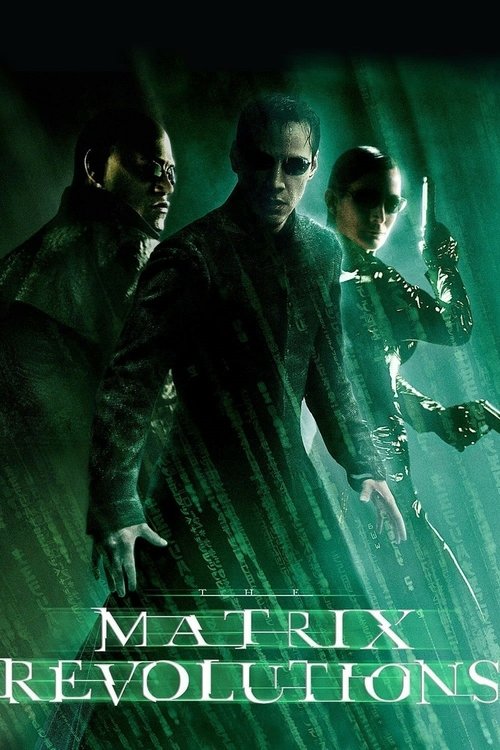
In the ending of The Matrix Revolutions, Neo confronts Agent Smith in a final battle to save both the Matrix and the real world. After a fierce fight, Neo sacrifices himself to destroy Smith, leading to peace between humans and machines. The Oracle and the Architect discuss the future, hinting at a new beginning. The film concludes with a sense of hope as Trinity and Neo's love is remembered, and the Matrix is left open for those who wish to leave.
As the climax of The Matrix Revolutions unfolds, the scene opens in the desolate ruins of the Machine City. Neo, having made his way through the dark, industrial landscape, arrives at the heart of the machines. He is determined to confront the looming threat of Agent Smith, who has begun to replicate himself throughout the Matrix, posing a danger not only to the digital world but also to the real world.
In a pivotal moment, Neo meets with the Oracle, who reassures him of his purpose. She tells him that he must face Smith, as only he can end the chaos that Smith has unleashed. The Oracle's calm demeanor contrasts with the urgency of the situation, emphasizing Neo's internal struggle and the weight of his destiny. He understands that this confrontation is not just about defeating Smith but also about the balance between humans and machines.
The scene shifts to the Matrix, where Neo and Smith engage in an epic battle. The environment is a chaotic blend of urban landscapes and digital glitches, reflecting the turmoil within the Matrix itself. As they fight, the intensity of their conflict escalates, showcasing Neo's determination and Smith's relentless pursuit of power. The fight is not just physical; it is a clash of ideologies, with Neo representing hope and freedom, while Smith embodies control and destruction.
As the battle reaches its zenith, Neo realizes that he must make the ultimate sacrifice. In a moment of profound clarity, he allows Smith to assimilate him, effectively becoming part of Smith. This act is a strategic move, as it enables Neo to access the source code of the Matrix. In this moment, Neo's internal motivation shifts from self-preservation to self-sacrifice, highlighting his growth as a character and his commitment to the greater good.
With Neo's sacrifice, the machines are able to launch a counterattack against Smith. The scene is visually striking, with a surge of energy coursing through the Matrix as the machines eradicate Smith and his clones. The destruction of Smith signifies the end of his reign of chaos, restoring balance to the Matrix and the real world.
Following the climactic battle, the narrative transitions to a serene setting where the Oracle and the Architect converse. The Architect, with his cold, calculating demeanor, acknowledges the outcome of the conflict. The Oracle expresses her belief in the possibility of peace between humans and machines, hinting at a new era. This dialogue encapsulates the film's themes of choice, coexistence, and the cyclical nature of conflict.
In the final moments, the audience is left with a poignant image of Neo and Trinity's love. As the camera pans out, it captures the essence of their relationship, which has been a driving force throughout the trilogy. Neo's fate is sealed as he is no longer present in the physical realm, but his legacy endures. The Matrix is left open for those who wish to escape, symbolizing hope and the potential for a better future.
In summary, Neo sacrifices himself to save both worlds, Smith is defeated, and the Oracle and Architect discuss a hopeful future. The film concludes with a sense of renewal, emphasizing the enduring power of love and the possibility of harmony between humans and machines.
Is there a post-credit scene?
The Matrix Revolutions does not have a post-credit scene. After the film concludes, the credits roll without any additional scenes or content. The film ends with a sense of closure, following the climactic battle between humans and machines, and the resolution of Neo's journey. The absence of a post-credit scene aligns with the film's themes of finality and the conclusion of the trilogy.
What happens to Neo at the end of The Matrix Revolutions?
At the end of The Matrix Revolutions, Neo sacrifices himself to save humanity and the machines. After a climactic battle with Agent Smith, who has taken over the Matrix, Neo allows himself to be assimilated by Smith. This act leads to a confrontation between Smith and the Source, the central program of the Matrix. Neo's connection to the Source allows the machines to delete Smith, restoring balance to the Matrix. Neo's fate is left ambiguous, but he is last seen in a peaceful state, suggesting he has found a form of liberation.
How does Trinity die in The Matrix Revolutions?
Trinity dies during a pivotal moment in The Matrix Revolutions when she and Neo are attempting to reach the Machine City. Their ship, the Logos, is attacked by Sentinels, and in the chaos, Trinity is thrown from the ship. She falls onto a metal structure, sustaining fatal injuries. In her final moments, she shares a heartfelt goodbye with Neo, expressing her love for him. Her death deeply affects Neo, fueling his determination to confront the machines and save humanity.
What is the significance of the Architect's conversation with Neo?
The Architect's conversation with Neo in The Matrix Revolutions is significant as it reveals the cyclical nature of the Matrix and the choices that have led to the current conflict. The Architect explains that Neo is not the first One, and that the Matrix has been rebooted multiple times. He presents Neo with a choice: to save humanity or to save Trinity. This moment highlights Neo's internal struggle between his love for Trinity and his responsibility as the One, ultimately shaping his decision to confront the machines.
What role does the Oracle play in The Matrix Revolutions?
In The Matrix Revolutions, the Oracle plays a crucial role as a guide and mentor to Neo and the other characters. She provides insight into the nature of choice and destiny, emphasizing the importance of understanding one's path. The Oracle also reveals that the war between humans and machines can only end through cooperation. Her conversations with Neo and other characters help to clarify their motivations and the larger stakes of the conflict, ultimately leading to the resolution of the war.
How does the final battle between Neo and Agent Smith unfold?
The final battle between Neo and Agent Smith in The Matrix Revolutions is an epic confrontation that takes place in a rain-soaked, desolate cityscape. The two engage in a fierce fight, showcasing their superhuman abilities. Neo, initially confident, finds himself overwhelmed as Smith has gained power by replicating himself. The battle escalates, with both characters exchanging blows and flying through the air. Ultimately, Neo realizes that he cannot defeat Smith through brute force alone. In a moment of self-sacrifice, he allows Smith to assimilate him, which leads to the destruction of Smith and the restoration of the Matrix.
Is this family friendly?
The Matrix Revolutions, produced in 2003, is not considered family-friendly due to its intense themes and graphic content. Here are some potentially objectionable or upsetting aspects that may affect children or sensitive viewers:
-
Violence: The film contains numerous scenes of intense violence, including gunfights, hand-to-hand combat, and large-scale battles. Characters are shown being shot, injured, or killed, which can be quite graphic.
-
Death and Destruction: The narrative involves significant loss of life, with scenes depicting the destruction of cities and the aftermath of battles, which can be distressing.
-
Dark Themes: The film explores heavy themes such as existentialism, sacrifice, and the struggle for freedom, which may be difficult for younger audiences to comprehend.
-
Intense Emotional Moments: Characters experience profound grief, loss, and despair, which can evoke strong emotional reactions.
-
Mature Language: There are instances of strong language that may not be suitable for younger viewers.
-
Philosophical Concepts: The film delves into complex philosophical ideas about reality and choice, which may be confusing or unsettling for children.
Overall, the combination of violence, dark themes, and mature content makes The Matrix Revolutions more appropriate for older teens and adults rather than younger audiences.









