





























Popular
What motivates James Bond to seek revenge in Quantum of Solace?
How does Bond's relationship with M evolve in Quantum of Solace?
What role does the character Dominic Greene play in the plot?
What is the significance of the title 'Quantum of Solace' in relation to Bond's journey?
How does the film depict Bond's internal struggle with trust?
Should I watch it?
Ask Your Own Question

What is the plot?
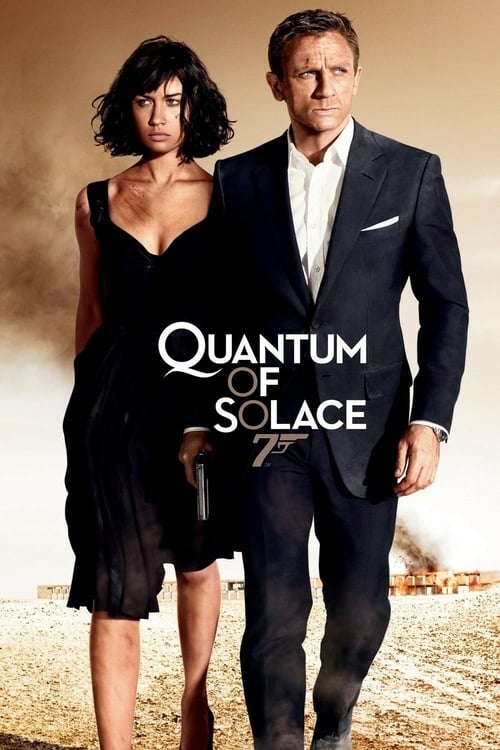
The film opens in the tense, sun-drenched landscape of Lake Garda, Italy, mere minutes after the harrowing events of Casino Royale. James Bond, still raw from the emotional betrayal and death of Vesper Lynd, is driving recklessly, his face set in grim determination. In the boot of his sleek Aston Martin DBS sits Mr. White, the captured operative whose cryptic words haunt Bond: "Quantum is everywhere. You can't fight an idea." Bond's grip tightens on the steering wheel as he maneuvers through narrow roads, evading pursuers with sharp precision, his mind consumed by vengeance and the need for answers.
Arriving in Siena, Bond delivers Mr. White to MI6 headquarters in London, where M (Judi Dench) oversees the interrogation. The atmosphere is thick with tension; M's sharp voice cuts through the room: "You're not a bloody hero, Bond. You're a blunt instrument." Mr. White's smug defiance unsettles the agents as he reveals Quantum's insidious reach, claiming operatives are embedded within MI6, the British government, and even the CIA. Suddenly, chaos erupts--Craig Mitchell, M's trusted bodyguard, reveals himself as a double agent. He shoots a guard and attacks M, creating a deadly distraction that allows Mr. White to escape. Bond reacts instantly, confronting Mitchell in a brutal fight that ends with Bond shooting him dead. The betrayal stings deeply; the organization's tentacles have already infiltrated Bond's own circle.
With Mr. White vanished, Bond's hunt takes him to Port-au-Prince, Haiti, where he crosses paths with Camille Montes, a fierce and enigmatic woman driven by her own thirst for vengeance. Camille's family was brutally murdered by General Medrano, a corrupt Bolivian dictator. Her path converges with Bond's when she is seen as the girlfriend of Dominic Greene, an environmental entrepreneur whose polished exterior masks a ruthless operative of Quantum. Greene's interest in acquiring vast tracts of land in Bolivia raises red flags. Bond quickly deduces that Greene's true plan involves monopolizing Bolivia's water supply, a vital resource being secretly dammed and controlled to manipulate the country's future.
The tension escalates as Bond and Camille fly over the Bolivian landscape, surveying the lands Greene is acquiring. Their plane is ambushed by a Bolivian fighter jet, forcing them into a desperate escape. In a daring move, Bond tricks the pursuing plane into crashing into the rugged terrain. They skydive into a massive sinkhole, plunging into the heart of Quantum's operation. Among the shadows, they discover the dammed water supply, confirming the sinister plot to control Bolivia's lifeblood. Camille's eyes flash with determination--this is her chance to exact justice for her family.
Returning to La Paz, Bond reunites with M and learns more grim truths. The organization has already killed Fields, an ally, by drowning her in crude oil--a brutal message of their reach and cruelty. Bond also meets Felix Leiter, the CIA operative who warns him of an imminent raid by the CIA's Special Activities Division targeting Quantum operatives. Despite M's orders and a suspension, Bond's resolve is unshaken. He evades MI6 guards and continues his pursuit, understanding that the stakes have never been higher.
The narrative threads converge at a remote, luxurious hotel in the Atacama Desert, powered by volatile hydrogen fuel cells. Here, Greene is set to meet Medrano to finalize a contract that will install Medrano as Bolivia's new president in exchange for granting Greene control over the country's water rights. The contract is a death sentence for Bolivia's independence and its people's survival.
Bond and Camille infiltrate the hotel under cover of darkness. The tension crackles as Bond silently dispatches the hotel's security detail, his movements precise and lethal. The air is thick with danger; every step could ignite the volatile fuel cells powering the compound. Meanwhile, Camille confronts Medrano in a chilling, emotionally charged scene. As Medrano attempts to rape a hotel waitress, Camille fights back fiercely, knocking the weapon away and seizing her own gun. With a steady hand, she shoots Medrano, avenging the brutal murders and rapes of her family. Her face is a mixture of pain and relief, reclaiming her power amid the chaos.
Bond's confrontation with Greene is brutal and unrelenting. The two men clash fiercely amid the hotel's corridors, their fight a physical manifestation of the battle for Bolivia's future. The struggle culminates as the hydrogen fuel cells rupture, igniting a massive explosion that engulfs the hotel in flames. Amidst the fire and smoke, Bond overpowers Greene, interrogating him about Quantum's true nature and reach. Rather than kill him outright, Bond leaves Greene stranded in the desert with only a can of engine oil--a poetic punishment for a man who tried to sell out an entire country's lifeblood for profit.
The aftermath is grim. Greene is later found dead in the desert, two bullets in his head, a likely execution by Quantum for his failure. Bond and Camille escape the burning hotel, sharing a moment of quiet understanding and closure. Camille wishes Bond luck in conquering his demons, acknowledging the personal toll of their shared quest for justice.
Throughout the film, Bond's journey is marked by loss and betrayal. The deaths are numerous and poignant: Craig Mitchell dies at Bond's hand during the MI6 betrayal; Mr. White escapes but is later found dead with two bullets in his head, likely Quantum's retribution; Solange, Greene's girlfriend, is drowned in crude oil, a victim of Quantum's ruthless tactics; Mathis, Bond's ally, is wounded and then accidentally killed by Bolivian police; and the police chief who betrays Mathis is killed by Bond in retaliation. The final deaths of General Medrano at Camille's hands and Dominic Greene's brutal desert demise close the chapter on Quantum's immediate threat.
The film ends with Bond reflecting on the path ahead. His quest for vengeance has uncovered the shadowy organization Quantum, but the war is far from over. With Camille's parting words echoing in his mind, Bond steels himself for the battles yet to come, determined to bring justice to those who betrayed him and to protect the innocent from the insidious grasp of Quantum. The story closes on a note of grim resolve, the embers of the desert fire fading as Bond disappears into the horizon, ready to continue his mission.
More Movies Like This
Browse All Movies →




What is the ending?
In the ending of "Quantum of Solace," James Bond confronts Dominic Greene at a remote hotel in the Bolivian desert. After a tense showdown, Bond kills Greene, who had been orchestrating a plot to control Bolivia's water supply. Bond then meets with M, revealing the truth about Vesper Lynd's betrayal and his quest for closure. The film concludes with Bond walking away, having found a sense of resolution but still haunted by his past.
As the film approaches its climax, we find James Bond in the Bolivian desert, having tracked down Dominic Greene, the antagonist behind the nefarious plot to control Bolivia's water supply. The scene opens with Bond arriving at a stark, modern hotel, the stark contrast of its architecture against the barren landscape emphasizing the isolation and tension of the moment. Bond's face is set with determination, a reflection of his internal struggle as he seeks vengeance for the betrayal he experienced with Vesper Lynd.
Inside the hotel, Bond confronts Greene, who is in the midst of a meeting with his associates. The atmosphere is thick with tension as Bond's presence disrupts the proceedings. Greene, smug and self-assured, attempts to negotiate, but Bond is resolute. The confrontation escalates into a violent struggle, showcasing Bond's physical prowess and emotional turmoil. As they fight, the stakes are palpable; Bond is not just fighting for justice but also for his own sense of closure.
In a pivotal moment, Bond gains the upper hand and holds Greene at gunpoint. Greene, realizing his imminent demise, tries to bargain for his life, but Bond, fueled by the pain of his past and the betrayal he has endured, delivers a cold, decisive line before pulling the trigger. Greene's lifeless body falls, symbolizing Bond's rejection of the manipulative world that has caused him so much suffering.
Following this confrontation, Bond seeks out M, the head of MI6, at a remote location. The scene is charged with emotion as Bond reveals the truth about Vesper's betrayal and the extent of Greene's machinations. M listens intently, her expression a mix of concern and understanding. Bond's admission of his feelings for Vesper and the pain of her betrayal is a cathartic moment for him, allowing him to confront the ghosts of his past.
In the final scenes, Bond walks away from M, a solitary figure against the vastness of the desert. His journey has been one of loss and vengeance, but as he strides away, there is a sense of resolution. He has avenged Vesper, but the emotional scars remain. The film closes with Bond's silhouette fading into the horizon, leaving the audience with a poignant reminder of the cost of his life as a spy.
As for the fates of the main characters: James Bond emerges from the ordeal changed but still haunted by his past. Dominic Greene is dead, his ambitions thwarted and his life extinguished by Bond's hand. M remains a steadfast figure in Bond's life, aware of the toll that their world takes on agents like Bond, yet committed to the mission. The film ends on a note of ambiguity, reflecting the ongoing conflict within Bond and the world he inhabits.
Is there a post-credit scene?
"Quantum of Solace," produced in 2008, does not have a post-credit scene. The film concludes with James Bond, played by Daniel Craig, having avenged the death of his love, Vesper Lynd, and confronting the organization behind her betrayal. The film ends on a note of resolution for Bond, as he walks away from the events that transpired, setting the stage for his character's ongoing journey without any additional scenes after the credits.
What motivates James Bond to seek revenge in Quantum of Solace?
James Bond is driven by a deep sense of betrayal and loss following the death of his love interest, Vesper Lynd. Her betrayal and subsequent death at the hands of the organization Quantum leave him emotionally scarred and determined to uncover the truth behind her actions and the organization itself. This personal vendetta fuels his relentless pursuit of justice throughout the film.
How does Bond's relationship with M evolve in Quantum of Solace?
In Quantum of Solace, Bond's relationship with M is strained yet complex. M is concerned about Bond's emotional state and his reckless pursuit of vengeance, which she believes could jeopardize MI6 and their operations. Despite her reservations, she also recognizes Bond's skills and determination, leading to moments of tension where she must balance her duty to protect him and the agency with her understanding of his personal motivations.
What role does the character Dominic Greene play in the plot?
Dominic Greene is the primary antagonist in Quantum of Solace, representing the shadowy organization Quantum. He is a ruthless businessman who seeks to control Bolivia's water supply for profit and power. Greene's manipulative nature and willingness to betray allies make him a formidable foe for Bond, who sees him as a direct link to Vesper's betrayal. Greene's actions and motivations drive much of the conflict in the film, as Bond seeks to dismantle his plans and expose his corruption.
What is the significance of the title 'Quantum of Solace' in relation to Bond's journey?
The title 'Quantum of Solace' reflects Bond's emotional state and his quest for closure after the turmoil caused by Vesper's betrayal. The term 'quantum' suggests a small, measurable amount, indicating that Bond is searching for even a fleeting sense of peace or solace amidst his pain and anger. Throughout the film, Bond grapples with his feelings of loss and betrayal, ultimately seeking a resolution that allows him to move forward.
How does the film depict Bond's internal struggle with trust?
Throughout Quantum of Solace, Bond grapples with his ability to trust others, a direct consequence of Vesper's betrayal. His interactions with characters like Camille Montes, who seeks revenge against Greene for her own reasons, highlight his struggle to open up and rely on anyone. Bond's internal conflict is palpable as he navigates alliances, often questioning the motives of those around him, which adds a layer of tension to his relationships and decisions.
Is this family friendly?
"Quantum of Solace," produced in 2008, is not considered family-friendly due to several potentially objectionable or upsetting scenes. Here are some aspects that may be concerning for children or sensitive viewers:
-
Violence: The film features intense action sequences, including hand-to-hand combat, gunfights, and explosions. These scenes can be graphic and may be distressing.
-
Death and Injury: Characters experience significant injury and death throughout the film, often depicted in a realistic manner that could be unsettling.
-
Themes of Betrayal and Revenge: The emotional weight of betrayal and the quest for revenge are central to the plot, which may be difficult for younger viewers to process.
-
Mature Themes: The film explores themes of corruption, manipulation, and the darker sides of human nature, which may not be suitable for all audiences.
-
Romantic Elements: There are scenes that involve romantic relationships, some of which may include suggestive content or implications that could be inappropriate for younger viewers.
-
Tension and Suspense: The film maintains a high level of tension and suspense, which could be anxiety-inducing for sensitive individuals.
Overall, the film's mature content and intense action make it more appropriate for older teens and adults rather than children.