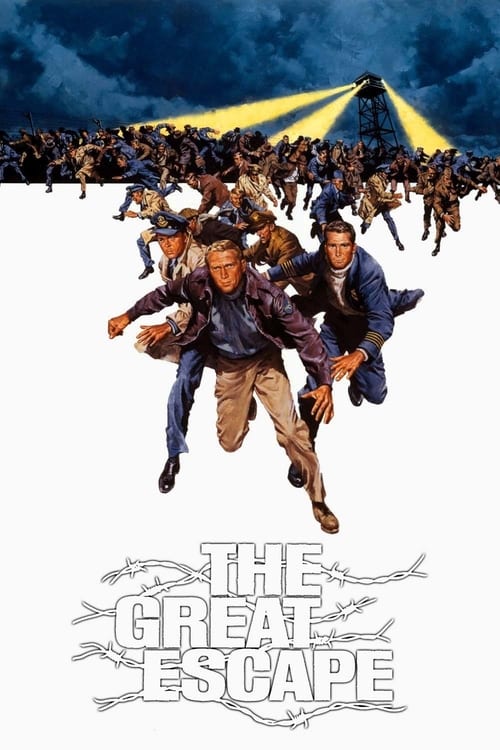

Popular
What is the significance of the tunnel named 'Tom' in the escape plan?
How does Captain Virgil Hilts, played by Steve McQueen, contribute to the escape?
What role does Colonel Robert Hendley, 'The Scrounger,' play in the escape?
What challenges do the prisoners face while digging the tunnels?
How does the character of Flight Lieutenant Dickie Attenborough contribute to the escape plan?
Should I watch it?
Ask Your Own Question

What is the plot?
Sorry, we aren't able to watch and write up a full detailed plot yet. Check back in a few days.


What is the ending?
In the ending of "The Great Escape," several prisoners attempt to flee from the German POW camp. While many manage to escape, the majority are recaptured, and some are executed. The film concludes with a sense of bittersweet triumph as the escapees' efforts highlight their indomitable spirit, despite the heavy losses.
As the film approaches its climax, the meticulously planned escape unfolds. The prisoners, led by the resourceful and determined Roger Bartlett, known as "Big X," execute their plan under the cover of darkness. They have dug three tunnels, named "Tom," "Dick," and "Harry," and the night of the escape arrives.
Scene by scene, the tension builds. The first group of prisoners begins to emerge from the tunnels, their hearts racing with a mix of fear and exhilaration. They navigate through the camp, avoiding guards and searchlights, their breaths shallow as they make their way toward freedom. Among them is the charismatic American, Captain Virgil Hilts, known as "The Cooler King," who embodies a rebellious spirit. He is determined to escape, not just for himself but for the camaraderie of his fellow prisoners.
As the escapees reach the perimeter of the camp, they face their first major obstacle: the barbed wire fence. With careful precision, they cut through the wire, their hands trembling with anticipation. The night is tense, filled with the sounds of distant guards and the rustling of leaves. Each escapee is acutely aware of the stakes; failure means not just recapture but severe punishment.
Once outside the camp, the escapees scatter into the surrounding woods, each man driven by his own motivations--some seeking freedom, others longing to return to their loved ones. The film intercuts between the escapees and the guards, who soon realize that something is amiss. The alarm is raised, and the camp is thrown into chaos as search parties are dispatched.
As dawn breaks, the escapees face the harsh reality of their situation. Some manage to find temporary refuge, while others are quickly apprehended. The film poignantly captures the emotional turmoil of the characters as they grapple with the consequences of their actions. The camaraderie among the prisoners is palpable, and their shared hope for freedom is a powerful driving force.
In a heartbreaking turn, the fate of the main characters is revealed. Roger Bartlett, the mastermind behind the escape, is ultimately captured and executed by the Gestapo, a grim reminder of the risks they took. Captain Hilts, after a series of narrow escapes, is recaptured and sent back to the camp, where he is placed in solitary confinement. His spirit remains unbroken, however, as he continues to embody the defiance of the human spirit.
Other characters, like the British officer, Flight Lieutenant Dickie Attenborough, manage to evade capture for a time but are eventually caught. The film concludes with a montage of the escapees' fates, underscoring the heavy toll of their daring attempt. The final scenes depict the aftermath of the escape, with the camp returning to a semblance of normalcy, yet forever changed by the audacity of the prisoners' actions.
The ending of "The Great Escape" leaves viewers with a poignant sense of loss and resilience, highlighting the sacrifices made by the characters in their quest for freedom. The film closes on a note of bittersweet reflection, celebrating the bravery of those who dared to dream of escape, even in the face of overwhelming odds.
Is there a post-credit scene?
The Great Escape, produced in 1963, does not have a post-credit scene. The film concludes with a powerful and poignant ending that leaves a lasting impact on the audience. After the intense and dramatic escape sequence, the film wraps up with a montage of the escapees' fates, underscoring the sacrifices made and the harsh realities faced by those who sought freedom. The final moments focus on the somber aftermath, emphasizing the themes of hope and resilience in the face of adversity, but there are no additional scenes or credits that follow.
What is the significance of the tunnel named 'Tom' in the escape plan?
The tunnel named 'Tom' is a crucial element in the escape plan devised by the prisoners. It represents the culmination of their efforts to break free from the confines of the Stalag Luft III camp. The tunnel is meticulously dug over several months, showcasing the prisoners' determination and ingenuity. It is significant not only as a physical means of escape but also as a symbol of hope and camaraderie among the prisoners, who work together to overcome the oppressive conditions of their captivity.
How does Captain Virgil Hilts, played by Steve McQueen, contribute to the escape?
Captain Virgil Hilts, known as 'The Cooler King,' is a rebellious and resourceful character who plays a pivotal role in the escape. His daring personality and knack for improvisation inspire the other prisoners. Hilts is involved in the planning and execution of the escape, using his skills to create distractions and evade the guards. His iconic motorcycle chase scene exemplifies his adventurous spirit and determination to break free, making him a memorable figure in the narrative.
What role does Colonel Robert Hendley, 'The Scrounger,' play in the escape?
Colonel Robert Hendley, referred to as 'The Scrounger,' is essential to the escape plan due to his ability to procure necessary supplies and equipment from within the camp. His resourcefulness allows the prisoners to gather items like uniforms, maps, and tools, which are critical for their escape. Hendley's character embodies the cleverness and adaptability required to survive in captivity, and his interactions with other prisoners highlight the importance of teamwork and trust in their shared goal.
What challenges do the prisoners face while digging the tunnels?
While digging the tunnels, the prisoners face numerous challenges that test their resolve and ingenuity. They must contend with the constant threat of discovery by the guards, who patrol the camp and monitor the prisoners' activities. The physical labor of digging is grueling, requiring them to work in secrecy and under the cover of darkness. Additionally, they face logistical issues, such as the need to dispose of the excavated dirt without raising suspicion. These challenges create a tense atmosphere, underscoring the risks involved in their daring escape.
How does the character of Flight Lieutenant Dickie Attenborough contribute to the escape plan?
Flight Lieutenant Dickie Attenborough, portrayed by Richard Attenborough, is a key figure in the escape plan as the leader of the prisoners. His character embodies leadership, strategic thinking, and a deep sense of responsibility for the well-being of his fellow inmates. Attenborough's character organizes the escape efforts, coordinating the various roles of the prisoners and ensuring that everyone is committed to the plan. His emotional investment in the success of the escape reflects the hope and determination that drives the group, making him a central figure in the narrative.
Is this family friendly?
"The Great Escape," produced in 1963, is a war film that depicts the story of Allied prisoners of war attempting to escape from a German camp during World War II. While it is a classic film, there are several aspects that may be considered objectionable or upsetting for children or sensitive viewers:
-
War Violence: The film contains scenes of violence related to war, including gunfire, explosions, and the consequences of escape attempts, which may be distressing.
-
Prisoner Treatment: There are depictions of harsh treatment of prisoners, including physical confrontations and the psychological strain of captivity.
-
Death and Loss: The film addresses themes of sacrifice and loss, with characters facing dire consequences for their actions, which may be emotionally heavy.
-
Tension and Suspense: The film builds significant tension as characters plan and execute their escape, which may be anxiety-inducing for some viewers.
-
Mature Themes: The overarching themes of war, survival, and the struggle for freedom may be complex and difficult for younger audiences to fully grasp.
Overall, while "The Great Escape" is a celebrated film, its content may not be suitable for all children or sensitive viewers due to its portrayal of war and its emotional weight.