
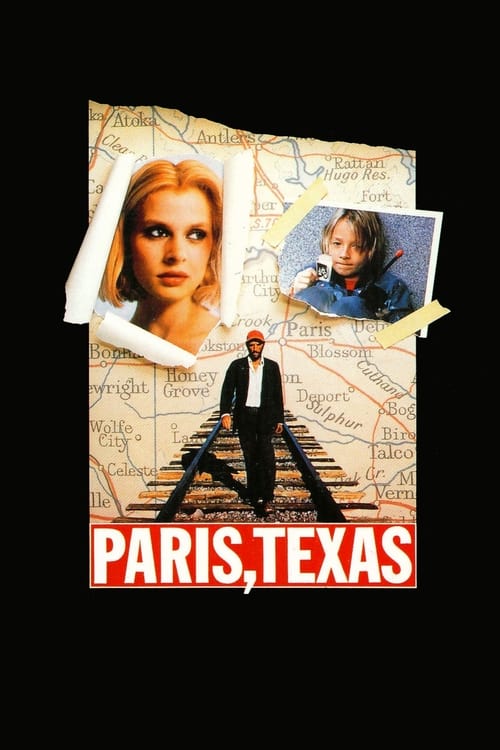











Popular
What is the significance of Travis's journey to find his son?
How does the relationship between Travis and Hunter evolve throughout the film?
What role does Jane play in Travis's life and his quest?
What does the landscape of Texas symbolize in the film?
How does the film portray the theme of communication and disconnection?
Should I watch it?
Ask Your Own Question

What is the plot?
Sorry, we aren't able to watch and write up a full detailed plot yet. Check back in a few days.







What is the ending?
In the ending of "Paris, Texas," Travis finds Jane, his estranged wife, in a peep show in Houston. They have a heartfelt conversation where Travis expresses his feelings and regrets. Jane reveals her struggles and the choices she made. After a poignant exchange, they part ways, and Travis returns to his son, Hunter, who has been waiting for him.
As the film approaches its conclusion, the scene shifts to a dimly lit peep show in Houston, where Travis, played by Harry Dean Stanton, finally locates Jane, portrayed by Nastassja Kinski. The atmosphere is heavy with tension and anticipation as Travis enters the establishment, his heart racing with a mix of hope and fear. The camera captures his hesitant steps, the flickering neon lights casting shadows on his face, reflecting the turmoil within him.
Inside, Travis finds Jane behind a glass partition, her expression a blend of surprise and recognition. The moment is charged with unspoken emotions, as Travis struggles to find the right words. He begins to speak, his voice trembling slightly, revealing the depth of his longing and regret. He tells her about the years apart, the pain of losing her, and the impact of her absence on their son, Hunter. The audience can feel the weight of his words, each syllable laced with vulnerability.
Jane listens intently, her eyes filled with a mixture of sadness and understanding. She shares her own story, recounting the choices she made and the life she has led since leaving Travis. The conversation is raw and honest, a cathartic release of years of pent-up emotions. As they talk, the camera alternates between close-ups of their faces, capturing the nuances of their expressions--Travis's yearning and Jane's sorrow.
In a pivotal moment, Travis asks Jane if she would like to see Hunter. The question hangs in the air, heavy with implications. Jane's response is hesitant; she is torn between her desire to reconnect with her son and the fear of the life she has led. The emotional stakes are high, and the audience can sense the internal conflict raging within her.
As the conversation draws to a close, Travis and Jane share a moment of profound connection, a fleeting glimpse of the love they once had. However, the reality of their situation looms large. They both know that their paths have diverged too far for reconciliation. With a heavy heart, Jane ultimately decides to leave, stepping away from the glass partition that separated them. The camera lingers on Travis's face, capturing the pain of loss as he watches her walk away, a figure disappearing into the shadows of the night.
The final scenes shift back to Travis and Hunter, who have been waiting for him. The reunion is bittersweet; Travis returns to his son, but the weight of his unresolved feelings for Jane hangs in the air. The film closes with a sense of ambiguity, leaving the audience to ponder the future of these characters. Travis, having faced his past, now must navigate the complexities of fatherhood and the emotional scars that remain.
In the end, Travis is left with the knowledge that he has confronted his past, but the journey of healing is far from over. Hunter, innocent and hopeful, looks up to his father, unaware of the emotional turmoil that lies beneath the surface. The film concludes with a poignant sense of longing and the realization that while some connections may be severed, the impact of those relationships endures.
Is there a post-credit scene?
The movie "Paris, Texas," produced in 1984, does not have a post-credit scene. The film concludes with a poignant and emotional ending that encapsulates the journey of the main character, Travis Henderson, as he reconnects with his son, Hunter, and seeks closure regarding his estranged wife, Jane. The final moments focus on the deep emotional resonance of their reunion and the complexities of their relationships, leaving the audience with a sense of reflection rather than additional scenes or content after the credits.
What is the significance of Travis's journey to find his son?
Travis, played by Harry Dean Stanton, embarks on a journey to reconnect with his son, Hunter, after being estranged for four years. His motivation is deeply rooted in his desire for redemption and to reclaim a sense of family that he lost. The journey symbolizes his struggle with his own identity and the need to confront his past mistakes.
How does the relationship between Travis and Hunter evolve throughout the film?
Initially, Travis is a distant and emotionally scarred figure, struggling to communicate with his son, Hunter. As they travel together, their bond begins to strengthen. Travis's protective instincts emerge, and he gradually opens up to Hunter, sharing stories and experiences. This evolution highlights the themes of fatherhood and the longing for connection.
What role does Jane play in Travis's life and his quest?
Jane, portrayed by Nastassja Kinski, is Travis's estranged wife and the mother of Hunter. Her presence in the film is pivotal as Travis's search for her is intertwined with his quest for redemption. When Travis finally finds Jane, their emotional reunion reveals the pain and unresolved issues from their past, showcasing the complexity of love and loss.
What does the landscape of Texas symbolize in the film?
The vast and desolate landscapes of Texas serve as a backdrop that reflects Travis's internal turmoil and isolation. The open roads and barren deserts symbolize his search for meaning and connection, while also emphasizing the loneliness he feels. The stark beauty of the environment contrasts with his emotional struggles, enhancing the film's themes of alienation and longing.
How does the film portray the theme of communication and disconnection?
Throughout 'Paris, Texas,' communication is a central theme, particularly in the relationships between Travis, Hunter, and Jane. Travis's initial inability to express his feelings leads to a profound sense of disconnection. As the story progresses, moments of vulnerability and honesty emerge, particularly in the climactic phone call between Travis and Jane, highlighting the challenges and importance of communication in rebuilding relationships.
Is this family friendly?
"Paris, Texas" is a film that explores complex themes of loss, alienation, and the search for connection, which may not be suitable for younger audiences or sensitive viewers. Here are some potentially objectionable or upsetting aspects:
-
Themes of Abandonment: The film deals with the emotional fallout of a family torn apart, including a father who has been absent for years and the impact of his return on his son.
-
Depictions of Grief and Trauma: Characters express deep emotional pain and trauma, which may be difficult for children to understand or process.
-
Substance Abuse: There are references to alcohol and the effects it has on the characters, which may be unsettling.
-
Loneliness and Isolation: The film portrays profound feelings of loneliness and disconnection, which could be heavy for younger viewers.
-
Intense Emotional Conversations: Some scenes involve intense discussions about relationships, love, and loss that may be too mature for children.
-
Visuals of Desolation: The film features stark landscapes and settings that evoke feelings of emptiness and despair, which might be unsettling.
Overall, while "Paris, Texas" is a critically acclaimed film, its themes and emotional depth may not be appropriate for children or those sensitive to such topics.






