
























Popular
What is the significance of the character K in the story?
How does Oh Kyung-soo's relationship with his partner evolve throughout the season?
What role does the antagonist, the corrupt businessman, play in the plot?
How does the concept of duality manifest in the character of Oh Kyung-soo?
What are the key turning points in Kyung-soo's character development throughout the season?
Should I watch it?
Ask Your Own Question

What is the plot?
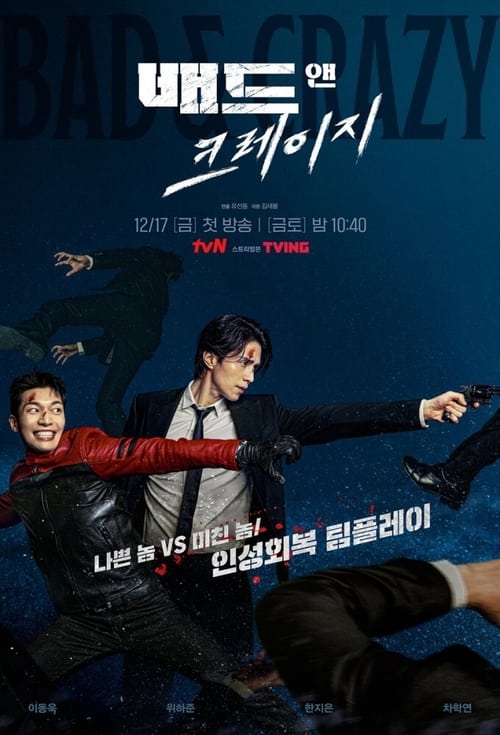
The story begins with a chaotic scene where police officer Soo-yeol, played by Lee Dong-wook, is seen struggling with his own moral compass. He is a self-serving cop who is more interested in personal gain than justice. One night, after a drunken escapade, he finds himself in a bizarre situation where he encounters a mysterious figure named K, portrayed by Wi Ha-joon. K is a seemingly crazy alter ego of Soo-yeol, who appears only when Soo-yeol is in dire situations. K embodies a sense of justice and righteousness that Soo-yeol lacks.
As the plot unfolds, Soo-yeol is assigned to investigate a series of bizarre and violent crimes linked to a drug syndicate. During the investigation, he is plagued by K's interruptions, who often acts impulsively and violently, leading to confrontations with criminals. K's presence becomes increasingly disruptive, causing Soo-yeol to question his own sanity. The audience sees Soo-yeol's internal struggle as he grapples with K's influence, which often leads him to make reckless decisions.
In one pivotal scene, Soo-yeol and K confront a group of thugs in an abandoned warehouse. The confrontation escalates into a physical fight, with K taking over and showcasing impressive combat skills. Soo-yeol, initially hesitant, is forced to join in, and together they manage to overpower the thugs. This victory, however, leaves Soo-yeol feeling conflicted about K's violent methods and his own inability to control the situation.
As the investigation deepens, Soo-yeol discovers that the drug syndicate is connected to a powerful politician. This revelation puts him in a precarious position, as he realizes that exposing the truth could endanger his life. K, however, urges him to pursue justice, leading to a clash between Soo-yeol's desire for self-preservation and K's moral imperative. This internal conflict intensifies as Soo-yeol begins to lose control over his own actions, often succumbing to K's influence.
The plot thickens when Soo-yeol's partner, a fellow officer named Oh Kyung-soo, becomes suspicious of his erratic behavior. Kyung-soo confronts Soo-yeol about his drinking and the strange occurrences surrounding K. This confrontation leads to a rift between the two, as Soo-yeol feels increasingly isolated. K, sensing Soo-yeol's vulnerability, pushes him to take more drastic actions against the drug syndicate.
In a climactic sequence, Soo-yeol and K infiltrate a high-stakes drug deal orchestrated by the syndicate. The tension builds as they navigate through a heavily guarded location. K takes charge, leading to a series of intense confrontations with armed guards. The fight choreography is dynamic, showcasing K's agility and combat prowess. Soo-yeol, caught between fear and adrenaline, ultimately joins in, and they manage to disrupt the deal, leading to a chaotic shootout.
As the dust settles, Soo-yeol faces the consequences of their actions. The fallout from the disrupted deal leads to increased scrutiny from his superiors and the media. K's influence begins to wane, leaving Soo-yeol to confront the reality of his choices alone. He grapples with feelings of guilt and confusion, questioning whether K is a blessing or a curse in his life.
In the final episodes, the narrative takes a darker turn as Soo-yeol learns that K's existence is tied to his own unresolved traumas and guilt. This revelation forces him to confront his past, including a tragic incident that shaped his current worldview. The emotional weight of this confrontation leads to a powerful climax where Soo-yeol must choose between embracing K's violent methods or finding his own path to justice.
The series concludes with a tense standoff between Soo-yeol and the remaining members of the drug syndicate, culminating in a final showdown that tests his resolve. In a moment of clarity, Soo-yeol decides to confront the syndicate without K's influence, showcasing his growth as a character. The resolution leaves viewers with a sense of ambiguity regarding K's fate and Soo-yeol's future, emphasizing the ongoing struggle between his darker impulses and the desire for redemption.








What is the ending?
In the ending of "Bad and Crazy," the main character, Soo-yeol, confronts the antagonist, who is revealed to be a powerful figure manipulating events from behind the scenes. With the help of his alter ego, K, Soo-yeol manages to expose the corruption and bring justice to those who have suffered. The series concludes with Soo-yeol embracing his duality, accepting both parts of himself, and moving forward with a renewed sense of purpose.
As the final episodes unfold, the tension escalates. Soo-yeol, a detective plagued by his own demons, finds himself in a precarious situation. The narrative begins with him grappling with the consequences of his actions and the chaos that K, his alter ego, has brought into his life. The audience witnesses Soo-yeol's internal struggle as he tries to balance his duties as a police officer with the unpredictable nature of K.
In a pivotal scene, Soo-yeol discovers that the corruption runs deeper than he initially thought. He uncovers a conspiracy involving high-ranking officials, including the police chief, who has been orchestrating a series of events to eliminate anyone who poses a threat to his power. This revelation sends Soo-yeol into a spiral of doubt and fear, but K's presence offers him a strange sense of confidence and clarity.
As the climax approaches, Soo-yeol and K team up to confront the antagonist in a dramatic showdown. The setting is tense, filled with dark shadows and flickering lights, symbolizing the moral ambiguity of their fight. Soo-yeol's determination to seek justice is palpable, and K's reckless bravery pushes him to take risks he would never consider alone. The two characters, representing different facets of Soo-yeol's psyche, work in tandem to outsmart their enemies.
In the final confrontation, Soo-yeol faces the antagonist, who taunts him with the idea that he will never truly escape his past. The scene is charged with emotion as Soo-yeol reflects on his journey, the mistakes he has made, and the people he has let down. However, with K's encouragement, he finds the strength to stand up for what is right. The battle culminates in a tense standoff, where Soo-yeol's resolve shines through, leading to the antagonist's downfall.
As the dust settles, the aftermath reveals the fates of the main characters. Soo-yeol, having exposed the corruption, is hailed as a hero, but he knows that the fight for justice is ongoing. He embraces his duality, acknowledging that both he and K are essential to who he is. K, having played a crucial role in Soo-yeol's transformation, begins to fade, symbolizing that while he may not be physically present, the lessons learned from their partnership will remain with Soo-yeol.
The series concludes with Soo-yeol standing at a crossroads, looking out at the city he has fought to protect. He is no longer just a detective; he is a man who has faced his fears and emerged stronger. The final shot captures his contemplative expression, hinting at the challenges that lie ahead but also the hope that comes with embracing one's true self.
Is there a post-credit scene?
In "Bad and Crazy," Season 1, there is no post-credit scene. The series concludes its episodes without any additional scenes or content after the credits roll. The focus remains on the main narrative and character arcs throughout the episodes, wrapping up the storylines without extending into post-credit material. The absence of a post-credit scene allows the audience to reflect on the events and character developments that have unfolded during the episode.
What is the significance of the character K in the story?
K is a manifestation of the protagonist's inner turmoil and represents his suppressed emotions and desires. Throughout the series, K challenges the main character, Oh Kyung-soo, to confront his fears and insecurities, often leading to intense and chaotic situations that force Kyung-soo to reevaluate his life choices.
How does Oh Kyung-soo's relationship with his partner evolve throughout the season?
Oh Kyung-soo's relationship with his partner, Detective Lee Seon-woo, begins with tension and distrust due to Kyung-soo's erratic behavior influenced by K. As the season progresses, they develop a deeper understanding of each other, with Seon-woo becoming a crucial ally in Kyung-soo's battle against his inner demons and the external threats they face.
What role does the antagonist, the corrupt businessman, play in the plot?
The corrupt businessman serves as a catalyst for the main conflict in the series. His illegal activities and manipulation of the law create a dangerous environment for Kyung-soo and Seon-woo. The businessman embodies the systemic corruption that Kyung-soo is fighting against, and his actions push Kyung-soo to confront both the external and internal battles he faces.
How does the concept of duality manifest in the character of Oh Kyung-soo?
Oh Kyung-soo embodies duality through his struggle between his professional duties as a police officer and his chaotic, reckless side represented by K. This internal conflict is visually depicted through his interactions with K, where moments of clarity and confusion blur the lines between his identity as a law enforcer and his personal struggles, leading to moments of both vulnerability and strength.
What are the key turning points in Kyung-soo's character development throughout the season?
Key turning points in Kyung-soo's character development include his initial denial of K's existence, the moment he begins to accept K as a part of himself, and the climactic confrontation with the corrupt businessman. Each of these moments forces Kyung-soo to confront his past mistakes, leading to significant growth as he learns to embrace both his strengths and weaknesses.
Is this family friendly?
"Bad and Crazy" is a South Korean drama that blends elements of action, comedy, and psychological thriller. While it has engaging storytelling and character development, it does contain several elements that may not be suitable for children or sensitive viewers.
-
Violence: The show features various scenes of physical confrontations, including fights and police action, which may be intense and graphic at times.
-
Mental Health Themes: The narrative explores themes of mental illness and psychological struggles, which could be distressing for some viewers, particularly those who are sensitive to such topics.
-
Language: There are instances of strong language and adult themes that may not be appropriate for younger audiences.
-
Mature Situations: The series includes scenes that depict crime, corruption, and moral ambiguity, which may be unsettling for children.
-
Emotional Turmoil: Characters experience significant emotional distress, betrayal, and conflict, which could be heavy for younger viewers to process.
Overall, while "Bad and Crazy" offers a compelling story, its content may be better suited for a mature audience.









