


















Popular
What motivates the main character, Prince, throughout the film?
How does Prince's relationship with his mentor influence his journey?
What role does the antagonist play in Prince's development?
How does the setting impact the story and Prince's character arc?
What significant events lead to Prince's transformation by the film's climax?
Should I watch it?
Ask Your Own Question

What is the plot?
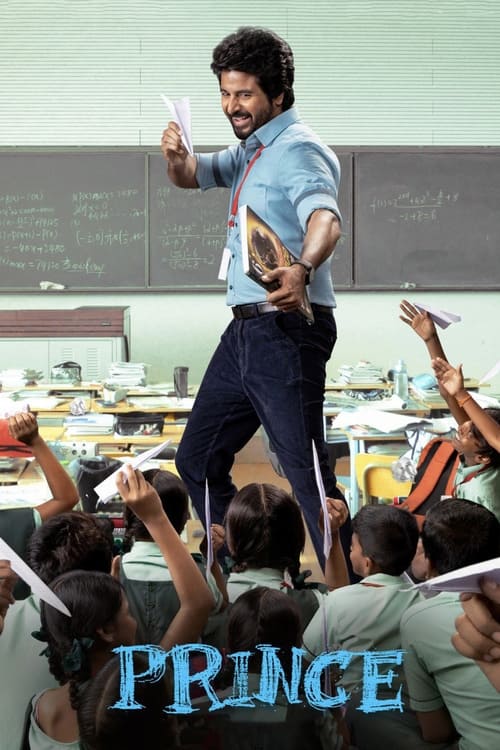
Anbu's story in Prince (2022) begins in Pondicherry with the easy charm of a man who seems to float through life as a popular social science teacher, but the film quickly turns that lightness into a battlefield of love, identity, and prejudice. He falls for Jessica, the new English teacher at his school, who is British by nationality yet, crucially, also born and raised in India, a detail that blurs the boundaries other people try to draw around her. What starts as a playful school romance immediately becomes more complicated because Anbu is not just pursuing a woman he likes; he is crossing social lines that the people around him treat as if they are fixed laws. The film frames this from the beginning as a romance-social satire set in a fictional village and town space where human relationships are constantly filtered through caste, nationality, family honor, and inherited bias.
Anbu's world is rooted in status, but not the kind that protects him from conflict. He comes from a wealthy and socially influential family, and that background gives him confidence, visibility, and the freedom to be openly affectionate in a way many others cannot. Yet the deeper social architecture of his environment is built on inequality. In the backstory surrounding his family, his father Ulaganathan is established as a man who rejects the caste and religious conventions that govern the village around him, a position that makes the family morally distinctive but also socially vulnerable. That opposition to hierarchy is not merely abstract; it shapes how the village sees them and how they see themselves. The film's atmosphere is therefore one of constant friction beneath comedy: jokes and dry irony on the surface, social prejudice underneath.
Jessica's arrival shifts that balance. She enters Anbu's school as the English teacher, and because she is both foreign and local in different ways, she becomes a figure onto whom the community projects its assumptions. Anbu is immediately taken with her, and the film presents his attraction as sincere rather than predatory or opportunistic. He begins to woo her in the confident, somewhat exaggerated manner that suits the movie's satirical tone, but Jessica is not simply a romantic prize; she is a professional colleague who has to navigate the same institutional pressures as everyone else. Her presence as a British woman teaching in India is already enough to make her stand out, and the romantic subplot begins almost at once to collide with questions of belonging, identity, and who gets to claim authority over whom.
The school becomes one of the film's central stages because the romance develops alongside everyday educational work, and the film uses that setting to reveal character. Jessica is teaching English, while Anbu teaches social science, and their interactions move between professionalism and personal feeling. A key early turning point comes through one of Jessica's students, Mahesh, who performs poorly on a test. The principal is disappointed in Jessica, and that disappointment matters because it shows how quickly her competence is judged in public. Anbu steps in and tutors Mahesh, helping the boy improve his grade. This moment is important not just as a plot device but as a moral demonstration: Anbu's kindness, intelligence, and willingness to help in a practical way become the qualities that make Jessica begin to see him differently. The film turns a classroom problem into the engine of emotional change.
That shift is gradual but decisive. Jessica grows fond of Anbu after seeing his support for Mahesh and his steadiness as a person. What had first looked like comic flirtation becomes mutual affection. Anbu eventually confesses his love to Jessica, and she initially doubts him, as if she is trying to determine whether his feelings are genuine or just part of a performance. But the film makes clear that the attraction is real on both sides, and soon she reciprocates. Their romance is not presented as a dreamy escape from society; it is immediately entangled with it. The more serious their bond becomes, the more the world around them responds with resistance, suspicion, and discomfort.
The story expands beyond the school and into the social landscape that surrounds it. In parallel with the Anbu-Jessica thread, Williams, Jessica's father, is introduced as a man who wants to return to England. His situation is not merely personal; it becomes folded into local discrimination and a land dispute. Boopathy emerges as a significant antagonist because he challenges Williams's land ownership and treats him as illegitimate on the basis that he is not Indian. This is one of the film's clearest expressions of xenophobia. Williams is not just an outsider in nationality; he is made into an outsider in rights, and that treatment mirrors the way Anbu and Jessica's relationship is treated as socially suspect. The film links these two strands so that romantic prejudice and property prejudice echo each other across different relationships.
Boopathy's opposition to Williams is important because it exposes the mechanisms of exclusion the film wants to criticize. He does not simply disagree with Williams; he attacks his belonging itself. In the hands of the village and local power structures, land ownership becomes a symbolic test of whether a person is truly entitled to exist in a place. Williams's wish to go back to England suggests exhaustion and displacement, as though he has tired of being measured against local prejudice. The conflict around him runs alongside the romance and gives the story a broader social dimension: this is not just about whether two people can fall in love, but about who gets recognized as fully human, fully local, and fully deserving of dignity.
Meanwhile, Anbu and Jessica's relationship deepens under pressure. The film's synopses repeatedly emphasize that the families and society oppose the match, and that opposition is what gives the story momentum toward its climax. The exact details of every confrontation are not fully documented in the available summaries, but the structure is clear: the couple moves from affection to mutual commitment, and then into a larger battle against inherited prejudice. The film's comedy comes from the exaggerated reactions of the people around them, but the underlying tension is serious. Because Anbu's grandfather was a freedom fighter, the relationship also acquires a symbolic national dimension. The story asks whether a family with anti-colonial lineage can accept a British daughter-in-law, and whether historic resentment can be separated from the actual person standing in front of them. The premise turns a love story into a test of principle.
As the pressure builds, the film keeps returning to the contrast between personal decency and social prejudice. Anbu's tutoring of Mahesh is one example of the former; the village's resistance to the couple is one example of the latter. Jessica, for her part, is no passive outsider. She is not just waiting to be rescued from social judgment; she is a participant in the emotional reality of the story. The revelation that she is British but also born and raised in India matters because it complicates the easy binaries that prejudice relies on. She is enough of an outsider to be targeted and enough of an insider to understand the context, which makes the film's social conflict more layered than a simple "foreign woman in a local village" narrative. The tension comes from the fact that people insist on reducing her to one label when the film keeps showing that she contains both histories.
Ulaganathan's role becomes increasingly central as the story moves toward resolution. He is not simply Anbu's father in the conventional domestic sense; he embodies the film's anti-caste, anti-conformist ideal. His rejection of caste and religious convention in the village backstory gives the climax its moral foundation. Even if the rest of the society is narrow, Ulaganathan has already been defined as someone who refuses that narrowness. That matters because the ending depends not on a sudden moral awakening from nowhere, but on the recovery of values the film has already planted. The family's ideological identity is part of the plot from the beginning, and the resolution has to bring that identity into direct contact with the couple's love.
The final stretch of the film, based on the available plot summaries, moves through the expected collision of family and social pressure into reconciliation. The confrontation does not end in tragedy, violence, or permanent separation. Instead, the conflict is resolved through apology and acceptance. The townspeople apologize, Ulaganathan welcomes them back into the village, and he explicitly promises to treat them respectfully. Most importantly, he accepts Anbu and Jessica's relationship. This is the emotional release the movie has been building toward: the people who had treated difference as contamination now must acknowledge shared humanity. The film's ideological argument lands through that moment of inclusion, where the family and community are brought back into ethical alignment with the values Ulaganathan has long represented.
There are no reported character deaths in the available sources for Prince (2022), and the story does not hinge on murder, sacrifice, or fatal violence. Its conflicts are social rather than lethal, and its climactic movement is toward reconciliation rather than destruction. That absence is significant because it keeps the film centered on prejudice as a living structure rather than on the sensational mechanics of crime or tragedy. The stakes are emotional, familial, and communal: whether a couple can marry, whether a father can remain, whether a village can abandon caste and xenophobia long enough to recognize what it has been denying. The "biggest battle" the synopsis points to is the battle to get married, and the film treats that as a full-scale social struggle.
By the time the ending arrives, the movie has moved from flirtation to tutoring, from tutoring to confession, from confession to social backlash, and from backlash to apology. The climax resolves the central conflict not by proving that prejudice was never real, but by showing that it can be confronted and overturned. Ulaganathan's welcome back into the village and his promise to treat everyone respectfully are the clearest signs that the social order has shifted, however briefly and ideally, in favor of decency. Anbu and Jessica are not left as a scandal to be endured; they become a couple the community must finally accept. The film closes on affirmation, with the romance surviving the social pressure that threatened to crush it and with its anti-caste, anti-xenophobia message made explicit through reconciliation rather than punishment.
If you want, I can also rewrite this into a more cinematic scene-by-scene version, but this is the fullest spoiler available from the sources you provided.








What is the ending?
In the ending of the movie "Prince," the protagonist, a young man named Prince, confronts the antagonist, leading to a climactic showdown. After a series of intense confrontations, Prince ultimately overcomes his adversary, reclaiming his identity and purpose. The film concludes with Prince finding peace and acceptance within himself, surrounded by his friends and loved ones.
As the final act unfolds, the scene opens in a dimly lit warehouse, where the tension is palpable. Prince stands at the center, his heart racing, as he faces off against the antagonist, a figure shrouded in darkness and deceit. The air is thick with anticipation, and the stakes are high. Prince's internal struggle is evident; he grapples with fear and doubt, but a flicker of determination ignites within him. He recalls the journey that brought him here--the friends he has lost, the battles he has fought, and the strength he has gained.
The confrontation escalates as the antagonist taunts Prince, attempting to undermine his confidence. With each word, the antagonist reveals their twisted motivations, seeking to manipulate Prince's emotions. However, Prince stands firm, drawing on the support of his friends who have gathered outside the warehouse, ready to back him up. Their unwavering belief in him fuels his resolve.
As the fight begins, the choreography is intense and visceral. Prince dodges and counters, each movement a testament to his growth and resilience. The camera captures the sweat glistening on his brow, the determination etched on his face. The clash of fists and the sound of grunts fill the air, echoing the internal battle Prince has fought throughout the film.
In a pivotal moment, Prince finds himself cornered, but he remembers the lessons learned from his past. He channels his pain into strength, launching a final, powerful strike that sends the antagonist sprawling to the ground. The warehouse falls silent, the weight of the moment hanging in the air. Prince stands over his defeated foe, breathing heavily, a mix of relief and triumph washing over him.
As the dust settles, Prince's friends rush in, their faces a blend of concern and pride. They embrace him, celebrating his victory, but also acknowledging the scars left by the battle. Prince looks around, his heart swelling with gratitude. He realizes that he is not alone; he has a community that supports him, and this realization brings him a profound sense of peace.
The film closes with a scene of Prince standing on a hill overlooking the city, the sun setting in the background. He reflects on his journey, the struggles he has faced, and the person he has become. The camera pans out, capturing the beauty of the moment, symbolizing hope and new beginnings. Prince's fate is one of redemption and self-acceptance, as he steps forward into a future filled with possibilities, surrounded by those who love him.
In the final moments, the screen fades to black, leaving the audience with a sense of closure and the understanding that while battles may be fought, the journey of self-discovery and connection with others is what truly defines us.
Is there a post-credit scene?
In the movie "Prince," produced in 2022, there is indeed a post-credit scene that adds an intriguing layer to the story.
As the credits roll, the screen fades to black before transitioning to a dimly lit room filled with shadows. The camera slowly pans to reveal a figure sitting at a desk, their face obscured by the low light. The atmosphere is tense, with a palpable sense of mystery hanging in the air.
The figure leans forward, and as the light catches their features, it becomes clear that it is a character who had been a minor yet pivotal presence throughout the film. They are holding a small, ornate box, which they open to reveal a collection of photographs and documents related to the main character's past.
The character's expression shifts from curiosity to determination, hinting at a deeper connection to the protagonist's journey. They mutter a few words under their breath, suggesting a plan that could significantly impact the future of the story. The scene ends with a close-up of the photographs, leaving viewers with a sense of anticipation and questions about how this revelation will intertwine with the main narrative.
This post-credit scene effectively sets the stage for potential sequels or further exploration of the characters' backstories, leaving the audience both intrigued and eager for more.
What motivates the main character, Prince, throughout the film?
Prince is driven by a deep desire to reclaim his family's honor and legacy, which has been tarnished by betrayal and loss. His internal struggle is marked by a longing for acceptance and a need to prove himself, both to his family and to the world around him.
How does Prince's relationship with his mentor influence his journey?
Prince's mentor serves as a guiding figure, instilling in him the values of resilience and courage. Their relationship is complex, filled with moments of tough love and wisdom, which ultimately shapes Prince's decisions and his growth as a leader.
What role does the antagonist play in Prince's development?
The antagonist represents the external challenges and moral dilemmas that Prince must confront. Their confrontations force Prince to confront his fears and insecurities, pushing him to evolve from a naive youth into a more strategic and determined individual.
How does the setting impact the story and Prince's character arc?
The setting, a vibrant yet tumultuous kingdom, reflects the chaos in Prince's life. The contrasting environments--from the opulence of the royal palace to the struggles of the common people--serve as a backdrop for Prince's journey, highlighting his internal conflict and the stakes of his quest.
What significant events lead to Prince's transformation by the film's climax?
Key events, such as the betrayal by a close ally and the revelation of hidden truths about his family's past, serve as catalysts for Prince's transformation. These moments of crisis force him to confront his identity and make pivotal choices that define his character by the climax.
Is this family friendly?
The movie "Prince," produced in 2022, contains several elements that may not be suitable for younger audiences or sensitive viewers. Here are some potentially objectionable or upsetting aspects:
-
Violence: There are scenes depicting physical confrontations and intense action sequences that may be distressing for children.
-
Emotional Turmoil: Characters experience significant emotional struggles, including themes of betrayal, loss, and identity crises, which could be heavy for younger viewers to process.
-
Mature Themes: The film explores complex themes such as power dynamics, revenge, and moral ambiguity, which may be difficult for children to understand fully.
-
Language: There may be instances of strong language that could be inappropriate for younger audiences.
-
Romantic Elements: The film includes romantic relationships that may involve mature content or implications that are not suitable for children.
These elements contribute to a narrative that, while engaging, may require parental guidance for younger viewers.