






















Popular
What motivates the character of Peco throughout the film?
How does the relationship between Peco and Smile develop in the film?
What role does the character of Sakuma play in Peco's journey?
How does the film portray the rivalry between Peco and his opponents?
What significance does the final match hold for Peco and Smile?
Should I watch it?
Ask Your Own Question

What is the plot?
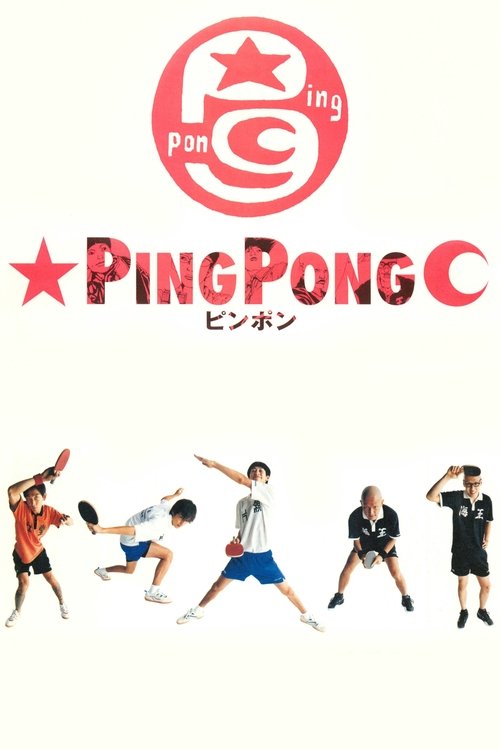
The film begins years before the tournament pressure and school rivalries, in a childhood memory that quietly defines everything that follows: the shy, inward Makoto "Smile" Tsukimoto is being bullied by a gang of kids when the loud, fearless Yutaka "Peco" Hoshino charges in and drives them off. From that moment, Peco becomes the force that pulls Smile out of isolation, and the two boys build their friendship around table tennis at the neighborhood hall run by Obaba, the stern old woman who presides over the local ping-pong dojo and treats the game like both discipline and destiny. Peco teaches Smile to play, but even in childhood their personalities are already opposites: Peco is bright, brash, and hungry to be great, while Smile is quiet, emotionally sealed off, and so restrained that his nickname comes from the fact that he almost never smiles. Their bond is intimate and unspoken, and the film keeps returning to the sense that Peco does not merely rescue Smile once; he gives him a language for feeling anything at all.
By the time the story moves into the present, both boys are members of Katase High School's table tennis club, and the contrast between them has sharpened into something almost painful to watch. Peco is still passionately obsessed with becoming the best player in the world, and he talks as if that dream is a natural extension of his personality, but in practice he is lazy, cocky, and far more likely to be found hustling kids for money at the local ping-pong parlor than training seriously. Smile, by contrast, is a prodigy who plays with chilling ease, yet he treats his own talent as something he should not use to hurt others. He repeatedly gives away points, games, and even matches out of loyalty to Peco and out of a strange, self-denying sympathy for weaker opponents. In that early stretch, the story does not feel like a conventional sports movie about triumph; it feels like a study in misused gifts, with Peco wasting his hunger and Smile suppressing his ability. The local hall, Katase High's gym spaces, and the tournament circuit become places where these habits are tested in public.
The first major crack appears when word spreads that a new player from Shanghai has been brought to nearby Tsujido Academy specifically to defeat the reigning local powerhouse Ryūichi "Dragon" Kazama of Kaiō High School. This player is Kōng "China" Wéngé, often called simply China, and his arrival changes the competitive atmosphere immediately. Peco and Smile go secretly to Tsujido Academy to see him for themselves, and what begins as curiosity turns into humiliation for Peco. In a match that exposes how far his self-image has drifted from reality, Peco is beaten by China. The loss lands like a shock, because it is not just a defeat; it is a public correction of Peco's fantasy that enthusiasm alone makes him elite. He has spent so long acting as if brilliance is his birthright that the match leaves him devastated, stripped of his swagger and forced to look at his own limits.
That humiliation grows worse at the next inter-school tournament, where the whole web of relationships tightens at once. Manabu Sakuma, nicknamed "Demon" or "Akuma," emerges as another important rival, a childhood acquaintance who also comes from the same neighborhood ping-pong world and who now stands on the opposite side of the competitive divide. Peco faces Akuma and loses again, this time in the third round, deepening the sense that his collapse is not an accident but a pattern. Smile, meanwhile, faces China and does what he has done so many times before: he lets the other player win rather than destroy him with his real ability. The result is almost unbearable in its emotional logic. Smile is capable of far more, but his kindness has become a kind of paralysis. While he refuses to take his opponents' confidence away, he is also refusing to become fully himself. At the same time, Kaiō High, led by the severe and intimidating Dragon, wins the tournament, reinforcing Dragon's status as the dominant force in the local hierarchy.
The aftermath is one of the film's most important turns, because Peco's collapse becomes total. He stops practicing, drifts, and behaves like a boy who has lost not just a match but the story he tells himself about who he is. The film lets this slump breathe, showing how his confidence curdles into resentment and inertia. Then Akuma confronts him directly and tells him, in essence, that the problem is not bad luck but complacency; Peco has been losing because he has been coasting. That confrontation matters because it is one of the first times Peco is forced to hear the truth without the cushioning effect of friendship or charm. He cannot laugh it off. He cannot pretend it does not matter. The accusation finally pierces the self-pity he has been hiding inside, and the film frames this moment as a kind of emotional rebirth. In a symbolic gesture, Peco jumps into a river, as if washing away the fantasy version of himself and emerging into a harsher reality. From there he returns to the Tamura ping-pong hall, where Obaba helps him train again. The hall, once only a nostalgic place from childhood, becomes the site where Peco remembers that ping pong can be joy as well as status. He is not rebuilding himself into a cold machine; he is learning to love the game honestly, without the noise of ego.
While Peco is relearning how to want the sport, Smile is being pulled in the opposite direction. His high school coach, often identified as Butterfly Joe, recognizes that Smile's passive brilliance is wasted unless he develops something harder than talent: a will to win. The training Smile receives is not simply technical; it is psychological, aimed at forcing him to stop coasting through life and to confront the fact that kindness and self-erasure are not the same thing as virtue. For Smile, this is an almost violent internal shift. He has spent so long accommodating others, especially Peco, that stepping into competition in earnest feels like betraying part of his identity. Yet the story steadily pushes him toward a more decisive version of himself, a player who can finally bring his full ability to bear without apology.
The next tournament becomes the stage on which all of these transformations begin to pay off. Peco, having rediscovered his desire, faces China again and defeats him in the first round. The result is not just revenge; it is proof that his collapse has become a recovery. He is no longer playing as the boy who believed talent alone would save him. He is playing as someone who has suffered, been humbled, and chosen to return. The momentum continues into the semifinal, where Peco faces Dragon, the cold, disciplined champion whose entire presence has been built around control. Peco goes into the match with an injured knee, which makes the confrontation physically as well as emotionally punishing. Dragon expects to win by superiority and iron focus, but the match changes him too. For the first time, he experiences the joy of table tennis rather than only its pressure. That revelation is one of the film's great emotional turns: the player who looked almost inhumanly serious is shown that the game can be alive, playful, and exhilarating, not merely a test of dominance. Peco, in beating him, does not simply advance; he gives Dragon something he has never had before.
At that point the tournament has narrowed into a dramatic destiny that has been looming all along: Peco and Smile are moving toward each other in the final. The story has been building this possibility from childhood, but it carries a special ache now because their paths have diverged in opposite directions and yet remain deeply intertwined. Peco has recovered his fire by accepting humility. Smile has acquired a competitive edge by learning to stop hiding his talent. Their final meeting is therefore not just a title match; it is the culmination of years of emotional dependency, resentment, admiration, and unspoken understanding. The film treats the match as the point where each boy must finally face what the other represents. Peco sees in Smile the self-control and hidden strength he has always lacked. Smile sees in Peco the reckless, wholehearted engagement with life that he himself has long suppressed.
The final match between them becomes the climax of the entire film, and it is staged not as a simple sports duel but as a reckoning between two ways of living. The rallying, the breathless momentum, and the tension of every point are matched by the emotional history pressing in behind each exchange. Peco fights with a newly honest love of the game, while Smile, now no longer content to lose out of politeness, brings a sharpened intensity to the table. What makes the confrontation satisfying is that neither boy is reduced to a symbol. Peco is not merely the impulsive hero redeemed by spirit, and Smile is not merely the quiet genius awakened by discipline. They are still themselves, but more complete, more dangerous, and more vulnerable than before. The final result, according to the film's ending as reflected in the sources, is that Peco wins the match. That victory is not presented as the triumph of one friend over another in any cruel sense; it is the endpoint of Peco's recovery and Smile's long-delayed emergence into full competition. The emotional meaning of the match matters more than the scoreboard.
After the tournament, the film moves into a future epilogue that shows how the victories and losses have settled into ordinary life. Several years later, Peco has fulfilled his dream of becoming a professional player in Europe, finally turning the boastful fantasy of his youth into reality through hard-won growth. Smile, meanwhile, has become a table tennis coach, helping a young boy learn the sport, which quietly mirrors the way Peco once pulled him into ping pong as a child. The circularity is deliberate and moving: the boy who was once rescued is now the one passing the game onward. The final image deepens that feeling of continuity and belonging, showing a photo behind Smile in which Peco, Smile, and Dragon are displayed as first, second, and third place respectively. It is a visual coda that confirms the film's true resolution. The story is not about one person crushing the others. It is about how competition reshapes the people inside it, leaving behind a record not only of rank but of friendship, rivalry, and survival. There are no deaths in this film, no murders, and no hidden crime to expose. Its drama comes from collapse, discipline, self-recognition, and the slow, exacting work of becoming someone who can finally stand at the table and play without lying to himself.





What is the ending?
In the ending of the movie "Ping Pong," the main characters, Peco and Smile, face off in the final match of the national table tennis tournament. Peco, who has grown through his experiences and challenges, ultimately wins the match against Smile. The film concludes with a sense of camaraderie and respect between the two players, highlighting their growth and the bonds formed through their shared passion for the sport.
As the final match approaches, the atmosphere is charged with anticipation. The scene opens in the packed arena, where the audience buzzes with excitement. Peco, now more confident and focused, stands at one end of the table, while Smile, who has always been a formidable opponent, prepares at the other end. The camera captures the intensity in their eyes, reflecting their determination and the weight of their journey.
The match begins, and the sound of the ping pong ball echoes through the hall, punctuated by the cheers and gasps of the crowd. Peco starts strong, showcasing the skills he has honed through countless hours of practice and the lessons learned from his mentor, the eccentric coach. Each rally is a testament to their rivalry, with both players pushing each other to their limits. Peco's style is aggressive and dynamic, while Smile's approach is more strategic and calculated.
As the game progresses, the tension builds. Peco recalls moments from his past, including his struggles and the support of his friends, which fuels his determination. Smile, on the other hand, reflects on his own journey, the pressure he feels to succeed, and the expectations placed upon him. The match becomes not just a competition but a culmination of their personal growth and the challenges they have faced.
In a pivotal moment, Peco finds himself at a critical point in the match, trailing behind. He digs deep, channeling his inner strength and the encouragement from his friends and coach. With each point he scores, the crowd erupts in cheers, rallying behind him. The camera captures the sweat on his brow, the intensity in his movements, and the fire in his spirit.
Finally, after a series of intense exchanges, Peco manages to secure the final point, winning the match. The arena erupts in applause, and Peco's face lights up with a mix of joy and disbelief. He looks over at Smile, who, despite his disappointment, offers a nod of respect. The two players share a moment of mutual acknowledgment, recognizing the journey they have both undertaken.
As the scene shifts, Peco is celebrated by his friends and coach, who embrace him in a whirlwind of excitement. The victory is not just his alone; it symbolizes the growth of all the characters who have supported him along the way. Meanwhile, Smile walks off the court, contemplative but proud, knowing that he has given his all.
The film concludes with a montage of both characters moving forward in their lives, emphasizing the bonds formed through their shared experiences in the world of table tennis. Peco's victory is a testament to perseverance, while Smile's journey reflects the importance of sportsmanship and personal growth. The final scenes leave the audience with a sense of hope and the understanding that, regardless of the outcome, the journey and the relationships built along the way are what truly matter.
Is there a post-credit scene?
The movie "Ping Pong," produced in 2002, does not have a post-credit scene. The film concludes its narrative without any additional scenes after the credits roll. The story wraps up with the characters reflecting on their journeys and the impact of table tennis on their lives, leaving the audience with a sense of closure regarding their development and relationships.
What motivates the character of Peco throughout the film?
Peco, a passionate and talented table tennis player, is driven by his desire to prove himself and to be the best. His journey is marked by a deep love for the game, which is intertwined with his friendships and rivalries. As he faces challenges, including his own self-doubt and the pressure of competition, Peco's motivation evolves from a simple love for the sport to a more profound quest for identity and recognition.
How does the relationship between Peco and Smile develop in the film?
Peco and Smile's relationship is central to the narrative, showcasing a deep bond forged through their shared passion for table tennis. Initially, Peco is more carefree and focused on winning, while Smile is more reserved and serious about the sport. As the story progresses, their friendship is tested by competition and personal growth, leading to moments of tension and reconciliation that highlight their differing approaches to the game and life.
What role does the character of Sakuma play in Peco's journey?
Sakuma serves as a mentor figure to Peco, embodying the wisdom and experience that Peco lacks. He challenges Peco to confront his weaknesses and pushes him to train harder. Sakuma's own struggles with his past and his relationship with the sport provide a backdrop for Peco's growth, as he learns to balance his passion with discipline and resilience.
How does the film portray the rivalry between Peco and his opponents?
The rivalry between Peco and his opponents, particularly with the character of the formidable player, is depicted with intensity and emotional depth. Each match is not just a test of skill but also a reflection of Peco's internal battles. The film captures the physicality of the sport, the tension of competition, and the psychological stakes involved, illustrating how these rivalries push Peco to evolve as both a player and a person.
What significance does the final match hold for Peco and Smile?
The final match is a culmination of Peco and Smile's journeys, representing not only a test of their skills but also a moment of self-discovery and resolution. For Peco, it is an opportunity to confront his fears and insecurities, while for Smile, it is a chance to step out of the shadows and assert his own identity. The emotional stakes are high, as both characters must reconcile their friendship with their competitive spirits, leading to a poignant climax that encapsulates their growth.
Is this family friendly?
"Ping Pong," produced in 2002, is generally considered family-friendly, but it does contain some elements that may be sensitive for children or more sensitive viewers. Here are a few aspects to consider:
-
Competitive Pressure: The film explores themes of intense competition and the pressure to succeed, which may be stressful for younger viewers to witness.
-
Emotional Struggles: Characters experience personal challenges and emotional turmoil, including feelings of inadequacy and the fear of failure, which could be upsetting for some.
-
Bullying and Rivalry: There are instances of bullying and rivalry among players, which may resonate negatively with children who have experienced similar situations.
-
Parental Expectations: The film touches on the expectations placed on young athletes by their parents, which could evoke feelings of discomfort for those who relate to such pressures.
-
Loss and Disappointment: Characters face losses and disappointments in their journeys, which may be difficult for sensitive viewers to process.
Overall, while the film has positive messages about friendship, perseverance, and personal growth, these elements may require parental guidance for younger audiences.