
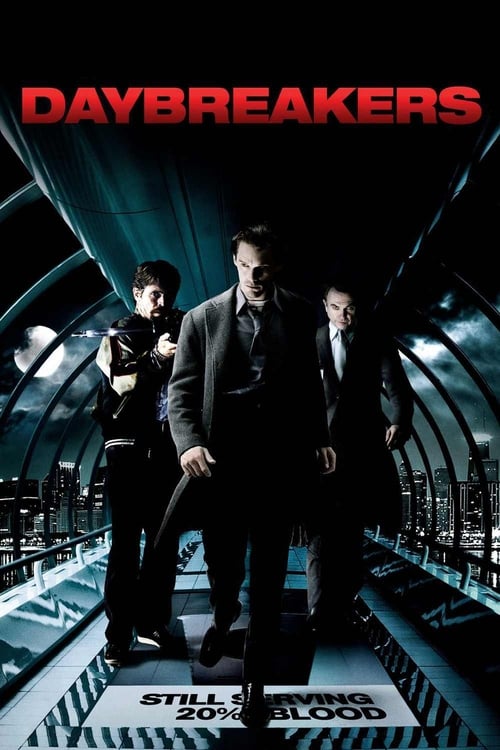




























Popular
What is the significance of the blood supply crisis in Daybreakers?
How does Edward Dalton's character evolve throughout the film?
What role does the character of Charles Bromley play in the story?
What is the significance of the human resistance group led by Lionel Cormac?
How does the film portray the transformation process from human to vampire?
Should I watch it?
Ask Your Own Question

What is the plot?
Sorry, we aren't able to watch and write up a full detailed plot yet. Check back in a few days.
More Movies Like This
Browse All Movies →




What is the ending?
In the ending of "Daybreakers," Edward Dalton, a vampire who has been working to find a blood substitute to save humanity, ultimately sacrifices himself to save the remaining humans. He injects himself with a serum that allows him to become human again, but in doing so, he becomes a target for the vampire society. The film concludes with a final confrontation between the remaining humans and the vampire overlords, leading to a hopeful yet uncertain future for humanity.
As the film approaches its climax, Edward Dalton, portrayed by Ethan Hawke, finds himself in a desperate situation. The world has been overrun by vampires, and the remaining humans are being hunted for their blood. Edward, a vampire himself, has been working tirelessly in a lab to develop a blood substitute that could save both humans and vampires from extinction. His internal conflict is palpable; he is torn between his nature as a vampire and his desire to help the dwindling human population.
In the final act, Edward learns that the only way to truly save humanity is to become human himself. He is presented with a serum developed from the blood of a human survivor, which has the potential to reverse his vampirism. However, this transformation comes with significant risks, as it makes him vulnerable to the vampire society that has been hunting humans relentlessly.
The scene shifts to a dark, oppressive vampire stronghold where the vampire overlords, led by the ruthless Charles Bromley, are preparing to eliminate the remaining humans. Edward, now fully aware of the stakes, decides to inject himself with the serum. As he transforms back into a human, he experiences a rush of emotions--fear, hope, and a sense of purpose. This moment is visually striking, as the camera captures the physical changes in Edward, highlighting the contrast between his former vampiric self and his new human form.
With his newfound humanity, Edward joins forces with a group of surviving humans, including the brave and determined Vanessa, played by Claudia Karvan, and the resourceful human leader, Lionel, portrayed by Michael Dorman. Together, they launch a final assault against the vampire stronghold, aiming to rescue the remaining humans and put an end to the vampire regime.
In a tense and action-packed sequence, Edward and the humans confront the vampire guards. The atmosphere is thick with tension as they navigate through the dark corridors, using both strategy and sheer will to fight back against their oppressors. Edward's transformation into a human gives him a renewed sense of strength and determination, and he fights with a ferocity that reflects his desire to protect those he once viewed as prey.
As the battle rages on, Edward faces Charles Bromley in a climactic showdown. The confrontation is intense, filled with physicality and emotional stakes. Edward, now fully embracing his humanity, fights not just for survival but for the future of the human race. In a moment of desperation, he manages to defeat Bromley, symbolizing a significant turning point in the struggle between humans and vampires.
However, the victory comes at a cost. Edward, having fully embraced his human side, is now vulnerable and exposed. In the aftermath of the battle, he realizes that the vampire society will not easily be defeated, and the fight for survival is far from over. The film closes with a poignant scene where Edward, now a symbol of hope, stands alongside the remaining humans, looking out at a world that is still fraught with danger but filled with the possibility of a new beginning.
The fate of the main characters is sealed in this final act. Edward, having sacrificed his safety for the greater good, becomes a beacon of hope for humanity. Vanessa and Lionel, who fought alongside him, are left to carry on the fight, embodying the resilience of the human spirit. The film ends on a note of uncertainty, leaving the audience to ponder the future of both humans and vampires in a world that has been irrevocably changed.
Is there a post-credit scene?
In the movie "Daybreakers," there is no post-credit scene. The film concludes with a dramatic ending that wraps up the story without any additional scenes after the credits. The narrative focuses on the struggle for survival in a world dominated by vampires, the quest for a blood substitute, and the moral dilemmas faced by the characters. The absence of a post-credit scene emphasizes the finality of the story and the fate of the characters involved.
What is the significance of the blood supply crisis in Daybreakers?
In Daybreakers, the blood supply crisis is a central plot element that drives the narrative. As the majority of the human population has been turned into vampires, the demand for human blood skyrockets, leading to a severe shortage. This crisis creates a sense of urgency and desperation among the vampire society, which is depicted as a dystopian world where humans are hunted for their blood. The crisis motivates the character Edward Dalton, a vampire hematologist, to seek a solution to save both humans and vampires, highlighting his internal conflict and moral dilemmas.
How does Edward Dalton's character evolve throughout the film?
Edward Dalton, played by Ethan Hawke, begins as a reluctant vampire who is disillusioned with the predatory nature of his kind. As the film progresses, his character evolves from a passive observer to an active participant in the fight for humanity's survival. His internal struggle is marked by his desire to find a cure for vampirism, which reflects his empathy for the remaining humans. This evolution is catalyzed by his interactions with human survivors, particularly with the character of Lionel 'Elvis' Cormac, who represents hope and resistance against the vampire regime.
What role does the character of Charles Bromley play in the story?
Charles Bromley, portrayed by Sam Neill, is a powerful and ruthless vampire businessman who represents the corporate interests of the vampire society. He is the head of Bromley Pharmaceuticals and is deeply invested in maintaining the status quo of vampire dominance over humans. His character embodies the moral decay of a society that prioritizes profit over ethics. Bromley's antagonistic relationship with Edward Dalton intensifies as he seeks to exploit the blood crisis for financial gain, ultimately leading to a confrontation that highlights the film's themes of survival and sacrifice.
What is the significance of the human resistance group led by Lionel Cormac?
The human resistance group, led by Lionel Cormac, plays a crucial role in the narrative of Daybreakers. This group symbolizes hope and the fight for survival against the oppressive vampire regime. Lionel, portrayed by Willem Dafoe, is a former vampire who has found a way to revert to human form, making him a key figure in the search for a cure. His leadership and determination inspire other characters, including Edward Dalton, to join the cause. The resistance's efforts to reclaim humanity from the vampires serve as a catalyst for the film's climax and resolution.
How does the film portray the transformation process from human to vampire?
In Daybreakers, the transformation from human to vampire is depicted as a violent and traumatic process. The film shows humans being attacked and drained of blood, leading to their conversion into vampires. This transformation is not just a physical change but also a loss of humanity and moral compass. The film visually emphasizes the horror of this process through graphic imagery and the emotional turmoil experienced by characters like Edward Dalton, who grapples with the implications of his own vampirism. The portrayal of this transformation serves to highlight the film's exploration of identity and the consequences of survival in a dystopian world.
Is this family friendly?
"Daybreakers," produced in 2010, is not considered family-friendly due to its mature themes and graphic content. Here are some potentially objectionable or upsetting aspects that may affect children or sensitive viewers:
-
Graphic Violence: The film contains numerous scenes of bloodshed, including violent confrontations between humans and vampires, which may be disturbing.
-
Vampire Feeding Scenes: There are intense moments depicting vampires feeding on humans, showcasing the brutality of their predatory nature.
-
Death and Despair: The film explores themes of extinction and survival, with scenes that depict the desperation of humans and the consequences of a world dominated by vampires.
-
Dark Atmosphere: The overall tone of the film is bleak and dystopian, which may be unsettling for younger audiences.
-
Mature Themes: The narrative delves into ethical dilemmas regarding survival, the value of human life, and the consequences of a society where vampires dominate, which may be complex for children to understand.
These elements contribute to a dark and intense viewing experience, making it more suitable for mature audiences.









