





























Popular
What exactly did Don say about Beth’s new novel that upset her?
Why does Beth confront Don after hearing him talk about the book?
What is Don’s job in the movie, and how does it connect to his storyline?
Who is Elliot, and what role does he play in the family conflict?
Does Beth’s career recover after the conflict with Don?
Should I watch it?
Ask Your Own Question

What is the plot?
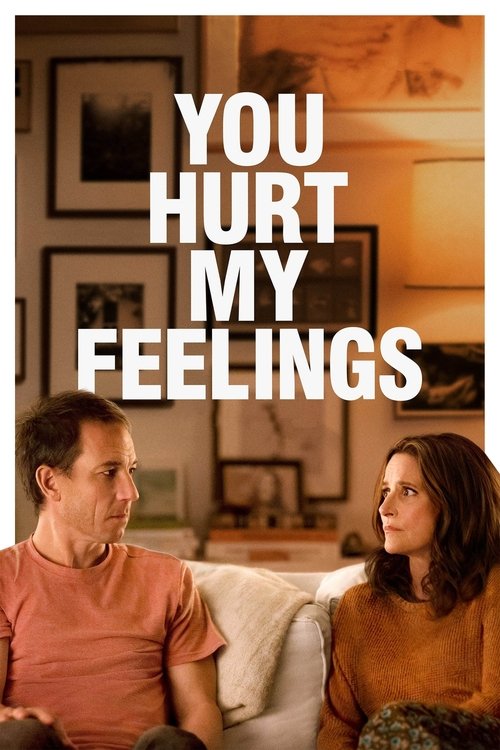
You Hurt My Feelings opens in New York City with Beth Mitchell, a successful memoirist and writing teacher, finishing what she hopes will be the breakthrough novel that proves she can do more than the memoirs and essays people already associate with her. Her husband, Don Mitchell, is introduced as a therapist who spends his days listening to other people's problems while quietly carrying his own private uncertainty about aging, his usefulness, and whether he is as good at his job as he appears to be. Their adult son, Elliot Mitchell, is also part of the family orbit, a 23-year-old working at a cannabis store and drifting through early adulthood with a mix of irony and fragility. The opening establishes a household that looks stable and affectionate on the surface, but one that is already built on a web of support, self-doubt, and small unspoken evasions.
Beth's first blow comes before the marriage crisis even begins. She brings her manuscript to her agent, expecting encouragement, and instead hears that the novel needs major revisions. The feedback lands like a punch, because Beth has invested not just time but identity in this book; it is not merely a project, it is proof that she is still creative, still relevant, still capable of producing something worthy on her own. The response sends her spiraling into self-doubt, and the film makes clear that her confidence is already more fragile than she lets on. Don tries to steady her, reading the manuscript and assuring her that it is good enough, even suggesting that she may need a new agent rather than a new book. His reassurance feels sincere, and for Beth it becomes a lifeline: if Don believes in the novel, then maybe she can keep believing in herself too.
That fragile balance shatters in an ordinary, devastatingly mundane moment. Beth is out in New York with her sister Sarah when she overhears Don speaking privately with Sarah's husband Mark. In that conversation, Don admits that he does not actually like Beth's novel. The cruelty of the moment lies in how casual it is: there is no explosive fight, no staged betrayal, only a husband speaking honestly when he thinks his wife cannot hear him. Beth is not merely hurt by the opinion itself; she is wounded by the collapse of the emotional safety she thought existed between them. The fact that Don had been telling her he liked the work makes the blow much deeper. What had felt like support now feels like performance, and Beth's trust in him begins to fray immediately.
From that point on, the film turns into a study of how one overheard sentence can distort an entire emotional landscape. Beth does not confront Don right away. Instead, she turns inward, growing tense, distant, and subtly hostile. She watches him differently, rereads his gestures, and begins to treat their marriage as if the hidden truth about the book might reveal some larger hidden truth about everything else. Don, for his part, has no idea what she knows. He simply experiences her mood as a mysterious shift in the weather. The audience, knowing the source of the rupture, watches every interaction with heightened tension. Their domestic scenes in the New York apartment become charged with silence, clipped replies, and the ache of a couple circling a subject neither can yet name.
The film deepens Don's character by showing that he is not merely the source of Beth's pain but another person struggling with his own anxieties. At work in his therapy office, he is shown listening to patients while appearing composed, but the scenes quietly suggest that he is not as settled or confident as his professional role implies. He is trying to be wise, empathetic, and useful, yet beneath the calm surface he is aware of his own limitations and of the possibility that he may be failing in subtler ways than he admits. That insecurity matters, because it explains why he may have lied about liking the novel: not only to protect Beth, but also to preserve the image of himself as the supportive husband, the good listener, the emotionally reliable man. The movie's comedy comes partly from how deeply everyone is trying to be decent while also protecting their own fragile sense of self.
Beth's hurt keeps hardening because the book is tied to her core identity. She is not just angry that Don dislikes the manuscript; she is terrified that he has been comforting her with a lie while she has been building her confidence around that lie. The novel becomes a symbol of whether her husband sees her clearly. If he can pretend to admire something he does not admire, then what else has he softened or hidden? The issue is not simply taste. It is honesty, intimacy, and the way long marriages are often held together by selective truths. The film repeatedly returns to this idea: that couples and families often tell small white lies not to deceive in a malicious way, but to spare one another's feelings and keep life moving. Beth, however, cannot absorb that logic while the wound is still fresh.
At the center of the story is the emotional escalation toward Beth's confrontation with Don. She grows increasingly sharp with him, and because he still does not understand why, his confusion only intensifies hers. Their marriage becomes a long, uneasy holding pattern in which one person is carrying a secret injury and the other is unknowingly walking through it. The setting remains largely private and domestic: their New York home, the spaces of family life, the city streets where encounters happen almost by accident. The emotional claustrophobia of these settings matters, because there is nowhere for the feelings to go except into the next conversation, the next look, the next strained silence.
The major confrontation arrives during a birthday dinner with Sarah and Mark. The gathering gives Beth the public setting she needs to stop pretending. In front of the others, she finally tells Don that she knows he lied about liking her book. The revelation breaks the tension open. What has been simmering privately becomes impossible to contain once spoken aloud, and the dinner table turns into a stage for the collapse of marital politeness. Don is forced to hear, in front of family, that his attempt to protect Beth's feelings has instead damaged her trust. The confrontation is awkward, painful, and deeply human: not a screaming match, but something worse in a way, because it exposes the gap between what each person thinks they are doing for the other and what the other person actually experiences.
That scene also allows the film to widen the conflict beyond the novel itself. Beth's son Elliot steps into the argument and pushes back against his mother. He tells her that she puts too much pressure on Don and, by implication, on him as well. This is a crucial twist in the emotional structure of the film, because it reveals that Beth's need for validation is not only hurting her marriage; it is shaping the emotional atmosphere of the entire family. Elliot's complaint forces Beth to see herself from the outside, not as the injured party alone, but as someone whose own expectations can wound the people closest to her. The movie does not turn him into a moral authority, but his words puncture Beth's certainty and widen the story into a three-way reckoning between spouse, spouse, and child.
After the dinner confrontation, Beth and Don finally do what they have been avoiding: they talk honestly. The conversation is not neat or instantly healing. It unfolds as a recognition that each of them has been living with insecurities they have not fully shared. Don admits, through the logic of the film's emotional structure if not always in exact confessional language, that he has his own fears about his competence, his age, and his value. Beth, in turn, is forced to confront how much of her self-worth has been tied to external approval, especially Don's. Their disagreement about the book becomes a larger discussion about how love operates in real marriages: not through perfect truth-telling, but through a continuous negotiation between honesty and kindness, candor and protection. The movie's point is not that lying is good, but that the stakes of truth can be more complicated than a simple moral rule allows.
Beth's emotional breakthrough reaches backward into her past as well. She comes to understand that her reaction is connected to older wounds and childhood trauma, which helps explain why the novel incident hits so hard. The film does not reduce her pain to pathology, but it does show how the present can unlock old insecurities with alarming force. What she experiences as a betrayal by Don is also magnified by a lifetime of learning how to measure herself through others' approval. That realization softens the conflict without erasing it. Beth is still hurt, but she is also more able to see the shape of her own response, and that self-knowledge becomes part of her recovery.
At the same time, Beth's professional life begins to move again. She finds a new agent, one who appears to offer the kind of support and confidence she needs. This matters not just because it helps her career, but because it marks a shift from dependence on Don's validation to a more independent creative footing. The manuscript that once represented a crisis becomes, gradually, a work she can own on her own terms. The movie treats this as a genuine victory, even if it is a quiet one. Beth is not suddenly transformed into a fearless artist; she is simply less trapped by the need to hear one particular person say the right thing.
The film also keeps the family dynamic alive by giving Elliot his own small creative arc. Near the end, he gives his parents a first draft of a play he has written. That gesture is important because it shows him stepping into his own artistic identity rather than remaining only the son of two anxious adults. It also subtly mirrors Beth's story: a young writer offering work into the uncertain space of family judgment, hoping to be seen honestly but kindly. The family has been wound tight by the problem of artistic validation, and Elliot's draft becomes part of the movie's broader argument that making art and loving people both require vulnerability.
Time passes, and the film moves into its final stretch with a one-year-later structure that signals repair rather than mere survival. Beth's novel is finally published, which confirms that her confidence has returned enough for the book to move beyond the private sphere of revision and hurt. The publication is not presented as a triumphant celebrity moment; instead, it functions as a sign that she has found her footing again, professionally and emotionally. Don and Beth are still together, and the marriage has not only survived the rupture but also absorbed it into a deeper understanding of each other. Their reconciliation is not based on pretending the injury never happened. It is based on accepting that both of them have said things in the name of kindness that were not fully true.
Don's own insecurity about aging comes to a surprisingly literal expression when he decides to get cosmetic surgery for his eye bags. The decision is small in plot terms but revealing in character terms. It suggests a man who is willing, finally, to admit that he cares about how he looks and how time is changing him. Beth supports him in this choice, encouraging him rather than mocking or dismissing his vanity. The gesture mirrors the emotional repair between them: where once they were hiding insecurities behind politeness, now they are more willing to reveal them and help each other through them. The surgery is not a cure-all, but it is a visible sign of Don's desire to change in ways that matter to him.
The final scene returns the story to the domestic intimacy with which it began. Beth and Don are in bed reading Elliot's draft together, side by side, settled into a shared quiet that feels earned rather than magical. The bruises from Don's surgery are still visible, but they are temporary, already understood as part of healing. The image closes the film on a note of tenderness: a marriage that has endured a major trust injury and come back not unchanged, but steadier for having confronted its own habits of concealment. There are no deaths in the film, no external catastrophe, no spectacular reconciliation--only two people, after all the hurt, choosing to remain in the same room, under the same blanket, reading their son's work together as the story fades out.







What is the ending?
Beth and Don end up reconciling, and the film closes with their marriage still intact. Beth finally says out loud that Don's dishonesty about liking her book hurt her, Don understands that he has hurt her, and the two of them move forward after admitting how much they have both relied on little lies.
Beth and Don also finish the story in a more stable place with their work and family. Beth gets a new agent and her novel is published, Don goes ahead with his eye surgery, and their son Elliot feels more comfortable sharing his screenplay with them.
Beth's anger has been building for most of the movie because she overheard Don privately admit to Mark that he did not like her book but kept pretending he did because he did not want to hurt her. Near the end, the pressure finally breaks in an awkward dinner scene with Beth's sister Sarah and Sarah's husband Mark. Beth blurts out the truth about why she has been so upset, and the conversation opens the door to everyone admitting that they have all told comforting lies in their relationships.
After that, the family's tension eases. Don and Beth talk more honestly, and their relationship settles back into closeness instead of suspicion. Elliot, who has been watching his parents struggle with honesty and reassurance, ends up feeling more confident about bringing them his work.
The ending of the film can be followed scene by scene like this:
Beth has already been carrying the shock of what she overheard Don say about her novel. She has been acting cold and agitated around him, while Don is confused by her distance and tries to keep his own life moving as a therapist and husband.
As the story moves into the final stretch, Beth's frustration stops being silent. At dinner with Sarah and Mark, she finally explains that Don lied to her about liking the book, and that this lie has been poisoning her trust. The conversation turns uncomfortable but direct, and it becomes clear that the family has all been living with versions of the truth that were softened to avoid hurt feelings.
Don does not fight her confession. Instead, he is forced to face that his attempt to spare Beth pain actually created a deeper wound. Beth, in turn, is forced to recognize that she has also been holding onto anger without speaking plainly about it. The conflict is not resolved by a dramatic break or separation; it is resolved by the characters finally saying what they mean.
From there, the ending broadens beyond Beth and Don's marriage. Beth's career moves forward when her new agent and her book's publication give her a concrete success at the same time that her emotional situation settles down. Don goes forward with eye surgery, and the film shows the result at the end, including the bruising around his eye. Elliot, seeing his parents less trapped in their private tension, brings them his screenplay with more confidence.
By the final moments, no one has been destroyed or permanently separated. Beth remains with Don, Don remains with Beth, their son remains connected to them, and Sarah and Mark are still part of the family circle. The ending leaves each main character in a place where their immediate conflict has been faced rather than avoided: Beth has her book out, Don has his surgery, Elliot has renewed confidence, and the marriage at the center of the story is still standing.
Is there a post-credit scene?
No, there is no post-credit scene in You Hurt My Feelings (2023). The film ends with its final narrative beat and does not add an extra scene after the credits.
What exactly did Don say about Beth’s new novel that upset her?
Don's honest reaction to Beth's novel is the central plot trigger: after having praised her drafts for a long time, he admits he does not actually like the finished book. Beth overhears this conversation and is deeply hurt because she had relied on his support and assumed his praise was genuine.
Why does Beth confront Don after hearing him talk about the book?
Beth confronts Don because his words make her feel betrayed, embarrassed, and professionally undermined. She believed his encouragement was real, so discovering that he had been pretending to like her work shakes both her trust in him and her confidence in herself as a writer.
What is Don’s job in the movie, and how does it connect to his storyline?
Don is a therapist, and his storyline follows his discomfort with aging, his professional frustrations, and his habit of softening the truth to protect other people's feelings. His work mirrors the film's main conflict about whether honesty in close relationships helps or harms.
Who is Elliot, and what role does he play in the family conflict?
Elliot is Beth and Don's adult son, and he works at a cannabis store. He becomes important because he openly comments on the ways parents and partners can create pressure by pretending to like each other's work, which adds another perspective to the family's tension.
Does Beth’s career recover after the conflict with Don?
Yes. Beth eventually finds a new, more enthusiastic agent, and by the end of the story her novel is published. The film closes with Beth and Don reconciled, celebrating their anniversary, showing that her professional life and marriage both move forward after the rupture.
Is this family friendly?
No--it is not especially family friendly for young children, mainly because it is rated R for language and includes adult relationship material, marijuana use, and some upsetting emotional conflict.
Potentially objectionable or upsetting aspects for children or sensitive viewers include: - Frequent strong profanity, including a high volume of sexual expletives and crude language. - Marijuana/drug use, including a character working in a weed store, references to edibles, and at least one scene of a main character smoking weed. - Alcohol use and mild intoxication in social settings. - Adult relationship tension and hurt feelings, with sustained arguments and emotional dishonesty that may be uncomfortable for sensitive viewers. - Brief sexual content, such as kissing and references to cheating in a relationship. - A mention of death from an allergic reaction, plus a scene involving an armed robbery without physical violence.
It does not appear to rely on graphic violence or explicit sexual content, but the language and adult themes make it better suited for teens and adults than for children.








