































Popular
What is the relationship between Freddie Quell and Lancaster Dodd?
How does Freddie Quell's past influence his behavior throughout the film?
What role does the character of Peggy Dodd play in the story?
What is the significance of the 'processing' sessions in the film?
How does the film depict the theme of control and manipulation through the character of Lancaster Dodd?
Should I watch it?
Ask Your Own Question

What is the plot?
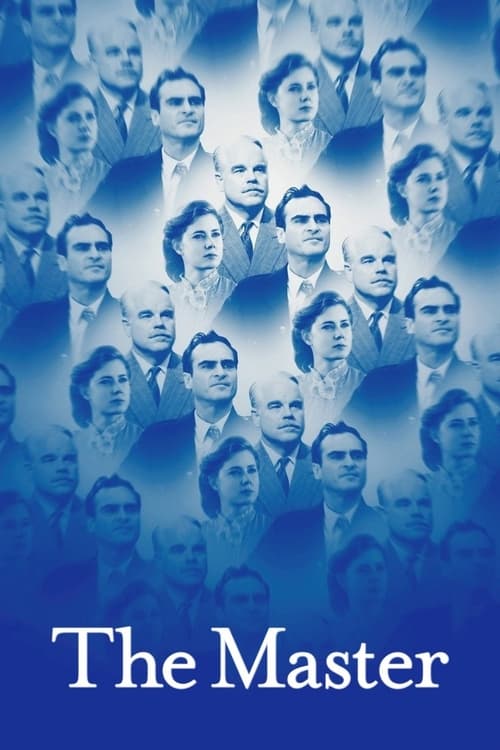
The story of The Master unfolds in the early 1950s, shortly after the end of World War II, in a United States still grappling with the scars of conflict and the search for meaning in a changed world. Freddie Quell, a volatile and deeply troubled Navy veteran, returns home from the war carrying wounds far beyond the physical. His first scenes reveal a man adrift: disoriented, erratic, and drowning his trauma in dangerous homemade alcohol concocted from paint thinner and other chemicals. He briefly works as a photographer in a department store, a place that feels more like a temple of consumer excess than a refuge, but his inability to conform soon erupts violently. After an outburst where he assaults a customer, Freddie is fired, his dark rage and self-destructive impulses making normal life impossible.
Freddie's journey takes him to a Filipino-American farm in California, where he tries to find work picking cabbages. Here, he brews his homemade moonshine, a symbol of his inner chaos and alienation. The poison he unknowingly passes on to an elderly colleague, who collapses and presumably dies after drinking it, forces Freddie to flee once again, haunted by the indirect death his recklessness causes.
One night, wandering drunk and lost, Freddie stumbles upon a lavish yacht party. This is the domain of Lancaster Dodd, a charismatic and articulate man who leads a burgeoning philosophical movement called The Cause. Dodd, known as "The Master," is a magnetic figure surrounded by devoted followers, including his wife Peggy, his daughter Elizabeth, and her husband Clark. The yacht is a microcosm of the cult's allure, a place where spiritual promises of clarity and peace mingle with social rituals and subtle power plays.
Lancaster Dodd notices Freddie's rawness and invites him aboard, sensing something in the broken man that could be molded. Freddie, craving belonging and purpose, accepts. Dodd introduces him to The Cause's central practice: "processing," an intense, confrontational form of psychoanalysis designed to unlock buried traumas and secrets. In their first session, Dodd's probing questions cut deep, forcing Freddie to confront his violent past, his sexual frustrations, and the traumas of war. The scene is electric, charged with tension as Freddie struggles to maintain eye contact, unable to blink or look away, caught in a psychological tug-of-war. This moment marks the beginning of a complex and often toxic bond between the two men.
As Freddie becomes more involved with The Cause, he travels with Dodd and his family along the East Coast, staying in the homes of women drawn to the movement. The relationship between Freddie and Lancaster is fraught with contradictions: at times paternal, at times adversarial, sometimes almost intimate. Dodd admires Freddie's raw, untamed nature but also tries to control and refine it. Freddie, meanwhile, struggles to fit into the rigid structure of the cult, his erratic behavior and alcoholism threatening to unravel the fragile order. Peggy Dodd, Lancaster's wife, watches with a wary eye, her icy control attempting to contain Freddie's volatility.
The movement expands, with Dodd publishing books and holding lectures in major cities like New York, Philadelphia, and Phoenix. Public scrutiny grows, and cracks begin to show in The Cause. During a book launch in New York, a man openly questions Dodd's teachings, prompting Freddie to violently assault the critic, a raw eruption of his primal instincts beneath the spiritual veneer. In Philadelphia, Helen Sullivan, a follower and hostess, confronts Dodd publicly about inconsistencies in his doctrine--particularly his shift from encouraging followers to recall past lives to merely imagining them in his new book. Dodd's temper flares, revealing the fragility beneath his charismatic exterior.
In Phoenix, tensions reach a boiling point. Dodd's publisher disparages the quality of his latest book, and Freddie, unable to contain his rage, attacks the man. This violent outburst further isolates Freddie, and Dodd begins to distance himself, though he never fully severs the bond. The relationship is a volatile dance of dependence and rejection.
A pivotal moment occurs at the salt flats, a stark desert landscape where Dodd organizes a motorcycle game. Participants pick a distant point and race toward it, a symbolic test of courage and fate. Freddie takes his turn but does not return, disappearing into the vast horizon. This disappearance is a powerful metaphor for Freddie's internal struggle and his potential break from Dodd's influence.
Freddie returns to his hometown of Lynn, Massachusetts, seeking a woman named Doris Day, a figure from his past and a symbol of lost connection. He learns from her mother that Doris has married and started a family, a poignant moment underscoring Freddie's isolation and the impossibility of reclaiming the past.
The story's tension culminates in a dramatic confrontation when both Freddie and Dodd are arrested--Dodd for practicing medicine without a license, and Freddie for assaulting police officers during the arrest. In adjacent jail cells, Freddie's rage explodes as he smashes the toilet and battering himself against the bars and his bunk. Dodd tries to calm him, but Freddie launches into a tirade, questioning the authenticity of Dodd and The Cause. He accuses Dodd of being a fraud, exposing the deep fissures in their relationship and the movement's foundations.
After their release, Dodd offers Freddie a stark ultimatum: commit fully to The Cause for life or leave and never return. Freddie chooses the latter, cryptically suggesting, "Maybe we'll meet again. As enemies. In another life." This moment crystallizes the complex, ambivalent bond between them--one of mutual need and inevitable separation.
The film's final scenes are haunting and ambiguous. Freddie picks up a stranger at a pub and, during their intimate encounter, playfully repeats the "processing" questions he learned from Dodd. The ritual is stripped of its original spiritual intensity, reduced to a game or a coping mechanism. This suggests that while Freddie has internalized parts of The Cause, he has also freed himself from its dogma, though not from his own inner turmoil.
The closing image is of Freddie curled up on a beach next to a crude sand sculpture of a woman he and his Navy comrades made during the war. The sculpture, fragile and incomplete, symbolizes lost innocence, unresolved trauma, and the ambiguous nature of Freddie's freedom. The blue hues that pervade the film linger here, representing both the repression and the yearning that define the characters' lives.
Throughout The Master, no other explicit deaths occur besides the elderly farm colleague's collapse after drinking Freddie's poisonous moonshine, for which Freddie bears indirect responsibility. The narrative is driven instead by psychological confrontations, emotional revelations, and the shifting power dynamics between Freddie Quell and Lancaster Dodd, culminating in a story of fractured identities, elusive salvation, and the search for meaning in a fractured post-war world.



What is the ending?
In the ending of "The Master," Freddie Quell confronts his tumultuous relationship with Lancaster Dodd. After a series of events that lead to a rift between them, Freddie ultimately leaves Dodd's movement and finds himself alone, struggling to find his place in the world. The film concludes with a poignant scene where Freddie and Dodd share a moment of connection, but it is clear that their paths have diverged.
As the film approaches its conclusion, we see Freddie Quell, played by Joaquin Phoenix, grappling with his inner demons and the chaotic life he has led. After a series of events that test his loyalty to Lancaster Dodd, portrayed by Philip Seymour Hoffman, Freddie's disillusionment with the movement becomes evident.
In a pivotal scene, Dodd is confronted by the authorities, and the tension between him and Freddie escalates. Dodd's charismatic facade begins to crack under the pressure of scrutiny, and Freddie, who has been a devoted follower, starts to question the very foundation of Dodd's teachings. The emotional weight of their relationship is palpable as Freddie's loyalty is tested against his instinct for self-preservation.
Freddie's internal conflict reaches a climax when he witnesses Dodd's vulnerability. In a moment of raw honesty, Dodd attempts to reassure Freddie, but the connection they once shared feels strained. Freddie's face reflects a mix of confusion, anger, and sadness as he realizes that he cannot fully align himself with Dodd's vision anymore. The bond that once seemed unbreakable is now frayed, and Freddie's need for independence becomes undeniable.
In the final scenes, Freddie leaves the group, symbolizing his rejection of Dodd's ideology. He wanders through a desolate landscape, embodying the isolation and uncertainty that have plagued him throughout the film. The camera captures his solitary figure against the backdrop of a vast, empty world, emphasizing his struggle to find meaning and belonging.
The film concludes with a haunting encounter between Freddie and Dodd. In a moment that feels both intimate and distant, they share a brief exchange that encapsulates their complex relationship. Dodd, still trying to maintain his composure, asks Freddie if he can "be helped." Freddie's response is ambiguous, reflecting his internal turmoil and the realization that he must forge his own path. The scene fades, leaving the audience with a sense of unresolved tension and the understanding that both characters are at a crossroads in their lives.
In the end, Freddie Quell is left to navigate his existence alone, while Lancaster Dodd remains a figure of both influence and disillusionment. Their fates are intertwined yet separate, highlighting the themes of loyalty, identity, and the search for purpose that permeate the film.
Is there a post-credit scene?
The movie "The Master," directed by Paul Thomas Anderson and released in 2012, does not have a post-credit scene. The film concludes with a powerful and ambiguous final sequence that leaves the audience contemplating the complex relationship between the characters Freddie Quell, played by Joaquin Phoenix, and Lancaster Dodd, portrayed by Philip Seymour Hoffman. After the climactic moments of their interactions, the film ends without any additional scenes or content during or after the credits. The focus remains on the intricate dynamics of their bond and the themes of searching for purpose and belonging, which resonate throughout the film.
What is the relationship between Freddie Quell and Lancaster Dodd?
Freddie Quell, played by Joaquin Phoenix, is a troubled World War II veteran struggling to find his place in the world after the war. He meets Lancaster Dodd, portrayed by Philip Seymour Hoffman, who is the charismatic leader of a philosophical movement called 'The Cause.' Their relationship is complex; Freddie is drawn to Dodd's confidence and the sense of purpose he offers, while Dodd sees Freddie as a project, someone he can mold and influence. This dynamic oscillates between mentor and mentee, with Freddie often displaying a childlike admiration for Dodd, while Dodd manipulates Freddie's vulnerabilities to solidify his own power and control within the movement.
How does Freddie Quell's past influence his behavior throughout the film?
Freddie Quell's past as a Navy veteran deeply affects his behavior and emotional state. He is haunted by his experiences during the war, which manifest in his struggles with PTSD, alcoholism, and violent outbursts. His inability to connect with others and his erratic behavior stem from a profound sense of alienation and trauma. This background drives him to seek solace in alcohol and casual relationships, but ultimately leads him to Lancaster Dodd, where he hopes to find acceptance and understanding. However, his past continues to haunt him, causing tension in his interactions and complicating his relationship with Dodd and the members of 'The Cause'.
What role does the character of Peggy Dodd play in the story?
Peggy Dodd, played by Amy Adams, is Lancaster Dodd's wife and a significant figure in the narrative. She is portrayed as a strong, intelligent woman who is fiercely protective of her husband and the movement they have created. Peggy often acts as a stabilizing force for Dodd, providing him with support and guidance while also being a shrewd strategist in managing the public perception of 'The Cause.' Her interactions with Freddie reveal her skepticism about his influence on Dodd and her desire to maintain control over their lives. Peggy's character embodies the complexities of loyalty, power dynamics, and the lengths one will go to protect their loved ones and their beliefs.
What is the significance of the 'processing' sessions in the film?
The 'processing' sessions are a central element of 'The Cause' and serve as a method for Lancaster Dodd to help his followers confront their past traumas and emotional issues. During these sessions, Dodd employs a mix of psychological techniques and philosophical teachings, aiming to unlock deeper truths within his subjects. For Freddie, these sessions become a battleground for his inner turmoil, as he struggles to articulate his feelings and confront his demons. The significance lies in how these sessions illustrate the power dynamics between Dodd and his followers, showcasing Dodd's control over Freddie and the manipulation inherent in their relationship. They also highlight the theme of seeking redemption and understanding through vulnerability.
How does the film depict the theme of control and manipulation through the character of Lancaster Dodd?
Lancaster Dodd is depicted as a master manipulator, using his charisma and intellect to exert control over his followers, particularly Freddie Quell. Dodd's ability to articulate complex ideas and present himself as a benevolent leader masks his underlying need for power and validation. Throughout the film, he employs various tactics to maintain dominance, including emotional manipulation, psychological 'processing,' and the creation of a cult-like environment. Dodd's interactions with Freddie reveal his desire to mold him into a loyal disciple, while simultaneously exploiting Freddie's vulnerabilities for his own gain. This theme of control is further emphasized by the way Dodd's authority is challenged, leading to moments of tension and conflict that ultimately question the nature of their relationship and the ethics of Dodd's leadership.
Is this family friendly?
"The Master," directed by Paul Thomas Anderson, is not considered family-friendly due to its mature themes and content. Here are some potentially objectionable or upsetting aspects that may affect children or sensitive viewers:
-
Substance Abuse: The film depicts heavy drinking and drug use, showcasing the protagonist's struggles with addiction.
-
Violence: There are scenes of physical altercations and aggressive behavior, which may be disturbing to some viewers.
-
Sexual Content: The film includes suggestive themes and scenes that involve sexual situations, which may not be appropriate for younger audiences.
-
Psychological Manipulation: The dynamics between characters often involve manipulation and emotional abuse, which can be unsettling.
-
Existential Themes: The film explores deep and complex themes such as identity, purpose, and the nature of belief, which may be challenging for younger viewers to understand.
-
Intense Emotional Scenes: Characters experience significant emotional turmoil, including moments of despair and conflict that could be distressing.
Overall, the film's exploration of these heavy themes and its portrayal of complex human relationships make it more suitable for mature audiences.









