
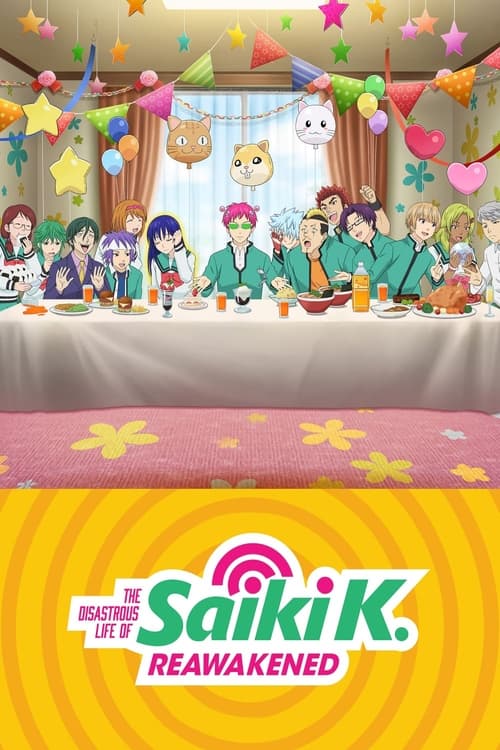











Popular
What are the main challenges Saiki faces in his daily life due to his psychic powers?
How does Saiki's relationship with his friends evolve throughout the series?
What role does Saiki's family play in his life and how do they react to his powers?
What are some of the most memorable comedic moments involving Saiki's powers?
How does the character of Kokomi Teruhashi challenge Saiki's desire for a normal life?
Should I watch it?
Ask Your Own Question

What is the plot?
The story begins with Kusuo Saiki, a high school student with powerful psychic abilities, feeling a sense of monotony in his life. He reflects on his past experiences and the challenges that come with his powers, which he often tries to keep hidden from his classmates. Saiki's internal monologue reveals his desire for a normal life, free from the complications his abilities bring.
As the narrative progresses, Saiki's friends, including Riki Nendou, Aren Kuboyasu, and Kokomi Teruhashi, are introduced in various comedic scenarios that highlight their unique personalities. Nendou, oblivious to Saiki's powers, often drags him into absurd situations, while Kuboyasu struggles with his own strength and reputation. Teruhashi, who believes she is the center of attention, often clashes with Saiki's indifferent demeanor.
One day, Saiki encounters a new transfer student, who turns out to be a girl named Kineshi Hairo. Hairo is energetic and enthusiastic, quickly becoming the leader of the class. He proposes a sports festival, which excites the students but fills Saiki with dread, as he knows that participating will only lead to chaos. Saiki internally debates how to avoid involvement while still maintaining his facade of normalcy.
As preparations for the sports festival begin, Saiki's friends rally around Hairo's enthusiasm, and he finds himself reluctantly drawn into the planning. Saiki uses his powers discreetly to help his friends train, ensuring they perform well without revealing his abilities. However, his efforts lead to unintended consequences, such as heightened expectations and increased pressure on his classmates.
During the sports festival, various events unfold, showcasing the talents and quirks of Saiki's friends. Nendou's over-the-top enthusiasm leads to comedic mishaps, while Teruhashi's attempts to shine are met with Saiki's unyielding indifference. Saiki's internal struggle intensifies as he tries to balance his desire for a quiet life with the chaos surrounding him.
As the festival progresses, a series of unexpected challenges arise, including a rival class that threatens to overshadow Saiki's class. Hairo's determination to win pushes everyone to their limits, and Saiki finds himself using his powers more frequently to keep things under control. This culminates in a dramatic relay race where Saiki must intervene to ensure his team does not lose, all while trying to remain inconspicuous.
In the final moments of the sports festival, Saiki's class manages to win, but not without a series of comedic blunders and misunderstandings. Saiki's friends celebrate their victory, oblivious to the extent of his involvement. Saiki, however, feels a mix of relief and frustration, realizing that his efforts to maintain a low profile have only drawn more attention to himself.
The story concludes with Saiki reflecting on the events of the sports festival, acknowledging the bonds he has formed with his classmates despite his desire for solitude. He contemplates the balance between his powers and the friendships he has developed, leaving viewers with a sense of the ongoing struggle between his extraordinary abilities and the ordinary life he yearns for.
More TV Shows Like This
Browse All TV Shows →







What is the ending?
In the ending of "The Disastrous Life of Saiki K.: Reawakened," Saiki Kusuo continues to navigate the challenges of his daily life while dealing with his friends and their antics. The series concludes with a sense of acceptance and camaraderie among the characters, highlighting the importance of friendship and the mundane joys of life, even for someone with extraordinary powers like Saiki.
As the story unfolds, we see Saiki, who possesses immense psychic abilities, trying to maintain a low profile while managing the chaos that his friends bring into his life. The final episodes showcase various comedic scenarios involving his classmates, including Riki Nendou, Kokomi Teruhashi, and Aren Kuboyasu, each contributing to the lighthearted yet chaotic atmosphere.
In the climax, Saiki faces a series of humorous and absurd situations that test his patience and resolve. Despite his desire for a quiet life, he finds himself drawn into the antics of his friends, ultimately realizing that their companionship is something he values deeply. The series ends on a note of warmth, with Saiki accepting the unpredictability of life and the bonds he has formed, leaving viewers with a sense of closure and contentment.
As the final episodes of "The Disastrous Life of Saiki K.: Reawakened" unfold, we find ourselves back in the familiar setting of PK Academy, where Saiki Kusuo, a high school student with extraordinary psychic powers, is attempting to lead a normal life. The sun shines brightly over the school, casting a warm glow on the bustling students as they go about their day. Saiki, with his signature green hair and stoic expression, walks through the halls, his mind racing with thoughts of how to avoid drawing attention to himself.
Scene 1: The Classroom Antics In the classroom, Saiki sits quietly at his desk, trying to focus on his studies. However, his peace is shattered by the loud and boisterous Riki Nendou, who is animatedly discussing his latest misadventures. Nendou's enthusiasm is infectious, and despite Saiki's best efforts to ignore him, he can't help but feel a flicker of amusement. Kokomi Teruhashi, the self-proclaimed "most beautiful girl in school," enters the room, and the atmosphere shifts as she demands attention. Saiki rolls his eyes, internally lamenting the chaos that surrounds him.
Scene 2: The Group Outing Later, the group decides to go on a class trip, and Saiki reluctantly joins, knowing that his friends will create a series of ridiculous situations. As they travel, the bus is filled with laughter and chatter, contrasting sharply with Saiki's desire for solitude. He observes his friends, feeling a mix of exasperation and fondness. The bus ride is filled with comedic moments, including Nendou's attempts to impress Teruhashi and Aren Kuboyasu's accidental destruction of the bus seat.
Scene 3: The Amusement Park Upon arriving at the amusement park, the group is excited, and Saiki is dragged into various attractions against his will. He uses his powers discreetly to ensure that no one gets hurt, but the chaos continues. Nendou's antics lead to a series of misunderstandings, and Saiki finds himself in increasingly absurd situations, such as being mistaken for a mascot character. Despite his efforts to remain detached, he can't help but feel a sense of belonging.
Scene 4: The Emotional Climax As the day progresses, the group faces a challenge when they get separated in the park. Saiki, worried about his friends, uses his powers to locate them. In a moment of vulnerability, he realizes how much he cares for them, despite the chaos they bring into his life. This realization hits him hard, and he feels a warmth in his chest, a stark contrast to his usual desire for solitude.
Scene 5: The Resolution The day ends with the group reuniting, and they share a heartfelt moment, laughing and recounting their adventures. Saiki stands slightly apart, a small smile breaking through his usual stoic demeanor. He acknowledges that while his life may be filled with disasters, it is also filled with moments of joy and connection. The camera pans out, showing the group together, a tight-knit circle of friends, as the sun sets behind them.
In the final moments, Saiki reflects on his journey, understanding that while he may have extraordinary powers, it is the ordinary moments with his friends that truly matter. The series concludes with a sense of acceptance, as Saiki embraces the unpredictability of life and the bonds he has formed, leaving viewers with a heartwarming sense of closure. Each character, from Nendou to Teruhashi, finds their place in this chaotic yet loving dynamic, reinforcing the theme that friendship can thrive even in the most disastrous of circumstances.
Is there a post-credit scene?
Yes, "The Disastrous Life of Saiki K.: Reawakened" features a post-credit scene that adds a humorous touch to the overall narrative.
In this scene, after the main credits roll, viewers are treated to a brief moment that showcases the character Saiki Kusuo's ongoing struggles with his psychic abilities and the chaos that surrounds him. The scene typically involves Saiki's friends, who are oblivious to his powers and the trouble they often cause.
As the scene unfolds, Saiki is seen trying to enjoy a moment of peace, perhaps while eating or relaxing. However, his friends, including Riki Nendou and Kokomi Teruhashi, inadvertently create a situation that disrupts his tranquility. Nendou, with his boisterous personality, might be engaging in some loud antics, while Teruhashi is likely trying to draw attention to herself, completely unaware of how her actions affect Saiki.
Saiki's internal monologue reveals his exasperation and desire for a normal life, contrasting sharply with the chaotic energy of his friends. The humor lies in the juxtaposition of his deadpan expressions and the absurdity of the situation, highlighting the ongoing theme of how his psychic powers complicate his interactions with those around him.
This post-credit scene encapsulates the essence of the series, blending comedy with the struggles of a young man trying to navigate life with extraordinary abilities while surrounded by equally extraordinary friends.
What are the main challenges Saiki faces in his daily life due to his psychic powers?
Saiki Kusuo, the protagonist, faces numerous challenges due to his overwhelming psychic abilities. He struggles with the constant need to hide his powers from his friends and family to maintain a semblance of normalcy. His telepathy allows him to hear the thoughts of those around him, which often leads to awkward situations as he tries to navigate social interactions without revealing his abilities. Additionally, he deals with the burden of being able to foresee potential disasters, which forces him to intervene subtly to prevent chaos, all while trying to avoid drawing attention to himself.
How does Saiki's relationship with his friends evolve throughout the series?
Saiki's relationship with his friends, particularly Riki Nendou and Kokomi Teruhashi, evolves significantly throughout the series. Initially, Saiki views Nendou as a nuisance due to his obliviousness and loud personality, but over time, he begins to appreciate Nendou's unwavering loyalty and genuine friendship. Teruhashi, on the other hand, initially sees Saiki as a challenge to her popularity, but as she learns more about him, she becomes intrigued by his indifference to her charm. Saiki's internal struggle to maintain distance while also valuing their companionship creates a complex dynamic that adds depth to their interactions.
What role does Saiki's family play in his life and how do they react to his powers?
Saiki's family plays a significant role in his life, often adding to the comedic and chaotic elements of the story. His parents, Kuniharu and Kurumi, are largely oblivious to his psychic powers, leading to humorous misunderstandings. Kuniharu is often portrayed as a carefree and somewhat irresponsible father, while Kurumi is more nurturing but also oblivious to the extraordinary nature of her son. Saiki's interactions with them highlight his desire for a normal family life, contrasting with the absurdity of his abilities. His younger brother, Kineshi, is more aware of Saiki's powers and often idolizes him, adding another layer to Saiki's internal conflict about revealing his true self.
What are some of the most memorable comedic moments involving Saiki's powers?
The series is filled with memorable comedic moments that showcase Saiki's powers in humorous ways. One notable scene involves Saiki using his teleportation ability to avoid a boring class, only to accidentally end up in a situation where he has to deal with an overzealous teacher. Another hilarious moment occurs when Saiki tries to use his telepathy to help Nendou with a romantic interest, but instead ends up causing more confusion and chaos. These moments highlight the absurdity of his powers and the comedic potential of everyday situations, emphasizing Saiki's struggle to maintain a low profile while dealing with the unpredictable nature of his abilities.
How does the character of Kokomi Teruhashi challenge Saiki's desire for a normal life?
Kokomi Teruhashi, the self-proclaimed 'goddess' of the school, challenges Saiki's desire for a normal life through her persistent attempts to gain his attention and admiration. Her confidence and charm initially frustrate Saiki, who wishes to remain unnoticed. Teruhashi's belief that everyone is enamored with her creates a conflict for Saiki, as he is immune to her allure due to his psychic powers. This dynamic leads to comedic situations where Teruhashi tries to impress Saiki, only to be met with his indifference. As the series progresses, her determination to befriend him forces Saiki to confront his feelings about friendship and acceptance, complicating his efforts to live a quiet life.
Is this family friendly?
"The Disastrous Life of Saiki K.: Reawakened" is generally considered family-friendly, but it does contain some elements that may be objectionable or upsetting for children or sensitive viewers. Here are a few aspects to be aware of:
-
Mild Language: There are instances of mild swearing and slang that may not be suitable for younger audiences.
-
Suggestive Humor: The show includes some jokes and situations that are suggestive in nature, which may not be appropriate for all children.
-
Social Anxiety and Bullying: Themes of social anxiety, bullying, and the struggles of fitting in are present, which could resonate negatively with sensitive viewers.
-
Supernatural Elements: The portrayal of psychic powers and their consequences can be intense at times, potentially causing discomfort for some viewers.
-
Character Quirks: Some characters exhibit eccentric behaviors that may be confusing or unsettling for younger audiences, such as obsessive tendencies or extreme reactions.
While the show is comedic and light-hearted overall, these elements may warrant parental guidance for younger viewers.









