


















Popular
What motivates Gareth Jones to investigate the truth about the famine in Ukraine?
How does Gareth Jones's relationship with Ada Brooks evolve throughout the film?
What role does the character of Walter Duranty play in the story?
What are the key challenges Gareth Jones faces while trying to report on the famine?
How does the film depict the impact of the famine on the Ukrainian people?
Should I watch it?
Ask Your Own Question

What is the plot?
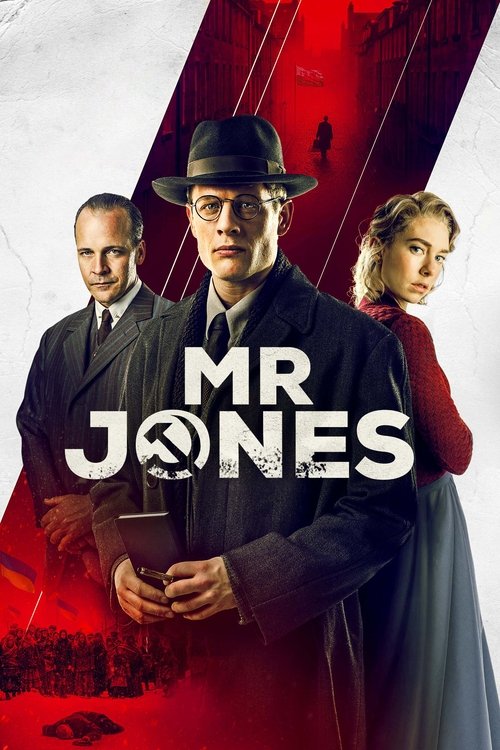
In London in 1933, as the Great Depression continues to damage economies across the world, Gareth Jones works as a political adviser to David Lloyd George. Jones is young, intelligent, multilingual, and already known as an unusually daring journalist. He has recently traveled to Germany and become one of the first foreign reporters to interview Adolf Hitler, even flying with him as Hitler presents himself as the architect of a new national revival. Now Jones studies the economic transformation taking place under authoritarian governments and asks a question that nobody around Lloyd George seems eager to answer: how is Joseph Stalin paying for the Soviet Union's extraordinary industrial expansion?
The Soviet Union claims that collectivized agriculture is producing unprecedented abundance. At the same time, Stalin is building factories, power stations, railways, and industrial cities at breathtaking speed. Jones cannot reconcile the official figures. The Soviet economy appears poor, yet the regime is purchasing machinery and Western technical expertise. If Ukrainian farms are truly flourishing, he reasons, the grain must be generating the money. But if the farms are not flourishing, then some hidden source is financing Stalin's Five-Year Plan.
Jones presents his concerns to Lloyd George's advisers, believing that Britain must understand what is happening in both Germany and the Soviet Union. Instead of being rewarded for his insight, he finds himself treated as expendable. His government position disappears, leaving him without a salary, an official platform, or institutional protection. The loss is humiliating, but it also frees him to pursue the story on his own.
Jones decides that the only way to solve the mystery is to travel to Moscow and interview Stalin. His political connections help him obtain a Soviet visa. He presents himself as a significant British figure still linked to Lloyd George, and the prestige of that association gives him access that an ordinary freelance journalist would never receive. He enters the Soviet Union believing that a conversation with Stalin might reveal how the country's apparent economic miracle is being funded.
Moscow initially seems to confirm the Soviet success story. The city is presented to foreign visitors as a controlled showcase of modernity and revolutionary progress. Foreign journalists are allowed to work there, but only inside carefully defined limits. They receive official information, are escorted on approved visits, and are discouraged from traveling independently. The countryside, where the real consequences of collectivization are unfolding, remains largely beyond their reach.
Jones meets Eugene Lyons, a Russian-American journalist who moves within the foreign-correspondent community. Lyons is connected with British engineers from Metropolitan-Vickers, the company whose specialists are helping Stalin construct the industrial infrastructure of the Soviet state. These engineers represent the strange partnership at the center of Stalin's modernization: a supposedly self-sufficient communist regime depends on Western knowledge, equipment, and labor while insisting that its system has surpassed the capitalist world.
Lyons and the engineers take Jones to the Moscow apartment of Walter Duranty, the powerful New York Times correspondent. Duranty is one of the most influential foreign journalists in the Soviet Union. He has won a Pulitzer Prize and has become a trusted interpreter of Stalin's regime for English-speaking readers. His home is luxurious, filled with alcohol, food, music, sexual tension, and the privileged atmosphere enjoyed by foreigners who have learned how to live comfortably under Soviet surveillance.
The party is an obscene contrast to the lives of Soviet citizens outside the apartment. While ordinary people face shortages and fear, the foreign press elite drinks and socializes in comfort. Duranty's apartment functions as both salon and informal communications center. Journalists exchange fragments of rumor, but nobody speaks plainly. The walls may be monitored, and everyone understands that access to the Soviet Union depends on obedience.
Jones hears oblique suggestions that the Soviet economic miracle is not based on successful farms. The regime is taking grain from Ukraine, selling or redirecting it, and using the proceeds to fund industrialization. The information is never delivered as a clear confession. Instead, Lyons and others hint at what they know, while Duranty's evasions reveal that he understands more than he is willing to acknowledge.
Duranty has become deeply invested in the official narrative. His influence depends on continued access to Soviet officials, exclusive information, and a privileged lifestyle. He does not need to believe every claim made by the regime; he only needs to protect the system that gives him status. His journalism turns political control into respectable news copy, and his prestige makes the Soviet version of events appear credible in the West.
Jones also meets Ada Brooks, a British journalist working in Moscow. Ada is observant and intelligent, but unlike Duranty she is troubled by the gap between official propaganda and private reality. The Soviet secret police, the OGPU, keep her under close observation. She knows that foreign journalists are watched and that their contacts may be arrested, expelled, or killed.
Ada confirms Jones's worst suspicions. A contact connected with his investigation into Ukraine has been murdered by Soviet authorities. The person had been attempting to investigate the supposed success of Ukrainian agriculture, and the authorities eliminated him rather than allow the information to circulate. This revelation changes the nature of Jones's investigation. The famine is not merely being overlooked because journalists lack access. The evidence is being suppressed, and those who try to expose it are being silenced.
Ada explains the rules of survival in Moscow. Information must be transmitted through hints, coded remarks, and private meetings. A direct accusation can endanger both the speaker and the listener. Her willingness to help Jones puts her at risk, but she recognizes that his questions are leading toward a truth the regime cannot permit him to see.
Jones now understands that the answer will not be found in Moscow's official offices. He needs to reach Ukraine, where the grain is produced and where the consequences of collectivization are hidden from foreign observers. Because ordinary foreign correspondents are forbidden from traveling freely, Jones uses his political credentials. He alters or manipulates his documentation so that he appears to retain an official connection with Lloyd George. He also uses his relationship to Western political circles to secure an invitation associated with Maxim Litvinov, the Soviet foreign minister.
The deception gives him permission to travel south, but the Soviet authorities intend to supervise every stage of the journey. Jones boards a train toward Kharkov, the Ukrainian capital, expecting that officials will control where he stops and what he sees. The train itself embodies the carefully managed Soviet system: passengers, food, information, and journalists all move along routes determined by the state.
During a brief stop, Jones takes his chance. He leaves the train to which he has been assigned and secretly boards another. This train is carrying starving peasant workers toward Hughesovka, the industrial settlement founded by Welshman John Hughes and renamed Stalino by the Soviet authorities.
The destination matters to Jones personally. His mother once worked as a teacher in Hughesovka, so the place connects his family history and Welsh identity to the industrial transformation he has come to investigate. He is not simply traveling toward an anonymous Soviet factory town. He is following a personal thread into the heart of Stalin's industrial empire.
When Jones reaches Stalino, the propaganda begins to collapse. The city is an industrial center, but the population is starving. Grain shipments pass through the region, yet the food is not being distributed to the people who produced it or to the workers who are building the factories. The grain is sent toward Moscow and into the state's wider trade and supply network.
Jones sees the answer to the question that began in London. Stalin's industrial expansion is being financed through the forced extraction of Ukrainian agricultural wealth. The Soviet state is taking grain from the countryside, moving it away from starving communities, and using it to support industrial construction, foreign purchases, and the regime's political ambitions.
Jones is soon identified as an unauthorized foreign investigator. Soviet officials regard him as a spy. The journey he has made outside the permitted system exposes him to pursuit, and he is forced to flee Stalino and enter the woods.
For several days, Jones moves through the Ukrainian countryside on foot. The polished Moscow of foreign correspondents disappears, replaced by empty roads, abandoned homes, silent villages, and fields stripped of food. The season gives the landscape a bleak, colorless appearance. The villages seem emptied not by war but by hunger. The Soviet state is still functioning--trains are moving, officials are enforcing orders, and grain is being transported--but the communities from which the food is taken are collapsing.
Jones meets villagers who have almost nothing left to eat. They tell him that the authorities have confiscated grain even when families are already starving. Food has been removed from local stores, homes have been searched, and people have been prevented from leaving in search of nourishment. The villagers describe the famine as something imposed from above, not as an unavoidable natural disaster.
Jones tries to help with whatever food he carries, but his supplies are insignificant beside the scale of the catastrophe. Each encounter forces him to confront the limits of his role. He has come as an investigator looking for proof, yet the people he meets do not need another question. They need food, and he cannot provide enough to save them.
He sees adults reduced to skeletal figures and children too weak to react normally. Some victims lie dead inside their homes, while others die in the streets or in the snow. Household spaces that should contain the ordinary signs of family life instead contain corpses, empty cupboards, or people waiting helplessly for death. The famine has invaded every private room.
The starving speak of eating bark, roots, and anything that can be chewed. The desperate consequences of hunger include reports of cannibalism, a final indication that social life has been pushed beyond its limits. Jones understands that this is not simply an agricultural failure. The Soviet authorities know that people are starving, continue removing food, and punish those who speak about it.
The contrast with Duranty's apartment becomes unbearable. In Moscow, foreign journalists and engineers drink in luxury while the Ukrainian countryside dies. The state has not merely failed to feed the population. It has created a hierarchy in which the survival of industrialization and political power matters more than the survival of millions of peasants.
Jones continues through the countryside, gathering no conventional documents because the dead cannot sign statements and the survivors have no safe means of communicating with the outside world. His evidence is physical and immediate: empty granaries, grain trains, abandoned houses, starving children, and bodies. The absence of food is itself evidence, especially because food is visibly being moved away.
Soviet agents pursue him. The authorities label him a foreign spy, and his unsanctioned movements provide the pretext for action. He is eventually captured or detained. The Soviet officials do not need to debate his observations. They simply remove him from the territory where he found them. His connection with Lloyd George, which helped him enter and travel through the Soviet Union, now becomes part of the formal justification for expelling him.
Jones is deported from the Soviet Union and returned to Britain. The regime has prevented him from continuing his investigation, but it cannot erase what he has seen. He arrives in London carrying the memory of the Ukrainian countryside and the knowledge that the famine has been deliberately concealed.
He begins writing and publishing accounts of the catastrophe. His reports state that the Soviet economic miracle is being financed by the seizure and export of Ukrainian grain. He describes villages where the inhabitants are dying, explains that collectivization has destroyed local control of food, and challenges the claim that Soviet agriculture is flourishing.
The reports immediately threaten the established Western interpretation of Stalin's rule. Jones is a young freelance journalist with no major newspaper machine behind him. Walter Duranty, by contrast, is a Pulitzer Prize-winning correspondent with prestige, contacts, and a long record of presenting the Soviet Union favorably.
Duranty counters Jones publicly and privately. Rather than treating Jones's testimony as a warning requiring investigation, he helps defend the official Soviet narrative. The conflict becomes a struggle over who will define reality for readers in Britain and the United States. Jones speaks from firsthand observation; Duranty speaks with the authority of access and reputation.
Jones insists that he has seen the famine himself. Duranty and other foreign correspondents rely on the information permitted by Soviet officials and on the protection of their positions in Moscow. The system rewards journalists who remain within its boundaries and punishes those who cross them. Duranty's denial therefore does more than contradict Jones. It helps preserve the mechanism that prevents the famine from becoming an international scandal.
The campaign against Jones grows more threatening. His story is dismissed, challenged, and treated as politically motivated. The Soviet state cannot easily refute the scenes he witnessed, so the attack shifts toward his credibility. He is portrayed as inexperienced, reckless, or unreliable. The same man whose political connections helped open doors now finds those connections used to make him appear compromised.
Jones's publisher eventually introduces him to a young writer named George Orwell. Orwell listens as Jones explains what he saw in Ukraine: the removal of grain, the starving villages, the bodies, and the deliberate suppression of information. Orwell understands that the matter is larger than one famine or one government. It reveals how authoritarian systems use language to transform violence into progress and deprivation into sacrifice.
The conversation links Jones's experience with Orwell's developing suspicion of totalitarian propaganda. Orwell recognizes that political language can reverse moral reality. A state can call confiscation collectivization, censorship truth, and starvation industrial progress. The people outside the official story then become invisible, while the privileged observers who repeat the story are treated as objective.
Orwell encourages Jones to continue telling the truth even if the truth is rejected. Jones has wanted the evidence to produce an immediate public reckoning, but the press campaign against him shows that facts alone cannot defeat a system built around controlled information. His responsibility is to preserve the testimony and place it before the public, regardless of whether influential readers choose to believe it.
The film's physical climax has already occurred in the Ukrainian countryside, where Jones survives pursuit and discovers the famine. Its final confrontation is fought in print. Jones's reports face Duranty's authority, Soviet censorship, and Western indifference. In the short term, Jones does not win. The famine is not immediately acknowledged by the international public, and the Soviet Union continues presenting itself as a successful modernizing state.
The film ends by moving beyond the immediate aftermath. Jones returns to Wales, walking with his bag as the burden of what he has seen follows him into an uncertain future. A concluding historical account explains that he continues working as a foreign correspondent and remains willing to pursue dangerous stories.
In 1935, two years after his investigation of Ukraine, Jones travels to Inner Mongolia during a fact-finding journey. He is accompanied by a fellow journalist who is also connected with the Comintern. Bandits kidnap the two men and demand a ransom. The circumstances are later understood to involve Soviet secret-police interests as well as the bandits themselves. Jones is executed, reportedly just one day before his thirtieth birthday. His companion is also killed.
Gareth Jones therefore dies not in the Ukrainian famine he exposed but while continuing the same work that took him there: traveling toward places powerful governments would rather keep hidden. Every major death in the film's story carries the mark of political violence. The Ukrainian victims die from forced collectivization, grain confiscation, repression, and the deliberate redirection of food. Jones's investigative contact is murdered by Soviet authorities for attempting to uncover the truth. Jones himself is ultimately executed in Inner Mongolia after his kidnapping.
The final irony is that Duranty succeeds temporarily in suppressing the story but fails permanently to control its meaning. In 1933, Jones is treated as an inconvenient young reporter while Duranty's prestige lends credibility to denial. Over time, however, Jones's eyewitness account becomes part of the historical record of the Holodomor, while Duranty's defense of Stalin's regime damages his reputation. The story ends with Jones dead, Stalin's famine concealed from the world for years, and the truth surviving because one journalist crossed the boundaries imposed on him and recorded what he saw.






What is the ending?
In the ending of "Mr. Jones," Gareth Jones, the protagonist, faces the consequences of his relentless pursuit of the truth about the Holodomor in Ukraine. After gathering evidence of the famine and the Soviet government's cover-up, he is ultimately captured by Soviet agents. The film concludes with a sense of unresolved tension, as Jones's fate remains uncertain, leaving the audience to ponder the cost of truth and the dangers faced by those who dare to expose it.
As the film approaches its climax, Gareth Jones, portrayed with a fierce determination, finds himself in a precarious situation. He has successfully infiltrated Ukraine, where he witnesses the devastating effects of the famine firsthand. The once-vibrant fields are barren, and the people are gaunt and desperate, their eyes hollow from starvation. Jones's heart aches as he interviews locals, documenting their harrowing stories, which he knows will be crucial in revealing the truth to the world.
In a pivotal scene, Jones meets with a group of Ukrainian peasants who share their plight with him. Their voices tremble with fear and desperation, and Jones feels a deep sense of responsibility to amplify their suffering. He scribbles notes furiously, his brow furrowed in concentration, knowing that the information he gathers could change the course of history. The emotional weight of their stories fuels his resolve, and he vows to bring their suffering to light.
However, as Jones continues his investigation, he becomes increasingly aware of the dangers surrounding him. The Soviet regime is tightening its grip, and he is constantly on edge, aware that he is being watched. In a tense moment, he narrowly escapes an encounter with Soviet agents, his heart racing as he slips away into the shadows. The fear of being caught looms over him, yet he presses on, driven by an unwavering commitment to uncover the truth.
In the final act, Jones manages to secure a meeting with a foreign journalist, hoping to share his findings and alert the world to the atrocities occurring in Ukraine. The atmosphere is charged with urgency as he lays out the evidence he has collected, his voice steady but filled with passion. The journalist listens intently, but the weight of the Soviet influence hangs heavy in the air, casting doubt on whether the truth will ever reach the public.
As Jones prepares to leave, he is ambushed by Soviet agents. The scene is chaotic, filled with the sounds of shouting and the scuffle of bodies. Jones fights back, his determination evident, but he is ultimately overpowered. The camera captures the moment of his capture in stark detail, his expression a mix of defiance and fear as he is dragged away, the reality of his situation sinking in.
The film concludes with a haunting image of Jones being taken away, the screen fading to black. The audience is left with a lingering sense of uncertainty about his fate. The final moments serve as a poignant reminder of the sacrifices made by those who seek the truth, and the dangers that accompany such a quest. The unresolved ending emphasizes the ongoing struggle against oppression and the importance of bearing witness to history, leaving viewers to reflect on the cost of courage in the face of tyranny.
Is there a post-credit scene?
The movie "Mr. Jones," produced in 2019, does not have a post-credit scene. The film concludes its narrative without any additional scenes after the credits roll. The story focuses on the historical events surrounding Gareth Jones, a Welsh journalist who uncovers the truth about the Holodomor in Soviet Ukraine during the 1930s. The film wraps up with a poignant reflection on the impact of truth and the consequences of exposing harsh realities, leaving the audience with a sense of the weight of history rather than a cliffhanger or additional narrative twist.
What motivates Gareth Jones to investigate the truth about the famine in Ukraine?
Gareth Jones, a young Welsh journalist, is driven by a deep sense of moral responsibility and a desire for truth. After witnessing the devastating effects of the Soviet regime during his travels, he becomes increasingly aware of the suffering caused by the man-made famine in Ukraine. His determination to expose the reality behind the propaganda and to inform the world about the plight of the Ukrainian people fuels his investigation.
How does Gareth Jones's relationship with Ada Brooks evolve throughout the film?
Initially, Ada Brooks, a journalist and secretary, is skeptical of Gareth's ambitions and the dangers he faces. However, as they work together, her admiration for his courage grows. Their relationship deepens as they share the risks of uncovering the truth, leading to a bond built on mutual respect and shared ideals. Ada's emotional support becomes crucial for Gareth as he navigates the perilous landscape of Soviet Ukraine.
What role does the character of Walter Duranty play in the story?
Walter Duranty, a prominent journalist for The New York Times, represents the complicity of the Western media in downplaying the severity of the Ukrainian famine. His character embodies the moral ambiguity of journalism during this period, as he prioritizes his relationship with the Soviet regime over the truth. Duranty's dismissive attitude towards Gareth's findings creates a stark contrast, highlighting the challenges Gareth faces in his quest for honesty.
What are the key challenges Gareth Jones faces while trying to report on the famine?
Gareth encounters numerous obstacles, including censorship, the threat of violence from Soviet authorities, and the pervasive atmosphere of fear among the Ukrainian populace. His attempts to gather evidence are met with hostility, and he must navigate a web of deception and propaganda. The emotional toll of witnessing the suffering around him weighs heavily on Gareth, intensifying his resolve to bring the truth to light despite the personal risks involved.
How does the film depict the impact of the famine on the Ukrainian people?
The film portrays the devastating impact of the famine through harrowing visuals of starvation, despair, and the struggle for survival among the Ukrainian populace. Scenes depict families scavenging for food, the haunting emptiness of villages, and the emotional anguish of individuals who have lost loved ones. These stark images serve to humanize the statistics and emphasize the urgency of Gareth's mission to expose the truth behind the famine.
Is this family friendly?
"Mr. Jones," produced in 2019, is not considered family-friendly due to its intense and mature themes. The film deals with the historical events surrounding the Holodomor, a man-made famine in Soviet Ukraine, and includes several potentially objectionable or upsetting scenes.
-
Graphic Depictions of Starvation: The film portrays the severe effects of famine, including scenes of emaciated individuals and the desperate measures people take to survive, which can be distressing.
-
Violence and Oppression: There are moments that depict the brutality of the Soviet regime, including violence against civilians and the suppression of dissent, which may be unsettling.
-
Emotional Trauma: Characters experience significant emotional distress, loss, and despair, which could be heavy for younger viewers or sensitive individuals.
-
Political Repression: The film addresses themes of censorship and the dangers faced by journalists, which may be complex and difficult for children to understand.
Overall, the film's serious subject matter and graphic content make it more suitable for mature audiences.






