

















Popular
What challenges does Nick confront while renovating the house?
How does Nick's relationship with his wife, Suzanne, evolve throughout the movie?
What role does Chuck play in the story, and how does he affect Nick's life?
How do the children react to the move and the changes in their lives?
What specific incidents highlight the comedic elements of the renovation process?
Should I watch it?
Ask Your Own Question

What is the plot?
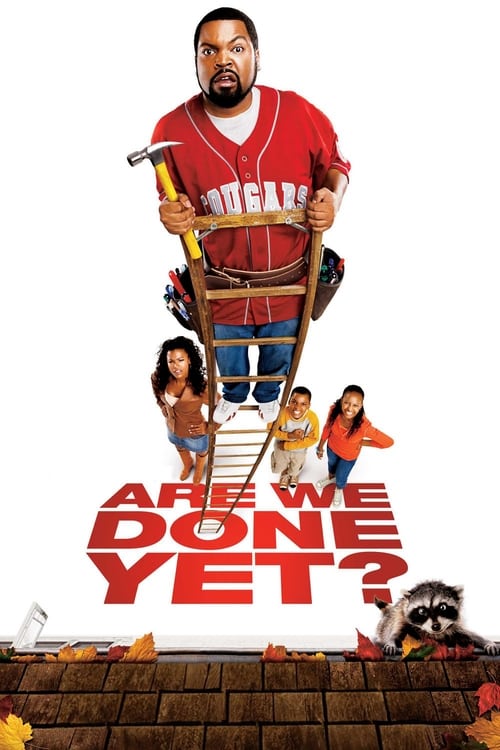
Two years after the chaos of Are We There Yet?, Nick Persons is trying to build a more stable life, but in Are We Done Yet? that stability collapses almost immediately into a bigger, messier crisis: a cramped city apartment, a surprise pregnancy, a disastrous move to the countryside, and a house that seems determined to ruin everyone's sanity. There are no deaths in the film; the stakes come instead from escalating domestic chaos, family conflict, and Suzanne's frantic labor when the babies arrive at the worst possible moment.
The story opens with Nick Persons now married to Suzanne Kingston Persons and living with her children, Lindsey and Kevin, in Nick's apartment, where the family has clearly outgrown the space. Nick has also sold his sports memorabilia store to his friend Marty and adopted a Berger Picard dog named Coco, showing that he is trying to settle into domestic life even as he keeps reaching for something bigger. At the same time, he is preparing to launch a sports magazine and is focused on an upcoming interview with Magic Johnson, a detail that immediately establishes one of the film's running jokes: Nick is always split between his family responsibilities and his own ambitions.
Suzanne keeps trying to tell Nick something important, but he is repeatedly distracted by the magazine launch and the looming Magic Johnson interview. That early pattern matters because it sets up the central dynamic of the film: Suzanne is trying to communicate practical, family-centered truth, while Nick is too busy, too determined, or too self-absorbed to hear it properly. The movie uses these interruptions as both comedy and character reveal, showing that even though Nick is a devoted husband and stepfather now, he still barrels through life with the same impatient energy he had before.
At breakfast, Suzanne finally gets the chance to speak, and she first reveals that she has bought a three-bedroom apartment from the neighbors, a practical attempt to solve the family's space problem. Before that solution can even settle in, she drops the real bombshell: she is pregnant. The pregnancy is then escalated further when the family learns that Suzanne is carrying twins. That revelation transforms the need for more space from a convenience into an urgent necessity, and the entire film pivots on that single domestic fact. The apartment is no longer enough, and the family begins looking for a place that can actually fit the life they are building.
Nick and Suzanne decide to move out of the city and into the country, hoping a larger house will solve their space problems and give the children a better life. They go looking for property and meet Chuck Mitchell Jr., a local real-estate agent and contractor whose business style is described in the sources as eccentric, incompetent, deceptive, or simply bizarre, depending on the account. Chuck becomes the film's main external nuisance, the kind of character who seems helpful at first but quickly proves to be a source of endless frustration. Nick is drawn in by the promise of a roomy home, but the house is already undermined by Chuck's odd confidence and by Nick's own failure to properly inspect it first.
The new house is positioned as the answer to the family's problems, but almost as soon as they buy it, it becomes obvious that it is a trap disguised as a solution. The house is a fixer-upper in the country, and instead of offering peace and space, it delivers mold, hidden damage, and a constant stream of repairs that never seem to end. This reversal is the movie's central joke and its central conflict: the thing Nick believes will save his family is the same thing that begins to pull them apart.
When the family packs up and moves in, Lindsey reacts most strongly to the change. She hates the country move because it takes her away from her friends, leaves her without cell phone reception, and cuts her off from the social life she wants, including the cute boys she is hoping to meet. Her complaints are more than teen attitude; they show that the move has real emotional costs for the children, especially Lindsey, who sees the house not as a fresh start but as exile. Kevin, though less combative, is also pulled into the upheaval, and the entire family now has to live inside a place that immediately feels too big, too broken, and too isolated.
The first major sign that Nick has made a terrible mistake comes when it becomes clear that he never had the house inspected. The family discovers a mold infestation, and everyone scolds him for rushing into the purchase without doing the basic due diligence that might have spared them the disaster. That failure is one of the story's key turning points because it marks the moment when the house stops being merely inconvenient and starts becoming a full-scale catastrophe. Nick's confidence crumbles under the weight of obvious evidence that he has made a disastrous decision, and the family's frustration turns inward.
From there, the renovation ordeal grows steadily worse. Chuck's work on the house makes things more and more complicated instead of better, and the sources describe him as both charming and deceiving, or as having a bizarre way of doing business. Nick grows increasingly angry as the repairs continue to expose new problems, and his tension with Chuck becomes the main adult conflict of the movie. The relationship is built on a familiar comedy rhythm: Chuck seems capable of helping, but every interaction only deepens the mess. Each new attempt to fix one problem uncovers two more, and the house becomes a living symbol of chaos.
As the pressure builds, Nick's frustration spills over into his family life. He starts taking out his anger on Suzanne and the kids, which sharpens the emotional stakes of the story and shows that the house is not just failing physically; it is damaging the family's relationships. Suzanne, who has been trying to hold everything together, is increasingly burdened by Nick's volatility, and the children are caught in the middle of the tension. Lindsey's resentment grows too, and at one point she sneaks out to a party, only to be grounded afterward. That subplot adds another layer to the family conflict, turning the film from a simple house-comedy into a story about a household that is constantly on the verge of breaking apart.
The strain eventually becomes so severe that Suzanne moves into the guesthouse with the children. That is one of the film's clearest emotional rupture points: the marriage remains intact, but the family is no longer functioning as a single unit under one roof. Suzanne's move into the guesthouse is both a protest and a protective measure, a way of creating distance from Nick's anger and the oppressive atmosphere of the main house. The decision makes the conflict visible in physical space, turning the property itself into a map of the family's division. The larger house Nick bought to unify everyone instead becomes the site of separation.
At the same time, the film keeps weaving in the comic humiliation of Nick's professional ambitions. He is still trying to launch the sports magazine, and the early promise of an interview with Magic Johnson hangs over the story like a symbol of success just out of reach. Nick wants to be seen as accomplished, capable, and in control, but the renovation nightmare keeps making him look foolish. The contrast between his public aspirations and his private failures deepens the humor while also exposing his vulnerability. He cannot master the house, cannot fully manage his wife's pregnancy, and cannot prevent his family from drifting away from him.
Chuck, meanwhile, remains a source of aggravation and unreliable assistance. He is the kind of character who should be helping solve the crisis but instead amplifies it simply by being involved. Even when he tries to show up, he is late or ineffective. In the climax, when Suzanne is finally in labor, Chuck attempts to get there but his truck breaks down and he is forced to power walk down to the house. The image is comic and fitting: just when the family needs a dependable adult to help, Chuck is reduced to trudging along on foot, too late to matter in any practical way. His delayed arrival preserves the movie's sense that no one outside the family can truly rescue them from the situation they have created.
Before that final emergency, Nick reaches the point where he finally tries to apologize for everything he has put Suzanne through. The timing is cruelly perfect and perfectly terrible. As he attempts to make amends, Suzanne is already in the middle of contractions and begins going into labor. His apology arrives too late to repair the emotional damage, just as the house arrives too late to be a comfortable home before the babies come. This is the film's emotional and structural climax: Nick is finally ready to say the right thing, but reality will not wait for him.
The family tries to get Suzanne to the hospital, but they discover that the hospital is too far away to reach in time; one account says it is half an hour away, while another says it is an hour away. Either way, the point is the same: the babies are coming too fast, and there is no chance to make the trip. The location matters because it traps the characters in the house and turns the fixer-upper into an emergency delivery room. The crisis is no longer about property or money or even marriage. It is about whether this family can pull together in a moment of genuine urgency.
With no alternative, Nick, Kevin, and Lindsey have to deliver the babies in the house itself. The scene transforms the entire comedy into a frantic, high-stakes domestic scramble. The same rooms that were supposed to represent expansion and security now become improvised medical space, filled with panic, shouting, and last-minute coordination. The children, who have spent so much of the movie resisting the move, are suddenly forced into the role of helpers, and their participation gives the climax a sense of hard-earned family unity. Nick, who has spent the film trying to control everything, must surrender to chaos and rely on the people he has been arguing with all along.
While Suzanne is still in labor, Nick gets a call from Magic Johnson. The timing is an elegant comic payoff to the opening setup. At the beginning of the film, Nick is desperate to make a good impression for Magic and to launch his magazine. Now, at the exact moment his wife is giving birth, the call finally comes through. The film uses that interruption to underline the absurdity of Nick's priorities and the irony of success arriving when he can least enjoy it. He is finally getting the professional attention he wanted, but the moment belongs entirely to his family.
Suzanne gives birth to identical twin boys. The birth resolves the immediate crisis and closes the central narrative circle: the woman whose pregnancy forced the search for a bigger house has now delivered the children who made that house necessary in the first place. There are no deaths, no tragic losses, and no hidden fatal twists anywhere in the story; the film's climax is about survival through domestic improvisation, not catastrophe. The twins' arrival gives the movie its emotional payoff, converting the exhausting chaos into a moment of family expansion and renewal.
After the birth, the story jumps ahead six months. The house has now been fully renovated, the family is back together, and the pressure that once split everyone apart has eased into a calmer routine. The final setting is the backyard, where a big barbecue gathers the Persons family and their friends in a scene of earned, if slightly chaotic, domestic happiness. The house that once felt like an impossible burden is now complete, and the family occupies it with the ease and warmth they were always chasing. Chuck is present too in the final social atmosphere, suggesting that even he has been absorbed into the strange ecosystem of the family's life.
The last beat belongs to Nick and his magazine. At the barbecue, he unveils his new publication, titled Are We Done Yet?, explicitly linking his professional success to the ordeal of buying and fixing the house. The title itself is a joke on the endless frustration of the renovation and on the question the entire family has been asking in one form or another since the move began. By turning the disaster into a magazine title, Nick transforms humiliation into ambition and chaos into identity. What began as a series of domestic failures ends as a story he can package, sell, and share. The movie closes with the sense that the family has survived the ordeal by enduring it together, and that Nick, at last, has learned to build something lasting out of the mess.









What is the ending?
In the ending of "Are We Done Yet?", Nick and Suzanne decide to embrace their new home and the challenges that come with it. They realize the importance of family and togetherness, ultimately finding joy in their chaotic life. The film concludes with a sense of resolution and acceptance of their new lifestyle.
As the film approaches its conclusion, we find Nick and Suzanne, played by Ice Cube and Nia Long, facing the culmination of their tumultuous journey in their new home. The couple has been through a series of trials and tribulations, primarily stemming from the renovations of their house, which have been fraught with mishaps and unexpected challenges.
Scene by scene, the tension escalates as Nick, who has been struggling to adapt to the demands of homeownership and family life, finds himself at a breaking point. He is overwhelmed by the constant disruptions caused by the renovations and the antics of the eccentric contractor, Chuck, portrayed by John C. McGinley. Chuck's unconventional methods and chaotic presence have added to Nick's stress, leading to a series of comedic yet frustrating situations.
In the penultimate scene, Nick confronts Chuck after a particularly disastrous incident involving a flooded basement. This confrontation is pivotal as it forces Nick to reflect on his own frustrations and the impact they have on his family. He realizes that his anger and impatience have been detrimental not only to his own well-being but also to his relationship with Suzanne and their children. This moment of self-awareness marks a turning point for Nick, as he begins to understand the importance of patience and acceptance in the face of adversity.
As the final scenes unfold, Nick and Suzanne come together to address the chaos in their lives. They have a heartfelt conversation about their experiences, acknowledging the challenges they have faced but also recognizing the strength of their family bond. This dialogue serves as a cathartic release for both characters, allowing them to express their fears and frustrations while reaffirming their commitment to one another.
In the climax of the film, the family gathers for a celebratory moment, symbolizing their newfound appreciation for their home and each other. They embrace the imperfections of their life, finding joy in the chaos that once overwhelmed them. The children, who have also been affected by the family's struggles, join in this moment of unity, showcasing the importance of family support and love.
The film concludes with a montage of the family enjoying their home, filled with laughter and warmth. Nick and Suzanne, now more united than ever, reflect on their journey and the lessons learned. They have come to understand that while life may be unpredictable and messy, it is the love and connection they share that truly matters.
In the end, Nick and Suzanne emerge as stronger partners, having navigated the trials of homeownership and family life together. Their children, witnessing their parents' growth, also learn valuable lessons about resilience and the importance of family. The film closes on a hopeful note, emphasizing that despite the challenges they face, they are ready to embrace whatever comes next, together.
Is there a post-credit scene?
In the movie "Are We Done Yet?" produced in 2007, there is no post-credit scene. The film concludes without any additional scenes or content after the credits roll. The story wraps up with the main characters, Nick and Suzanne, reflecting on their experiences and the challenges they faced while renovating their new home, ultimately emphasizing themes of family, patience, and the importance of togetherness. The absence of a post-credit scene aligns with the film's focus on the journey of the characters rather than setting up for a sequel or additional narrative.
What challenges does Nick confront while renovating the house?
Nick faces numerous challenges during the renovation of his new home, including dealing with unexpected structural issues, a lack of experience in home improvement, and the chaotic presence of the eccentric contractor, Chuck. These challenges lead to comedic situations, such as Nick accidentally causing damage to the house and struggling to keep his family's spirits up amidst the chaos.
How does Nick's relationship with his wife, Suzanne, evolve throughout the movie?
Nick and Suzanne's relationship is tested as they navigate the stresses of moving and renovating their new home. Initially, Nick is focused on making the house perfect, which leads to tension between them. However, as they face challenges together, they learn to communicate better and support each other, ultimately strengthening their bond.
What role does Chuck play in the story, and how does he affect Nick's life?
Chuck, the quirky contractor, plays a significant role in the story as both a source of comic relief and frustration for Nick. His unconventional methods and carefree attitude often clash with Nick's desire for order and control, leading to humorous situations. Chuck's presence forces Nick to confront his own perfectionism and learn to embrace the chaos of life.
How do the children react to the move and the changes in their lives?
The children, particularly the eldest, are initially resistant to the move, feeling uprooted from their familiar surroundings. They express their frustrations through various antics, showcasing their struggle to adapt to the new environment. However, as the family begins to settle in and face challenges together, the children gradually find joy in their new home and develop a sense of belonging.
What specific incidents highlight the comedic elements of the renovation process?
Several incidents highlight the comedic elements of the renovation process, such as Nick accidentally demolishing a wall that he intended to keep, leading to a chaotic mess. Another instance includes a mishap with a plumbing issue that results in a water explosion, soaking Nick and creating a slapstick moment. These comedic situations serve to illustrate the absurdity of home renovation and Nick's struggles to maintain control.
Is this family friendly?
"Are We Done Yet?" is generally considered a family-friendly film, but it does contain some scenes and themes that may be potentially objectionable or upsetting for children or sensitive viewers. Here are a few aspects to consider:
-
Physical Comedy and Slapstick Humor: The film features several scenes of physical comedy that involve characters getting hurt or into precarious situations. While intended to be humorous, some viewers may find these moments distressing.
-
Frustration and Conflict: The main character, Nick, experiences significant stress and frustration throughout the film, particularly related to home renovations and family dynamics. This may resonate with children who are sensitive to themes of conflict or parental stress.
-
Mild Language: There are instances of mild language and some humorous innuendos that may not be suitable for younger audiences.
-
Emotional Moments: The film explores themes of family, responsibility, and the challenges of home ownership, which may evoke emotional responses. Some scenes may touch on feelings of inadequacy or frustration that could be upsetting for sensitive viewers.
-
Animal Humor: There are scenes involving animals that may be perceived as chaotic or potentially harmful, which could be distressing for younger viewers or those who are sensitive to animal welfare.
Overall, while the film aims for a lighthearted tone, these elements may warrant consideration for parents and guardians when deciding if it is appropriate for their children.