
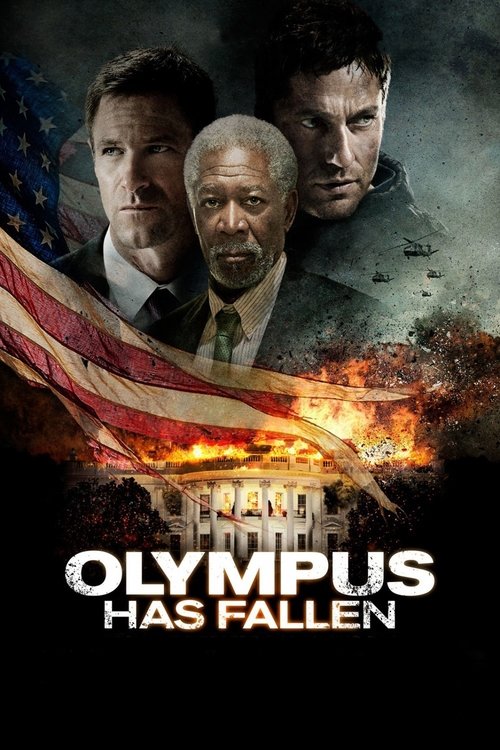



















































Popular
What motivates Mike Banning to return to the White House during the attack?
How does the character of President Benjamin Asher respond to the crisis?
What role does the character of Kang play in the plot?
How does the relationship between Mike Banning and President Asher evolve throughout the film?
What tactics does Mike Banning use to combat the terrorists inside the White House?
Should I watch it?
Ask Your Own Question

What is the plot?
Sorry, we aren't able to watch and write up a full detailed plot yet. Check back in a few days.







What is the ending?
In the ending of "Olympus Has Fallen," Mike Banning successfully rescues President Asher and defeats the terrorists. After a tense confrontation, he manages to kill the main antagonist, Kang, and prevent a catastrophic attack. The film concludes with Banning being recognized for his bravery, and he is seen reuniting with his estranged wife, Leah.
As the climax of "Olympus Has Fallen" unfolds, the tension reaches its peak within the confines of the White House, now a battleground. Mike Banning, the former Secret Service agent, has fought his way through the chaos, determined to save President Asher from the clutches of the North Korean terrorists led by the ruthless Kang.
Scene by scene, the narrative progresses as Banning, having successfully located the President, engages in a fierce struggle against Kang and his men. The atmosphere is thick with urgency and desperation. Banning's internal motivation is clear; he is driven not only by duty but also by a personal desire to redeem himself after a past failure that cost him his position in the Secret Service.
In a pivotal moment, Banning confronts Kang in the Oval Office. The room, once a symbol of power and democracy, is now a site of violence and betrayal. The two engage in a brutal hand-to-hand fight, showcasing Banning's skills and determination. As they grapple, the stakes are high; the President's life hangs in the balance, and the fate of the nation is at risk. Banning's emotional state is one of fierce resolve, fueled by the need to protect not just Asher, but the ideals he represents.
After a tense struggle, Banning gains the upper hand. He manages to overpower Kang, ultimately killing him in a decisive moment that signifies the end of the immediate threat. The camera captures Banning's face, a mix of relief and exhaustion, as he realizes he has saved the President and thwarted the terrorists' plans to detonate a bomb that would have caused mass destruction.
With Kang defeated, Banning rushes to President Asher, who is shaken but unharmed. The two share a moment of understanding and gratitude, solidifying their bond forged through adversity. Asher, recognizing Banning's bravery and skill, expresses his appreciation, acknowledging the sacrifices made to protect him and the nation.
The final scenes transition to the aftermath of the attack. The White House is in disarray, but the immediate threat has been neutralized. Banning is seen being honored for his heroism, receiving accolades from government officials and the public. His journey from a disgraced agent to a national hero is complete, showcasing his resilience and dedication.
In a poignant closing moment, Banning reunites with his estranged wife, Leah. Their embrace signifies not only personal reconciliation but also a return to normalcy after the chaos. The emotional weight of their separation is lifted, and the audience is left with a sense of hope and renewal.
As the credits roll, the fates of the main characters are clear: President Asher emerges as a leader who has faced a grave threat and survived, while Banning finds redemption and a chance to rebuild his personal life. The film concludes with a powerful message about courage, sacrifice, and the enduring strength of the human spirit in the face of overwhelming odds.
Is there a post-credit scene?
"Olympus Has Fallen," produced in 2013, does not have a post-credit scene. The film concludes with a resolution to the main conflict, focusing on the aftermath of the terrorist attack on the White House and the heroics of Mike Banning, played by Gerard Butler. After the intense climax, the film wraps up with a sense of closure, showing Banning reuniting with his estranged wife, Leah, and reflecting on the events that transpired. The absence of a post-credit scene aligns with the film's straightforward narrative, emphasizing the emotional and physical toll of the events rather than setting up for a sequel or additional storyline.
What motivates Mike Banning to return to the White House during the attack?
Mike Banning, a former Secret Service agent, is driven by a deep sense of duty and guilt over a past incident that led to the death of the President's wife. His personal connection to the President and his desire to protect him and the nation compel him to re-enter the White House during the terrorist attack.
How does the character of President Benjamin Asher respond to the crisis?
President Benjamin Asher initially tries to maintain composure and control during the attack, showing his leadership qualities. However, as the situation escalates and he is taken hostage, his vulnerability is revealed, showcasing his fear for his life and the safety of his family.
What role does the character of Kang play in the plot?
Kang is the main antagonist, a North Korean terrorist leader who orchestrates the attack on the White House. His motivations are rooted in a desire for revenge against the United States, and he is portrayed as ruthless and cunning, willing to go to extreme lengths to achieve his goals.
How does the relationship between Mike Banning and President Asher evolve throughout the film?
Initially, there is tension between Mike Banning and President Asher due to Banning's past failure. However, as the crisis unfolds, their relationship deepens, with Banning proving his loyalty and bravery, ultimately earning Asher's trust and respect as they work together to thwart the terrorists.
What tactics does Mike Banning use to combat the terrorists inside the White House?
Mike Banning employs a combination of stealth, hand-to-hand combat, and strategic thinking to outmaneuver the terrorists. He uses his knowledge of the White House layout to his advantage, setting traps and ambushing the attackers, showcasing his skills as a former Secret Service agent.
Is this family friendly?
"Olympus Has Fallen" is not considered family-friendly due to its intense action and violent themes. Here are some potentially objectionable or upsetting aspects that may affect children or sensitive viewers:
-
Graphic Violence: The film contains numerous scenes of gunfire, explosions, and hand-to-hand combat, resulting in injuries and deaths that are depicted in a realistic manner.
-
Terrorism: The central plot revolves around a terrorist attack on the White House, which may be distressing for younger viewers or those sensitive to themes of violence and fear.
-
Hostage Situations: There are tense scenes involving hostages, which can create a sense of anxiety and fear.
-
Death and Injury: Characters experience significant physical harm, and there are moments of emotional distress related to loss and sacrifice.
-
Strong Language: The film includes strong language that may not be suitable for younger audiences.
-
Intense Emotional Moments: Characters experience extreme stress, fear, and desperation, which may be unsettling for some viewers.
Overall, the film's mature themes and intense action sequences make it more appropriate for adult audiences.







