
























Popular
Should I watch it?
Ask Your Own Question

What is the plot?
The sun rises over a forgotten river, its waters glinting with a cold, ancient light. Sméagol, a young Stoor Hobbit, stands knee-deep in the current, his hands searching the riverbed. Beside him, his cousin Déagol casts a net, laughing at the morning's catch. Suddenly, Déagol gasps. His fingers close around something smooth, heavy, and golden. He pulls it from the water--a ring, pulsing with a strange, hypnotic glow. "Look, Sméagol!" he cries, holding it aloft. "I found it!"
Sméagol's eyes lock onto the ring. His breath quickens. "Give it to me," he whispers, stepping closer. Déagol shakes his head, smiling. "It's mine. I found it." Sméagol's face twists with sudden, unnatural rage. "Give it to me!" he snarls, lunging forward. The two struggle, their laughter turning to shouts, then silence. Sméagol stands alone, the ring clutched in his hand, Déagol's body sinking beneath the surface. The ring whispers to him, promising power, immortality, secrets. Sméagol vanishes into the shadows, and the world forgets him. But the ring does not.
Years pass. The ring surfaces again, found by a creature known only as Gollum, twisted by centuries of obsession and isolation. The film's present begins in the desolate wastelands of Mordor, where Frodo Baggins and Samwise Gamgee trudge through ash and ruin, guided by Gollum. Frodo's eyes are hollow, his spirit frayed by the weight of the One Ring. Sam watches him with growing concern, his loyalty unshaken. "We're close, Mr. Frodo," Sam says, his voice steady. "Just a bit further."
Gollum leads them through treacherous paths, his mind torn between his promise to serve Frodo and his desperate desire to reclaim the Ring. He whispers to himself, "We wants it, we needs it. Must have the precious." Frodo, weakened by the Ring's influence, begins to doubt Sam, manipulated by Gollum's lies. "You want it for yourself," Frodo accuses, his voice trembling. "You're trying to take it from me." Sam, heartbroken, pleads his innocence, but Frodo, consumed by paranoia, orders him to leave. "Go home, Sam," Frodo says, turning away. "I can't trust you."
Sam departs, tears streaming down his face, but he cannot abandon Frodo. He follows at a distance, watching as Gollum leads Frodo into the lair of Shelob, a monstrous spider. Shelob attacks, her venomous fangs piercing Frodo's flesh. Sam, witnessing the horror, rushes to Frodo's aid, battling Shelob with courage and desperation. He drives her back, but Frodo lies unconscious, his body limp. Sam, believing Frodo dead, takes the Ring, intending to complete the quest himself. But as he prepares to leave, Frodo stirs. Sam, overcome with relief and guilt, returns the Ring. "I'm sorry, Mr. Frodo," he says, tears in his eyes. "I couldn't let you go."
Together, they press on, their bond stronger than ever. Gollum, defeated but not broken, trails behind, his mind consumed by the Ring's call.
Meanwhile, in the city of Minas Tirith, the capital of Gondor, the air is thick with fear. Denethor, the Steward of Gondor, sits in his tower, his eyes hollow with despair. His son, Boromir, lies dead, and his other son, Faramir, is gravely wounded. Gandalf, the wizard, arrives with Pippin Took, a young Hobbit. Pippin, seeking to atone for Boromir's death, swears fealty to Denethor. "I offer you my service, Lord Denethor," Pippin says, bowing his head. Denethor, cold and distant, accepts.
Gandalf, sensing the growing darkness, urges Denethor to light the beacons of Gondor, calling for aid from Rohan. Denethor refuses, consumed by hopelessness. "The world is ending," he mutters. "There is no hope." Gandalf, determined, takes Pippin to the city's highest tower, where they watch as the beacons are lit by others, their flames spreading across the mountains. The call for help is answered.
In Rohan, King Théoden receives the signal. He gathers his army, including his niece Éowyn and nephew Éomer, and rides to Gondor's aid. "We ride to war," Théoden declares, his voice strong. "For Gondor, for Middle-earth."
Aragorn, heir to the throne of Gondor, stands at the edge of the Paths of the Dead, a haunted road leading to the cursed Army of the Dead. With him are Legolas, the Elf, and Gimli, the Dwarf. Aragorn, wielding the reforged sword Andúril, steps into the darkness. "I am Isildur's heir," he declares, his voice echoing through the mountains. "I command you to fulfill your oath." The Army of the Dead, bound by ancient curses, rises from the shadows, their ghostly forms swirling around Aragorn. "We will fight for you," their leader intones. "But only if you release us from our curse."
Aragorn agrees, and the Army of the Dead joins him, their presence a harbinger of doom for Sauron's forces.
The siege of Minas Tirith begins. Sauron's armies, led by the Witch-king of Angmar, descend upon the city. The walls tremble under the onslaught, and Denethor's madness deepens. He orders Faramir, still wounded, to lead a suicidal charge against the enemy. "Go, my son," Denethor says, his voice cold. "Prove your worth." Faramir, loyal but broken, obeys.
The battle rages. The Witch-king, a towering figure of darkness, rides through the streets, his presence striking fear into the hearts of men. Gandalf, standing atop the city's walls, rallies the defenders. "Stand, men of Gondor!" he cries. "Do not falter!"
Faramir is gravely wounded in the charge, and Denethor, believing him dead, descends into madness. He orders a pyre built, intending to burn himself and Faramir. "We will not be captured," he mutters, his eyes wild. Pippin, witnessing the horror, alerts Gandalf. Together, they rescue Faramir, but Denethor, consumed by despair, throws himself onto the pyre, his body consumed by flames.
Theoden's army arrives, charging onto the Pelennor Fields. The battle turns, but the Witch-king proves unstoppable. He mortally wounds Theoden, his blade piercing the king's heart. "The time of the kings is ended," the Witch-king sneers. But Éowyn, disguised as a man, confronts him. "I am no man," she declares, driving her sword into the Witch-king's flesh. With Merry's aid, she slays the Nazgûl, avenging her uncle.
Theoden dies in Éowyn's arms, his final words a blessing. "I go to my fathers," he whispers. "In the halls of Mandos, I shall sit with them."
Aragorn arrives with the Army of the Dead, their ghostly forms overwhelming Sauron's forces. The tide of battle turns, and Gondor is saved. Aragorn, standing amidst the carnage, declares, "I am the king. I will not forsake my people."
Frodo and Sam, guided by Gollum, reach the slopes of Mount Doom. The air is thick with smoke and ash, the ground trembling beneath their feet. Gollum, driven by madness, leads them into a trap, but Sam's vigilance saves them. They press on, their strength fading, until they stand at the Cracks of Doom.
Frodo, overwhelmed by the Ring's power, succumbs to its influence. "I have come," he whispers, holding the Ring aloft. "But I cannot destroy it." He puts the Ring on, his body vanishing from sight. Gollum, driven by desperation, attacks, biting off Frodo's finger to reclaim the Ring. In the struggle, Gollum falls into the fiery chasm, the Ring destroyed in the flames.
The Eye of Sauron vanishes, Barad-dûr collapses, and Sauron's armies scatter. The land is freed from darkness.
The surviving members of the Fellowship reunite in Minas Tirith. Aragorn is crowned King of Gondor, taking Arwen as his queen. The hobbits are honored, their courage celebrated. "All that is gold does not glitter," Aragorn says, looking at Frodo. "Not all those who wander are lost."
The hobbits return to the Shire, where Sam marries Rosie Cotton. Life resumes, but Frodo remains wounded in spirit and body. Four years later, he departs Middle-earth for the Undying Lands with Gandalf, Bilbo, and the Elves, seeking peace beyond mortal life.
The story ends with Frodo standing on the shores of the Undying Lands, the Ring's burden lifted, his spirit finally at rest.
More Movies Like This
Browse All Movies →


What is the ending?
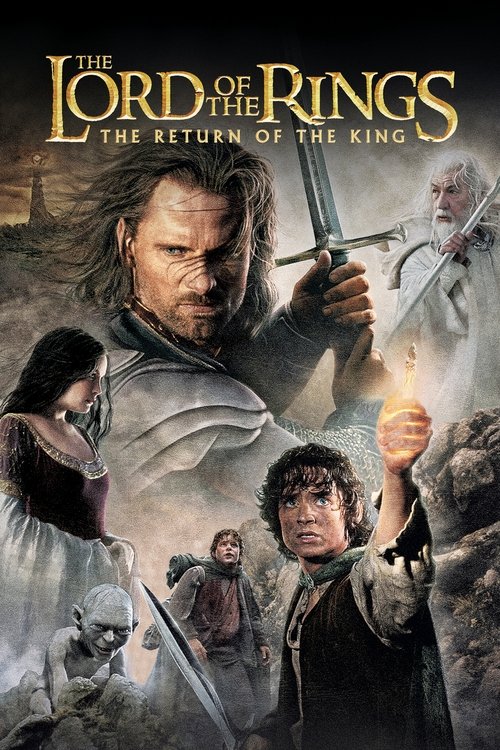
At the end of The Lord of the Rings: The Return of the King, Frodo and Sam destroy the One Ring in Mount Doom, leading to Sauron's defeat. Aragorn is crowned king, and peace is restored to Middle-earth. The hobbits return to the Shire, but Frodo struggles with his experiences and ultimately departs for the Undying Lands with Gandalf, Bilbo, and the Elves.
As the film approaches its climax, the scene shifts to Mount Doom, where Frodo Baggins and Samwise Gamgee face their final challenge. The air is thick with tension as they navigate the treacherous landscape, the fiery chasms of the volcano reflecting the turmoil within Frodo. He is weary, burdened by the weight of the One Ring, which has begun to corrupt him deeply. Sam, ever loyal, encourages Frodo, reminding him of their purpose and the hope that lies beyond their struggle.
In a moment of intense conflict, Frodo reaches the Cracks of Doom, but the Ring's power overwhelms him. He claims it for himself, putting it on and becoming invisible. Gollum, who has been following them, leaps at the chance to reclaim his "precious." In a desperate struggle, Gollum bites Frodo's finger to take the Ring, but in the chaos, he loses his balance and falls into the fiery chasm, taking the Ring with him. The Ring is destroyed, and with it, Sauron's power crumbles. The dark clouds over Mordor dissipate, and the Eye of Sauron is extinguished, signaling the end of his reign.
The scene transitions to the fields of Pelennor, where the forces of Gondor and Rohan celebrate their hard-won victory. Aragorn, now revealed as the true king, is crowned in a grand ceremony. He is joined by his loyal companions, including Legolas and Gimli, who stand by his side, proud of their achievements. The people of Gondor cheer, and the atmosphere is filled with hope and renewal. Aragorn, embodying the spirit of leadership, acknowledges the sacrifices made by his friends and the fallen.
Meanwhile, the hobbits return to the Shire, where they find their home has been marred by the effects of war. They work together to restore it, but Frodo feels a lingering emptiness. The weight of his journey has left scars that cannot be healed. In a poignant moment, he realizes that he cannot fully return to the life he once knew.
As the story draws to a close, Frodo, along with Gandalf, Bilbo, and the Elves, prepares to leave Middle-earth for the Undying Lands. The ship awaits at the Grey Havens, a symbol of peace and a new beginning. Frodo's departure is bittersweet; he bids farewell to Sam, who has been his steadfast companion throughout their journey. Sam, filled with love and gratitude, watches as Frodo sails away, understanding that his friend must find peace beyond the shores of Middle-earth.
The final scenes depict Sam returning to his family, embracing his children and finding solace in the simple joys of life. The film concludes with a sense of closure, yet it leaves a lingering reminder of the sacrifices made and the enduring bonds of friendship. Each character has found their path, and the legacy of their journey will echo through the ages.
Is there a post-credit scene?
The Lord of the Rings: The Return of the King does not have a traditional post-credit scene like many modern films. However, the film concludes with a series of poignant epilogues that serve as a reflective closure to the epic journey.
After the climactic battle at the Black Gate and the destruction of the One Ring, the film transitions to a serene scene in the Shire. Frodo, Sam, Merry, and Pippin return home, greeted by the familiar sights and sounds of their beloved homeland. The Shire is depicted in its peaceful glory, with lush green hills and vibrant gardens, symbolizing the return to normalcy after the chaos of war.
As the story progresses, we see the characters settling back into their lives. Sam marries Rosie Cotton, and they have children, showcasing the hope and renewal that follows the darkness. The camera captures the warmth of their home, filled with laughter and love, contrasting sharply with the earlier struggles.
Frodo, however, is deeply affected by his experiences. He struggles to find peace, haunted by the memories of his journey and the burden of the Ring. This internal conflict culminates in a poignant moment where Frodo decides to leave Middle-earth. He boards a ship with Gandalf, Bilbo, and the Elves, sailing to the Undying Lands. This departure is filled with bittersweet emotions, as Frodo says goodbye to his friends, particularly Sam, who is left behind with a heavy heart.
The film closes with Sam returning to his family, a symbol of hope and resilience. He looks at his children and the Shire, embodying the spirit of perseverance and the enduring power of friendship. The final shot lingers on the peaceful landscape, leaving the audience with a sense of closure and the enduring legacy of the journey they have witnessed.
While there is no post-credit scene, the ending serves as a reflective and emotional conclusion to the saga, encapsulating the themes of sacrifice, friendship, and the bittersweet nature of moving on.
What happens to Frodo and Sam during their journey to Mount Doom?
Frodo and Sam's journey to Mount Doom is fraught with peril and emotional turmoil. As they traverse the treacherous landscape of Mordor, they face exhaustion, hunger, and the overwhelming weight of the One Ring. Frodo, increasingly burdened by the Ring's corrupting influence, struggles with his sense of purpose and the fear of failure. Sam, ever loyal, provides emotional support, encouraging Frodo to keep going. Their bond is tested when Frodo, in a moment of desperation, declares that he will not share the burden of the Ring any longer, leading to a tense confrontation. Ultimately, they reach Mount Doom, where Frodo's will is nearly broken, and he claims the Ring for himself, only to be thwarted by Gollum's intervention.
How does Aragorn claim the throne of Gondor?
Aragorn's claim to the throne of Gondor is a pivotal moment in the film. After the climactic battle at the Black Gate, Aragorn reveals his lineage as the heir of Isildur. He steps forward to confront Sauron's forces, demonstrating his leadership and bravery. Following the victory, he is crowned King of Gondor in a grand ceremony, where he is presented with the crown and the sword of his ancestors. This moment is filled with emotion, as Aragorn embraces his destiny, uniting the people of Gondor and restoring hope to Middle-earth.
What role does Gollum play in the story's climax?
Gollum plays a crucial role in the climax of 'The Return of the King.' His obsession with the One Ring drives him to follow Frodo and Sam to Mount Doom. In a moment of desperation, Gollum confronts Frodo, attempting to reclaim the Ring. The struggle culminates in a fierce battle at the edge of the fiery chasm of Mount Doom. Gollum bites Frodo's finger to take the Ring, but in his ecstatic triumph, he loses his balance and falls into the lava below, destroying the Ring and himself. This act ultimately leads to the downfall of Sauron, showcasing Gollum's tragic and pivotal role in the fate of Middle-earth.
What is the significance of the Paths of the Dead?
The Paths of the Dead serve as a haunting and significant location in the film. Aragorn, Legolas, and Gimli venture into this dark, eerie realm to summon the Army of the Dead, who are bound by an oath to Isildur. The atmosphere is thick with tension and dread, as they navigate through the ghostly caverns filled with the whispers of the cursed spirits. Aragorn's courage is tested as he confronts the King of the Dead, asserting his claim to lead them. The successful summoning of the Dead Army becomes a turning point in the battle for Gondor, as they aid Aragorn in the fight against Sauron's forces, symbolizing the redemption of the cursed souls.
How does the relationship between Aragorn and Arwen develop throughout the film?
The relationship between Aragorn and Arwen is deeply emotional and central to the narrative. Throughout 'The Return of the King,' their love is tested by the looming threat of war and Aragorn's responsibilities. Arwen, portrayed with a sense of longing and determination, faces the choice of leaving Middle-earth for a mortal life or staying with Aragorn. Their connection is highlighted in poignant scenes, such as Arwen's vision of a future with Aragorn and her decision to remain in Middle-earth, despite the risks. In the end, their love triumphs as they reunite after the war, symbolizing hope and the enduring power of love amidst darkness.
Is this family friendly?
The Lord of the Rings: The Return of the King, while an epic and visually stunning film, contains several elements that may be considered objectionable or upsetting for children or sensitive viewers. Here are some aspects to be aware of:
-
Violence and Battle Scenes: The film features intense battle sequences, including large-scale conflicts with swords, arrows, and other weapons. There are graphic depictions of combat, injuries, and death.
-
Dark Themes: The overarching themes of despair, loss, and the struggle against overwhelming evil may be emotionally heavy for younger viewers. Characters face significant moral dilemmas and personal sacrifices.
-
Death and Grief: Several key characters experience death, and the emotional weight of loss is portrayed poignantly. The reactions of surviving characters can be quite intense and may evoke strong feelings.
-
Monsters and Creatures: The film includes frightening creatures, such as orcs, trolls, and the Nazgûl, which may be scary for younger audiences. The visual design of these beings is often dark and menacing.
-
Tension and Suspense: There are moments of high tension and suspense that may be distressing, particularly as characters face dire situations and threats.
-
Emotional Turmoil: Characters undergo significant emotional struggles, including fear, despair, and hopelessness, which may be difficult for sensitive viewers to process.
Overall, while the film is a masterpiece of storytelling and visual effects, it contains elements that may not be suitable for all children or sensitive individuals. Parental guidance is recommended.









