
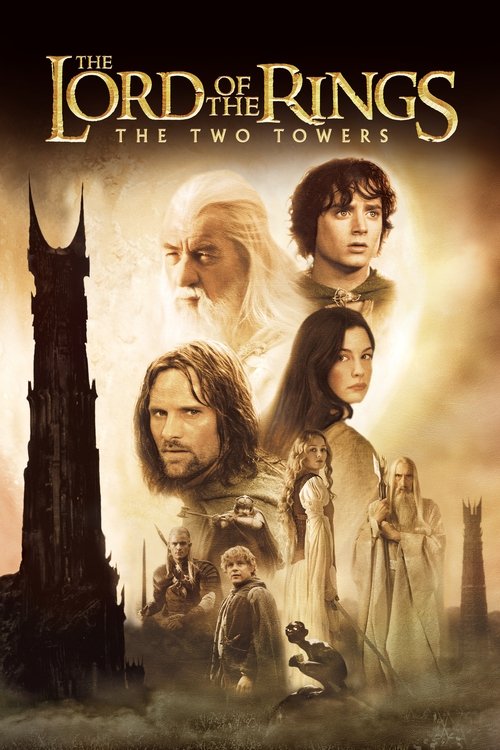

















Popular
What happens to Frodo and Sam as they journey to Mordor?
What role does Aragorn play in the battle at Helm's Deep?
How does the relationship between Legolas and Gimli develop throughout the film?
What is the significance of the Ents and their attack on Isengard?
What internal struggles does Frodo face while carrying the Ring?
Should I watch it?
Ask Your Own Question

What is the plot?
Frodo Baggins dreams of falling and fire.
In the dark he hears Gandalf the Grey's voice echo off stone: "You shall not pass!" The Bridge of Khazad‑dûm hangs over the abyss in Moria. The Balrog's whip curls, Gandalf stands against it, staff and sword blazing. The bridge breaks, the demon falls--and its whip snags Gandalf's ankle. As Frodo watches in horror, Gandalf is pulled from the bridge and plummets. But the fall does not end there; he and the Balrog plunge together, striking a black underground lake, then crashing onto a distant peak in a cavern lit by magma. Their fight continues in flame and shadow, a battle Frodo never saw but somehow now relives. Gandalf's voice fades into darkness, and suddenly Frodo jolts awake, gasping.
He is lying among knife‑edged rocks and grey ridges: the tangled maze of Emyn Muil, in the wilderness east of the River Anduin, sometime after the fall of Gandalf and the breaking of the Fellowship. There is no precise date given, but the shadow of Mordor already lies heavy across the sky. Beside him, Samwise Gamgee clambers up a ridge, muttering about how lost they are, about food, and about how "we shouldn't be here at all." The black line of the Misty Mountains is far behind; ahead, somewhere, are the iron teeth of Mordor.
They struggle through the razor ravines and blind ledges of the Emyn Muil, trying to follow a path only vaguely indicated on their memories and maps. The One Ring hangs from a chain under Frodo's shirt, heavy, an invisible gravitational pull that never loosens. Frodo's face is thinner, his eyes older. Sam worries aloud they'll run out of food before they find a way down. As the light dies, Frodo realizes something else.
They are being followed.
We see, in the distance and above, pale hands on stone and great luminous eyes: Gollum, once known as Sméagol, slipping spider‑like over the cliffs, muttering "my precious" to himself. Frodo and Sam set a watch, but Gollum comes by night, dropping out of the darkness directly onto Frodo, clawing for the Ring. Sam grapples with him and they tumble together; Gollum is faster, wirier, almost animal. Steel flashes in the moonlight as he tries to choke them both.
Sam gets an Elven rope around his neck. Together they haul Gollum down, binding his limbs and dragging the rope tight. The rope burns his skin; he thrashes and shrieks, "It burns us! It freezes!" The Elven cord glows faintly, a quiet sign of the grace that gave it. Sam wants to put an end to Gollum then and there. Frodo, remembering Gandalf's words about pity and death, refuses. "We can't do that," he says quietly. "We need him." Gollum sobs and begs, promising to serve "nice master," to show them a path into Mordor. Frodo looks at the endless stone maze around them and knows Sam is right about one thing: without guidance, they will die here.
Frodo orders Sam to loosen the rope. Gollum gasps, then straightens, rubbing his neck. For the first time we hear the name from his own mouth: "Sméagol. Sméagol will be very good, master." Frodo takes the risk and makes him their guide, over Sam's objections. The dynamic is set: Frodo, who sees in Gollum a twisted mirror of himself, extending fragile trust; Sam, deeply suspicious and fiercely protective; Gollum, divided and unstable, pulled between two selves.
While they pick their way down out of the Emyn Muil, the story cuts back in time and space across Middle‑earth.
Far to the west, under a bleak sun, three figures run across the rolling grasslands of the Riddermark, the kingdom of Rohan: Aragorn son of Arathorn, Legolas Greenleaf, and Gimli son of Glóin. It is only days after the breaking of the Fellowship at Amon Hen. They pursue a column of Uruk‑hai who have seized Meriadoc "Merry" Brandybuck and Peregrin "Pippin" Took. Their quarry is tireless and fast; the three companions run without stop for days, Gimli gasping that Dwarves are wasted on cross‑country pursuits, meant "for sprinting, not for long distances."
At the same time, we see Merry and Pippin themselves, bound hand and foot, slung like sacks over Uruk backs. The Uruk‑hai--Saruman's bred soldiers--argue with smaller Mordor orcs over food and prisoners. One suggests eating the hobbits now. Lurtz, or his surviving fellows, insist that Saruman wants them alive. Pippin, trying to think like his cousin Frodo, manages to work his hands loose enough to yank off his Elven brooch and drop it into the grass as they pass, leaving a sign Aragorn will later find.
In the north and west, the camera cuts again, this time to the ringed vale of Isengard, where Saruman the White stands upon the balcony of Orthanc. Under a sickly sky, gigantic furnaces blaze and white‑hand banners flap. Saruman has turned Isengard from a green valley into an industrial hell, burning the adjacent Fangorn Forest to fuel his forges. We see pits where the Uruk‑hai are bred in wet, obscene sacs, and lines of orcs and human wild‑men receiving armor, swords, pikes, and crude explosive devices. Saruman orders his captains to unleash war upon Rohan, to "burn every village" in the Westfold. He needs the Riddermark cleared to give room for Sauron's shadow and to crush any resistance.
Across Rohan, we see raids in progress: orcs and Dunlending men burning thatched houses, slaughtering villagers. Children flee under the hooves of horses. A small boy, bearing his father's sword, rides to Edoras, Rohan's hilltop capital, to bring word of the devastation.
In Edoras, time seems to have stopped. Inside the golden hall of Meduseld, King Théoden of Rohan sits slumped on his throne, hair white and lank, eyes clouded and unfocused. His skin is waxy, his voice cracked. The man is not old enough to be this feeble; he is being eaten from within by Saruman's will. At his side is Gríma Wormtongue, pale and slick‑haired, his whispering counselor. Through flattery and poison words--and hints of a more literal poison--Gríma has twisted the king, turning him away from his own kin. He has already contrived the banishment of Éomer son of Éomund, Théoden's nephew and marshal of the Rohirrim, for daring to oppose him.
Théoden's son, Théodred, lies dying from an orc ambush at the Fords of Isen. Éomer, furious, confronts Gríma, seizing him by the throat in front of the king. For that, Éomer is stripped of rank and exiled, sent to "gather the remaining loyal men" but forbidden to return. Éowyn, Théoden's niece, watches this with helpless anger. She cares for her uncle's withered body, her eyes blazing with a will to fight that her uncle no longer shows. Gríma's gaze slides over her with oily possessiveness, another kind of threat lurking in the hall.
As Saruman's orcs march and raze villages, Éomer gathers his Riders in the open plains, refusing to abandon his people. One night under a wind‑ripped sky, his Rohirrim surround a camp of Uruk‑hai--the very group carrying Merry and Pippin--and charge. The battle is savage and swift. Horses thunder through orc ranks, spears thrusting, swords cutting. We see orcs cleaved from horseback and crushed under hooves. All of that Uruk band die by Rohirrim steel: heads taken, chests pierced, bodies trampled. No named hero falls here, but dozens of Saruman's soldiers are cut down, their black blood staining the grass.
In the chaos, an orc tries to take Merry and Pippin as meat. Rohirrim spears him through; his body collapses, and the bound hobbits roll away into the dark edge of the forest. Here, another force awakens: Fangorn itself.
Merry and Pippin, still tied, scramble into the shadows of ancient trees. Branches creak overhead like old bones. A massive root moves; they step on what they think is a log, but it lifts them into the air. The camera tilts up to show a face in bark: Treebeard, oldest of the Ents, feeling the small weight of "little Orcs" he thinks he has caught. Pippin shouts that they're hobbits, not orcs. Treebeard frowns, considering, and decides to take them "to his house," deep in Fangorn. They are carried off, bewildered, as behind them Éomer's men stack Uruk corpses into piles and burn them, destroying the last of that pursuing band.
Out on the plains, Aragorn, Legolas, and Gimli find the smoking corpses by dawn. Aragorn searches desperately for small hobbit footprints among the dead. There are none--because Merry and Pippin fled into the woods. He discovers instead Pippin's silver Elven brooch on the ground. "They are not dead," Aragorn says. "They would not leave this behind." Hope returns.
They press on into Fangorn Forest, where the light dims and the air smells of damp earth and sap. Gimli whispers that no one who goes in ever comes out. The forest feels sentient, crowding around them. Suddenly a blinding white light flares through the trees. A figure in white stands ahead, glowing so brightly his face cannot be seen. Aragorn, Legolas, and Gimli think at once of Saruman. They draw swords and bow, Gimli spits defiance. The "white wizard" easily deflects their attacks; arrows bounce away, swords fly from hands.
Then the light dims, and the man speaks with a voice they know. It is Gandalf, but changed: Gandalf the White, robed in pure white, staff shining. He explains in simple but laden words that he fell with the Balrog, pursued it up to the mountaintop, and there finally defeated it, "casting down my enemy." Then he passed "out of thought and time" until he was "sent back" to complete his task. The death we saw in Frodo's dream was real; Gandalf died and returned. The fellowship gains its leader again, now transfigured and more powerful.
Gandalf wastes no time. He tells them the real battle is in Rohan. Saruman has poisoned the mind of Théoden; if Rohan falls, Sauron gains a gateway into the west. They ride out of Fangorn to Edoras, Gandalf borrowing a great horse, Shadowfax, lord of the Mearas, who comes at his whistle.
At Edoras, the mood is heavy. Gandalf and his companions stride toward Meduseld. Rohirrim guards try to bar them, but Aragorn convinces them to allow entry. Inside, Gríma sees Gandalf and whispers to have him disarmed. Swords are taken, but Gandalf insists his staff is part of his walking habit. Théoden sits hunched on his throne, eyes milky, skin sagging.
Gandalf steps forward and drops the pretense. "I will draw you, Saruman, as poison is drawn from a wound," he declares. Power flares from his staff. Théoden convulses; Saruman's voice speaks through his mouth, mocking Gandalf. The king's body is a battleground between two wills. In a brief vision we see Saruman thrown back in Orthanc as Gandalf drives his presence out of the king. With a final cry, Théoden collapses, then slowly straightens. The years fall from his face in a startling visual transformation; his eyes clear to bright blue. He recognizes Éowyn standing before him. She weeps as he rises unaided from the throne.
Gríma, seeing his control shattered, begs for mercy. Théoden seizes him by the throat and draws a knife, ready to kill him then and there. Aragorn intervenes. "No, my lord. Let him go." There is a brief, charged pause. Théoden relents, flinging Gríma out of the hall. Gríma stumbles down the steps of Edoras, spitting curses, and rides away to Isengard to rejoin Saruman. He is not killed here; he slinks into the next chapter of treachery.
Théoden soon must face the first brutal revelation of his restored mind. Outside Meduseld, under the sky of Rohan, he stands at the newly raised mound and white tombstone of his son, Théodred. "No parent should have to bury their child," he says, voice breaking. The camera lingers on his grief: a father waking to learn he has lost the heir he loves while he was not truly himself. This death, though it took place before Gandalf's arrival, lands on Théoden only now, fueling both his bitterness and his resolve.
Gandalf urges immediate war. Saruman is breeding an army at Isengard; Rohan must ride to meet it on the fields. Théoden, still reeling, chooses instead to gather his people and retreat to the ancient fortress of Helm's Deep, the Hornburg in the Deeping‑coomb, to protect civilians behind stone. Gandalf warns that Helm's Deep has one weakness: if Saruman knows Rohan flees there, he will send his full might against the fortress. But Théoden does not trust open battle. He chooses retreat over offensive war, and commands his people to prepare.
Outside, Éowyn brings Aragorn a sword, testing his skill, and we see the first sparks of her fascination with him. She swings fiercely; he parries gently and disarms her. She confesses her fear of "a cage," of staying behind while others ride to war. Aragorn sees both her courage and her loneliness.
As Rohan's refugees--women, children, the elderly--begin the slow march toward Helm's Deep, Sauron's gaze returns east, to the Ring.
Gollum leads Frodo and Sam down from Emyn Muil and into the Dead Marshes, a fetid bog stretching under a low, reeking mist. Corpse‑candles flicker over black water. Beneath the surface float countless pale faces: Men, Elves, and Orcs fallen in an ancient battle of the Second Age, now preserved as ghostly corpses under oily film. "Don't follow the lights," Gollum warns, in one of his rare honest pieces of guidance. Frodo, exhausted and increasingly under the Ring's spell, stares too long into the water. A dead Elven face, eyes glowing, seems to open its mouth, beckoning him. Hands reach, trying to drag him into the cold. Frodo slips and plunges beneath the surface; spectral corpses coil around him. Gollum dives in and drags him out, saving his life almost instinctively. For a moment, Sméagol's anxious care looks genuine.
Above them, shadows cross the clouds: a Nazgûl on a Fell Beast, newly winged, scouring the sky for the Ring. The shriek rips through the marsh, slicing straight into Frodo's mind. They cower under reeds as the great reptilian creature passes, its rider blind yet somehow searching, drawn to the Ring's presence. It does not find them here, but the sense of being hunted is now constant.
Back in Rohan, Saruman accelerates his preparations. He has given his Uruk‑hai a monstrous explosive: a black powder packed into a shell, to be ignited at a weak point in Helm's Deep's walls. He orders his Warg‑riding scouts to harry Théoden's refugee column.
On the trail to Helm's Deep, as twilight falls, a pack of huge, hyena‑like Wargs, ridden by orcs, sweep in from the hills. The Rohirrim form ranks; Aragorn, Legolas, and Gimli charge into the fray. We see multiple deaths here: Rohirrim soldiers torn from their saddles and ripped by Warg jaws, orcs speared through by riders, Wargs skewered or beheaded. Legolas slides down a hillside, firing arrow after arrow, killing orc after orc at range. One Warg slams Aragorn; they tumble and he is dragged, tangled in the saddle, over a cliff. He falls, striking rocks and crashing into a river far below. The others see only his fall; they believe him dead.
Refugees reach Helm's Deep with the grim news that Aragorn has fallen. Éowyn is devastated; Théoden, already convinced they are doomed, sinks further into fatalism. Gandalf, however, has seen more than one man return from the abyss. Shadows move on Aragorn's face under water; he coughs and wakes, battered but alive, pulled by the current to a bank where his horse Brego finds him and kneels to let him mount. As he rides, half‑delirious, he sees in the distance the vast army marching out of Isengard: ten thousand Uruk‑hai, an iron tide heading for Helm's Deep. This is not a skirmish; this is annihilation on the march.
Inside Helm's Deep, refugees are herded into caverns behind the main keep. Théoden surveys his warriors: only three hundred fighting men, some grey‑haired, many merely boys, farmers and old men pressed into service. He gives them swords and shaky words of encouragement. The fortress itself is a marvel of stone: a massive outer wall, the Deeping Wall, with a small culvert where water flows out, and a high keep with the horn tower, the Hornburg. The stakes are clear: if Helm's Deep falls, Rohan's people die.
Meanwhile, in Fangorn, Treebeard carries Merry and Pippin to an Entmoot, a meeting of Ents at a stone ring. The Ents, colossal walking trees with deep, booming voices, debate whether to go to war. Time for them is long; their discussion stretches, in their terms, over days, though the film compresses it. Merry, watching is frustrated. Pippin whispers they'll talk themselves out of doing anything. Treebeard initially leans toward staying out of "the affairs of Men." He does not yet know the full extent of Saruman's crimes against the forest.
As dawn brightens over Helm's Deep, Elven banners appear at the gate. Against the book's story but central in the film, Haldir of Lórien arrives at the head of a company of Elven warriors. He tells Aragorn they come on behalf of Elrond and Galadriel, riding to honor the old alliance between Men and Elves. Théoden and his men, facing extinction, are stunned and relieved. With the Elves, their defenders swell to perhaps a thousand. Haldir and his archers take positions along the Deeping Wall. Aragorn moves through the ranks, putting small boys' hands on sword hilts, telling them where to stand, how to survive.
Aragorn keeps one thing close in his heart: Arwen Undómiel. In Rivendell, in flashback, we see her and Aragorn together: Arwen placing her hand on the Evenstar pendant at his throat, promising to stay with him, to face a mortal life and death for his sake. Elrond Half‑elven, her father, tries to dissuade her. He tells her Aragorn will one day grow old and die, and if she stays, she will not die with him; she will remain immortal, unchanging, doomed to fade in a world where everyone she loves is gone. In scenes suffused with cold blue light, Elrond convinces her to join the Elves leaving Middle‑earth for the Grey Havens and the Undying Lands. The film's timeline implies that by the time of Helm's Deep, she has already turned back from that decision and chosen to stay, but Elrond, believing otherwise, tells Aragorn later that she is sailing West. For now, Aragorn only has memory: a past full of hope and a future clouded in uncertainty.
Night falls. Rain lashes the stones of Helm's Deep. On the slopes above the Deeping‑coomb, torches appear--first a few, then a forest. Saruman's army forms in lines: Uruk‑hai with pikes and shields, berserkers, ladders, a squad carrying the black powder charge. Thunder rolls as they stamp their weapons. The defenders of Helm's Deep look down into a sea of death.
A single Uruk steps forward toward the wall, roaring. An archer on the wall accidentally looses early; the arrow strikes the Uruk, killing him. He falls, and like a dropped match in dry grass, the entire host surges forward. Arrows rain from Elf and Man alike, cutting down dozens of Uruks as they charge. Several Uruk‑hai die pierced through the throat or eye, tumbling into the mud. But numbers tell: ladders slam against the wall, grappling hooks catch, and Uruk‑hai begin to climb.
On the parapet, Legolas and Gimli compete in friendly rivalry, counting their kills: fourteen, fifteen, seventeen. Legolas fires with supernatural speed; Gimli hews Uruk‑hai in brutal chops, sending them tumbling from the walls. Many nameless Uruk‑hai die by their blades here, skulls split, limbs severed. Helm's Deep becomes a charnel house of orc blood.
Down by the culvert, the key tactical move unfolds. Saruman's special explosive is carried in a siege shell and shoved into the drain's recess by two orcs, who die moments later under arrows and spear thrusts. Their sacrifice is the first death in this prong of the assault. A monstrous Uruk berserker, bearing a blazing torch, sprints toward the culvert. Aragorn sees the danger and screams in Sindarin for Legolas to "kill him!" Legolas shoots; arrows sink into the berserker's chest, but he does not fall. He dives into the culvert with the torch, directly onto the powder. A heartbeat later, the world becomes white flame.
The explosion rips a jagged crater in the Deeping Wall, stones blasting outward, flinging both Rohirrim and Elves into the air. Those nearest the blast--dozens of defenders and Uruk‑hai--die instantly, torn apart by fire and shrapnel. The sudden detonation is a turning point: Saruman's technology has shattered a wall thought unbreachable. Uruk‑hai pour through the smoking breach, flooding into the Deeping‑coomb interior. Aragorn and others rush to meet them below, fighting hand‑to‑hand in a narrow killing ground. More defenders fall; more Uruks die in brutal close‑quarters combat. In the melee on the wall, Haldir leads his archers to hold the line, but the pressure is too great. He kills many Uruk‑hai, blades cutting them down at the wall‑top. An Uruk sword slams into him from behind; he staggers, slays another, then is struck again. We watch as Haldir, Elf of Lórien, falls backward, eyes widening, and dies in Aragorn's arms. His death is the major named loss on the defenders' side in this battle, a visual symbol of Elven sacrifice and the fading of their power.
As Helm's Deep buckles under attack, the film returns to the smaller but equally pivotal struggle of Frodo, Sam, and Gollum.
Beyond the Dead Marshes, they reach a crag overlooking the Black Gate of Mordor, the Morannon. The sky is a storm of ash; a giant gate between fanged towers guards the only obvious entry. They watch a column of Easterling soldiers march toward the gate, cloaked and masked, heavily armed. Siege trolls haul the great doors closed behind them. Sam, thinking in straight lines, urges Frodo to make a run for it and slip through while the gate opens. They nearly do, but an approaching patrol forces them back into hiding. It is there that Gollum panics. He reveals there is "another way," a secret path he knows that does not go through the Black Gate. This revelation--that the direct approach is impossible, and that Gollum holds knowledge of a hidden route--changes their entire journey.
They turn south instead, following Gollum toward Ithilien, the green land bordering Mordor on the western side of the Anduin. Here, the war touches yet another front. Hidden among the woods is a company of Gondorian rangers, led by Faramir, younger brother of Boromir and son of the Steward Denethor II of Gondor. Faramir's men ambush a column of Haradrim marching with a giant Mûmakil (or oliphaunt): a tower‑backed war elephant. Arrows fly, Haradrim die pierced through; some tumble from the beast's harness. Gondorian blades cut down others on the ground. The Mûmakil itself, terrified, rampages and is driven off. In this skirmish many Haradrim fall to Faramir's rangers; several Gondorians also die, cut down by spears or crushed by the staggering beast. Exact names are not given, but the battle is lethal on both sides.
Frodo, Sam, and Gollum watch this from behind a bush, trying to stay unnoticed. Gollum is captured first, dragged screaming from a pool where he was catching fish--"the forbidden pool"--a sacred or militarily sensitive spot near the rangers' hideout. Frodo and Sam are seized soon after, pressed against walls with swords to their throats. Faramir appears, dark‑haired, serious, haunted by his brother's shadow. He interrogates them, learning they are hobbits from the Shire, that they traveled with Boromir. Frodo realizes with a sick twist that this man is Boromir's kin; he sees Boromir's face in Faramir's and flinches.
At this point only the audience and Sam fully know that Boromir died trying to take the Ring. Frodo, worn and quiet, reveals only that Boromir is dead. Faramir's grief is contained but deep. When he eventually learns from Sam's outburst that Boromir tried to seize the Ring and fell to orc arrows, he understands how the Ring corrupts. For now, he is drawn to the power it represents. Once he realizes Frodo carries the One Ring, he decides to take them not back to Ithilien's refuge but east, to Osgiliath, the ruined river‑city where Gondor fights a losing holding action against Sauron's forces.
Faramir hopes to present the Ring to his father, Denethor, and win his approval at last. This decision--unlike the book's nobler Faramir--creates another mortal confrontation between duty and desire. He is not evil; he is desperate for validation and blind to the cost of using such a weapon.
Back at Helm's Deep, the defenders are pushed back step by bloody step. The Deeping Wall is lost; the Glittering Caves behind the Hornburg fill with screaming civilians as orcs batter at doors. Théoden, inside the keep, sees his people's doom approaching. "So much death," he says. "What can men do against such reckless hate?"
Aragorn refuses despair. He remembers Gandalf's parting words before the wizard rode from Edoras: "Look to my coming at first light on the fifth day. At dawn, look to the east." He urges Théoden to ride out with him and cut a path through the enemy, to die with honor if they must. Théoden, moved, agrees. They clad themselves in armor, ride to the gate, and lower the drawbridge one final time. Gimli climbs the tower and blows the great horn of Helm Hammerhand, its booming note echoing through the Deep.
At first light--the fifth day since Gandalf left--Aragorn and Théoden ride forth from the keep with a small company of Rohirrim, spears leveled, into a packed mass of Uruk‑hai. The camera pulls back to show how hopeless this charge is: a handful of horsemen descending into thousands. Below, many Uruk‑hai die beneath hooves and swords in those first seconds, but sheer weight of numbers threatens to swallow the riders.
Then the sun's rim crests the ridge to the east, and it blinds for a moment. On the hilltop stands Gandalf the White, joined by Éomer and the Rohirrim he has rallied since his exile. "Helm's Deep has one weakness," Gandalf had said--but also one strength: allies. The Rohirrim c*** their spears and charge down the steep slope in parallel with Théoden's sally. As they descend, the light grows, flaring bright behind them. The impact at the foot of the hill is like a hammer into clay: horses slam into dense orc lines, impaling Uruks on lances, knocking them aside. Many Uruk‑hai die in this charge; those not speared are crushed under hooves or cut down by Rohirrim blades.
Panic seizes Saruman's army. They break and run, fleeing into the dark trees of Fangorn Forest that loom just behind Helm's Deep's outer dike. Those trees are not passive. Earlier, Gandalf hinted that the forest itself is angry. Now, as the surviving Uruk‑hai pour into the woods, the trees close ranks. Branches move like arms; trunks shift. We do not see individual deaths in detail, but the implication is clear and chilling: the forest devours them. The Uruk‑hai who enter Fangorn do not come out. Saruman's host at Helm's Deep is destroyed almost to the last soldier by Rohirrim steel and Ent‑driven wrath.
Up on the battlements, Gandalf stands with Aragorn, Legolas, Gimli, and Théoden. They look out over a field of dead Uruk‑hai, now silent in the bright morning. Gandalf speaks words that define the moment: the battle of Helm's Deep is won, but the war for Middle‑earth is only beginning. Saruman has lost his immediate hammer‑blow against Rohan, but Sauron will respond.
That same night--or very close in time--another war reaches a second climax at Isengard.
Treebeard, after the Entmoot, at first announces that the Ents have decided not to get involved. Merry is furious; Pippin is sad. But Pippin, more cunning than he appears, asks Treebeard to take them south, toward the forest's edge "which used to be" there. Treebeard walks to a rise and suddenly stops. Before him lies a charred wasteland: stumps, smoking pits, miles of forest burned and felled to feed Saruman's furnaces. Treebeard's booming voice breaks with grief and rage. "Many of these trees were my friends," he says. "They had voices of their own." That revelation changes everything. He roars out a call, and Ents emerge from all directions, marching toward Isengard. The Entmoot's decision, long delayed, is finally made: war.
They come by daylight, a host of living trees walking with thunderous steps. As they reach Isengard's ringwall, orcs and laborers attempt a defense, firing arrows and launching missiles. The Ents wade through them, hardly slowed. One Ent is set alight by burning oil or a missile; he flails, screaming in rustling agony. Another Ent rushes to the aqueduct, smashes the stone, and douses him in the released water, quenching the fire. Orcs die crushed beneath Ent feet, hurled by branch‑arms into walls, or buried under falling masonry. There is a brutal satisfaction in watching Saruman's forces--who have killed so many Men and trees--now themselves killed en masse by the very forest they tried to consume.
Treebeard and others tear at the dam that has been holding back the river. The masonry cracks, then gives way; a great torrent roars down through Isengard's industrial pits, smashing furnaces, drowning fire and orc alike. Many orcs die here by drowning, swept helplessly into churning water amid twisted iron and stone. Saruman watches from the pinnacle of Orthanc as his machines drown. The black tower itself cannot be broken by Ent strength, but everything around it is laid waste. Isengard becomes a flooded crater, Orthanc an island in a lake, Saruman besieged and contained but not yet killed.
And atop the wreckage, in one of the film's few purely light moments, Merry and Pippin sit on the rubble outside the tower, breaking into Saruman's storerooms for food and pipeweed. They laugh, toss down barrels, and drink ale as the Ents stand guard over the drowned forges. War's outcome is not comic, but their hobbit resilience adds a necessary note of survival.
Back east, Faramir leads Frodo, Sam, and a beaten, traumatized Gollum into the shattered streets of Osgiliath, the ruined city straddling the Anduin River. The place is a skeleton of Gondor's former glory: crumbling arches, a half‑fallen bridge, garrisoned by too few men under constant assault from Mordor's forces. Faramir plans to hold this ruin as long as possible. He also now knows, from overheard words at the forbidden pool and from Frodo's reactions, that his captive bears the One Ring. This object, the very engine driving Sauron's war, sits on a chain around a halfling's neck in his care.
This knowledge brings him to a moral crossroads. He could send the Ring to Minas Tirith, to Denethor, and perhaps turn the tide of war--at least so he imagines. Or he could honor Frodo's mission and let it go east. His first instinct is the former.
But outside Osgiliath's broken walls, a darker force is already moving. As Faramir's men brace for another assault, the sky blackens. The Nazgûl come, mounted on Fell Beasts, leading a new attack by orcs across the ruined spans. Osgiliath erupts in battle: Gondorian soldiers fall to orc arrows, are cut down by scimitars, or dragged screaming from parapets. Orcs die in turn, felled by sword and spear. In the midst of this, one Fell Beast swoops low over the city, its Nazgûl rider suddenly sensing something: the Ring is here.
The creature circles and dives. Frodo, already frayed, feels its call inside his skull like a hook. The Ring on his chest grows heavier, more insistent. In a trance, he walks away from Sam and Faramir's men, up a broken stairway toward an exposed parapet. The Nazgûl swoops in, its shriek piercing. Frodo climbs, step after step, eyes empty. At the top, on a narrow stone ledge, he lifts the Ring toward the sky, ready to put it on and deliver it directly into the Wraith's hand.
Sam reaches him just in time, tackling him. They tumble. Frodo, in a panic and half‑enslaved by the Ring, turns his blade on Sam, pressing Sting to his friend's throat. Sam, tears in his eyes, begs him to remember who he is. Recognition returns to Frodo's face; he drops the sword, horrified. Below, Gondorian archers and Faramir's men fire on the Nazgûl; the Fell Beast shies away, injured, and retreats. The immediate threat passes, but all have seen how close Frodo came to surrendering everything.
In the aftermath, Frodo collapses, whispering that he cannot do this, that the Ring is too heavy. Sam, who has carried him step by step, now carries him with words. Sitting amid the ruins of Osgiliath, as orc corpses lie nearby and Gondor's men listen, Sam speaks:
"It's like in the great stories, Mr. Frodo. The ones that really mattered…" He speaks of darkness and how those stories had chances to turn back but did not. He says, "There's some good in this world, Mr. Frodo… and it's worth fighting for." His speech is not just comfort; it is a counter‑spell against despair, heard not only by Frodo but by Faramir and the soldiers around them. Faramir sees, perhaps for the first time, the true nature of Frodo's burden and the Ring's corrosive pull.
This is Faramir's turning point. He understands now that to take the Ring to Minas Tirith would not save Gondor; it would destroy it. He orders his men to cease preparations to send the hobbits west. Instead, he takes Frodo and Sam aside and releases them. He also frees Gollum from the sack and rope where he has been beaten and interrogated. Faramir's men had nearly killed Gollum at the forbidden pool earlier; they struck him, put a hood over his head, dragged him roughly. Frodo had lured Gollum from the water with promises of safety so that Faramir's archers could capture him, a betrayal Gollum will not forget.
Faramir tells them he cannot help them more; he must remain to defend Gondor. He acknowledges Boromir's fall and contrasts his own choice now with his brother's failure. In choosing to let the Ring go, he redeems, in part, his family's line. He warns Frodo that Osgiliath will not hold; Mordor's full strength has not yet even been unleashed. Then he opens the way east. The crucial decision is made: Gondor will not seize the Ring; the quest can continue.
Gollum watches all this with increasingly fractured eyes. After the company leaves Osgiliath and climbs into the rough lands leading toward Mordor's western mountains, he slinks behind Frodo and Sam, talking to himself. We are brought inside his mind more clearly than ever: two voices, Sméagol and Gollum, argue. Sméagol claims "Master" (Frodo) cares, that they swore an oath on the Ring to serve him. Gollum snarls that Master betrayed them, let "the Men" hurt them, tricked them at the pool. The scene is half dark comedy, half psychological horror, as the camera cuts from one side of Gollum's face to the other with each persona.
At first, earlier in the film, Sméagol had "banished" Gollum and pledged to be "good," touched by Frodo's pity. Now, after Faramir's men beat and threatened him, and after Frodo's role in luring him in, that fragile trust shatters. The Gollum persona wins. "We'll takes the precious," he hisses. "We'll takes them to her." The "her" is not named in the film, but Gollum speaks of a secret path through Cirith Ungol, a way past the Black Gate, and hints of a monstrous "she" who dwells there. The audience familiar with the books knows this is Shelob, the giant spider; for film‑only viewers, it is ominous foreshadowing. Either way, the meaning is clear: he will lead Frodo and Sam into a trap, let "her" kill them, and take the Ring from their corpses.
This is the final internal confrontation in the film: Sméagol's better nature strangled by Gollum's bitterness and obsession. No one dies in this scene, but a potential for redemption does.
Elsewhere, the various threads approach their temporary resolutions.
At Helm's Deep, corpses of Uruk‑hai lie piled, dead by sword, arrow, falling stone, and Ent vengeance. Rohirrim and Elves have also died in their hundreds. We saw Haldir fall specifically; many unnamed Rohirrim--a boy who bragged of his first sword, grey‑haired veterans--now lie still. The cost of victory is high, but the fortress stands. Gandalf tells Théoden to ride out and reclaim the lands, warning that Sauron will not rest. Théoden, now fully a king again, resolves to fight rather than hide.
At Isengard, water laps at the black base of Orthanc. The machinery of Saruman's war is ruined. Orcs that were not crushed or drowned when the dam broke have fled and been hunted by the Ents. Saruman and Gríma Wormtongue are trapped in the tower, effectively neutralized. The Palantír, Sauron's seeing‑stone, glows somewhere within, connecting Saruman still to greater darkness, but this film does not yet show it being used. Merry and Pippin, high on newfound independence and stolen food, joke about salted pork and second breakfasts, oblivious to the cosmic stakes just for a moment.
In Rivendell, Elrond has made his choice to send Arwen away, convinced there is no future for Men that is not shadow and ruin. In some versions of the scene, he tells Aragorn he will not return from the war, trying to push his daughter toward the West. Arwen, in turn, is shown in vision choosing otherwise, but the present‑tense action of The Two Towers ends before those choices fully play out. For now, Aragorn carries only the weight of an uncertain love and the hint of a destiny: to claim the throne of Gondor.
The very last images of the film intercut between three points.
On the flooded plain of Isengard, Treebeard stands guard with other Ents as Orthanc juts from the waters like a black tooth. Merry and Pippin lounge among barrels and crates, eating, smoking, and commenting on the ridiculousness of war and the excellence of Saruman's supplies. Their innocence is not entirely intact, but their ability to find comfort in small pleasures remains.
On the high ramparts and fields around Helm's Deep, Gandalf, Aragorn, Legolas, Gimli, Théoden, and Éomer look out toward the plains of Rohan under clean daylight. The sky is finally clear here. Gandalf's words linger: victory in the west, yet the great Eye in the east is only now beginning to move. Rohan has survived, but Sauron's wrath will fall hardest elsewhere--on Gondor, on Minas Tirith, and, most crucially, on two small hobbits walking into the shadow.
And on a rocky path in the crags near Cirith Ungol, Frodo Baggins and Samwise Gamgee trudge behind Gollum, drawing ever closer to Mordor. There are no dates on the screen; time is measured in miles and in the deepening hollows under their eyes. Sam still believes--perhaps stubbornly, perhaps rightly--that there is "some good in this world" and that they can preserve it. Frodo is gaunter, more haunted, but he presses on. The Ring still hangs on its chain, still whispers, but his hand does not yet lift it to his finger.
Behind them, in the shadows of boulders, Gollum pauses, eyes glittering. In a low voice not meant for hobbit ears, he confirms his plan with himself: "We'll lead them to her… to the tunnel. Then we'll take it once they're dead." Sméagol's brief moment of loyalty is gone; Gollum's treachery is ascendant.
The camera pulls back. Ahead lies a sky bruised with the fumes of Mordor, the stark outline of Mount Doom just a suggestion against cloud. Behind, the lands of Men smolder, preparing for the next phase of war. The film ends here, on this dual note: the apparent defeat of Saruman and the rescue of Rohan, and the quiet, terrible knowledge that the greater enemy, Sauron, still waits--and that the guide on whom Frodo now depends has chosen to betray him. Everyone important to the story is alive or dead in the positions needed for the final act: Gandalf the White reborn and victorious in the West; Théoden king again; Éomer restored; Merry and Pippin safe but changed; Faramir morally tested and proven; Saruman contained but breathing; and Frodo and Sam, still living, walking steadily into danger with the One Ring still unclaimed--but one treacherous companion already plotting how to take it.
More Movies Like This
Browse All Movies →

What is the ending?
At the end of The Lord of the Rings: The Two Towers, the story culminates in a fierce battle at Helm's Deep, where the forces of Rohan, led by King Théoden, defend against Saruman's army of Uruk-hai. Aragorn, Legolas, and Gimli join the fight, while Frodo and Sam continue their journey towards Mordor, guided by Gollum. The film concludes with the hope of the Fellowship still alive, despite the overwhelming odds they face.
As the battle at Helm's Deep unfolds, the night is filled with the sounds of clashing swords and the cries of warriors. The people of Rohan, led by King Théoden, prepare for the onslaught of Saruman's Uruk-hai. The atmosphere is tense, with fear and determination etched on the faces of the defenders. Aragorn, Legolas, and Gimli stand resolute, ready to fight for their lives and the future of Middle-earth.
As dawn breaks, the Uruk-hai launch their attack, and the defenders of Helm's Deep brace themselves. The battle is chaotic, with arrows flying and swords clashing. The camera captures the desperation of the Rohan soldiers as they fight valiantly against overwhelming numbers. King Théoden rallies his men, urging them to hold the line, while Aragorn leads a charge to protect the walls. The emotional weight of the battle is palpable, as each character fights not just for survival, but for hope and freedom.
In a pivotal moment, as the situation grows dire, Gandalf arrives with the Riders of Rohan, led by Éomer. Their timely intervention turns the tide of battle, and the Uruk-hai are driven back. The sight of Gandalf, radiant and powerful, inspires the defenders, and they rally to push the enemy away from Helm's Deep. The victory is hard-won, but it ignites a spark of hope in the hearts of the people of Rohan.
Meanwhile, Frodo and Sam's journey takes a darker turn as they navigate the treacherous terrain of Mordor. Gollum, who has been guiding them, reveals his dual nature--both a guide and a threat. As they approach Mount Doom, Frodo struggles with the burden of the Ring, feeling its corrupting influence. The internal conflict within Frodo intensifies, showcasing his vulnerability and the weight of his quest.
The film concludes with Frodo and Sam standing at the edge of Mount Doom, looking into the fiery chasm where the Ring must be destroyed. The emotional toll of their journey is evident on Frodo's face, as he grapples with the Ring's power and his own resolve. The final scene leaves the audience with a sense of uncertainty and anticipation, as the fate of Middle-earth hangs in the balance.
In summary, the ending of The Two Towers encapsulates the themes of hope, sacrifice, and the struggle against darkness. Each character faces their own challenges, with Aragorn, Legolas, and Gimli emerging as heroes in the battle, while Frodo and Sam's journey continues, fraught with peril and moral dilemmas. The film closes with a sense of impending conflict, setting the stage for the final confrontation in the saga.
Is there a post-credit scene?
The Lord of the Rings: The Two Towers, produced in 2002, does not have a post-credit scene. The film concludes with a powerful and emotional climax, focusing on the fates of the main characters and setting the stage for the final installment of the trilogy. After the credits roll, there are no additional scenes or content that follow. The film ends with a sense of urgency and anticipation for the next chapter in the saga, leaving viewers with the weight of the characters' struggles and the looming threat of Sauron.
What happens to Frodo and Sam as they journey to Mordor?
Frodo and Sam, having left the Fellowship, continue their perilous journey towards Mordor to destroy the One Ring. They encounter Gollum, who becomes their guide. Initially, Frodo is wary of Gollum, but he also sees a glimmer of the creature's former self. As they travel, they face numerous challenges, including the treacherous terrain and Gollum's internal conflict between his loyalty to Frodo and his desire for the Ring. The emotional tension builds as Frodo struggles with the burden of the Ring and the growing influence it has over him.
What role does Aragorn play in the battle at Helm's Deep?
Aragorn emerges as a leader during the Battle of Helm's Deep, rallying the men of Rohan to defend against Saruman's forces. He displays bravery and tactical acumen, inspiring hope among the weary defenders. As the battle rages, he fights valiantly alongside Legolas and Gimli, showcasing his skills with both sword and bow. His internal conflict is palpable as he grapples with his destiny and the weight of leadership, especially when faced with overwhelming odds.
How does the relationship between Legolas and Gimli develop throughout the film?
Legolas and Gimli's relationship evolves from initial rivalry to a deepening friendship. Their banter provides comic relief amidst the darkness of war, but it also highlights their growing respect for one another. As they fight side by side at Helm's Deep, they begin to appreciate each other's strengths--Legolas's agility and keen eyesight complementing Gimli's strength and resilience. Their camaraderie culminates in a moment of mutual admiration when they agree to count their kills, showcasing their competitive yet supportive bond.
What is the significance of the Ents and their attack on Isengard?
The Ents, led by Treebeard, play a crucial role in the fight against Saruman. Initially slow to act, they are spurred into action by Merry and Pippin, who help them realize the urgency of the threat posed by Saruman's deforestation and industrialization. The Ents' attack on Isengard is a powerful moment, symbolizing nature's wrath against the destruction wrought by Saruman. The visual spectacle of the Ents marching and the subsequent flooding of Isengard showcases their strength and determination, marking a turning point in the war against Saruman.
What internal struggles does Frodo face while carrying the Ring?
Throughout 'The Two Towers', Frodo grapples with the immense burden of the One Ring. As they journey towards Mordor, the Ring's corrupting influence begins to weigh heavily on him, causing paranoia and distrust, especially towards Gollum. Frodo's internal struggle is marked by moments of doubt and fear, as he questions his ability to resist the Ring's power. His relationship with Sam becomes strained as he tries to shoulder the burden alone, reflecting his growing isolation and the emotional toll of their quest.
Is this family friendly?
The Lord of the Rings: The Two Towers contains several scenes and themes that may be considered objectionable or upsetting for children or sensitive viewers. Here are some aspects to be aware of:
-
Violence and Battle Scenes: The film features intense battle sequences, including large-scale conflicts with swords, arrows, and other weapons. Characters are shown fighting, and there are moments of injury and death.
-
Dark Creatures: The presence of menacing creatures, such as orcs and the monstrous spider Shelob, can be frightening. Their appearances are often accompanied by suspenseful music and tense situations.
-
Death and Loss: Themes of loss are prevalent, with characters mourning the deaths of friends and allies. This can evoke strong emotions and may be distressing for younger viewers.
-
Tension and Fear: Several scenes create a sense of dread and fear, particularly those involving the Ringwraiths and the treacherous journey through dark landscapes.
-
Emotional Struggles: Characters experience significant internal conflict, including moments of despair, temptation, and moral dilemmas, which may be complex for younger audiences to understand.
-
Mature Themes: The film explores themes of power, corruption, and sacrifice, which may be heavy for children to grasp fully.
Overall, while The Two Towers is an epic fantasy film with rich storytelling, it contains elements that may not be suitable for all children or sensitive viewers. Parental guidance is recommended.









