






Popular
What motivates Guts to continue fighting despite his overwhelming struggles?
How does Griffith's transformation into Femto affect his relationship with Guts?
What role does Casca play in Guts' journey throughout the series?
How does the Band of the Hawk's fate during the Eclipse shape the story's events?
What is the significance of the Brand of Sacrifice on Guts and its impact on his journey?
Should I watch it?
Ask Your Own Question

What is the plot?
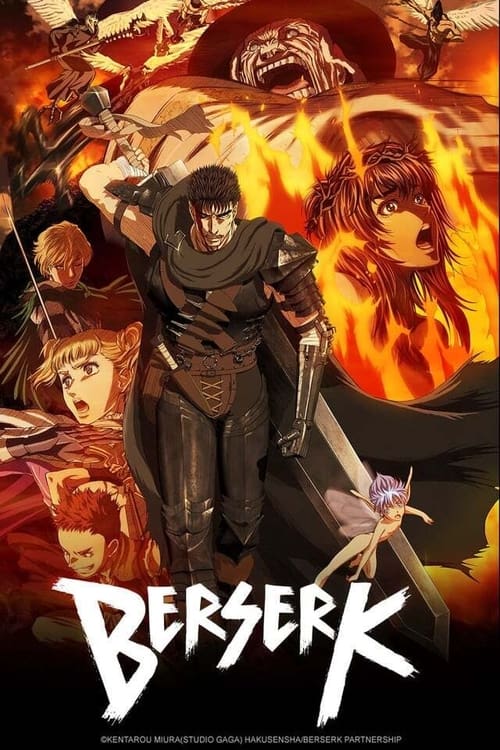
The story begins with Guts, the Black Swordsman, traveling through a dark and desolate landscape, haunted by his past and pursued by demonic entities known as Apostles. He is heavily scarred, both physically and emotionally, carrying the massive Dragon Slayer sword on his back. Guts is driven by a desire for revenge against Griffith, the former leader of the Band of the Hawk, who betrayed him and sacrificed their comrades to become a member of the God Hand.
Guts encounters a group of bandits led by a man named Gambino. After a brutal confrontation, Guts is forced to fight for his life. He displays incredible skill and ferocity, but the bandits are relentless. During the fight, Guts is injured, and Gambino, who has a personal vendetta against him, attempts to kill him. Guts manages to escape, but not without suffering deep emotional scars from his past experiences.
As Guts continues his journey, he meets Puck, a small elf who becomes his companion. Puck provides comic relief and a contrasting perspective to Guts' grim demeanor. They travel together, facing various monsters and challenges, and Puck tries to lighten Guts' heavy heart. Guts, however, remains focused on his quest for vengeance, often pushing Puck away emotionally.
The narrative shifts to Griffith, who is now a powerful figure known as Femto, having ascended to the rank of a God Hand member. He is shown manipulating events from the shadows, gathering followers and building an army. His charisma and ambition draw people to him, including a new group of mercenaries who are unaware of his dark past. Griffith's motivations are revealed to be driven by a desire for power and a vision of a new world.
Guts and Puck arrive at a town where they encounter a group of mercenaries led by a man named Serpico. The mercenaries are initially hostile, but Guts proves his strength in battle, earning their respect. However, Guts is still haunted by visions of his past, particularly the memories of his time with the Band of the Hawk and the betrayal he suffered at Griffith's hands.
As Guts continues to confront his demons, he faces off against various Apostles, each battle revealing more about the dark forces at play. He fights against a powerful Apostle named Zodd, who tests Guts' strength and determination. The battle is intense, with Guts using all his skills and the Dragon Slayer to fend off Zodd's overwhelming power. Despite the odds, Guts manages to hold his ground, showcasing his relentless spirit.
During his journey, Guts encounters Casca, his former lover and a key member of the Band of the Hawk. Casca is now traumatized and mentally unstable due to the events of the Eclipse, where Griffith sacrificed their comrades. Guts is determined to protect her, but he struggles with the emotional weight of their shared past. Their relationship is strained, as Guts grapples with his desire for revenge and his need to care for Casca.
The story progresses as Guts and his companions face off against the forces of Griffith, who is now actively seeking to expand his influence. Guts' internal conflict deepens as he must choose between his quest for vengeance and the responsibility he feels towards Casca and his new allies. The tension builds as they prepare for an inevitable confrontation with Griffith and the God Hand.
In a climactic battle, Guts and his allies confront Griffith's forces. The fight is chaotic, with Guts showcasing his incredible combat skills against overwhelming odds. He fights fiercely, driven by rage and a desire to protect those he cares about. The battle is filled with visceral action, showcasing the brutality of the world they inhabit.
As the dust settles, Guts faces Griffith directly. The confrontation is emotionally charged, with Guts expressing his anger and betrayal. Griffith, now fully embodying his role as Femto, taunts Guts, revealing the depth of his ambition and the sacrifices he has made. The encounter leaves Guts more determined than ever to continue his fight against the darkness that has consumed his life.
The series concludes with Guts and his companions continuing their journey, facing the challenges that lie ahead. Guts remains a tormented figure, driven by his past but also finding a glimmer of hope in his relationships with Puck and Casca. The story leaves open the possibility of further conflict and exploration of Guts' struggle against the forces of fate and his own inner demons.
More TV Shows Like This
Browse All TV Shows →


What is the ending?
In the ending of the 2016 anime adaptation of Berserk, Guts confronts Griffith, who has now become the Hawk of Light and is leading a new band of followers. The story culminates in a battle where Guts fights against Griffith's forces, but ultimately, he is unable to save his friends. The series concludes with Guts continuing his struggle against fate, while Griffith's ambitions grow ever more powerful.
As the final episodes unfold, the atmosphere is thick with tension and despair. The scene opens with Guts, the Black Swordsman, standing amidst the ruins of a battlefield, his massive sword, Dragonslayer, resting heavily on his shoulder. The air is filled with the echoes of clashing steel and the cries of the fallen. Guts is driven by a singular purpose: to confront Griffith, the man who betrayed him and his comrades.
In the next scene, we see Griffith, now transformed into the Hawk of Light, surrounded by his new followers, the Band of the Hawk. He stands atop a hill, radiating an almost divine aura, his presence commanding and unsettling. Griffith's ambition is palpable; he seeks to reshape the world according to his vision, and he is willing to sacrifice anything and anyone to achieve it.
As Guts makes his way through the chaos, he is haunted by memories of his past, particularly of his fallen comrades from the Band of the Hawk. Each flashback serves as a reminder of the bonds he once shared and the betrayal that shattered them. His internal struggle is evident; he is torn between his desire for vengeance and the lingering hope of saving those he loves.
The confrontation between Guts and Griffith is inevitable. In a climactic battle, Guts faces off against Griffith's forces, showcasing his incredible skill and determination. The fight is brutal, with Guts unleashing his fury against the soldiers who now serve the man he once called a friend. However, despite his strength and resolve, Guts is outnumbered and overwhelmed.
As the battle rages on, we see the emotional toll it takes on Guts. He fights not just for revenge but also to protect the memories of his fallen friends. The weight of his past is a constant reminder of what he has lost, and it fuels his rage. Yet, even as he fights valiantly, the futility of his struggle becomes apparent.
In a pivotal moment, Griffith descends from the sky, embodying his new role as a god-like figure. He confronts Guts, and their exchange is charged with the history of their relationship. Griffith's cold demeanor contrasts sharply with Guts' raw emotion. Guts, filled with rage and sorrow, realizes that he cannot change what has happened, nor can he save those who have been lost.
The final scenes depict Guts' retreat from the battlefield, battered and broken but still alive. He is left to grapple with the reality of his situation: Griffith has ascended to a new level of power, and Guts is left to wander the world alone, burdened by his past and the weight of his sword. The series closes with Guts continuing his journey, a solitary figure against the backdrop of a dark and unforgiving world.
As the credits roll, the fate of the main characters is starkly clear. Guts remains a relentless warrior, driven by his desire for vengeance and haunted by his memories. Griffith, now a figure of immense power, stands as a symbol of ambition and betrayal, having forsaken his humanity for his dreams. The story leaves viewers with a sense of unresolved conflict, emphasizing the themes of fate, loss, and the struggle against insurmountable odds.
Is there a post-credit scene?
In the 2016 adaptation of Berserk, there is no post-credit scene following the final episode. The series concludes with a focus on the ongoing struggles of Guts, the Black Swordsman, and his relentless pursuit of vengeance against Griffith and the God Hand. The final moments emphasize Guts' internal turmoil and the weight of his journey, leaving viewers with a sense of unresolved tension and anticipation for what lies ahead in his quest. The absence of a post-credit scene reinforces the somber and intense atmosphere that permeates the series, highlighting the ongoing nature of Guts' battle against fate and the darkness that surrounds him.
What motivates Guts to continue fighting despite his overwhelming struggles?
Guts, the protagonist, is driven by a deep-seated desire for vengeance against Griffith, who betrayed him and caused the death of his comrades. His internal conflict is fueled by a mix of rage, sorrow, and a longing for connection, as he grapples with his past and the loss of his friends. This relentless pursuit of revenge often leads him into battles that test his physical and emotional limits.
How does Griffith's transformation into Femto affect his relationship with Guts?
Griffith's transformation into Femto marks a pivotal moment in the narrative, as it signifies his complete abandonment of humanity for power. This act shatters the bond he once shared with Guts, turning their relationship from one of camaraderie to one of bitter enmity. Guts is left feeling betrayed and consumed by a desire for revenge, while Griffith, now a demonic figure, embodies the very ideals of ambition and sacrifice that Guts despises.
What role does Casca play in Guts' journey throughout the series?
Casca serves as both a love interest and a source of emotional turmoil for Guts. Her presence in his life brings moments of tenderness and hope, but her tragic fate after the Eclipse deeply impacts Guts, driving him into a darker path of vengeance. Guts' determination to protect and eventually save Casca from her trauma becomes a central motivation in his journey, highlighting his struggle between love and the desire for revenge.
How does the Band of the Hawk's fate during the Eclipse shape the story's events?
The Eclipse is a catastrophic event that leads to the slaughter of the Band of the Hawk, profoundly affecting Guts and shaping the narrative's trajectory. This betrayal and massacre at the hands of Griffith and the God Hand not only fuels Guts' quest for vengeance but also serves as a catalyst for the dark themes of sacrifice and the loss of innocence that permeate the series. The trauma experienced by Guts and the remaining survivors sets the tone for their subsequent struggles.
What is the significance of the Brand of Sacrifice on Guts and its impact on his journey?
The Brand of Sacrifice marks Guts as a target for demons and signifies his connection to the traumatic events of the Eclipse. This curse forces Guts to constantly battle against supernatural foes, amplifying his struggles and isolation. The Brand serves as a physical reminder of his past and the sacrifices he has made, driving his relentless pursuit of revenge while also highlighting the themes of fate and free will in his journey.
Is this family friendly?
The 2016 adaptation of Berserk is not family-friendly and contains several potentially objectionable or upsetting scenes and aspects that may be distressing for children or sensitive viewers. Here are some key elements:
-
Graphic Violence: The series features intense and explicit scenes of violence, including brutal battles, dismemberment, and bloodshed. The depiction of combat is often visceral and can be quite shocking.
-
Dark Themes: The narrative explores heavy themes such as betrayal, revenge, and the struggle against fate. These themes can be emotionally taxing and may not be suitable for younger audiences.
-
Sexual Content: There are instances of sexual violence and suggestive content that are portrayed in a disturbing manner, which can be upsetting for viewers.
-
Death and Suffering: Characters experience significant trauma, loss, and suffering throughout the series, which can evoke strong emotional reactions.
-
Psychological Horror: The show delves into the darker aspects of human nature and features scenes that may be psychologically unsettling, including moments of despair and hopelessness.
Overall, the combination of graphic content, dark themes, and emotional intensity makes Berserk (2016) inappropriate for children and potentially distressing for sensitive viewers.