














Popular
What are the powers of the main characters in Platinum End?
What motivates Mirai Kakehashi to participate in the God candidate selection?
How does the relationship between Mirai and Saki develop throughout the series?
What is the significance of the red and white arrows in the story?
Who are the other God candidates and what are their motivations?
Should I watch it?
Ask Your Own Question

What is the plot?
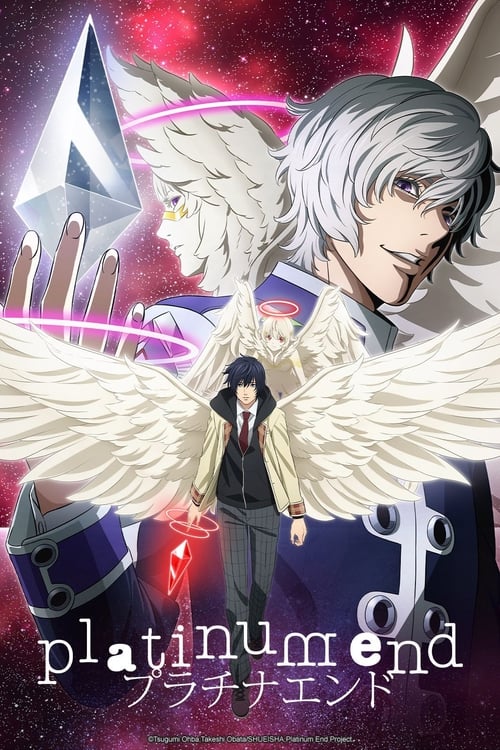
The story begins with Mirai Kakehashi, a high school student who is deeply depressed after the tragic death of his parents in a car accident. He lives with his abusive aunt and uncle, who mistreat him. One day, feeling hopeless, he decides to end his life by jumping off a building. As he prepares to jump, he is suddenly saved by a mysterious girl named Nasse, who reveals herself to be a guardian angel. Nasse gives Mirai a pair of wings and a red arrow, which can make anyone fall in love with him. She explains that he has been chosen to participate in a game where twelve candidates, each with their own angel, will compete to become the next God.
Mirai is initially hesitant about the game but is motivated by the desire to create a better world. He learns that the other candidates are also people who have faced significant hardships. The first candidate he encounters is Saki, a girl he has loved from afar. Mirai uses the red arrow on her, and she becomes infatuated with him. However, he struggles with the morality of using the arrow, as he wants Saki to love him for who he is, not because of manipulation.
As the game progresses, Mirai meets other candidates, including the ruthless and cunning candidate, Mukaido, who has a strong desire to become God to create a world free of suffering. Mukaido's motivations are driven by his own traumatic past, and he is willing to eliminate other candidates to achieve his goal. Mirai witnesses the brutal nature of the game when Mukaido kills another candidate, showcasing the high stakes involved.
Mirai's internal conflict deepens as he grapples with the implications of the game. He befriends another candidate, Kaki, who is also struggling with his own demons. Kaki reveals his tragic backstory, which resonates with Mirai, and they form a bond. However, the tension escalates when Kaki is killed by another candidate, pushing Mirai further into despair.
As the competition continues, Mirai learns more about the powers of the angels and the consequences of their actions. He discovers that using the red arrow has a time limit, and he must act quickly to secure alliances and protect himself. Mirai's relationship with Saki becomes complicated as she begins to question the nature of their love. She feels conflicted about her feelings, knowing they were influenced by the arrow.
The game takes a darker turn when Mirai confronts Mukaido, who has become increasingly aggressive. In a tense encounter, Mirai is forced to use his wings to escape Mukaido's attack. This moment marks a turning point for Mirai, as he realizes he must take a stand against the other candidates to survive. He begins to strategize and form alliances, recognizing that he cannot rely solely on Saki's love or Nasse's guidance.
As the number of candidates dwindles, Mirai faces off against several opponents, each with their own unique abilities and motivations. He witnesses the brutal elimination of candidates, which weighs heavily on his conscience. Mirai's resolve strengthens as he vows to protect Saki and create a world where people can live without fear.
In a climactic battle, Mirai confronts Mukaido once again. The fight is intense, with both characters using their powers to gain the upper hand. Mirai's determination to protect Saki fuels his strength, and he ultimately manages to defeat Mukaido, but not without significant emotional turmoil. The victory comes at a cost, as Mirai is left grappling with the loss of his friends and the harsh realities of the game.
As the final candidates are revealed, Mirai faces the last remaining opponents, each representing different ideologies about what it means to be God. The stakes are higher than ever, and Mirai must confront his own beliefs about power, love, and sacrifice. He realizes that becoming God is not just about eliminating others but about understanding the responsibility that comes with such power.
In the final moments of the series, Mirai is faced with a choice that will determine the fate of the world. He must decide whether to use his powers for personal gain or to create a better future for humanity. The weight of his decisions culminates in a dramatic conclusion, leaving viewers with a sense of uncertainty about the future and the true nature of divinity.
More TV Shows Like This
Browse All TV Shows →


What is the ending?
In the ending of "Platinum End," Mirai Kakehashi confronts the final battle against the remaining candidates for God. After a series of intense confrontations, he ultimately decides to reject the notion of becoming God, choosing instead to create a world where people can live freely. The series concludes with Mirai and his friends, including Saki, finding hope in their future together, while the other candidates meet their fates, either through death or resignation.
As the final episodes unfold, the tension escalates among the remaining candidates for God. Mirai Kakehashi, having endured immense emotional turmoil and loss, stands at a crossroads. The scene opens with Mirai, his face a mixture of determination and despair, as he reflects on the deaths of his friends and the weight of the choices he must make. The air is thick with the remnants of past battles, and the stakes have never been higher.
In a pivotal confrontation, Mirai faces off against the last of the candidates, including the ruthless Mukaido and the enigmatic Kira. Each character is driven by their own motivations: Mukaido, seeking to create a world free from suffering, and Kira, who revels in the power and chaos of the game. The atmosphere crackles with tension as they exchange heated words, revealing their conflicting ideologies about what it means to be God.
As the battle intensifies, Mirai's internal struggle becomes palpable. He grapples with the idea of power and the responsibility that comes with it. The visuals are striking, with vibrant colors contrasting the dark themes of death and despair. Mirai's wings, a symbol of hope, shimmer against the backdrop of destruction, representing his desire to protect those he loves.
In a climactic moment, Mirai is faced with a choice: to take the mantle of God or to reject it. The scene is charged with emotion as he recalls the faces of those he has lost, particularly Saki, who has been a beacon of light in his life. The camera lingers on his expression, capturing the weight of his decision. Ultimately, Mirai chooses to reject the role of God, believing that true power lies in the ability to choose one's own path.
As the dust settles, the remaining candidates meet their fates. Mukaido, having fought valiantly for his ideals, succumbs to the consequences of his actions, while Kira, consumed by his own madness, faces a tragic end. The scene shifts to Mirai and Saki, who stand together amidst the ruins, their hands intertwined. The world around them begins to transform, symbolizing a new beginning.
In the final moments, Mirai and Saki look towards the horizon, filled with hope for the future. The series closes on a poignant note, emphasizing the importance of choice, love, and the resilience of the human spirit. Mirai's journey culminates in a powerful message: that even in a world filled with despair, the potential for a brighter tomorrow exists when one chooses to believe in it.
Is there a post-credit scene?
In the anime series "Platinum End," there is no post-credit scene following the final episode. The series concludes with a significant climax and resolution to the characters' arcs, particularly focusing on Mirai and his choices regarding the future of humanity and the role of the God candidates. The absence of a post-credit scene means that the story wraps up without additional content or hints at future developments, leaving viewers with the emotional weight of the series' themes and character journeys.
What are the powers of the main characters in Platinum End?
In Platinum End, each of the main characters, who are candidates to become the next God, possesses unique powers granted by their respective angels. For instance, Mirai Kakehashi, the protagonist, is given the power of flight and the ability to create a 'red arrow' that compels others to fall in love with him. Other characters, like Saki Hanakago, also have their own distinct abilities, such as the 'white arrow' that can kill. These powers play a crucial role in the conflicts and strategies employed throughout the series.
What motivates Mirai Kakehashi to participate in the God candidate selection?
Mirai Kakehashi is initially driven by despair after a traumatic childhood filled with neglect and the loss of his family. His motivation shifts when he meets his angel, Nasse, who offers him a chance at a new life and the opportunity to become God. Mirai grapples with his desire to create a better world, influenced by his past experiences and the hope that he can prevent others from suffering as he did.
How does the relationship between Mirai and Saki develop throughout the series?
Mirai and Saki's relationship evolves significantly as they navigate the challenges of being God candidates. Initially, Saki is drawn to Mirai due to his kindness and vulnerability, and she becomes a source of emotional support for him. As the series progresses, their bond deepens, especially when they face moral dilemmas and the threat posed by other candidates. Saki's feelings for Mirai grow, leading to moments of tenderness and conflict as they both struggle with their roles in the deadly game.
What is the significance of the red and white arrows in the story?
The red and white arrows are central to the conflict in Platinum End. The red arrow allows the shooter to make someone fall in love with them, which can be used strategically to manipulate others. In contrast, the white arrow is lethal, capable of killing a target instantly. The use of these arrows reflects the characters' moral choices and the lengths they are willing to go to achieve their goals, highlighting themes of love, manipulation, and the value of life.
Who are the other God candidates and what are their motivations?
In addition to Mirai and Saki, several other God candidates are introduced, each with their own motivations and backstories. For example, Kanade Uryu is a ruthless candidate who seeks to eliminate others to achieve his vision of a perfect world. His cold demeanor contrasts with Mirai's more compassionate approach. Another candidate, Mukaido, is driven by a desire for revenge against those who have wronged him. Each character's motivations add layers to the narrative, creating a complex web of alliances and rivalries.
Is this family friendly?
"Platinum End" is not considered family-friendly due to several potentially objectionable or upsetting scenes and themes. Here are some aspects that may be concerning for children or sensitive viewers:
-
Suicide and Death: The series features multiple instances of characters contemplating or committing suicide, which is depicted in a graphic manner. This theme is central to the narrative and may be distressing.
-
Violence: There are scenes of intense violence, including battles between characters that result in serious injuries and fatalities. The depiction of these confrontations can be quite graphic.
-
Mature Themes: The show explores heavy themes such as despair, the value of life, and the morality of killing, which may be difficult for younger audiences to process.
-
Psychological Manipulation: Characters experience significant emotional turmoil, including manipulation and betrayal, which can be unsettling and may evoke strong emotional responses.
-
Dark Atmosphere: The overall tone of the series is dark and somber, with a focus on existential questions and moral dilemmas that may not be suitable for younger viewers.
These elements contribute to a narrative that is more appropriate for older teens and adults rather than children.