
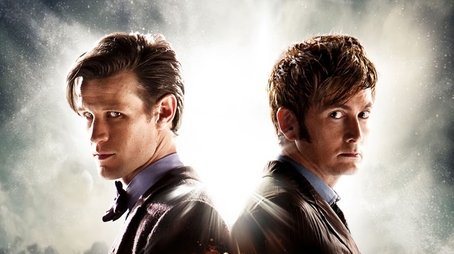


Popular
What is the significance of the Tenth Doctor's regeneration in the 2005 specials?
How does the relationship between the Doctor and Rose Tyler evolve throughout the specials?
What role does the Daleks play in the specials, particularly in 'The Parting of the Ways'?
What is the impact of the Time Lord's return in 'The Christmas Invasion'?
How does the theme of sacrifice manifest in 'Doomsday'?
Should I watch it?
Ask Your Own Question

What is the plot?
The 2005 "Doctor Who" Specials begin with "The Christmas Invasion." The Tenth Doctor, played by David Tennant, has just regenerated from the Ninth Doctor. He is disoriented and weak, lying in the TARDIS as it lands in London on Christmas Day. Rose Tyler, his companion, is excited but also worried about the Doctor's condition. The TARDIS materializes in the middle of a crisis as the Sycorax, a hostile alien race, have taken control of Earth, threatening to kill one person every hour unless the humans surrender.
As the Sycorax leader, a tall, imposing figure, demands the humans' submission, the Doctor remains incapacitated. Rose, feeling helpless, tries to negotiate with the Sycorax but is dismissed. Meanwhile, the Doctor's friend, Mickey Smith, is trying to help but is also outmatched. The Sycorax use a device to control the minds of humans, and they begin to take over the population. The situation escalates when the Sycorax leader challenges the Doctor to a duel, but the Doctor is still recovering.
Suddenly, the Doctor awakens, fully regenerated and more confident. He quickly assesses the situation and uses his sonic screwdriver to disrupt the Sycorax's control device. He confronts the Sycorax leader, engaging in a battle of wits and strength. The Doctor cleverly uses the Sycorax's own technology against them, ultimately defeating the leader by cutting off his hand, which causes him to fall to his death. The remaining Sycorax retreat, and the Doctor saves the day.
After the battle, the Doctor is still adjusting to his new form and personality. He shares a tender moment with Rose, who is relieved to have him back. The Doctor expresses his desire to travel with her and explore the universe. They celebrate Christmas together, and the Doctor begins to embrace his new identity.
The next special, "The Runaway Bride," opens with a wedding in progress. Donna Noble, played by Catherine Tate, is about to marry her fiancé, but suddenly, she is transported into the TARDIS, where the Doctor is piloting. Confused and panicked, Donna confronts the Doctor, who is equally bewildered by her presence. The TARDIS is under attack by a group of robotic creatures known as the Racnoss, who are seeking to revive their queen.
The Doctor and Donna work together to escape the TARDIS as it crashes back to Earth. They find themselves in London, where the Doctor explains the situation. Donna is initially frustrated and wants to return to her wedding, but the Doctor convinces her to help him stop the Racnoss. They discover that the Racnoss queen is trying to awaken her children, which would lead to catastrophic consequences for Earth.
The Doctor and Donna infiltrate the Racnoss lair, where they confront the queen. The Doctor attempts to reason with her, but she is ruthless and determined to fulfill her plan. A fierce battle ensues, with the Doctor using his intelligence and resourcefulness to fight off the Racnoss minions. Donna proves to be a valuable ally, using her quick thinking to help the Doctor.
In a climactic moment, the Doctor realizes that the only way to stop the Racnoss is to destroy their entire lair. He sets off a chain reaction that leads to the destruction of the Racnoss and their queen. Donna is initially horrified by the destruction, but the Doctor reassures her that it was necessary to save countless lives.
After the battle, Donna returns to her wedding, but she is forever changed by her experience with the Doctor. The Doctor, feeling a connection with Donna, invites her to join him on his travels, but she declines, choosing to return to her normal life. The Doctor respects her decision, and they part ways, with Donna promising to remember their adventure.
The next special, "Voyage of the Damned," begins with the Doctor aboard the Titanic, a spaceship modeled after the famous ocean liner. The Doctor is enjoying the festivities when disaster strikes, and the ship is attacked by a swarm of hostile robots known as the Host. The Doctor quickly takes charge, trying to save the passengers and crew from the impending doom.
As the ship begins to break apart, the Doctor meets several key characters, including Astrid Peth, played by Kylie Minogue. She becomes an ally, and together they work to save the remaining passengers. The Doctor uses his sonic screwdriver to disable the Host robots, but the situation becomes increasingly dire as the ship is on a collision course with Earth.
In a desperate attempt to save everyone, the Doctor devises a plan to redirect the ship's trajectory. He and Astrid work together to implement the plan, but it requires great sacrifice. The Doctor realizes that he must destroy the ship to prevent it from crashing into London. He makes the difficult decision to activate the ship's self-destruct sequence.
As the ship begins to explode, the Doctor and Astrid share a poignant moment, expressing their feelings for each other. Astrid ultimately sacrifices herself to save the Doctor and the remaining passengers, allowing them to escape in a lifeboat. The Doctor is heartbroken by her loss but knows it was necessary to save others.
The special concludes with the Doctor mourning Astrid's sacrifice. He reflects on the fragility of life and the weight of his decisions. He vows to continue traveling and helping those in need, carrying the memory of Astrid with him.
The final special, "The Stolen Earth," begins with the Doctor and his companions, including Rose, Donna, and Martha, facing a new threat as the Earth is mysteriously transported to the Medusa Cascade. The Doctor discovers that the Daleks are behind the abduction, and they are planning to use the Earth as a weapon.
The Doctor rallies his companions and allies, including Captain Jack Harkness and Sarah Jane Smith, to confront the Daleks. They devise a plan to infiltrate the Dalek ship and rescue the Earth. The tension escalates as the Doctor faces off against his old enemies, showcasing his determination to protect his home planet.
As the battle unfolds, the Doctor is faced with difficult choices and sacrifices. He must confront the reality of the Daleks' power and the potential loss of his friends. The emotional stakes rise as the Doctor fights to save the Earth and those he loves.
In a climactic showdown, the Doctor uses his intelligence and resourcefulness to outsmart the Daleks. He manages to return the Earth to its rightful place, but not without significant consequences. The Doctor is left grappling with the emotional toll of the battle and the losses he has endured.
The special concludes with the Doctor reflecting on the events that transpired. He is left with a sense of determination to continue his journey, knowing that he must face whatever challenges lie ahead. The bonds he has formed with his companions remain strong, and he is ready to embrace the future.








What is the ending?
In the ending of Doctor Who: Specials (2005), the Tenth Doctor, portrayed by David Tennant, faces his impending regeneration after a confrontation with the Time Lord's enemies. He ultimately sacrifices himself to save Wilfred Mott, his friend, and companion. The Doctor regenerates into his Eleventh incarnation, played by Matt Smith, leaving behind a legacy of hope and adventure.
As the final moments unfold, the Tenth Doctor stands in the control room of the TARDIS, a place filled with memories and echoes of his past adventures. The atmosphere is heavy with a sense of impending change. The Doctor, aware of his fate, reflects on his life and the countless lives he has touched. His eyes, usually filled with mischief and wonder, now carry a weight of sorrow and acceptance.
The scene shifts to Wilfred Mott, played by Bernard Cribbins, who is trapped in a chamber filling with radiation. The Doctor, hearing Wilfred's cries for help, rushes to save him. The urgency in the Doctor's movements is palpable; he knows that every second counts. As he reaches Wilfred, the two share a moment of connection, a bond forged through shared experiences and mutual respect. The Doctor's determination to save Wilfred is evident, showcasing his deep-seated compassion and heroism.
However, the Doctor soon realizes that saving Wilfred will come at a great cost. The radiation exposure is too much for him to bear, and he must make a choice. In a moment of selflessness, he tells Wilfred to leave, insisting that he will be alright. The emotional turmoil is visible on the Doctor's face as he grapples with the reality of his sacrifice. Wilfred, filled with desperation, pleads with the Doctor, but the Doctor reassures him, urging him to go.
As Wilfred escapes, the Doctor stands alone, facing the consequences of his actions. The TARDIS begins to glow with energy, signaling the onset of regeneration. The Doctor's internal struggle is evident; he is not ready to say goodbye to his life, his friends, and the universe he has fought to protect. He reflects on his past, recalling moments of joy, sorrow, and the many companions who have traveled with him.
In a final act of defiance against his fate, the Doctor shouts, "I don't want to go!" His voice echoes through the TARDIS, filled with a mix of anger, sadness, and acceptance. The energy envelops him, and in a brilliant flash of light, the Tenth Doctor regenerates. The transformation is both beautiful and chaotic, as the familiar features of David Tennant shift into the new visage of Matt Smith.
As the regeneration completes, the Eleventh Doctor emerges, disoriented but filled with a new sense of purpose. He takes a moment to gather himself, looking around the TARDIS with wide eyes, filled with wonder and curiosity. The transition signifies not just a change in appearance but a renewal of spirit and adventure.
The final scene leaves viewers with a sense of hope and continuity. The Doctor, though changed, remains a force for good in the universe. Wilfred, having witnessed the Doctor's sacrifice, is left with a profound sense of loss but also a deep appreciation for the man who saved him. The legacy of the Tenth Doctor lives on, as the Eleventh Doctor prepares to embark on new adventures, ready to face whatever challenges lie ahead.
Is there a post-credit scene?
In the 2005 "Doctor Who" Specials, there is no post-credit scene. The episodes, including "The Christmas Invasion," "The Runaway Bride," and "The Stolen Earth/Journey's End," conclude without any additional scenes after the credits roll. Each episode wraps up its narrative within the main storyline, focusing on the Doctor's adventures and the emotional arcs of the characters involved. The absence of post-credit scenes in these specials maintains the focus on the immediate resolutions and character developments, leaving viewers with a sense of closure for each story.
What is the significance of the Tenth Doctor's regeneration in the 2005 specials?
The Tenth Doctor's regeneration is a pivotal moment that encapsulates his journey and character development. It occurs in 'The Parting of the Ways,' where the Doctor faces the Daleks and ultimately chooses to regenerate rather than die. This decision highlights his deep-seated desire to protect life, even at the cost of his own. The emotional weight of this moment is amplified by his farewell to Rose Tyler, showcasing his love and the pain of separation. The regeneration itself is a visually stunning transformation, symbolizing both an end and a new beginning.
How does the relationship between the Doctor and Rose Tyler evolve throughout the specials?
Throughout the 2005 specials, the relationship between the Doctor and Rose Tyler deepens significantly. In 'The Christmas Invasion,' Rose's loyalty and bravery are tested as she stands by the Doctor during his recovery from regeneration. Their bond is further explored in 'The Parting of the Ways,' where Rose's feelings for the Doctor become more pronounced, culminating in a heart-wrenching moment when she realizes she may lose him. The emotional stakes are heightened in 'Doomsday,' where they are forcibly separated by the Void, leaving both characters devastated and forever changed by their experiences together.
What role does the Daleks play in the specials, particularly in 'The Parting of the Ways'?
The Daleks serve as a formidable antagonist in 'The Parting of the Ways,' representing the ultimate threat to the Doctor and humanity. Their return marks a significant moment in the series, as they embody the Doctor's greatest fears and past traumas. The confrontation with the Daleks forces the Doctor to confront his own morality and the consequences of his actions. The emotional climax occurs when the Doctor must choose between saving his own life or sacrificing himself to save others, showcasing the depth of his character and the weight of his responsibilities.
What is the impact of the Time Lord's return in 'The Christmas Invasion'?
In 'The Christmas Invasion,' the return of the Time Lords is hinted at through the Doctor's regeneration and the mention of the Time Lord's legacy. This moment serves to re-establish the Doctor's identity and the weight of his heritage. The impact is felt as the Doctor grapples with his new persona, showcasing a blend of vulnerability and strength. The Time Lord's return also sets the stage for future conflicts and the exploration of the Doctor's past, emphasizing the complexity of his character and the burden of his history.
How does the theme of sacrifice manifest in 'Doomsday'?
In 'Doomsday,' the theme of sacrifice is poignantly illustrated through the characters of the Doctor and Rose. As they face the impending separation caused by the Void, both characters are forced to confront what they are willing to give up for the greater good. Rose's decision to stay behind in a parallel universe to save the world from the Daleks exemplifies her bravery and love for the Doctor. The emotional farewell scene is heart-wrenching, as they express their love for each other, knowing they may never reunite. This moment encapsulates the essence of sacrifice, love, and the pain of loss that permeates the episode.
Is this family friendly?
"Doctor Who: Specials" from 2005 is generally considered family-friendly, but it does contain some scenes and themes that may be unsettling for younger viewers or sensitive individuals. Here are some potentially objectionable or upsetting aspects:
-
Violence and Threats: There are scenes featuring alien creatures and monsters that may be frightening. Some episodes include moments of peril where characters are in danger, which can be intense.
-
Death and Loss: Themes of mortality and loss are prevalent, with characters facing life-and-death situations. The emotional weight of these moments can be heavy, particularly in episodes that deal with sacrifice or the consequences of actions.
-
Emotional Turmoil: Characters often experience deep emotional struggles, including grief, loneliness, and fear. These themes can resonate strongly and may be distressing for some viewers.
-
Dark Imagery: Certain episodes feature dark and eerie settings, with visual elements that may be scary, such as haunted locations or grotesque alien designs.
-
Mature Themes: Some episodes touch on complex themes such as war, sacrifice, and ethical dilemmas, which may require a level of maturity to fully understand.
While the show is designed to be accessible to a wide audience, parents may want to preview episodes to gauge their suitability for younger viewers.