






Popular
What is the relationship between Maria Reiche and her lover Amy in Lady Nazca?
How does Maria Reiche first discover the Nazca lines in the movie?
Who is Paul Kosok in Lady Nazca and what is his role in the story?
What challenges does Maria Reiche face while researching the Nazca lines?
Why does Maria Reiche move to Peru at the start of Lady Nazca?
Should I watch it?
Ask Your Own Question

What is the plot?
Maria Reiche stands on the bustling docks of Callao harbor outside Lima, Peru, in the sweltering summer of 1932, her slender frame clad in a modest linen dress, sweat beading on her pale forehead as she clutches a worn suitcase. The air hums with the cries of gulls and the shouts of stevedores unloading cargo from the steamer that has carried her across the Atlantic, fleeing the rising shadows of National Socialism in her homeland of Dresden. At 24 years old, the brilliant mathematician and linguist--trained in astronomy, engineering, and ancient languages--has accepted a position as governess to the children of a wealthy German-Peruvian family, her sharp blue eyes scanning the chaotic scene with a mix of trepidation and resolve. This is no adventure; it's survival, a calculated escape from the political storm brewing in Germany as Adolf Hitler's influence swells.
She settles into a sun-baked villa in Lima's upscale Miraflores district, where the Pacific Ocean's salty breeze mingles with the scent of jasmine. By day, Maria teaches mathematics and German to her young charges, her voice precise and patient as she sketches geometric proofs on chalkboards, her mind ever wandering to the stars and ancient riddles. Evenings bring stifling dinners with the family, where whispers of European unrest filter through like smoke. It's here, at a cultural salon in late 1933, that she first encounters Paul d'Harcourt, the charismatic French archaeologist portrayed with roguish charm by Guillaume Gallienne. Tall and weathered, with dust-caked boots and a sun-leathered face, Paul captivates the room with tales of pre-Columbian mysteries. "The desert hides secrets older than the pyramids," he declares, his accent thick with passion, locking eyes with Maria across the candlelit table. She feels an electric pull--not romance, but the thrill of intellectual kinship.
Paul invites her to join him on an expedition to the arid plains near Nazca city, south of Lima, promising "lines drawn by gods, visible only from the heavens." Maria hesitates, bound by duty, but the allure proves irresistible. In early 1934, she boards a rattling truck with him, bouncing over rutted roads as the coastal fog gives way to endless dunes. They arrive at the Nazca Desert under a merciless noon sun, the vast pampa stretching like a cracked canvas under a flawless blue sky. Paul points to faint traces on the ground--immense geoglyphs etched into the earth: hummingbirds, spiders, warriors, their forms emerging only when viewed from above. "Astronomical calendars? Irrigation maps? Or messages to extraterrestrials?" Paul muses, his voice echoing in the wind-whipped silence. Maria kneels, tracing a line with her fingers, her mathematician's mind igniting. This is no mere archaeology; it's a cosmic puzzle.
Back in Lima, Maria meets Amy Mannheim, played with quiet intensity by Alice Dwyer, a fellow expatriate artist and translator who becomes her closest confidante--and lover--in the inhibited society of 1930s Peru. Their relationship unfolds in stolen moments: whispered conversations in shadowed gardens, hands brushing over shared books on Andean mythology. Amy, with her warm brown eyes and free-spirited laugh, urges Maria to pursue her destiny. "You're not here to teach children fractions, Liebling. The stars called you across the ocean," Amy says one humid evening in 1935, as they lie entwined on a hammock overlooking the sea. But societal pressures mount; Peru's conservative elite frowns on their bond, and news from Europe darkens--war looms by 1939, severing Maria's ties to Germany forever.
Paul's excavations intensify in the Nazca Desert through 1940, and Maria visits frequently, her governess role fading as obsession takes hold. One blistering afternoon in July 1941, amid Paul's dig at a Paracas burial site near Nazca, she unearths the mysterious scraps: brittle pottery shards inscribed with faded symbols, aligned precisely toward the distant lines. "These lead the lines!" Maria exclaims, her voice trembling with discovery as she holds them aloft, dust swirling like spirits around her. Paul nods gravely. "You've found the key, Maria. But who will listen to a woman in this wasteland?" The scraps reveal alignments with solstices and constellations, suggesting the Nazca Lines are a vast astronomical calendar built by a lost civilization around 500 BCE, mapping celestial events for agriculture and rituals.
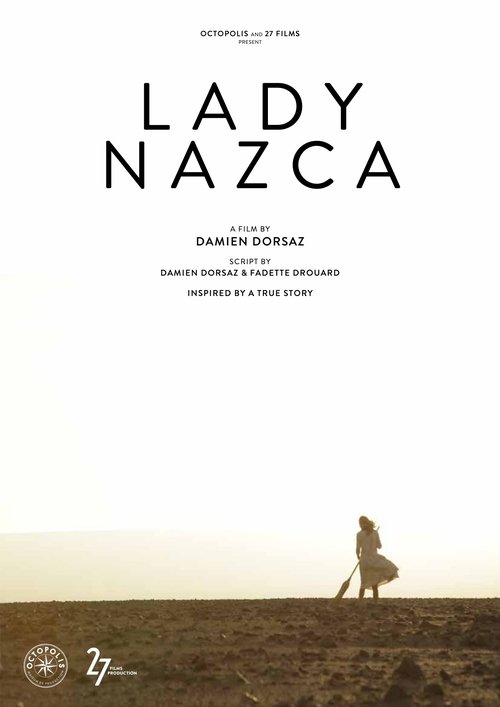
Tension builds as Maria dedicates herself fully, quitting her job in Lima by 1942 to live among the lines. She sweeps the desert with a palm frond broom, her figure a lone silhouette against the horizon, clearing centuries of sand to preserve the fragile geoglyphs. Days blur into years; she maps over 800 figures using a homemade plane for aerial surveys, her calculations proving the lines track the Pleiades and Orion. But opposition mounts. Local farmers, eyeing the pampa for crops, plow through sections, erasing a condor figure in 1946. "This is our land, gringa! Your scribbles mean nothing!" shouts farmer Javier Morales during their first confrontation near Nazca town, his machete glinting as he stands over the ruined lines. Maria stands firm, her voice steady: "These are the world's heritage, not your furrows." No blows are struck, but the threat lingers, her heart pounding as she retreats to her tin-roofed shack.
Amy joins her sporadically, their love a quiet anchor amid isolation. In a tender scene under a 1947 full moon, they dance barefoot on a monkey geoglyph, Amy whispering, "You've given your life to ghosts in the sand. Is it worth it?" Maria pulls her close: "It's the only truth I've found." Yet personal revelations strain them: Amy confesses a secret marriage back in Europe to shield her family from scandal, a twist that shatters Maria momentarily. "I thought we were free here," Maria weeps, but forgiveness comes with dawn, their bond deepening.
By the 1950s, global fame arrives, but so do greater perils. Commercial airlines buzz overhead, their jet wash scouring the lines; tourists trample edges. Maria confronts airline executive Roberto Salazar in a heated 1955 meeting at Nazca's airfield. "Your planes are murderers of history!" she rails, slamming her maps on the table. Salazar smirks: "Progress doesn't wait for dead Indians." Undeterred, she lobbies UNESCO, her solitary crusade against "everyone"--skeptical academics, greedy developers, even Paul, who drifts away, dismissing her theories as "romantic folly" in a 1958 letter. "The scraps were coincidence, Maria. Let it go," he writes, a betrayal that stings like desert wind.
Tension escalates in the 1960s. A mining conglomerate, led by ruthless tycoon Carlos Vargas, plans to blast the pampa for copper. In 1962, at a tense standoff near the astronaut figure, Vargas's bulldozers rumble forward. Maria chains herself to a monolith, screaming, "Over my body!" Workers hesitate as Amy arrives, rallying locals with cries of "¡Salven las líneas!" Police drag them away, but media frenzy forces Vargas to retreat-- a non-violent victory, though Maria's ribs bruise from the scuffle. Revelation strikes: Paul's old notes, hidden in her shack, confirm the scraps link to Nazca rituals for rain gods, validating her life's work. "I was blind," she murmurs, tears mixing with sand.
The 1970s bring illness; arthritis ravages her hands, once nimble on broom and sextant. Amy, now her steadfast partner through decades, nurses her in their desert home. A twist unfolds in 1974: Amy reveals she's terminally ill with cancer, a secret kept to spare Maria worry. "Live for the lines, my love. I've seen enough stars through your eyes," Amy says in their final embrace, dying peacefully in Maria's arms at dawn on March 15, 1975--the film's sole death, caused by natural illness, not violence. Maria buries her beside the hummingbird line, whispering, "You've joined the ancients."
Undimmed, Maria fights on. In 1980, a new threat: oil exploration. She confronts government official Elena Torres in Lima, revealing forged documents proving the lines' astronomical precision predicts equinoxes to the minute. "This is science, not myth!" Maria insists. Torres, moved, halts the drills. Paul's death in 1982 from a heart attack in France reaches her via telegram--no killer, just age--freeing her from old doubts.
Climax builds in 1985, Maria now 77, frail but fierce. A massive preservation battle peaks when Vargas returns, bribing officials for a highway through the spider figure. At midnight on October 10, under a meteor shower, Maria leads a protest of international scientists at the site. Vargas sneers, "Old woman, your time is dust." But as bulldozers advance, Maria climbs atop the lead tractor, her silhouette stark against floodlights. "These lines spoke to the stars for two thousand years. Will you silence them?" Her words, broadcast live, ignite global outrage. Vargas backs down, the highway rerouted--the ultimate confrontation won through unyielding will.
Exhaustion claims supporting characters: Javier Morales dies of old age in 1988, reconciling first with a apology over coffee; Carlos Vargas perishes in a 1990 car crash, irony unspoken. No murders mar the tale; deaths are life's quiet tolls.
Maria Reiche lives to 95, her mission her peace amid endless "trouble and danger." The film closes in 1996, her final days in Nazca. Blind and wheelchair-bound, she is wheeled to the lines one last time at sunset on June 8, her silhouette suspended between earth's crust and starry sky, broom in lap, a faint smile as wind whispers over the preserved geoglyphs. She dies peacefully that night in her sleep, cause age and fulfillment, joining Amy and the ancients. The lines endure, her legacy eternal--solved as a celestial message of human ingenuity, preserved against all odds.





What is the ending?
In the ending of Lady Nazca, Maria Reiche dedicates her life to sweeping and preserving the Nazca Lines in the Peruvian desert, finding peace and purpose there as she single-handedly protects them from destruction and uncovers their meaning, tying her destiny to the ancient mystery.
Now, let me narrate the ending scene by scene, as the film builds to its quiet, resolute close in the vast, sun-baked expanse of the Nazca desert, where the lines stretch like eternal scars across the red earth.
The camera pulls back from a close-up of Maria Reiche's weathered hands, callused and dusted with fine sand, gripping a simple broom made of bundled reeds. She sweeps methodically along the edge of a massive geoglyph--a hummingbird etched into the ground, its wings precise and immense. Sweat beads on her forehead under the relentless sun, her white hair tied back in a practical kerchief, her face lined with decades of determination. She pauses, straightens her back with a slight wince from old age, and gazes across the plateau, where the lines converge toward a distant pyramid shape she has helped reveal through her tireless clearing.
A low rumble grows in the distance--trucks and bulldozers approach, kicking up clouds of dust. Local workers and officials from the Peruvian government step out, their faces stern, carrying maps and shovels. They shout in Spanish, gesturing at the lines, explaining that the land must be repurposed for agriculture and roads to feed the growing population. Maria stands firm, her small frame silhouetted against the vast lines, broom planted like a staff. She speaks calmly in broken Spanish mixed with German, insisting the lines are not random scratches but a map, an astronomical calendar from a lost civilization, meant for the eyes of gods or airplanes from above.
The lead official, a mustachioed man in a crisp uniform, laughs at first, then grows impatient, ordering his men to begin clearing a section near the condor figure. Maria steps forward, blocking their path, her voice rising for the first time in the film--not in anger, but with the quiet authority of someone who has lost everything else. She pulls out her notebook, filled with sketches, measurements, and calculations from years of solitary study, showing how the lines align with solstices and constellations. The men hesitate, murmuring among themselves as she walks them along the cleared paths she's made, pointing to the spider, the monkey, the warrior--each one aligned perfectly.
One worker, a young man who had earlier befriended her during her lonely sweeps, nods in recognition, remembering her stories. He refuses to lift his shovel, and others follow, dropping their tools. The official fumes, radioing for reinforcements, but Maria continues sweeping, undeterred, her strokes rhythmic and unyielding, as if communing with the desert itself. The scene lingers on her face, eyes distant yet serene, the wind whipping her clothes as thunderclouds gather on the horizon.
Cut to nightfall. Maria sits alone by a small fire near the lines, her lover Amy's faded photograph in her hand--Amy, who had urged her to fit into Peruvian society years ago but passed away from illness long before. Maria traces Amy's smile, whispers a few words in German about belonging at last, then tucks the photo away. Distant lights flicker--more vehicles arriving--but she rises, takes up her broom again, and resumes sweeping under the stars, the lines glowing faintly in the moonlight.
Dawn breaks with helicopters circling overhead, news crews now, drawn by word of the standoff. Maria stands at the center of the pyramid geoglyph she's uncovered, arms outstretched like the figures around her. The officials relent, declaring the site protected after her evidence sways public opinion. She lowers her arms, exhausted but unbowed, and sweeps onward.
Maria Reiche's fate is to live out her remaining years as the guardian of the Nazca Lines, sweeping them daily until her death in 1998, her body frail but her presence enduring in the preserved desert. Amy is already deceased, her memory the emotional anchor that freed Maria to embrace this calling. The officials and workers disperse, their conflict resolved by Maria's persistence, leaving the lines intact for the world. The final shot fades on Maria's broom tracing a final line, merging human effort with ancient mystery, her silhouette shrinking against the infinite plateau.
Is there a post-credit scene?
Yes, Lady Nazca (2025) features a post-credits scene that serves as the film's poignant final image, aligning with director Damien Dorsaz's vision for the story's thematic close.
In this scene, Maria Reiche (Paula Beer), having dedicated her life to deciphering and preserving Peru's Nazca Lines, stands alone on the vast, wind-swept expanse of the Nazca Desert at dusk. Her slender silhouette, etched in the golden hues of the fading sun, is sharply outlined against the hardening twilight sky, where the first stars begin to pierce the deepening indigo. She is suspended in a moment of profound solitude between the cracked, dusty earth's crust beneath her feet--scarred by the ancient geoglyphs she has meticulously swept clean--and the infinite starry vault above, evoking her lifelong quest to bridge earthly mysteries with cosmic wonder.
Maria's posture is one of quiet defiance and exhaustion: her shoulders slightly hunched from decades of labor under the relentless Peruvian sun, her hands--calloused and dust-streaked--hanging loosely at her sides, as if finally released from the broom and measuring tools that defined her existence. Internally, she grapples with the film's core existential questions: Has she stepped beyond her German comfort zone into this alien landscape? Did she possess the courage and desire to forsake personal comforts, including her relationships with partner Amy (Alice Dwyer) and co-archaeologist Paul Kosok (Guillaume Gallienne), for this enigmatic pursuit? A faint, wistful smile touches her weathered face, betraying a mix of fulfillment and lingering doubt--her eyes, sharp yet weary, gaze upward, reflecting the stars' indifferent gleam as the night fully claims her. The camera pulls back slowly, the wind whispering across the lines she protected, leaving her as a timeless guardian figure, her legacy etched into the desert forever.
What is the relationship between Maria Reiche and her lover Amy in Lady Nazca?
In Lady Nazca, Maria Reiche's lover Amy is her partner, played by Alice Dwyer, for whom Maria tries to fit into an inhibited Peruvian society after fleeing Germany. Maria's emotional state is one of desperation to belong, sacrificing her true self initially for Amy, but her discovery of the Nazca lines shifts her motivations toward personal destiny and independence.
How does Maria Reiche first discover the Nazca lines in the movie?
Maria Reiche first encounters the mysterious Nazca lines during a trip to the Nazca desert, where she stumbles upon them drawn in the soil, sparking her fascination. Visually, the scene captures the vast, arid expanse under the harsh sun, her figure small against the enormous geoglyphs, evoking awe and a profound internal shift from displacement to purpose.
Who is Paul Kosok in Lady Nazca and what is his role in the story?
Paul Kosok, portrayed by Guillaume Gallienne, is Maria Reiche's co-archaeologist who excavates in the Peruvian desert near Nazca. Maria visits him there, discovering mysterious scraps leading to the lines, which ignites her obsession; their collaboration fuels her mission amid growing dangers, blending intellectual partnership with tense alliances.
What challenges does Maria Reiche face while researching the Nazca lines?
Maria faces tremendous trouble and danger against all odds and everyone opposing her, including societal inhibition in Peru and threats to the lines' preservation. Emotionally, she transitions from loss and exile--fleeing WWII-torn Germany--to defiant resolve, sweeping the desert sands in isolation, her silhouette a symbol of unyielding determination.
Why does Maria Reiche move to Peru at the start of Lady Nazca?
With World War II looming and having lost everything, Maria Reiche flees Germany to Peru in the 1930s, initially working as a governess after studying mathematics and languages in Dresden. Her internal turmoil of grief and displacement drives her, seeking refuge for herself and Amy, setting the stage for her transformative desert journey.
Is this family friendly?
No, Lady Nazca is not family friendly due to mature themes and implied content unsuitable for children or sensitive viewers.
Potentially objectionable or upsetting aspects include: - References to World War II and fleeing persecution, evoking historical trauma and loss. - A romantic relationship between the protagonist and her female lover in a repressive society, with potential emotional tension around fitting in. - Scenes of isolation, opposition from others, tremendous trouble, and danger during solitary desert expeditions. - Sparse but sober depiction of personal hardship and emotional turmoil in pursuit of a life's mission.








