





















Popular
What challenges does Roberta Guaspari face while trying to teach music in the public school?
How does Roberta's relationship with her students evolve throughout the film?
What role does Roberta's personal life play in her teaching career?
How does the film depict the importance of community support for Roberta's music program?
What impact does the benefit concert have on the students and Roberta?
Should I watch it?
Ask Your Own Question

What is the plot?
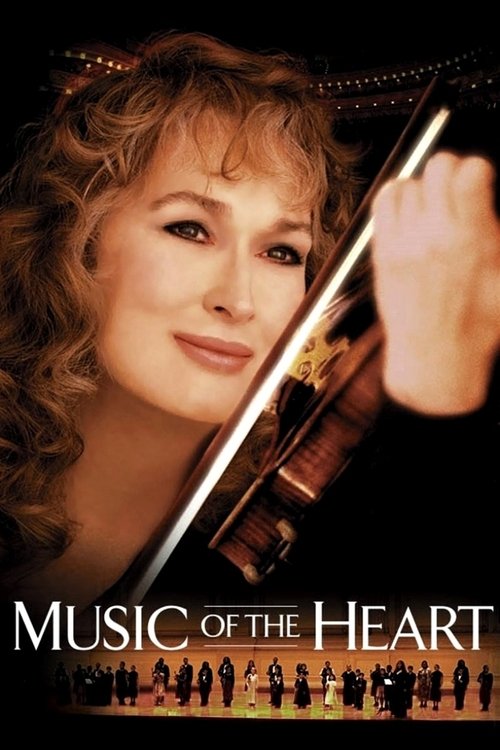
In 1981, New York City feels gray and unforgiving as winter light slants across streets still streaked with old snow. Inside a modest Queens apartment belonging to Assunta Guaspari, a violin leans in the corner like a forgotten limb of the family. Roberta Guaspari stands in the cramped kitchen, hands braced on the counter, trying to absorb the shape of her new life: her husband, U.S. Navy officer Charles Demetras, is gone, and he has not just left her--he has left her for Lana Holden, a woman she once called her friend. Her two boys, Alexi "Lexi" Guaspari and Nicholas "Nick" Guaspari, are already asleep in the back bedroom, small bodies lost in borrowed beds. The clock over the sink reads just after 10 p.m., and Assunta moves quietly around her daughter, trying not to crowd but unable to stop worrying.
"You can't stay like this," Assunta tells her, voice as practical as it is loving. "You have to think of the boys. You have to work." She gestures toward the violin, its case scuffed but carefully kept. "You have a gift, Roberta. Use it."
Roberta's laugh is brittle. "Play the violin for who? For what? Nobody's lining up to pay for scales and etudes." She is still in the shock phase, everything in her chest clamped tight. Her marriage hasn't just ended; it has humiliated her. Charles is already elsewhere, already with Lana. The betrayal is raw and specific--faces, rooms, voices she knows too well.
Later that night, she stands in the boys' doorway, watching Nick and Lexi breathe. Their tiny rental‑store violins are tucked under their beds, because that's where they insist they belong, close enough to touch. She taught them both herself, small fingers guided into curved shapes, bows coaxed into straight lines. When she finally crawls into the daybed Assunta has made up for her in the living room, she keeps seeing Charles's face, hearing his rehearsed phrases about needing something else, about it "not being about you, Roberta." The words echo against the bare walls.
Days slip into a blur of resumes and rejections. The date on the calendar is meaningless except for the bills due at the end of the month. Roberta takes whatever she can find. By mid‑December 1981, she is standing under fluorescent lights in a Midtown department store, a red apron tied around her waist, fingers stiff from tying ribbon after ribbon around glossy packages. The muzak in the background is tinny and relentlessly cheerful. She feels anonymous, swallowed.
"Roberta?" a man's voice says, tentative. She looks up.
Brian Sinclair--once Brian Turner to some sources, but to her just Brian, the boy she knew in high school--is standing there in a good coat, a bag of purchases at his feet. He's older, of course, but she recognizes his eyes immediately. He recognizes her, too, under the cheap holiday apron and the exhaustion.
"Brian," she says, startled. "My God."
They talk in stolen minutes between customers, fast and overlapping. He is now a successful writer, a man with deadlines instead of deployments. He remembers her in orchestra, remembers the way she attacked a passage of Bach like it had insulted her. "You were the best violinist in school," he says simply. "You loved it. You lit up."
She shrugs, embarrassed. "That was a long time ago."
He glances at her hands, still deft even as they twist ribbon. "So why aren't you playing? Teaching?" he presses. When she admits she's desperate for work but doesn't know where to start, he says, "I might know something. There's this school in East Harlem, Central Park East. They might have an opening. Not much money, but…" He studies her. "You were born to do this, Roberta."
The next morning, early winter light flat and pale over East Harlem, Roberta rides the subway clutching a manila folder with her sparse resume and a worn violin case. The train rattles above tracks edged with graffiti. She checks the address Brian gave her: Central Park East School, East Harlem, New York. It is 9 a.m. when she steps into the school building, the noise of children echoing down concrete hallways.
Janet Williams, the principal and head teacher, is waiting behind a cluttered desk stacked with files. Angela Bassett's Janet is composed, wary, efficient. She flips through Roberta's thin file. "You don't have any formal teaching experience," Janet observes, not unkindly, but with the bluntness of someone who has no time to waste.
"I've taught privately. My boys play. I--" Roberta begins.
Janet cuts her off gently. "We barely have money for basics. You want to start a violin program? Here?" She leans back, folds her hands. "We don't have funds for instruments. For salaries. It's just not realistic."
Roberta feels the familiar burn of humiliation. She sees through the window: kids spilling into the yard, backpacks slung, sneakers scuffing. She also sees the fluorescent department‑store ceiling, hears the endless rustle of wrapping paper. She cannot go back to that.
"I have violins," she blurts. "Fifty of them. I bought them in Greece, years ago. They're mine. You wouldn't have to pay for instruments."
Janet's eyebrows lift. "Fifty."
"Yes." Roberta holds her ground. "I can show you. I can teach kids. I've been teaching my sons since they were little. Let me demonstrate. Please."
Janet's lips compress, a sign of reluctance wrestling with possibility. "I appreciate your enthusiasm, Ms. Guaspari, but we can't just--" She shakes her head. "I'm sorry. I can't offer you the position."
Roberta walks out of the office into the corridor. The rejection stings more than the low pay would have. She goes back to Assunta's that night, the boys circling her with questions. "Did you get the job?" Nick asks, eyes bright.
"No," she says flatly, hanging her coat. Assunta watches her get a glass of water with a hard look that says: try again.
The next morning, Roberta doesn't ask anyone's permission. She gets Nick and Lexi up early, dresses them in their best shirts, combs their hair with brusque tenderness.
"Why are we going to a school?" Lexi asks, rubbing sleep from his eyes.
"Because you're going to help me get a job," she says. "Bring your violins."
At 8 a.m., she marches her sons into Central Park East, past surprised teachers, straight to Janet's office. She knocks once and opens the door before Janet can answer.
"I want to show you something," Roberta says.
Janet starts to reprimand her for barging in, then notices the boys. "Who are these?"
"My sons, Nicholas and Alexi. Sit." Roberta positions them like chess pieces in front of Janet's desk. "Take out your violins."
The boys obey, their reverence for the instruments cutting through their nervousness. Roberta nods once. "Okay. 'Twinkle' with variations. Together."
Their bows rise. The first notes are rough with nerves but committed. The sound fills Janet's office, thin but clear. Janet watches, expression slowly shifting from annoyance to something like respect. The boys move into a simple Bach minuet, fingers finding notes they learned in cramped Queens rooms. Their mother doesn't play; she conducts, gesturing small corrections, like she has done a thousand times.
When they finish, the room is quiet except for the hum of the building. Janet exhales, not realizing she'd been holding her breath.
"You taught them?" she asks.
"Yes," Roberta says. Her voice is steady but her eyes are fierce. "And I can teach a classroom full of kids just like them. If you let me."
Janet looks at the boys again, sees the pride in their straight backs, the way they cradle their instruments. Something in her calculation shifts. "I can give you a position," she says at last. "Temporary. We'll see how it goes."
Relief hits Roberta so hard she almost sways. "You won't regret it," she says.
That fall, the East Harlem classroom smells of old chalk and radiator heat. Desks have been shoved aside to make room for folding chairs. On them sit kids who eye the row of violins on the front table with a mixture of suspicion and curiosity. The date on the chalkboard reads September 1981. Outside, sirens wail faintly; inside, Roberta walks in with an armful of sheet music.
"Good morning," she says, too brightly. The kids barely murmur back. She sets her violin down, looks at each face: some bored, some tough, some frightened under the toughness. "My name is Ms. Guaspari. This is a violin." She lifts hers, lets it catch the fluorescent light. "By the end of this year, every one of you is going to know how to make this sing."
A boy in the back snorts. "I ain't playin' no baby fiddle."
Laughter ripples. Roberta doesn't flinch. "You will if you want to pass my class," she says. "And trust me, you want to pass my class." Her tone, equal parts challenge and certainty, cuts through the noise.
The first weeks are a war of attrition. Kids talk, roll eyes, sawing at strings just to make screeching sounds. More than once, a bow gets raised like a sword. Roberta's temper shows; she snaps at them, confiscates an instrument, orders them to stand up and sit down again until they can do it without slouching. The other teachers roll their eyes at this intense white woman from Queens, whispering that she'll burn out by Christmas.
But she keeps coming back. "Left hand here. Thumb opposite the first finger, not wrapped around the neck," she corrects, again and again, voice sharp but never mocking. She makes them say the names of the strings out loud. "G, D, A, E," the class chants, some louder than others, some under their breath as if embarrassed to be heard caring. When a boy refuses to play, she leans in and says quietly, "You don't have to like me. You don't even have to like the violin. You just have to do the work."
At home, Assunta watches her daughter come in late, shoulders knotted. "They're impossible," Roberta mutters, dropping onto a chair. "They don't care. They think I'm a joke."
"And what do you think?" Assunta asks.
Roberta looks at her sons practicing in the corner, bows moving in the uneven rhythm of children concentrating. "I think… they don't know yet what they can do," she says, softer now. "But they will. I'll be damned if I let them quit on themselves."
The months stretch into years. Holidays come and go. The calendar pages flip: 1982, 1983, 1984. The students change; faces age, cohorts cycle through. The classroom, though, remains the same battleground of focus and chaos. Slowly, patterns emerge. The first time a student manages a clean, in‑tune scale, Roberta makes the entire class stop and listen. "Look at her," she says, pointing at the girl whose cheeks flare red. "This is what work sounds like."
There are confrontations, steady and relentless. One afternoon, after a long day, a tall woman in a heavy coat shows up in the hallway, face thunderous. She is the mother of one of Roberta's most promising students. She corners Roberta outside the classroom.
"My boy has better things to do than learn some dead white men's music," she snaps, voice loud enough to draw glances. "He's got homework, chores, real life. You think he's gonna be the next Yo‑Yo whoever?"
"Yo‑Yo Ma plays cello," Roberta says before she can stop herself. Then she reins her sarcasm in. "Your son lights up in my class. He works harder here than anywhere else. This isn't about dead white men. This is about him learning discipline, learning he can do something difficult and do it well."
The woman scoffs. "Discipline? Making pretty sounds on a toy?"
Roberta steps closer. "When he sticks with this, when he stands up on stage in front of a crowd and plays something he thought was impossible, that changes him. It changes how he walks through the world. Don't take that away from him because you think this music belongs to someone else. It belongs to him if he wants it."
The mother stares at her, fists on hips, temper wrestling with the memory of her son coming home practically vibrating with excitement, clutching his violin case like a treasure. Finally, she mutters, "We'll see," and stomps off. Months later, that same woman will be one of the loudest voices defending the program.
Meanwhile, Roberta's personal life lurches and stumbles. Brian reappears, steady, charming, amused by her intensity. They share coffee in crowded diners between her classes, talk about books and concerts he's covered. There is an undercurrent of attraction, a cautious warmth.
"You don't make it easy on yourself, do you?" he says one evening, watching her sort through a stack of student progress reports at her kitchen table.
"They don't need easy," she says. "They need someone who won't let them quit."
"What about what you need?" he asks quietly.
She hesitates, then shakes her head lightly. "I need a paycheck. And some quiet. That's about it."
They circle each other for years in this way, close and yet never fully committed. Roberta bears the scars of Charles's departure too visibly. Every time Brian inches closer--suggesting a weekend away, asking her to meet his family--she pulls back, bristles, finds an excuse. Their confrontations are quieter than her classroom battles but just as charged; they argue about time, about commitment, about her tendency to bulldoze through feelings the way she bulldozes through a difficult passage in class. He accuses her of hiding behind the kids. She accuses him of not understanding what it means to be solely responsible for two growing boys and a fragile program.
As Nick and Lexi grow, their needs change, too. The early years where violin practice is a game give way to adolescence, where the instrument becomes a battlefield. It is the mid‑to‑late 1980s now. The boys are taller, played by older actors: Nick first by Michael Angarano, later by Charlie Hofheimer; Lexi by Henry Dinhofer and then Kieran Culkin. They slam doors, roll eyes, push back. Roberta has moved out of Assunta's place into a small apartment of her own with the boys, proof that she has carved out economic stability, but the emotional terrain is more volatile.
One night, after a particularly harsh argument about homework and curfews, Nick explodes. It is late--sometime after 11 p.m.--and he stands in the living room, face flushed, violin case on the floor where he's dropped it.
"You care more about those kids in Harlem than you do about us!" he yells. "You're always there. You're always yelling at them, pushing them, and then you come home and there's nothing left for me and Lex."
"That's not true," she snaps, exhausted and stung. "Everything I do is for you."
"Bullshit!" he shouts, voice cracking. "You drove Dad away! You're so pushy and pigheaded all the time--he couldn't stand it. You drove him away, and now you're doing the same thing to me."
The words land like a slap. For a moment, Roberta can't breathe. She sees Charles packing a suitcase, sees Lana's face in a mirror, hears her own voice begging him to stay. She sees Nick at five years old, waiting by the window for his father to visit, slowly realizing he's not coming. Rage surges up, but beneath it there is something deeper: a need to finally tell the truth.
"You think I drove him away?" she says, voice low now, dangerous. "You think if I'd just smiled more, been quieter, he'd still be here?" She steps toward her son. "Your father left because he wanted something else. He left because he wanted Lana. He chose her over you. Over Lexi. Over me. That's what happened."
Nick flinches. He has suspected pieces of this, but hearing it, blunt and unvarnished, is something else. "He wouldn't--"
"He did," she says. "He walked out on us. He chose himself. You don't get to blame me for his selfishness just because it's easier than admitting your father isn't the hero you want him to be."
There is a long, terrible silence. Nick's eyes shine with tears he refuses to let fall. "You could've tried harder," he says weakly.
"I tried," she says, her own voice breaking now. "I tried, Nick. For years. But I was not going to beg a man to love his own children." She takes a breath, steadies herself. "You don't have to like me. You can be angry with me. But you will see me for who I am. I stay. I show up. Every day. For you and Lexi. For my students. I don't run."
That night cracks something open between them. It hurts, but it also realigns the narrative in Nick's head. He begins, slowly, to see his father's absence as Charles's choice, not his mother's failure. It does not fix everything, but it clears some of the poison from the air.
Back in East Harlem, the years have transformed the violin program from a curious experiment into an institution. We jump ahead about a decade. It is now around 1991. Roberta's hair is slightly different, her face more lined, but her energy in the classroom is undimmed. The program has expanded from Central Park East to two additional schools in East Harlem. Violins, each tagged and carefully maintained, are stacked in storage rooms; sheet music fills cabinets. Kids now talk about "Ms. G's class" as something coveted. Demand is so high that students have to enter a lottery to get in.
The hallways of the schools buzz on the days of performance. Parents who once doubted the program now stand in stuffy auditoriums, craning to see their children on makeshift stages. Roberta watches from the wings, arms folded to keep from rushing out to adjust a bow hold or murmur a last‑minute correction. When they play, she sees not just notes but transformations: shy kids who now stand straighter, angry kids who have learned to channel their fury into precise fingerwork, scattered kids whose attention has gradually knitted itself into something like focus.
There are still conflicts. A teacher complains that the violin program is siphoning time from reading and math. An administrator questions why so much energy is going into what he calls "extras." Roberta meets each challenge with the same stance: feet planted, arguments sharp.
"This isn't extra," she tells a skeptical staff member in a faculty meeting. "These kids learn discipline here. They learn to listen. To themselves. To each other. That makes them better students in every subject."
Her allies now include a whole network of parents whose children's lives have been altered by the program. They remember the first time their kids brought home their instruments, the way they cared for them like fragile animals, the practice sessions that filled cramped apartments with fractured Mozart that slowly became music.
Then, one day, the letter comes.
It is the early 1990s, though no date is spelled out on screen; the sense of time comes from the "ten years later" leap in the narrative. Roberta sits at her small desk in the school office, reading the dense bureaucratic language once, then again. The New York City Board of Education has decided to cut funding for "extras," a category that includes the entire East Harlem violin program she has built. There will be no money to pay her salary, no budget for maintenance, no support. After roughly a decade of work, her job is effectively gone with the stroke of a pen.
She takes the letter to Janet. They sit across from each other, the air heavy.
"I'm sorry," Janet says, genuinely. "It's not just you. They're cutting across the board."
"Football isn't being cut," Roberta snaps. "Basketball isn't being cut. Just the arts. Just the music."
Janet nods grimly. "They see it as expendable."
"Well, I don't," Roberta says. Her jaw works. "I am not going to fade away quietly because some pencil‑pusher in an office thinks what I do is a luxury."
"Roberta--"
"No," she says, rising, fists clenched around the letter. "No. I've watched these kids change. I've watched them fight their way onto these stages. You think I'm going to look them in the eye and tell them, 'Sorry, it was just an extra'? No." She turns, pacing. "We'll find another way."
"What, private funding?" Janet asks. "You think you can raise enough to cover three schools?"
Roberta stops. The idea is terrifying. It is also, suddenly, the only possible path. "Yes," she says, because there is no other word she can live with. "Yes, I do."
The news ripples through the community. In living rooms and on stoops, in bodegas and hair salons, parents talk. Kids come to class with questions--are they still having the concert? Are they going to have to give their violins back? Roberta answers what she can and hides what she cannot.
One evening, back in her apartment, she sits at the kitchen table with her head in her hands. Nick, now older, watches her. Lexi leans in the doorway. Their roles have reversed; they are the ones coming to her with concern.
"Can't you talk to someone higher up?" Lexi asks.
"I've talked," she says. "They hear 'arts' and they see something they can cut without consequences. They don't see your faces. They see numbers on a page."
Nick leans on the counter. "So go around them."
She looks up. "Around them to who?"
He shrugs. "You're always telling your kids to think bigger. Do that. Get someone with a big mouth to pay attention."
The next day, in the hallway of one of the East Harlem schools, she corners a friend, a colleague who seems to know everyone. "Do you know anybody who works for The New York Times?" she asks, half in jest, half in desperate hope.
As it happens, the friend does. Or at least she knows someone who knows someone. Threads are pulled, calls made, introductions arranged. Before long, a reporter is visiting the schools, sitting in on classes, talking to students and parents, watching Roberta bark corrections and then smile, brief and fierce, when a piece comes together. The reporter goes back downtown and writes.
The resulting New York Times article does what Roberta alone cannot do: it turns a local budget cut into a public story, a symbol of larger battles over arts education in public schools. Readers learn about the East Harlem program, about the 50 violins Roberta once bought cheaply in Greece and turned into a lifeline for hundreds of children. They see photos of tiny hands on fingerboards, hear quotes from parents who talk about discipline, about joy, about college dreams that started with a bow in a child's hand.
One of the readers is a magazine writer who has contacts in the music world. Another is someone close to major classical performers. Slowly, the story spreads beyond the city, into circles where names like Isaac Stern and Itzhak Perlman and Arnold Steinhardt are not just familiar but personal. Phone calls are made. Ideas are floated.
In a late‑night planning meeting in a borrowed conference room somewhere in Manhattan, Roberta sits with a small group: a magazine writer, a couple of parents, an arts administrator sympathetic to their cause. Coffee cups ring the table with brown circles.
"What if we did a benefit?" the writer says. "Something big. High‑profile. You have former students now. They play well. And if we could get some big names to donate their time…"
"Big names?" a parent repeats.
He ticks them off on his fingers. "Isaac Stern. Itzhak Perlman. Arnold Steinhardt. People who could sell tickets just by walking on stage."
Roberta stares at him. "Why would they do that? For us?"
"Because it's the right thing. Because your story is compelling. Because they care about music education. Because it would be good press," he adds, pragmatic. "And because they can."
"And where would this benefit be?" another parent asks.
The writer smiles, a little wild. "Carnegie Hall."
The words land in the room like a chord. For a moment, everyone imagines it: kids from East Harlem holding their instruments under the gold‑leaf ceilings of the most famous concert hall in America. The idea feels absurd. It also feels exactly right.
They start calling it "Fiddlefest," a name that sounds playful enough to be accessible and serious enough to be taken seriously. Flyers are mocked up. Letters go out. Roberta's former students, who are now scattered--some in college, some working, some still playing violin, some not--begin to get phone calls. "Ms. G needs you," they're told. "She's fighting to keep the program alive."
One by one, the calls from the classical world come in, too. Isaac Stern agrees to play. Itzhak Perlman agrees to play. Arnold Steinhardt agrees to play. Others join. They will appear as themselves, their presence an imprimatur of legitimacy no school board can ignore.
The weeks leading up to the concert are a blur of logistics and rehearsals. In East Harlem, Roberta drills her current students harder than ever. "You are not just playing for yourselves," she tells them. "You're playing for every kid who has ever walked into this classroom. You're playing for this program's future." Hands cramp; bows slip; tempers flare. She pushes and pulls, cajoles and berates, then laughs with them when a passage finally clicks.
Her former students arrive at practices, older and taller, some with sophisticated instruments they've bought or been given since they left the program. They hug her awkwardly at first, then more freely. "You still yell as much as you used to," one jokes.
"Only when you deserve it," she fires back, eyes shining.
At home, Nick and Lexi watch their mother live in a state of controlled frenzy. She is on the phone with organizers at midnight, scribbling names and notes, arguing about rehearsal times. She misses more of their dinners than they like, but they understand now in a way they might not have before. "She needs these kids," Nick had said earlier, and now he sees that they also need her. The balance is delicate, but the boys are older now, more forgiving.
The night of Fiddlefest arrives. The date is not printed on screen, but it is early 1990s New York, and Carnegie Hall's façade glows against the dark Manhattan sky. Outside, a diverse crowd gathers: East Harlem families in their best clothes, donors in evening wear, musicians with instrument cases slung over shoulders. Posters reading "Fiddlefest" flank the doors, listing the performers: students from East Harlem, alumni of the program, and the luminaries--Isaac Stern, Itzhak Perlman, Arnold Steinhardt, among others.
Inside, the foyer hums with anticipation. The hall itself is a world away from the peeling paint of East Harlem classrooms. Gold balconies curve around plush red seats. Chandeliers cast warm light across the stage, where music stands stand ready. Roberta stands in the wings, peeking out. Her students cluster around her, jittery.
"Ms. G," one tiny girl whispers, eyes enormous. "I'm gonna throw up."
"No, you're not," Roberta says briskly, kneeling to meet her gaze. "You're going to walk out there, plant your feet, and play like you're in class. The people in those seats? They're just more chairs. Ignore them."
"What if I mess up?"
"You will," Roberta says. The girl blinks, startled. "Everybody messes up. The question is, do you keep going? That's what matters." She squeezes the girl's shoulder. "Now breathe."
She straightens and turns to look at the cluster of older faces--her former students. In their eyes, she sees the entire history of the program: the first victories, the first concerts, the tears, the laughs. One young man lifts his violin slightly in salute. She nods back, throat tight.
Then the house lights dim. The murmur dies. The emcee steps out, welcomes the audience, explains the stakes: this concert is a fundraiser to save a threatened music program. Applause blossoms, supportive and expectant.
From her spot in the wings, Roberta watches the famous men take the stage one by one. Isaac Stern, Itzhak Perlman, Arnold Steinhardt--names she once only saw on LP sleeves--now walk under the same lights as her kids, their presence an acknowledgment that what has happened in East Harlem matters. They play, and the music is as transcendent as expected, but their performances are not the heart of the night. The heart comes when the students file out.
The youngest children step onto the stage clutching their violins like life vests. They are dwarfed by the space. But when they lift their bows and the first notes ring out, wavering but in tune, something shifts in the hall. The audience leans forward. These are not prodigies from private academies; these are public school kids from East Harlem, standing on the Carnegie stage because one woman refused to let their program die.
Roberta stands just offstage, a conductor without a baton. Her hands move, subtle, keeping time, cueing entrances. She mouths along with their internal counts. When a bow arm slips, she flinches; when a phrase lands just right, she smiles.
As the concert builds, older students join, filling out the sound. At one point, her alumni and the celebrity violinists share the stage, playing together. It is a visual rebuttal to every person who said "these kids" could not handle "dead white men's music," a phrase that once stung but now feels almost irrelevant in the face of what is happening in front of them. This music belongs to everyone; the proof is in the way the kids' bodies sway with the rhythms, the way their fingers fly.
Between pieces, there are brief speeches. A parent takes the microphone and, voice shaking, talks about what the program has meant to her family--how her son used to be angry, directionless, and how the violin gave him somewhere to put that anger until it became something else. Another parent, perhaps that same woman who once railed against "dead white men's music," now thanks Roberta publicly, saying, "You showed me my boy could be more than I ever thought. You made me see differently."
Roberta herself is coaxed out to speak. She steps into the lights, blinking. The applause is immediate and overwhelming. She stands there, this woman who has spent fifteen years in beating fluorescent classrooms, now facing the most prestigious audience of her life.
"I never set out to save anything," she says, once the applause fades. Her voice in the hall is smaller than in her classroom but no less intense. "I was just a divorced woman who needed a job and had a bunch of violins I'd bought in Greece by accident." The line gets a ripple of laughter. "I walked into a school in East Harlem and met kids who--" She stops, swallows. "Kids who taught me as much as I taught them."
She looks toward the wings, where some of her youngest students peer out. "People call this an 'extra,' like it's frosting. What I've seen is that for these kids, this is bread. It's how they learn to show up. To keep going when it's hard. To listen. You can call that an extra if you want. I call it essential."
She ends simply. "Thank you for being here. Thank you for believing they belong on this stage."
The audience rises to its feet, applause rolling over her. She retreats to the wings, overwhelmed, and presses her back against the wall. For a second, she lets herself feel it all: the years, the fights, the collapses and rebuildings, the letter from the Board of Education that had felt like a death sentence, the night she told her son the ugly truth about his father, the afternoon she stood in Janet's office and made her boys play for a chance at survival.
Backstage, kids buzz. "Did you see? Did you hear them clapping?" one boy exclaims, nearly dropping his violin in his excitement.
"You were great," another says, "even when you squeaked."
"I didn't squeak!"
"You totally squeaked."
Roberta moves among them, straightening a collar here, adjusting a bow there, laughing, scolding gently. They are flushed with adrenaline, glowing in their own reflected accomplishment. They do not yet fully understand what they have done beyond playing well. They will, later, when they see what this night buys them.
In the days and weeks that follow, the numbers are tallied. Ticket sales, donations, pledges. The proceeds from Fiddlefest are enough to cover what the Board of Education has withdrawn; enough to save the East Harlem violin program, at least for the foreseeable future. Roberta's position is secured not by a line item in a budget, but by the will of a community, the support of internationally renowned artists, and the scrutiny of a public that has seen the program's value with their own eyes.
There are still bureaucratic hurdles, of course, grant applications to file, details to hammer out. But the narrative has changed. The program is no longer a vulnerable "extra"; it is a thriving, publically validated institution. The board, faced with the optics of cutting a program that just filled Carnegie Hall with paying supporters, retreats.
In a final sequence, the film does not give us a legislative resolution or a detailed accounting. Instead, it returns to what has always mattered most: the kids and the music. We see a montage of faces--students old and new, black, brown, white--holding violins, drawing bows across strings. We see Roberta in the classroom again, calling out, "Again! From the top!" as she has a thousand times. The Carnegie Hall glow is replaced by the familiar flicker of overhead lights, but after what we've seen, the classroom feels like a stage, too.
Somewhere amid these images, we glimpse her with her sons--now young men--sitting at a table, sharing a meal, the atmosphere easier than it once was. The earlier explosive confrontation with Nick has evolved into something gentler. He has seen her stand up to a system, fight for kids who are not her own in ways their father never fought for them. His accusation that she "drove Dad away" has been, if not erased, then answered. Lexi, still playing, teases her about her relentless standards, and she laughs, accepting the ribbing with good grace.
We also see Janet Williams watching a performance at one of the East Harlem schools, expression proud. The skeptical principal who once turned Roberta away has long since become an ally, a quiet constant presence in the background of this success. When their eyes meet across the auditorium, there is a wordless exchange: See? I told you. And: You were right to fight.
In the last moments, the camera lingers on Roberta standing at the back of a school auditorium, arms crossed loosely, watching her current crop of students play. The piece is simple, but they play it with focus. Parents in the folding chairs dab at their eyes with tissues, applaud at the end with a ferocity that says they know exactly what is at stake.
Roberta claps too, but her gaze is steady, already assessing, already planning how to make them better. This is who she is: overbearing, pushy, pigheaded, as one review notes, not just in the classroom but in life. Those flaws are inseparable from the qualities that have allowed her to work miracles--stubbornness, persistence, an unwillingness to accept what the world tells her about what is possible for her students.
There are no deaths to tally; no murders, no accidents, no terminal illnesses drive this story. The only near‑death was institutional: the threatened extinction of a music program that, to some, looked like an expendable luxury. The climax at Carnegie Hall resuscitated it, not with defibrillators, but with bows and strings, with community and willpower.
As the final notes from the students' violins fade, Roberta's eyes shine. The screen holds her face for a heartbeat: tired, lined, still fiercely alive. Then it cuts to black, leaving the clear sense that tomorrow, and the day after, and the day after that, she will be back in those same classrooms in East Harlem, placing violins in new hands, saying, "Again. From the top," and building, one scale at a time, a legacy that no budget cut can erase.



What is the ending?
In the ending of "Music of the Heart," Roberta Guaspari, played by Meryl Streep, faces the culmination of her struggles to keep the music program alive in a New York City public school. After a series of challenges, including funding issues and personal doubts, she ultimately succeeds in securing the necessary support to continue teaching violin to her students. The film concludes with a heartfelt performance by her students, showcasing their growth and the impact of music in their lives.
As the story unfolds towards its conclusion, we find Roberta Guaspari in a state of emotional turmoil. After years of dedication to her students at the East Harlem school, she faces the harsh reality of budget cuts that threaten to eliminate the music program she has fought so hard to establish. The stakes are high, and Roberta feels the weight of her students' futures resting on her shoulders.
In a pivotal scene, Roberta attends a school board meeting where she passionately advocates for the continuation of the music program. Her heartfelt speech resonates with some members of the board, but the financial constraints remain a significant barrier. Despite the setbacks, Roberta's determination does not waver. She is driven by her love for music and her commitment to her students, who have become like family to her.
As the days pass, Roberta's situation becomes increasingly precarious. She faces the possibility of losing her job and, with it, the chance to inspire her students through music. In a moment of vulnerability, she confides in her friend and fellow teacher, who encourages her to keep fighting. This support reignites Roberta's resolve, and she begins to explore alternative funding options.
In a climactic turn of events, Roberta organizes a benefit concert featuring her students. The concert is a labor of love, showcasing the talent and hard work of the children she has nurtured. The scene is filled with tension as they prepare to perform, but Roberta's unwavering belief in them shines through. The concert is a resounding success, drawing a large audience and raising the funds necessary to keep the music program alive.
As the film reaches its emotional peak, we see Roberta standing proudly on stage, watching her students perform with passion and skill. The joy on their faces reflects the transformative power of music in their lives. The audience is moved, and Roberta realizes that her efforts have not been in vain.
In the final moments, we witness a montage of Roberta's students continuing their musical journeys, some even pursuing careers in music. Roberta herself is shown as a fulfilled teacher, having made a lasting impact on her students and the community. The film closes with a sense of hope and triumph, emphasizing the importance of perseverance, the power of music, and the profound connections formed between a teacher and her students.
In summary, Roberta Guaspari's fate is one of triumph as she secures the future of the music program, while her students flourish under her guidance, embodying the film's central themes of resilience and the life-changing impact of music education.
Is there a post-credit scene?
The movie "Music of the Heart," produced in 1999, does not have a post-credit scene. The film concludes with a powerful and emotional resolution, focusing on the journey of Roberta Guaspari, played by Meryl Streep, as she fights to keep her violin program alive in a struggling New York City school. The story wraps up with a sense of hope and triumph, showcasing the impact of music on the lives of her students and the community, but there are no additional scenes or content after the credits roll.
What challenges does Roberta Guaspari face while trying to teach music in the public school?
Roberta Guaspari, played by Meryl Streep, faces numerous challenges while trying to teach music in a public school in East Harlem. She struggles against a lack of funding and resources, as the school is underfunded and the students come from difficult backgrounds. Additionally, she encounters resistance from some parents and school administrators who doubt the value of music education. Roberta's determination to provide her students with a musical education is tested as she navigates these obstacles, all while trying to inspire her students to find their passion for music.
How does Roberta's relationship with her students evolve throughout the film?
Roberta's relationship with her students evolves significantly throughout the film. Initially, the students are disinterested and skeptical about music lessons, viewing them as an unnecessary burden. However, as Roberta passionately introduces them to the world of music, they begin to open up and engage. She fosters a sense of community and belonging, encouraging them to express themselves through music. The emotional connection deepens as they face personal challenges together, and by the end of the film, the students not only respect Roberta but also see her as a mentor and a source of inspiration.
What role does Roberta's personal life play in her teaching career?
Roberta's personal life significantly impacts her teaching career. After her marriage ends, she becomes a single mother, which adds to her struggles as she juggles her responsibilities at home with her commitment to her students. Her experiences of hardship and resilience shape her teaching philosophy, as she draws from her own life lessons to connect with her students. Roberta's determination to succeed despite her personal challenges serves as a powerful example for her students, motivating them to overcome their own obstacles.
How does the film depict the importance of community support for Roberta's music program?
The film highlights the importance of community support for Roberta's music program through various key moments. As Roberta faces financial difficulties and the threat of losing her job, she rallies support from parents, local musicians, and community members. The pivotal moment comes when the community comes together to organize a benefit concert, showcasing the talent of the students and raising funds for the program. This collective effort not only helps sustain the music program but also reinforces the idea that music can unite people and foster a sense of belonging.
What impact does the benefit concert have on the students and Roberta?
The benefit concert has a profound impact on both the students and Roberta. For the students, it serves as a culmination of their hard work and dedication, allowing them to showcase their musical talents to the community. The experience boosts their confidence and pride, as they realize the value of their efforts and the support they have from their peers and families. For Roberta, the concert is a validation of her teaching methods and a testament to the power of music education. It reinforces her belief in her students' potential and strengthens her resolve to continue fighting for music in schools.
Is this family friendly?
"Music of the Heart," produced in 1999, is generally considered family-friendly, but it does contain some themes and scenes that may be sensitive for children or those who are particularly sensitive. Here are a few aspects to consider:
-
Struggles with Poverty: The film addresses financial difficulties faced by the protagonist, which may be upsetting for younger viewers who may not fully understand the implications of poverty.
-
Personal Loss: There are emotional moments related to loss and sacrifice, particularly concerning the protagonist's personal life, which could evoke sadness.
-
Conflict and Discrimination: The film touches on themes of conflict, including challenges faced by the protagonist in a school setting, which may include moments of tension or discrimination.
-
Emotional Struggles: Characters experience significant emotional turmoil, including feelings of inadequacy and frustration, which may resonate deeply and could be distressing for sensitive viewers.
-
Intense Rehearsals and Performances: The pressure of music performances and the stress associated with them may be intense for some children to watch.
Overall, while the film conveys a positive message about perseverance and the power of music, these elements may require parental guidance for younger audiences.







