
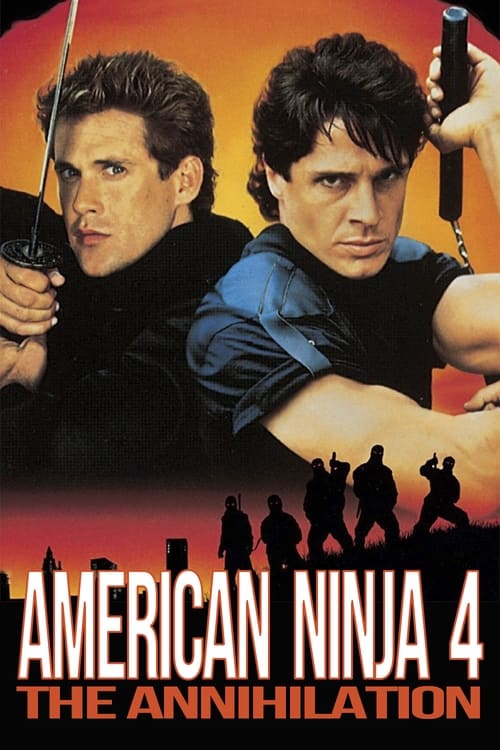











Popular
Who are the main characters in American Ninja 4: The Annihilation?
What is the role of the Black Ninja in the film?
How do Joe Armstrong and Scott McCoy work together to combat the terrorists?
What is the significance of the training sequences in the film?
What motivates Joe Armstrong to confront the Black Ninja?
Should I watch it?
Ask Your Own Question

What is the plot?
The film opens in a state of immediate crisis: somewhere in Lesotho, or at least in an unnamed African country serving as the film's battlefield, a Delta Force unit has already been sent by the President of the United States to stop a terror plot and recover a suitcase nuclear bomb before it can be used against New York City. The mission is already failing when the story begins. The commandos try to pull back under fire, but Mulgrew's ninja force cuts them down in a brutal pursuit, and most of the team is killed while the survivors are captured and taken deep into the stronghold of Colonel Scarf Mulgrew, the sadistic British ex-soldier who is coordinating the operation with Sheikh Ali Maksood.
The threat is cold, direct, and enormous: if the United States does not pay 50 million dollars, New York will be destroyed by the bomb. Maksood is not merely holding hostages; he is training a private army of ninjas in the countryside, turning the region into a fortress of fear and preparing the city-sized blackmail with almost theatrical cruelty. The prisoners are not just bargaining chips. They are proof that the first American response has already failed, and that anyone who comes next is walking into a machine built to break them.
That second response arrives in the form of CIA agent Sean Davidson, a hard-edged operative sent to rescue the captured Delta Force men. He is paired with Carl Brackston, his sidekick and partner, and the two are sent on a mission that is supposed to be quick, surgical, and decisive. The film briefly pulls back into civilian life before the violence takes hold of everything again. Joe Armstrong is living far from this war now, working as a teacher with the Peace Corps, trying to inhabit the calmer life of a man who has left battlefield work behind. In one of the more pointed early transitions, Joe is at Brackston's wedding when a call comes through on the walkie-talkie, yanking him out of the fragile peace of the moment and back toward the mission. The visual contrast is sharp: a wedding ceremony on one side, a nuclear ultimatum on the other. Joe's civilian disguise cannot hold for long.
At the CIA briefing, the scale of the crisis becomes clear. Sean and Carl are told that a terrorist organization in Africa, led by Maksood and backed by Mulgrew, has assembled a bomb that can fit in a suitcase and is prepared to unleash it on New York City if their demand is refused. The Delta Force team that tried to stop them has been "decimated" and captured. The mission is no longer just about rescue. It is about preventing a nuclear attack, but the route to that goal runs through a fortress held by men who have already proved they can slaughter trained soldiers without hesitation.
Sean and Carl infiltrate the area by parachute and push toward the stronghold. The countryside around the base is not just hostile terrain; it is an extension of the villain's control, dotted with training grounds where Maksood's ninja army drills for the coming slaughter. The fortress itself is a grim old stronghold, described variously as a British fort or monastery-like compound, with prison areas carved into its interior and armed guards watching every approach. Sean and Carl try to move carefully, but Mulgrew's security is too tight and the ninja fighters are too numerous. They are detected, pursued, and forced into a desperate running battle.
The assault collapses. Sean and Carl do not complete the mission; instead, they are overpowered and taken prisoner themselves. The film deliberately intensifies the humiliation by turning its rescue team into the very hostages they came to save. Sean is captured by the enemy force, and Carl is trapped beside him, both men now at the mercy of Mulgrew's sadistic command structure. One review notes that they are even taunted by Mulgrew after being captured, underscoring how fully the villains have seized the initiative. The new CIA hope has failed, and with it the film's apparent last chance. That failure becomes the hinge that brings Joe Armstrong back into the center of the story.
Joe is lured out of retirement because the mission is collapsing and because his friend is in danger. He does not return as a reluctant comic figure but as the film's true final weapon, a man whose peace-time life is revealed to be temporary and fragile. The call is framed as urgent necessity rather than choice. Sean and Carl are imprisoned, the bomb remains active, and the only path forward is to send in the one man the plot has been saving for this moment: Joe Armstrong.
Joe accepts, and the story pivots from rescue failure to insurgent counterattack. He seeks out the local resistance, a rebel group that has been living under Mulgrew's shadow and has its own reasons to bring the stronghold down. One source describes them as the Sulfur Springs rebels, a rough, resourceful group who live with the improvised toughness of a post-apocalyptic gang and can provide the distraction the mission needs. Joe persuades their leader to stage a false assault on the fortress. This revelation is crucial: the villains' control is formidable, but not total. There are people on the ground who know the terrain, hate the occupiers, and can exploit the fortress's blind spots.
The final act begins with the rebels launching their diversion. Their attack pulls Mulgrew's security forces away from the critical routes, allowing Joe to slip into the stronghold while the outer defenses are busy fighting elsewhere. The film's momentum builds from there into a prolonged battle of movement, smoke, gunfire, and blades. The setting turns claustrophobic again as Joe penetrates deeper into the fortress, moving from exterior skirmish to interior prison corridors, toward the place where the hostages and the bomb are being held. The film's tension rests on two parallel dangers: the prisoners may be executed before Joe reaches them, and the suitcase nuclear device may be moved or activated before it can be stopped.
The climax is a chaotic all-out war between Joe's side, the local rebels, Mulgrew's guards, and Maksood's ninja army. The film does not provide a clean named kill-by-kill ledger in the sources available, but it is explicit that the action includes repeated killings by ninja assassins and that many opponents on both sides are cut down during the failed raid and the final assault. What the story does make clear is the pattern of the carnage: the Delta Force team is decimated in the opening operation, the commandos who survive are captured, Sean and Carl are later captured as well, and the final battle is the decisive moment when the prisoners, the bomb threat, and the villains' hold on the region are all challenged at once.
Joe fights his way through the fortress with the urgency of a man who knows there is no backup coming. The prison areas become a series of brutal confrontations as he pushes toward the center of the enemy operation. The rebels keep the defenders occupied, but Mulgrew's men still throw waves of resistance at him, and the ninja fighters remain the most visible symbol of the villains' military reach. The combat is staged as a race against time and a test of endurance. Joe is not simply saving people; he is dismantling the machinery of the threat room by room.
At the heart of the stronghold, Joe reaches the captured men and the bomb threat converges with the hostage crisis. The final confrontation with Mulgrew and Maksood's network plays out as the collapse of their entire scheme. According to the available plot descriptions, Joe defeats the plot, saves the hostages, and prevents the nuclear strike on New York City. The central blackmail device--the suitcase bomb--never reaches its intended target, and the demand for $50 million is rendered meaningless by the destruction of the villains' operation. The action sources emphasize that the end result is not ambiguous: the terror plan is stopped, the prisoners are rescued, and Joe's return from retirement is justified by success.
The film's final emotional note comes from that reversal. Joe Armstrong, who had been teaching with the Peace Corps and trying to live outside this world, is forced back into it by loyalty and duty, and he emerges as the man who finishes what Sean Davidson and Carl Brackston could not. Sean and Carl are no longer the last hope; Joe is. The movie closes with the immediate crisis resolved, the hostage situation broken, and New York City spared from the nuclear threat that has driven the entire narrative. What remains is the sense that the villains' fortress has been shattered from the inside, the rebel attack has helped expose their vulnerability, and Joe's return to action is complete because the world he left behind has demanded him back.




What is the ending?
In the ending of "American Ninja 4: The Annihilation," the final confrontation occurs between the protagonists, Joe Armstrong and his ally, and the villainous ninja, who has been terrorizing them. After a fierce battle, Joe defeats the main antagonist, saving his friends and restoring peace. The film concludes with a sense of camaraderie and triumph among the heroes.
Now, let's delve into the ending in a more detailed, chronological narrative.
As the climax approaches, Joe Armstrong, portrayed by Michael Dudikoff, and his partner, a fellow ninja named Scott, find themselves in a high-stakes showdown against the nefarious ninja leader, who has been orchestrating a series of attacks. The setting is a dimly lit warehouse, filled with shadows and the tension of impending conflict. The air is thick with anticipation as Joe and Scott prepare for the confrontation, their expressions a mix of determination and resolve.
The battle begins with a flurry of martial arts moves, showcasing Joe's agility and skill. He dodges and counters the attacks from the henchmen, each movement fluid and precise. Scott, fighting alongside him, displays his own prowess, but it is clear that the main threat lies with the ninja leader, who is a formidable opponent. The choreography of the fight is intense, with punches and kicks exchanged in rapid succession, punctuated by the sound of grunts and the impact of bodies colliding.
As the fight escalates, Joe faces the ninja leader directly. The villain, clad in dark attire, embodies menace and power, his movements calculated and lethal. The two engage in a fierce duel, exchanging blows that resonate with the weight of their conflict. Joe's internal motivation is palpable; he fights not only for his own survival but also to protect his friends and restore order. The stakes are high, and the emotional intensity of the moment is underscored by the urgency of their battle.
In a pivotal moment, Joe manages to outmaneuver the ninja leader, using his training and instincts to gain the upper hand. With a swift and decisive move, he disarms the antagonist, leaving him vulnerable. The tension in the room reaches its peak as Joe stands over the defeated ninja leader, breathing heavily, the adrenaline coursing through him. The villain, now at Joe's mercy, realizes the futility of his ambitions.
With the threat neutralized, Joe and Scott regroup with their allies, who have been watching the battle unfold. There is a palpable sense of relief and triumph among them. The camera captures their expressions of camaraderie and victory, highlighting the bond forged through their shared struggle. Joe, though weary from the fight, feels a sense of fulfillment, knowing that they have thwarted the villain's plans.
As the film draws to a close, the characters reflect on their journey. Joe and Scott share a moment of camaraderie, acknowledging the challenges they faced and the strength they found in each other. The final scenes depict them walking away from the warehouse, the sun rising in the background, symbolizing a new beginning. The fate of the main characters is one of survival and unity; Joe and Scott emerge as heroes, having defeated evil and solidified their friendship.
In the end, the film leaves the audience with a sense of closure, emphasizing themes of bravery, loyalty, and the triumph of good over evil. Joe Armstrong stands as a symbol of resilience, having faced his fears and emerged victorious, ready to face whatever challenges may come next.
Is there a post-credit scene?
American Ninja 4: The Annihilation does not have a post-credit scene. The film concludes without any additional scenes or content after the credits roll. The story wraps up with the resolution of the main conflict, focusing on the defeat of the villain and the restoration of peace, leaving no further narrative threads to explore in a post-credit sequence.
Who are the main characters in American Ninja 4: The Annihilation?
The main characters in American Ninja 4: The Annihilation include Joe Armstrong, played by Michael Dudikoff, and his partner, Scott McCoy, portrayed by David Bradley. They are joined by the villainous Black Ninja, who leads a group of terrorists, and other supporting characters such as the female lead, who assists them in their mission.
What is the role of the Black Ninja in the film?
The Black Ninja serves as the primary antagonist in American Ninja 4: The Annihilation. He is a skilled martial artist who leads a group of terrorists aiming to steal a powerful weapon. His character embodies the classic villain archetype, showcasing ruthless ambition and a desire for power, which drives the conflict against Joe Armstrong and Scott McCoy.
How do Joe Armstrong and Scott McCoy work together to combat the terrorists?
Joe Armstrong and Scott McCoy work together by combining their martial arts skills and strategic thinking. Throughout the film, they engage in various action sequences where they demonstrate teamwork, using their unique fighting styles to take down the terrorists. Their camaraderie is highlighted in moments of banter and mutual respect, showcasing their deep bond as they face overwhelming odds.
What is the significance of the training sequences in the film?
The training sequences in American Ninja 4: The Annihilation serve to showcase the characters' martial arts skills and prepare them for the challenges ahead. These scenes are filled with intense physicality, emphasizing discipline and the mental fortitude required to be a ninja. They also highlight the growth of Scott McCoy as he learns from Joe Armstrong, reinforcing themes of mentorship and personal development.
What motivates Joe Armstrong to confront the Black Ninja?
Joe Armstrong is motivated by a sense of duty and justice to confront the Black Ninja. His internal struggle is fueled by the desire to protect innocent lives and stop the terrorist threat posed by the Black Ninja's organization. Throughout the film, Joe's determination is palpable, as he grapples with the weight of his responsibilities as a martial artist and protector.
Is this family friendly?
"American Ninja 4: The Annihilation" contains several elements that may not be suitable for children or sensitive viewers. Here are some potentially objectionable aspects:
-
Violence: The film features numerous martial arts fight scenes, including hand-to-hand combat, weapon use, and some graphic depictions of injuries. The violence is stylized but can be intense.
-
Death and Threats: Characters face life-threatening situations, and there are moments where death is implied or shown, which may be distressing for younger audiences.
-
Mature Themes: The plot involves themes of terrorism and criminal organizations, which may be complex or unsettling for children to understand.
-
Language: There are instances of mild profanity and aggressive language that may not be appropriate for younger viewers.
-
Tension and Suspense: The film contains scenes of high tension and suspense that could be frightening for sensitive viewers, particularly during confrontations between heroes and villains.
These elements contribute to a tone that may not be considered family-friendly, especially for younger children or those who are sensitive to violence and mature themes.








