

Popular
What motivates Ethan Edwards to search for Debbie?
How does the relationship between Ethan and Martin evolve throughout the film?
What is the significance of the character of Debbie Edwards in the story?
What role does the landscape play in the film's narrative?
How does the film portray the Comanche people, particularly in relation to Ethan's character?
Should I watch it?
Ask Your Own Question

What is the plot?
Sorry, we aren't able to watch and write up a full detailed plot yet. Check back in a few days.




What is the ending?
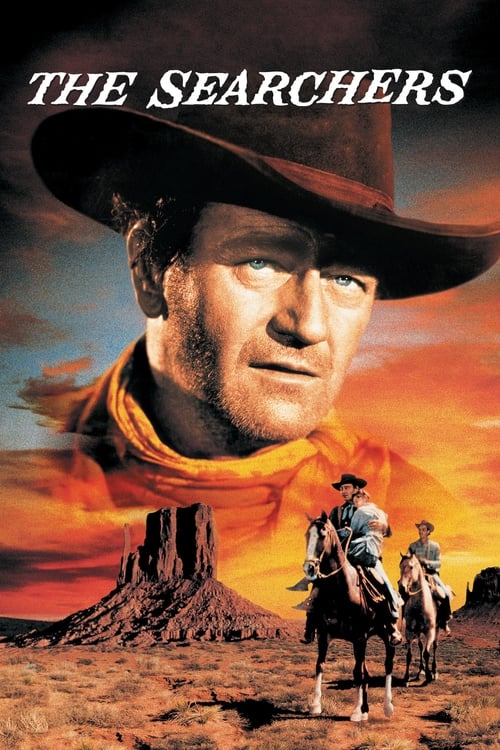
In the ending of "The Searchers," Ethan Edwards finally confronts the reality of his quest for revenge against the Comanche who kidnapped his niece, Debbie. After finding her, he realizes she has assimilated into the Comanche way of life. In a moment of emotional turmoil, he cannot bring himself to kill her. The film concludes with Ethan standing alone outside the doorway of the family home, symbolizing his isolation and unresolved inner conflict.
Now, let's delve into the ending in a more detailed narrative fashion:
As the sun begins to set over the vast Texas landscape, Ethan Edwards, played by John Wayne, and Martin Pawley, portrayed by Jeffrey Hunter, finally locate Debbie, now a young woman living among the Comanche. The tension is palpable as they approach the camp, the air thick with the weight of Ethan's long-held desire for vengeance. The camera captures Ethan's hardened face, revealing the emotional scars of his relentless pursuit.
When they find Debbie, she is initially hesitant, caught between her past and her present. The Comanche chief, Scar, has raised her, and she has adopted their ways. Ethan's heart is torn; he has spent years searching for her, driven by a fierce love and a desire for retribution against those who took her. Yet, as he stands before her, the reality of her situation hits him. She is not the innocent girl he remembers but a woman who has found a place in a world he despises.
In a moment of intense conflict, Ethan draws his gun, his face a mask of rage and sorrow. He aims it at Debbie, but as he looks into her eyes, he falters. The internal struggle is evident; he is a man torn between his duty to protect his family and the hatred that has consumed him. The camera lingers on his face, capturing the turmoil within. Ultimately, he cannot pull the trigger. Instead, he lowers his weapon, a decision that signifies a profound shift in his character.
After this pivotal moment, the group returns to the homestead. The atmosphere is heavy with unspoken words and unresolved feelings. Ethan, still grappling with his demons, stands outside the doorway of the family home. The frame captures him in stark contrast to the warmth inside, symbolizing his alienation from the very family he sought to protect.
As the film draws to a close, the final shot lingers on Ethan's solitary figure. He turns away from the light of the home, embodying the themes of loss and the inability to fully reintegrate into a world that has moved on without him. The door closes behind him, leaving him outside, a man forever searching, not just for his niece but for a sense of belonging and peace that eludes him.
In this ending, Ethan Edwards remains a complex character, shaped by his experiences and the harsh realities of the world around him. Martin Pawley, who has been a loyal companion throughout the journey, finds a sense of closure as he steps into the warmth of the home, contrasting sharply with Ethan's fate. The film concludes with a poignant reminder of the costs of vengeance and the enduring scars of conflict, leaving viewers to reflect on the nature of family, belonging, and the search for redemption.
Is there a post-credit scene?
The movie "The Searchers," produced in 1956, does not have a post-credit scene. The film concludes with a powerful and poignant ending that encapsulates the journey of its main character, Ethan Edwards, played by John Wayne. After the climactic events of the film, Ethan stands at the threshold of the doorway of the homestead, framed by the light of the outside world. He hesitates, reflecting the internal conflict and emotional turmoil he has experienced throughout the story.
As the door closes behind him, he turns away from the home and walks into the vastness of the landscape, symbolizing his ongoing search and the unresolved nature of his character. This final image leaves the audience with a sense of both closure and ambiguity, emphasizing themes of loss, redemption, and the complexities of human nature. The film ends without any additional scenes or credits, focusing instead on the weight of Ethan's journey and the emotional resonance of his character's fate.
What motivates Ethan Edwards to search for Debbie?
Ethan Edwards, played by John Wayne, is driven by a complex mix of emotions in his quest to find his niece, Debbie. His motivations are rooted in a deep sense of familial duty and a personal vendetta against the Comanche tribe that kidnapped her. Ethan's character is marked by a fierce determination, but also by a profound inner turmoil, as he grapples with his own prejudices and the violent impulses that arise from his desire for revenge.
How does the relationship between Ethan and Martin evolve throughout the film?
Initially, Ethan Edwards views Martin Pawley, played by Jeffrey Hunter, with disdain due to Martin's mixed heritage, as he is part Comanche. However, as the journey progresses, Ethan's attitude shifts. Martin's bravery and loyalty earn Ethan's grudging respect, and they develop a complex bond. Despite Ethan's harsh demeanor, there are moments of camaraderie that reveal a deeper connection, showcasing Ethan's struggle between his ingrained racism and the need for companionship in their perilous quest.
What is the significance of the character of Debbie Edwards in the story?
Debbie Edwards, portrayed by Natalie Wood, serves as the emotional core of the film. Her abduction by the Comanche tribe sets off the central conflict and drives the narrative. As the story unfolds, Debbie's character represents the loss of innocence and the impact of violence on individuals. When she is finally found, her transformation into a Comanche woman complicates Ethan's mission, as he must confront his own prejudices and the harsh reality of her situation, leading to a poignant climax.
What role does the landscape play in the film's narrative?
The vast and rugged landscapes of the American West serve as both a backdrop and a character in 'The Searchers.' The desolate plains, towering mountains, and expansive deserts reflect the isolation and challenges faced by Ethan and Martin on their journey. The changing scenery also symbolizes the emotional landscape of the characters, with the harshness of the environment paralleling Ethan's internal struggles and the moral complexities of their quest. The cinematography captures the beauty and brutality of the land, enhancing the film's themes of exploration and survival.
How does the film portray the Comanche people, particularly in relation to Ethan's character?
The portrayal of the Comanche people in 'The Searchers' is complex and multifaceted. While Ethan Edwards embodies a deeply ingrained racism and sees the Comanche as the enemy, the film also presents them as a proud and resilient culture. Through characters like Scar, the Comanche chief, the film explores themes of conflict and misunderstanding. Ethan's relentless pursuit of revenge against the Comanche for Debbie's abduction reveals his internal conflict, as he grapples with his hatred while also being forced to confront the humanity of those he views as adversaries.
Is this family friendly?
"The Searchers," produced in 1956, is a classic Western film directed by John Ford, but it contains several elements that may be objectionable or upsetting for children or sensitive viewers. Here are some aspects to consider:
-
Violence: The film features scenes of gunfights, including the deaths of characters, which may be intense for younger audiences. The portrayal of violence is typical of Westerns but can be graphic.
-
Racial Themes: The film explores complex themes of racism and prejudice, particularly in the context of Native American characters. Some dialogue and attitudes reflect the racial tensions of the time, which may be uncomfortable for viewers.
-
Kidnapping: The central plot revolves around the kidnapping of a young girl by Native Americans, which can be distressing, especially for younger viewers.
-
Emotional Turmoil: The characters experience significant emotional struggles, including grief, obsession, and vengeance, which may be heavy themes for children to process.
-
Moral Ambiguity: The protagonist, Ethan Edwards, exhibits morally questionable behavior and attitudes, leading to complex character motivations that may be difficult for younger audiences to understand.
These elements contribute to a film that, while a significant work of art, may not be suitable for all viewers, particularly children or those sensitive to themes of violence and racial conflict.








